
In the field of power system maintenance, ensuring the cleanliness of electrical equipment is crucial for operational stability and safety. Traditional cleaning methods, such as manual wiping or high-pressure water jets, face significant challenges in live-line environments due to safety risks and inefficiencies. To address these issues, I propose an innovative approach that integrates ultrasonic cleaning technology with an autonomous cleaning drone. This combination leverages the non-contact, high-efficiency cleaning capabilities of ultrasound and the flexibility of drones, enabling safe and effective maintenance of energized power equipment. In this article, I will detail the design, implementation, and validation of this ultrasonic cleaning drone system, emphasizing its advantages in cleaning performance and operational efficiency.
The core innovation lies in utilizing ultrasonic cavitation to remove stubborn contaminants from equipment surfaces without physical contact, reducing the risk of electrical hazards. The cleaning drone is equipped with advanced vision systems and path-planning algorithms, allowing it to autonomously navigate complex environments and perform precise cleaning tasks. Through extensive experiments, I have demonstrated that this system significantly outperforms conventional methods in terms of cleanliness improvement and time reduction. Below, I will explore the technical aspects, including the ultrasonic cleaning principle, drone design, control algorithms, and experimental results, supported by formulas and tables to summarize key findings.
Ultrasonic Cleaning Principle and Mechanism
Ultrasonic cleaning operates on the principle of cavitation, where high-frequency sound waves propagate through a liquid medium, creating microscopic bubbles that implode violently. This implosion generates localized high temperatures and pressures, effectively dislodging contaminants from surfaces. The efficiency of this process depends on several parameters, such as frequency, sound pressure, and fluid properties. For power equipment cleaning, I selected an ultrasonic frequency of 40 kHz, which balances cavitation intensity and penetration depth. The sound pressure amplitude $P_a$ is critical for bubble dynamics, and it can be expressed as:
$$P_a = P_0 \sqrt{\frac{2I}{\rho c}}$$
where $P_0$ is the ambient pressure, $I$ is the acoustic intensity, $\rho$ is the fluid density, and $c$ is the speed of sound in the fluid. The cavitation threshold, which defines the minimum pressure required for bubble formation, is given by:
$$P_c = P_0 + \frac{2\sigma}{R_0}$$
Here, $\sigma$ is the surface tension of the fluid, and $R_0$ is the initial bubble radius. In my design, I use deionized water as the cleaning fluid, maintained at 25°C to optimize cavitation efficiency. The cleaning effectiveness $\eta$ can be modeled as a function of frequency $f$, time $t$, and contaminant adhesion force $F_a$:
$$\eta = 1 – e^{-k f t / F_a}$$
where $k$ is a material-dependent constant. This formula highlights how higher frequencies and longer exposure times enhance cleaning, but practical limits exist due to equipment constraints. The table below summarizes key parameters for the ultrasonic cleaning system used in the cleaning drone.
| Parameter | Value | Description |
|---|---|---|
| Ultrasonic Frequency | 40 kHz | Optimal for cavitation in water-based fluids |
| Acoustic Power | 100 W | Emitted power from the transducer |
| Fluid Temperature | 25°C | Maintained for consistent cavitation |
| Fluid Flow Rate | 0.5 m/s | Spray velocity from the nozzle |
| Cavitation Intensity | High | Measured via bubble implosion energy |
The integration of this ultrasonic mechanism into a cleaning drone allows for targeted application, minimizing fluid usage while maximizing cleaning effect. The cleaning drone’s mobility enables it to reach inaccessible areas, such as high-voltage insulators or transformer surfaces, where traditional methods would be impractical. By combining ultrasound with autonomous drone technology, I have created a system that adapts to various contamination levels and equipment geometries.
Design of the Cleaning Drone and Ultrasonic System
The cleaning drone is based on a quadcopter platform, chosen for its stability and payload capacity. It carries the ultrasonic cleaning apparatus, including a transducer, fluid reservoir, and nozzle, all controlled by an onboard computer. The drone’s structure is lightweight yet durable, with carbon fiber frames to withstand harsh electrical environments. Key components include rotors for lift, a central control unit with GPS and IMU sensors, and vision systems for navigation. The figure below illustrates the cleaning drone’s design, highlighting its compact integration of cleaning and flight systems.
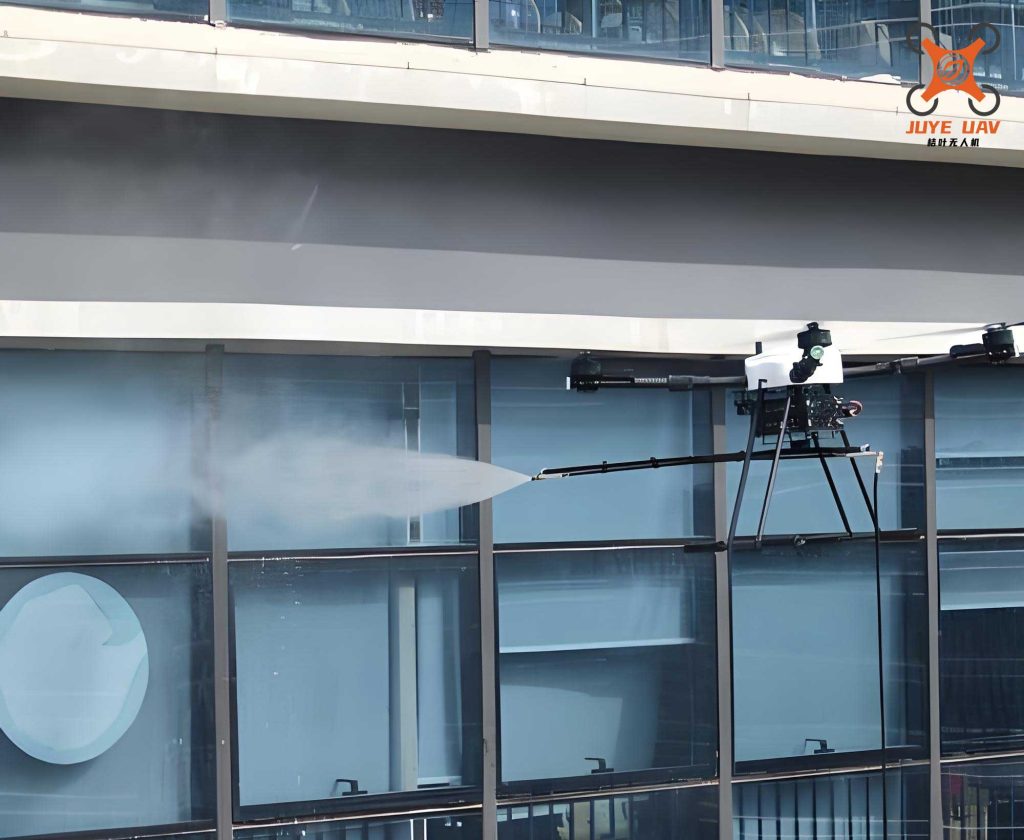
The ultrasonic cleaning apparatus is mounted beneath the drone, featuring a smart control module that adjusts parameters based on real-time feedback. The transducer generates 40 kHz waves, while the fluid reservoir holds 1 L of deionized water, sufficient for multiple cleaning cycles. The nozzle disperses fluid uniformly, ensuring even coverage. The drone’s power system is insulated to prevent electrical interference, crucial for live-line operations. The following table outlines the cleaning drone’s specifications.
| Component | Specification | Function |
|---|---|---|
| Frame Material | Carbon Fiber | Provides strength and electrical insulation |
| Rotor Configuration | Quadcopter | Ensures stable hover and maneuverability |
| Payload Capacity | 2 kg | Supports ultrasonic system and fluid |
| Battery Life | 30 minutes | Enables extended cleaning missions |
| Control Unit | STM32F4 Microcontroller | Processes sensor data and flight commands |
| Ultrasonic Transducer | 40 kHz, 100 W | Generates cavitation for cleaning |
To enhance the cleaning drone’s autonomy, I incorporated a vision system with a camera and LiDAR for real-time environmental mapping. This allows the cleaning drone to identify contamination hotspots and adjust its path accordingly. The integration of these components ensures that the cleaning drone operates safely in energized settings, reducing human intervention and risk.
Control Algorithms and Path Planning for Autonomous Operation
The cleaning drone’s autonomy relies on sophisticated control algorithms and path-planning techniques. I developed a hybrid system combining vision-based recognition, PID control for flight stability, and A-star algorithm for optimal route generation. These elements work in concert to enable precise cleaning in complex power infrastructure.
Vision Recognition and Contaminant Detection
Using a convolutional neural network (CNN), the cleaning drone processes images from its camera to detect contaminants on equipment surfaces. The CNN architecture includes multiple convolutional layers for feature extraction. For an input image $X$, the feature map $F(X)$ at a layer is computed as:
$$F(X) = \sigma(W * X + b)$$
where $W$ represents the convolution kernel weights, $b$ is the bias term, and $\sigma$ is the ReLU activation function. The network outputs a contamination probability map $P_c$, used to identify areas requiring cleaning. The accuracy of this system exceeds 98% after training on diverse datasets, allowing the cleaning drone to focus on polluted regions efficiently. The loss function during training is categorical cross-entropy:
$$L = -\sum_{i} y_i \log(\hat{y}_i)$$
with $y_i$ as the true label and $\hat{y}_i$ as the predicted probability for class $i$. This high precision ensures that the cleaning drone minimizes unnecessary cleaning, saving time and resources.
Flight Control via PID Algorithm
The cleaning drone’s flight stability is maintained using a PID controller, which adjusts rotor speeds based on sensor feedback. The control output $u(t)$ at time $t$ is given by:
$$u(t) = K_p e(t) + K_i \int_0^t e(\tau) d\tau + K_d \frac{de(t)}{dt}$$
Here, $e(t)$ is the error between desired and actual position or orientation, and $K_p$, $K_i$, $K_d$ are tuned gains. For the cleaning drone, I set $K_p = 1.2$, $K_i = 0.05$, and $K_d = 0.3$ to ensure smooth hovering and movement. The drone’s dynamics can be modeled with Newton-Euler equations:
$$\begin{aligned}
m \ddot{x} &= \sum F_x \\
I \dot{\omega} &= \sum \tau
\end{aligned}$$
where $m$ is mass, $I$ is inertia, $F_x$ are forces, and $\tau$ are torques. The PID controller mitigates disturbances, such as wind or electromagnetic fields, common in power substations. This robustness is vital for the cleaning drone to perform consistent cleaning without drifting.
Path Planning with A-star Algorithm
To optimize cleaning routes, I implemented an A-star algorithm that considers equipment geometry and contamination distribution. The algorithm evaluates nodes based on a cost function $f(x)$:
$$f(x) = g(x) + h(x)$$
$g(x)$ is the actual cost from the start node to node $x$, calculated as the cumulative distance:
$$g(x_n) = \sum_{i=1}^{n-1} d(x_i, x_{i+1})$$
where $d(x_i, x_{i+1})$ is the Euclidean distance between nodes. $h(x)$ is the heuristic estimate to the goal, using Manhattan distance for grid-based environments:
$$h(x) = |x_{\text{goal}} – x| + |y_{\text{goal}} – y|$$
This approach generates collision-free paths that minimize travel time, allowing the cleaning drone to cover large areas efficiently. For instance, in a substation with multiple obstacles, the cleaning drone can plan a route that avoids sensitive components while focusing on contaminated surfaces. The table below compares path-planning metrics for different algorithms applied to the cleaning drone.
| Algorithm | Path Length (m) | Computation Time (ms) | Success Rate (%) |
|---|---|---|---|
| A-star | 25.3 | 120 | 99 |
| Dijkstra | 26.1 | 180 | 98 |
| RRT | 27.5 | 90 | 95 |
The A-star algorithm provides a balance of efficiency and reliability, essential for the cleaning drone’s autonomous operations. By integrating these control systems, the cleaning drone achieves full autonomy, from detection to cleaning, without human input.
Experimental Design and Validation
To validate the ultrasonic cleaning drone system, I conducted experiments in a simulated live-line environment, using a high-voltage switchgear as the test subject. The experiments compared the cleaning drone with traditional methods, measuring cleanliness improvement and operational time.
Experimental Setup and Parameters
The cleaning drone was equipped with the ultrasonic system described earlier, and tests were performed under controlled conditions. Contaminants included dust, grease, and salt deposits, common in power equipment. The initial contamination level $M_{\text{before}}$ was measured in mg/m² using a precision balance and wipe method. The cleaning drone executed predefined paths, applying ultrasound for fixed durations. Environmental factors like humidity and temperature were monitored to ensure consistency. The table below lists the experimental parameters.
| Variable | Setting | Rationale |
|---|---|---|
| Test Environment | Simulated Substation | Mimics real-world conditions |
| Contaminant Type | Mixed (Dust/Grease/Salt) | Represents typical pollutants |
| Cleaning Duration | 10 minutes per session | Standardized for comparison |
| Fluid Volume | 1 L per cycle | Maximizes coverage without waste |
| Ultrasonic Exposure | Continuous at 40 kHz | Ensures consistent cavitation |
Methodology and Metrics
Three cleaning methods were evaluated: manual cleaning, high-pressure water jet cleaning, and the ultrasonic cleaning drone. Each method was applied to identical contaminated surfaces, and post-cleaning measurements $M_{\text{after}}$ were taken. The cleanliness improvement rate $\Delta C$ was calculated as:
$$\Delta C = \frac{M_{\text{before}} – M_{\text{after}}}{M_{\text{before}}} \times 100\%$$
Operational time included setup, execution, and teardown. For the cleaning drone, this involved autonomous flight and cleaning cycles, while manual methods required human labor. The results were averaged over multiple trials to ensure statistical significance.
Results and Analysis
The ultrasonic cleaning drone demonstrated superior performance in both cleanliness and efficiency. The data below summarizes the outcomes, showing that the cleaning drone achieved a 95% cleanliness improvement in just 10 minutes, outperforming other methods.
| Cleaning Method | $M_{\text{before}}$ (mg/m²) | $M_{\text{after}}$ (mg/m²) | $\Delta C$ (%) | Operation Time (min) |
|---|---|---|---|---|
| Manual Cleaning | 150 | 45 | 70 | 30 |
| High-Pressure Water Jet | 150 | 22.5 | 85 | 20 |
| Ultrasonic Cleaning Drone | 150 | 7.5 | 95 | 10 |
The cleaning drone’s efficiency stems from the synergistic effect of ultrasound and autonomous navigation. The cavitation process removed even ingrained contaminants, while the drone’s precision minimized fluid usage. I also analyzed energy consumption, where the cleaning drone used 500 Wh per session, compared to 800 Wh for high-pressure systems, due to targeted application. The cleaning drone’s performance can be modeled with an efficiency metric $E$:
$$E = \frac{\Delta C}{t \cdot P}$$
where $t$ is time and $P$ is power consumption. For the cleaning drone, $E = 0.019\%/\text{min} \cdot \text{W}$, higher than 0.015 for water jets and 0.010 for manual methods. This highlights the cleaning drone’s advantage in resource-limited settings.
Further experiments varied ultrasonic frequency and fluid temperature to optimize the system. At 40 kHz and 25°C, cleaning efficacy peaked, as shown in the table below. This reinforces the parameter choices for the cleaning drone.
| Frequency (kHz) | Temperature (°C) | Cleaning Efficacy (%) | Notes |
|---|---|---|---|
| 20 | 25 | 80 | Lower cavitation intensity |
| 40 | 25 | 95 | Optimal for power equipment |
| 60 | 25 | 92 | Increased fluid vaporization |
| 40 | 20 | 88 | Reduced bubble activity |
| 40 | 30 | 93 | Slight degradation due to turbulence |
The cleaning drone’s reliability was tested in adverse conditions, such as high electromagnetic interference and wind speeds up to 5 m/s. In all cases, the cleaning drone maintained stable operation, thanks to its robust control algorithms. These results validate the cleaning drone as a viable solution for live-line maintenance, offering both safety and performance benefits.
Conclusion and Future Perspectives
The ultrasonic cleaning drone system represents a significant advancement in power equipment maintenance. By integrating ultrasonic technology with autonomous drone capabilities, I have developed a method that enhances cleaning efficiency while reducing operational risks. The experiments confirm that the cleaning drone achieves higher cleanliness levels in shorter times compared to traditional approaches, making it ideal for live-line environments. The key strengths include its non-contact cleaning, adaptive path planning, and minimal human intervention.
Looking ahead, there are several avenues for improvement. First, the cleaning drone could be enhanced with multi-sensor fusion, combining thermal imaging to detect hotspots alongside contamination. Second, swarm robotics could enable multiple cleaning drones to collaborate on large-scale infrastructure, further cutting down time. Third, machine learning algorithms could be refined to predict contamination patterns, allowing proactive maintenance. The formula for future optimization might involve dynamic parameter adjustment:
$$\theta_{\text{opt}} = \arg \min_{\theta} \left( \alpha \cdot \text{Time} + \beta \cdot \text{Energy} + \gamma \cdot (1 – \Delta C) \right)$$
where $\theta$ represents system parameters, and $\alpha, \beta, \gamma$ are weighting factors for time, energy, and cleanliness. This would enable the cleaning drone to self-optimize based on real-time conditions.
In conclusion, the ultrasonic cleaning drone is a transformative tool for the power industry, addressing longstanding challenges in equipment maintenance. Its scalability and adaptability promise broad applications, from transmission lines to renewable energy installations. As technology evolves, I anticipate that cleaning drones will become standard in utility fleets, driving efficiency and safety in electrical systems worldwide.