
The proliferation of high-rise buildings, particularly those adorned with extensive glass facades, has presented a persistent challenge for maintenance. Traditional cleaning methods, reliant on manual labor suspended from platforms or cradles, are notoriously inefficient, costly, and pose significant safety risks. The advent of climbing robots offered a partial solution, yet their complexity and limited adaptability to diverse architectural forms constrained widespread adoption. In this context, the cleaning drone has emerged as a transformative technology. Leveraging the inherent flexibility and aerial capabilities of multi-rotor unmanned aerial vehicles (UAVs), the cleaning drone promises to revolutionize facade maintenance by combining high efficiency with enhanced operational safety. However, the development of a truly effective cleaning drone is fraught with technical challenges, most notably the inherent conflict between the need for agile movement and the requirement for stable, reliable contact with the vertical surface during the cleaning operation.
My analysis delves into the technological trajectory of the building facade cleaning drone through the lens of patent documentation. Patents serve as a critical indicator of innovative activity, revealing the focus, evolution, and strategic directions of research and development. By systematically analyzing patent filings related to cleaning drones, we can map the current state of the art, identify dominant technological solutions, and forecast future innovation pathways. This exploration covers the analysis of patent application trends, key applicants, legal statuses, and a detailed breakdown of core technological branches including wall-fixing mechanisms, cleaning assemblies, motion design, and auxiliary functions.
Research Context and Technological Foundations
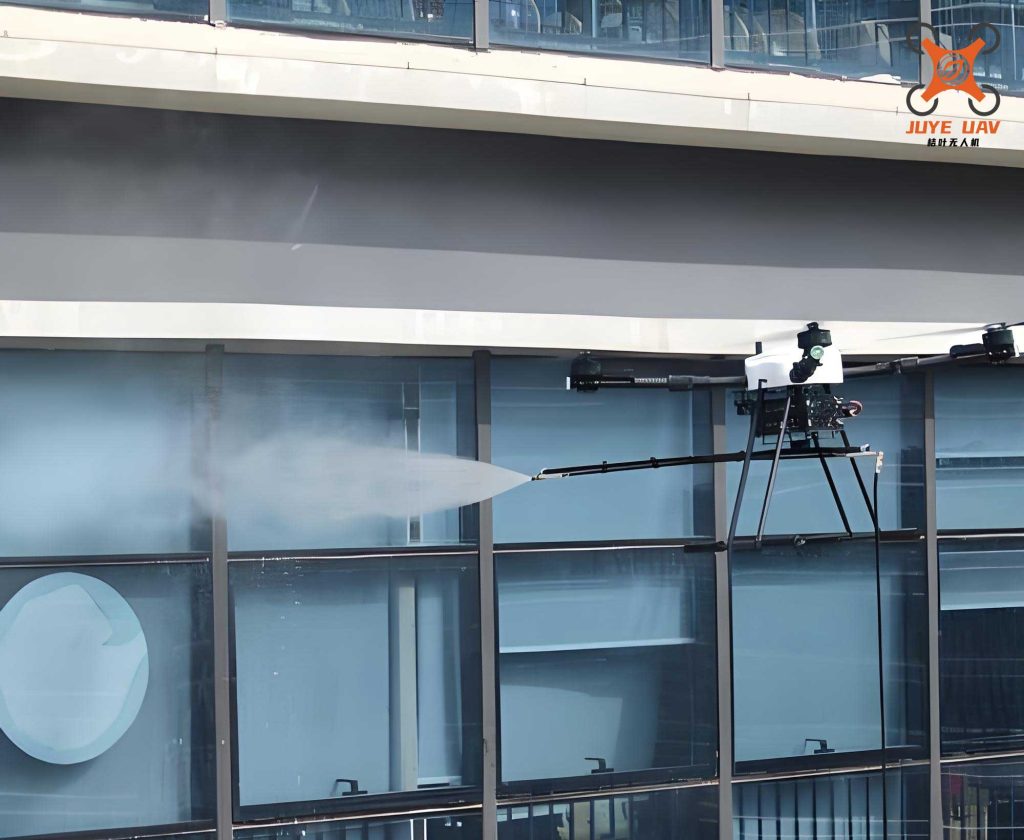
The concept of the cleaning drone is built upon foundational advancements in aerial manipulation. Early research into UAVs equipped with robotic arms for grasping and manipulation, such as the work from the University of Pennsylvania in 2013, paved the way for more specialized applications. The cleaning drone represents a convergence of UAV stability control, precision navigation, and mechatronic systems designed for surface treatment. Initial prototypes and studies, like those from the Shenyang Institute of Automation in 2019, demonstrated the feasibility of using a quadcopter as a platform for exterior wall cleaning. Subsequent research has focused on refining specific subsystems: developing specialized brush mechanisms and buffering structures, establishing dynamic models for drone-wall interaction, and designing advanced flight control algorithms that account for the cleaning contact forces. Fundamentally, the modern cleaning drone is an aerial platform that employs attached cleaning tools—brushes, sprayers, or a combination thereof—to perform maintenance tasks on vertical structures.
The performance of a cleaning drone is largely dictated by the cleaning method it employs. Each method presents a distinct set of trade-offs between cleaning efficacy, system complexity, and design difficulty, as summarized below.
| Method | Advantages & Disadvantages |
|---|---|
| Dry Brushing/Rubbing | Simple structure, moderate design difficulty, but generally offers lower cleaning effectiveness. |
| Liquid Spray/Jet Washing | Better cleaning for certain soils, but requires complex liquid storage and delivery systems, increasing design complexity. |
| Combined Washing & Brushing | Offers the highest potential cleaning effectiveness. However, it involves the most complex architecture and significant challenges in coordinating multiple subsystems. |
To structure the patent analysis, I have decomposed the overarching technology of the cleaning drone into four primary functional branches, each with subsequent sub-categories. This decomposition is essential for mapping the patent landscape accurately.
| Primary Branch | Secondary Branches (Examples) |
|---|---|
| Wall-Fixing Technology | Suction Cups, Support Wheels/Rollers, Grippers/Clamps, etc. |
| Cleaning Assembly | Brushing/Rubbing, Spray Washing, Combined Brushing & Washing. |
| Cleaning Motion Design | Uni-directional (X, Y, Z), Bi-directional (X-Y, X-Z), Three-dimensional (X-Y-Z), Circular. |
| Auxiliary Functions | Imaging/Camera, Thrust Application, Balance Stabilization, Surface Recognition, Dust Collection/Suction, etc. |
Patent Application Landscape for Cleaning Drones
The global patent filing activity for cleaning drone technology reveals a dynamic and rapidly evolving field. The trend can be segmented into four distinct phases:
- Slow Development (1991-2013): Characterized by sporadic, single-digit annual filings. An early example is a 1991 Japanese patent for an airship-based cleaning system, which failed to catalyze immediate follow-on innovation.
- Initial Growth (2014-2015): Marked by a noticeable, though still modest, increase in patent applications, signaling a renewed interest in the concept.
- Rapid Expansion (2016-2017): This period witnessed an explosive growth in filings, peaking in 2017, driven by broader advancements and commercialization in civilian drone technology.
- Consolidation & Maturation (2018-Present): Application volumes have gradually declined from the peak, suggesting a shift from exploratory, broad-based innovation to more focused, in-depth development of specific technical solutions within the cleaning drone domain.
Geographically, China dominates the patent landscape for cleaning drones, accounting for approximately 85% of global filings. This aligns with the country’s position as a leader in general-purpose UAV manufacturing and application. South Korea and the United States follow as distant secondary sources. Within China, the distribution of applicants is led by enterprises (47.2%), followed by universities (29.2%) and individual inventors (20.2%). The geographical hotspots for innovation within China are Guangdong and Jiangsu provinces, forming a first tier, with several coastal and central regions forming a second tier of innovative activity.
| Applicant Type | Percentage of Filings (%) |
|---|---|
| Enterprises | 47.2 |
| Universities & Research Institutes | 29.2 |
| Individual Inventors | 20.2 |
| Research Units | 3.4 |
An analysis of patent types and their legal status provides insight into the quality and stability of the intellectual property. Invention patents (both applications and granted patents) constitute 62% of the portfolio, with utility models making up the remaining 38%. Notably, only 27% of the invention patents are currently in a valid/active state (granted and in force, or pending), indicating a high rate of abandonment or rejection. This suggests that while innovative activity is high, the technical maturity or the strategic value of many filings may be limited, pointing to an area where focused R&D could yield more robust and protectable inventions for the cleaning drone.
| Patent Type | Legal Status | Number of Filings |
|---|---|---|
| Active/Granted | 35 | |
| Pending | 33 | |
| Lapsed/Abandoned | 97 | |
| PCT – National Phase Expired | 8 | |
| PCT – In National Phase | 1 | |
| Active | 18 | |
| Lapsed | 2 | |
| Status Unclear | 2 | |
| Active | 57 | |
| Lapsed | 62 |
Analysis of Key Technology Distributions
Wall-Fixing Technologies
Stable contact with the building facade is paramount for effective cleaning. The patent data reveals a strong preference for suction-based systems, which account for 77% of filings that specify a fixing method. Suction cups provide reliable adhesion with relatively simple mechanics but inherently limit mobility, confining the cleaning drone’s operational range. Alternative methods like wheeled support structures (17%) and mechanical grippers (2%) are less prevalent but represent important avenues for innovation, particularly for cleaning drones designed for continuous traversal or attachment to specific building features.
Cleaning Assembly Architectures
The cleaning assembly is the core functional subsystem of any cleaning drone. My analysis separates it into brushing/rubbing structures and spray washing structures.
Brushing/Rubbing Structures: These consist of a brush head and the mechanism connecting it to the drone’s arm or body. The most prevalent combination is a roller brush head paired with a rotary connection mechanism (e.g., a motor-driven spindle). This design effectively translates rotary motion into cleaning action. Other common pairings include bristle brush heads with rotary connections and cloth/pad heads with fixed connections. The distribution highlights a focus on rotary motion for mechanical brushes.
| Brush Head Type | Connection Mechanism Type (Number of Filings) | |||
|---|---|---|---|---|
| Rotary | Linear | Fixed | Vibratory/Other | |
| Bristle Brush | 47 | 1 | 19 | 3 |
| Roller Brush | 59 | 0 | 1 | 0 |
| Cloth/Pad | 16 | 5 | 38 | 2 |
| Combination | 5 | 0 | 5 | 0 |
| Other | 7 | 1 | 11 | 1 |
Spray Washing Structures: These consist of a spray head and a liquid reservoir system. The dominant design employs nozzle-type spray heads fed by an internal reservoir tank embedded within the drone’s body. This integrated approach simplifies design but limits cleaning duration due to onboard liquid capacity. Alternative designs use external (tethered) reservoirs or combine internal and external systems, though these are less common.
| Spray Head Type | Reservoir System Type (Number of Filings) | ||
|---|---|---|---|
| Internal Tank | Tethered External | Combined Internal/External | |
| Nozzle | 125 | 48 | 4 |
| Integrated (e.g., in brush) | 31 | 6 | 1 |
| Other | 3 | 0 | 0 |
Cleaning Motion Design
To enhance cleaning effectiveness, the cleaning tool often executes programmed motions relative to the wall. Defining the wall plane as X-Y and the normal direction as Z, patent filings show a prevalence of simple, single-axis motions (X, Y, or Z), favored for their reliability and simpler mechanical implementation. Two-dimensional motions within the X-Y plane (linear or circular) are also common, offering better area coverage. Complex motions involving the Z-axis (X-Z or X-Y-Z) are rare, indicating the significant design and control challenges they pose for a cleaning drone.
The effectiveness of a motion pattern can be conceptualized in terms of coverage rate. A simple metric for a reciprocating brush can be expressed as:
$$ C = N \cdot A_e \cdot \eta $$
where $C$ is the effective cleaning coverage rate (m²/s), $N$ is the frequency of the reciprocating motion (Hz), $A_e$ is the effective area covered per stroke (m²), and $\eta$ is an efficiency factor accounting for overlap and pressure distribution. More complex 2D patterns aim to maximize $A_e$ while maintaining a practical $N$.
| Motion Pattern | Approximate Percentage | Characteristics |
|---|---|---|
| Single Axis (X, Y, or Z) | 61% (X:18%, Y:15%, Z:28%) | Simple, reliable, limited coverage. |
| X-Y Plane (2D Linear/Circular) | 19% (X-Y:12%, Circular:7%) | Improved coverage, greater mechanical complexity. |
| X-Z or X-Y-Z (3D) | 6% | Potential for deep cleaning/adaptation, highly complex. |
| Other/Unspecified | 14% | – |
Auxiliary Functions
Beyond core cleaning, auxiliary functions enhance the capability and autonomy of the cleaning drone. Imaging (cameras) is the most commonly patented auxiliary feature (33%), crucial for navigation, inspection, and process monitoring. “Walking” or traversing functions (14%) are often linked to wheeled support structures, enabling the drone to cover large areas. “Thrust” application (9%) is a critical function where the drone actively pushes against the wall to maintain consistent cleaning pressure, countering reaction forces. This can be modeled as a force balance:
$$ F_{thrust} = F_{contact} + F_{friction} $$
where $F_{thrust}$ is the UAV’s applied force normal to the wall, $F_{contact}$ is the desired cleaning pressure, and $F_{friction}$ accounts for losses in the support mechanism. Other functions like dust collection, surface recognition, and automated docking for recharging or water exchange are emerging but less frequent.
Technology Evolution and Developmental Trajectory
Tracing the patent filings over time reveals the evolutionary path of the cleaning drone. In wall-fixing technology, suction cups, established in a key 2009 patent, remain the canonical solution. Wheeled and gripper-based systems emerged around 2015-2016 as alternative mobility-focused paradigms. In cleaning assemblies, the fundamental technical approaches—various brush-head/actuator combinations and sprayer/reservoir setups—were largely established by 2016, with subsequent innovation focusing on optimization and novel combinations within this established framework.
The evolution of motion design began with 2D X-Y plane concepts in 2009, followed by various single-axis implementations. Circular motion patterns and complex 3D motions appeared later, representing niche advancements. Auxiliary functions have steadily diversified from basic traversal and thrust compensation in the early 2010s to include intelligent features like AI-based recognition, path planning, and fully automated support systems in more recent years. This trajectory indicates a maturation from solving basic mechanical attachment and cleaning action to integrating sensing, intelligence, and operational autonomy into the cleaning drone ecosystem.
Conclusions and Strategic Recommendations
My patent-driven analysis leads to several key conclusions about the state of cleaning drone technology. The field is dominated by Chinese innovation, with suction-based fixation and rotary brush/internal tank sprayers as the dominant technical paradigms. Motion designs tend towards simplicity, and auxiliary functions are increasingly focused on adding intelligence and autonomy. Based on these findings, I propose the following strategic recommendations for future research and development aimed at advancing the capabilities and commercial viability of the cleaning drone:
- Innovate Beyond Suction-Based Fixation: While effective, suction limits mobility. R&D should prioritize hybrid or alternative fixation methods that enable reliable adhesion and efficient traversal. This could involve advanced adhesion materials, adaptive gripper systems for architectural features, or dynamically controlled magnetic systems for metallic surfaces. Enhancing the mobility of the cleaning drone is crucial for operational efficiency.
- Advance Cleaning Assembly Synergy: Future development should move beyond optimizing standalone brushing or spraying. Focus should be on intelligent, synergistic combinations—for instance, developing brush heads with integrated micro-spray nozzles that apply cleaning fluid directly to the contact point, or creating multi-modal cleaning tools that can adapt their method (brush, scrub, rinse) based on real-time surface feedback from the cleaning drone’s sensors.
- Implement Adaptive, High-Coverage Motion Control: Moving from simple pre-programmed motions to adaptive, path-optimized patterns will significantly boost efficiency. R&D should integrate real-time surface mapping and dirt detection to allow the cleaning drone to execute optimized cleaning paths, applying more effort where needed. Developing lightweight, robust mechanisms capable of controlled 2D or even 3D motions without compromising the UAV’s stability is a key engineering challenge.
- Integrate Comprehensive Support and AI Functions: To transition from a remotely piloted tool to an autonomous system, the next-generation cleaning drone must be part of a larger ecosystem. This includes R&D into automated docking stations for battery swapping, clean water replenishment, and waste-water recovery. Furthermore, embedding advanced AI for surface condition assessment, anomaly detection (like crack identification), and fully autonomous mission planning will maximize the value proposition of the intelligent cleaning drone, transforming it from a simple cleaner to a full-fledged building inspection and maintenance platform.
The journey of the cleaning drone from a conceptual novelty to a practical tool is well underway, as evidenced by the rich patent landscape. The path forward lies in addressing the core tension between stability and mobility, deepening the integration and intelligence of cleaning mechanisms, and building a supportive autonomous infrastructure. By focusing R&D efforts on these strategic fronts, the potential of the cleaning drone to redefine facade maintenance can be fully realized.