
As a drone pilot navigating the skies, I have witnessed the rapid evolution of the low-altitude economy firsthand. What began as a hobby has transformed into a profession that blends technology, artistry, and precision. The rise of drones has democratized flight, allowing individuals like me to capture perspectives once reserved for birds or expensive aircraft. Through this journey, I have come to understand that drone training is not just a step but a continuous process essential for mastering this craft. In this article, I will share my experiences, insights, and the intricate world of drone piloting, emphasizing how drone training shapes every aspect of our work.
My entry into this field was sparked by a fascination with aerial photography. Initially, I dabbled with consumer drones, capturing scenic vistas during weekends. However, I quickly realized that operating a drone required more than just basic controls; it demanded a deep understanding of aviation principles, regulations, and safety protocols. This realization led me to pursue formal drone training, a decision that fundamentally altered my trajectory. Drone training programs, often spanning several weeks, cover a wide range of topics, from meteorology and law to hands-on flight practice. The curriculum is designed to prepare pilots for the rigorous certification exams administered by aviation authorities.
To illustrate the components of a typical drone training program, consider the following table that breaks down the key modules:
| Module | Content | Duration (Hours) | Importance Level |
|---|---|---|---|
| Theoretical Knowledge | Aviation regulations, airspace classification, weather patterns, and physics of flight | 20 | High |
| Practical Flight Skills | Basic maneuvers (e.g., hovering, orbiting), emergency procedures, and payload operation | 30 | Critical |
| Technical Proficiency | Drone maintenance, software tools for flight planning, and data analysis | 15 | Medium |
| Legal and Ethical Aspects | Privacy laws, insurance requirements, and commercial licensing | 10 | High |
This structured approach to drone training ensures that pilots are well-equipped to handle real-world scenarios. The theoretical component, for instance, involves understanding aerodynamic forces, which can be summarized by the lift equation for multi-rotor drones: $$L = \frac{1}{2} \rho v^2 S C_L$$ where \(L\) is lift, \(\rho\) is air density, \(v\) is velocity, \(S\) is rotor area, and \(C_L\) is the lift coefficient. Mastering such concepts through drone training enhances our ability to optimize flight performance and safety.
After completing my initial drone training, I obtained a pilot license, which opened doors to commercial opportunities. However, the learning never stops. Advanced drone training is often necessary for specialized fields like aerial surveying, infrastructure inspection, or agricultural monitoring. In my case, I ventured into cinematography, where drone training focused on capturing smooth, cinematic shots. The process involves precise control of gimbal angles and flight paths, often described by kinematic equations. For example, the position of a drone in 3D space over time \(t\) can be modeled as: $$\vec{r}(t) = \vec{r}_0 + \vec{v}_0 t + \frac{1}{2} \vec{a} t^2$$ where \(\vec{r}_0\) is the initial position, \(\vec{v}_0\) is initial velocity, and \(\vec{a}\) is acceleration. Such formulas, taught in advanced drone training, help pilots plan complex maneuvers.
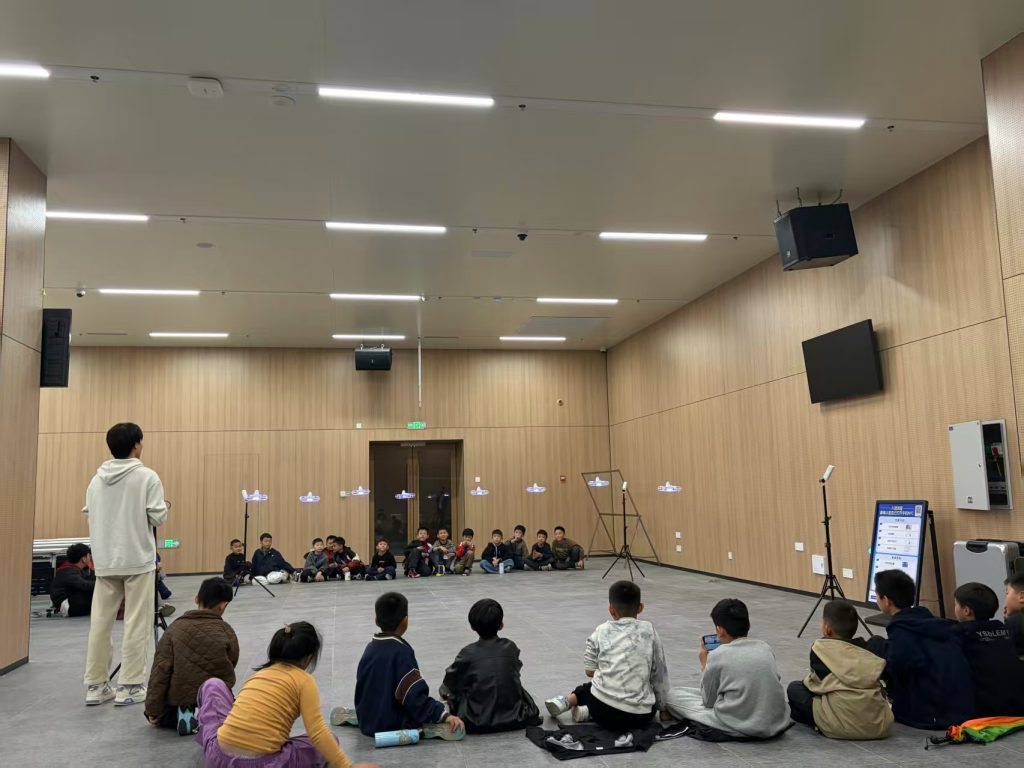
The image above symbolizes the immersive nature of drone training, where pilots engage in simulated and real-flight exercises. Drone training facilities often feature such setups to practice in controlled environments before tackling external challenges. This hands-on component is crucial, as it builds muscle memory and reflexes. In my experience, repetitive practice during drone training led to what I call “human-drone synergy,” where the aircraft feels like an extension of my body. This synergy is vital for tasks requiring precision, such as flying through narrow gaps or maintaining stable footage in windy conditions.
As I progressed, I encountered diverse applications of drone technology. The industry can be categorized by drone type and sector, each with distinct training requirements. Below is a table summarizing these aspects and associated income ranges, based on my observations and industry reports:
| Drone Type | Typical Applications | Required Training Level | Average Monthly Income (USD) |
|---|---|---|---|
| Multi-rotor Drones | Aerial photography, surveillance, small-scale inspections | Basic to Intermediate Drone Training | 1,000 – 3,000 |
| Vertical Take-Off and Landing (VTOL) Fixed-Wing | Large-area mapping, forestry surveys, agricultural analysis | Advanced Drone Training | 3,000 – 6,000 |
| Unmanned Helicopters | Heavy-lift operations, industrial inspections, search and rescue | Specialized Drone Training | 5,000 – 10,000+ |
| Emerging Types (e.g., Low-Altitude Passenger Drones) | Urban air mobility, cargo delivery, experimental testing | Cutting-Edge Drone Training | 8,000 – 15,000+ |
This table highlights how drone training correlates with earning potential. For instance, pilots operating VTOL fixed-wing drones typically undergo extensive drone training in flight planning software and data processing, which commands higher fees. The demand for such skills is growing, but so is competition. Therefore, continuous drone training is key to staying relevant. I have invested in multiple drone training courses over the years, each focusing on new software or regulations. This commitment has allowed me to transition from part-time gigs to more lucrative projects.
One of the most challenging aspects of drone piloting is managing flight logistics. During a typical survey mission, I use mathematical models to optimize battery usage and flight paths. The battery life \(B\) of a drone can be estimated using: $$B = B_{\text{max}} \times e^{-\lambda t} – \sum_{i=1}^{n} \beta_i d_i$$ where \(B_{\text{max}}\) is maximum capacity, \(\lambda\) is decay rate, \(t\) is time, \(\beta_i\) is energy cost per maneuver, and \(d_i\) is distance for maneuver \(i\). Such equations, often covered in technical drone training, help prevent mid-air failures. Additionally, weather factors like wind speed \(w\) affect stability, requiring adjustments based on formulas like: $$F_{\text{drag}} = \frac{1}{2} C_D \rho A w^2$$ where \(C_D\) is drag coefficient and \(A\) is cross-sectional area. Drone training programs incorporate these physics lessons to foster risk assessment skills.
The commercial landscape for drone pilots is multifaceted. Sectors such as construction, agriculture, and entertainment offer varied opportunities, each necessitating specific drone training. For example, in agricultural monitoring, pilots must understand crop health indices derived from multispectral imagery. The Normalized Difference Vegetation Index (NDVI) is calculated as: $$\text{NDVI} = \frac{\text{NIR} – \text{Red}}{\text{NIR} + \text{Red}}$$ where NIR is near-infrared reflectance and Red is red light reflectance. Drone training for agriculture includes interpreting such indices to provide actionable insights to farmers. Similarly, in infrastructure inspection, training focuses on detecting defects using thermal imaging, where heat loss \(Q\) can be modeled by: $$Q = U \times A \times \Delta T$$ with \(U\) as thermal transmittance, \(A\) area, and \(\Delta T\) temperature difference.
Despite the opportunities, the profession faces hurdles. Many new pilots complete basic drone training but lack practical experience, leading to a saturation in entry-level markets. Information asymmetry also hinders growth; clients may not recognize the value of advanced drone training, resulting in price undercutting. To address this, I advocate for standardized drone training certifications across industries. Moreover, the rise of autonomous drones poses both a threat and an opportunity. While automation may reduce manual flying tasks, it elevates the need for pilots skilled in AI supervision and data analysis—areas where drone training must evolve. I have started learning about quantum computing models for flight optimization, a niche yet promising domain emphasized in futuristic drone training curricula.
From a personal perspective, a day in my life involves meticulous planning. Before each flight, I conduct pre-flight checks—a ritual ingrained during drone training. This includes verifying battery levels, calibrating sensors, and assessing weather conditions using probabilistic models. For instance, the probability of safe flight \(P_s\) given wind gusts can be expressed as: $$P_s = 1 – \int_{w_{\text{max}}}^{\infty} f(w) dw$$ where \(f(w)\) is the wind speed distribution and \(w_{\text{max}}\) is the drone’s tolerance. Such statistical approaches, taught in safety-oriented drone training, mitigate accidents. Post-flight, I analyze data, often using software tools covered in technical drone training modules. The cyclical nature of this work—plan, fly, process—requires discipline honed through repeated drone training.
The economic impact of drone piloting is significant. The low-altitude economy, fueled by drone technology, is projected to grow exponentially. According to industry analyses, the return on investment (ROI) for drone training can be modeled as: $$\text{ROI} = \frac{\sum_{t=1}^{T} (R_t – C_t)}{C_0} \times 100\%$$ where \(R_t\) is revenue in year \(t\), \(C_t\) is operating cost, and \(C_0\) is initial training cost. For most pilots, ROI becomes positive within a year of advanced drone training. However, income distribution is skewed; top-tier pilots with extensive drone training in high-demand sectors can earn six figures, while beginners might struggle. This disparity underscores the importance of specialized drone training for career advancement.
Looking ahead, innovations like low-altitude passenger drones will redefine the industry. Pilots for such systems will require rigorous drone training in human safety protocols and advanced avionics. The training might involve simulators replicating urban air traffic, with complexity modeled by queuing theory equations: $$L = \lambda W$$ where \(L\) is average number of drones in system, \(\lambda\) arrival rate, and \(W\) average wait time. Preparing for this future, I engage in ongoing drone training focused on these emerging technologies. The drone training ecosystem is expanding, with online platforms and hands-on workshops offering modular courses. This accessibility democratizes expertise but also necessitates discernment in choosing quality drone training programs.
In conclusion, being a drone pilot is a journey of perpetual learning. Drone training forms the backbone of this profession, equipping us with the skills to navigate technical, legal, and creative challenges. As I soar above landscapes, capturing moments or collecting data, I am reminded that each flight is a testament to the training undertaken. The drone training I received—and continue to pursue—transforms raw enthusiasm into professional competence. For aspiring pilots, I emphasize that drone training is not a one-time event but a lifelong commitment. In the symphony of rotor hums and digital signals, we chase winds of innovation, grounded by the knowledge that thorough drone training is our compass in the vast skies of the low-altitude economy.
To further illustrate the progression in drone training, here is a table mapping skill levels to training milestones and typical outcomes:
| Skill Level | Drone Training Focus | Certifications Earned | Common Projects |
|---|---|---|---|
| Beginner | Basic flight controls, safety rules, introductory regulations | Part 107 (or equivalent), basic operator license | Simple aerial photos, personal videos |
| Intermediate | Advanced maneuvers, payload management, basic data processing | Advanced pilot certificate, industry-specific endorsements | Real estate tours, event coverage, small-scale surveys |
| Advanced | Specialized applications (e.g., LiDAR, thermal imaging), flight planning software | Master pilot certification, instructor ratings | Large-scale mapping, infrastructure inspections, cinematic productions |
| Expert | Research and development, autonomous systems, regulatory advocacy | Doctoral or engineering certifications, consulting credentials | Urban air mobility trials, disaster response coordination, technology R&D |
This tiered approach to drone training ensures a structured path from novice to expert. Each level builds on the previous, with drone training acting as the scaffold. In my own trajectory, I moved from beginner to intermediate through dedicated drone training courses, which emphasized hands-on practice. The formula for skill acquisition can be analogized to: $$\text{Competence} = \int_{0}^{T} \text{Training Intensity}(t) \cdot \text{Practice}(t) \, dt$$ where \(T\) is time invested. This integral reflects how cumulative drone training yields proficiency.
Ultimately, the drone pilot community thrives on shared knowledge. We exchange tips on drone training programs, discuss regulatory updates, and collaborate on projects. This collective wisdom, rooted in diverse drone training backgrounds, fosters innovation. As I reflect on my journey, I am grateful for the drone training that shaped my career—it is the wind beneath my wings, propelling me toward new horizons in the ever-expanding low-altitude economy.