
From my perspective as an observer and analyst of modern policing methodologies, the rise of the low-altitude economy presents a transformative moment for public security operations. The integration of Unmanned Aerial Vehicles (UAVs) into investigative workflows is evolving from a collection of disparate, ad-hoc applications into a coherent and powerful system—low-altitude drone investigation. This system capitalizes on airspace below 3,000 meters to collect evidence, elucidate case facts, and apprehend suspects with unprecedented efficiency. The core of its effectiveness, however, is not solely in the hardware but in the sophisticated drone training programs that transform these tools into reliable extensions of investigative will. This article examines the evolution of this system, critically assesses its functional dimensions, and proposes a multidimensional framework for its optimization in the digital intelligence era.
I. Evolutionary Trajectory of Low-Altitude Drone Investigation
The development path of drone-assisted investigation can be mapped along three converging axes: its application paradigm, its technological underpinnings, and its overarching functional role in public security.
A. Application Paradigm: From Single-Purpose Tool to Multifunctional Asset
Historically, the use of drones was confined to military reconnaissance, adhering to a core principle of risk aversion and resource conservation. This foundational logic transfers seamlessly to criminal investigation, where risks to officer safety and the efficient use of investigative resources are paramount. Low-altitude drone investigation has expanded this core into a triad of operational paradigms:
- Mobility Paradigm: Overcoming complex terrains, large crowds, and logistical bottlenecks to ensure rapid deployment and sustained operations.
- Covert Paradigm: Leveraging small size and agility for discreet surveillance, reducing the likelihood of suspect counter-detection and enabling secret evidence gathering.
- Panoramic Paradigm: Achieving comprehensive, three-dimensional visualization of crime scenes, from macro-scale scene reconstruction to micro-scale data quantification.
These paradigms directly mitigate classic investigative challenges. For instance, a hazardous chemical spill site can be assessed panoramically and remotely (mitigating health risks), suspects under surveillance can be tracked covertly over time (conserving human resources), and evidence in difficult terrain can be located and documented with mobile precision (preserving physical resources). Effective application across all paradigms is not innate; it is drilled through rigorous scenario-based drone training that simulates these exact conditions.
B. Technological Evolution: From Basic Recording to Data-Driven Intelligence
The technological progression has shifted from enhancing the drone’s basic functions (flight stability, camera resolution) to integrating it with advanced data systems, creating a synergy that drives investigative intelligence. Initial uses involved simple aerial photography and videography. Today, the focus is on integration:
- With Sensors: Hyperspectral cameras, LiDAR, and POS (Position and Orientation Systems) for precise geotagging and 3D modeling.
- With AI: Onboard or real-time processed computer vision algorithms (e.g., improved YOLO models) for automatic object detection, tracking, and anomaly recognition.
- With Data Hubs: Feeding captured data into larger big-data analytics platforms for predictive pattern analysis.
This transformation marks the shift from a traditional, reactive investigative tool to a proactive, data-driven node in a wider security network. The pivotal element enabling this shift is the technical drone training provided to operators and analysts, teaching them not just to fly, but to manage data workflows, interpret algorithmic outputs, and maintain complex sensor suites.
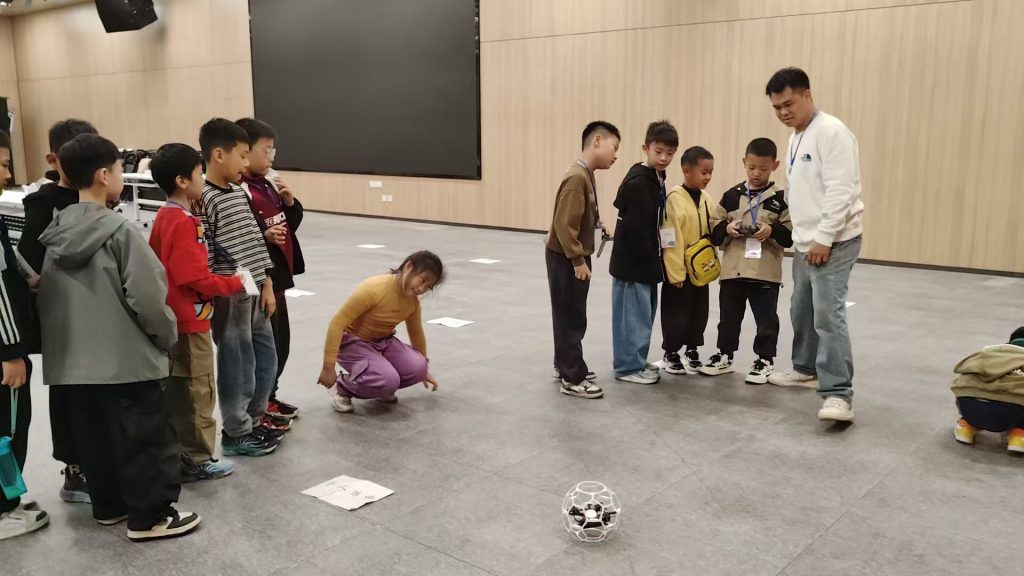
As illustrated, specialized drone training environments are crucial for developing the muscle memory and decision-making skills required to operate sophisticated UAV platforms under pressure, ensuring that the technological potential is fully realized in the field.
C. Functional Shift: From Post-Crime Reaction to Pre-Crime Prevention
Aligning with the global shift in public security governance towards a “prevention-first” model, the function of investigation is expanding. Traditionally focused on “exposing” completed crimes, investigation now increasingly encompasses “prevention and control” and “rights safeguarding.” Low-altitude drone investigation is at the forefront of this functional augmentation.
- Enhancing “Exposure”: Drones do not just find evidence faster; with AI, they can proactively flag suspicious behaviors (e.g., illegal dumping, unauthorized loitering) in real-time streams, accelerating the investigative trigger.
- Deepening “Prevention & Control”: Through persistent, low-cost aerial monitoring of high-risk areas (e.g., borders, critical infrastructure) and data-driven heat mapping of crime patterns, drones enable a continuous, preventive security posture. This is the essence of predictive policing, powered by aerial data collection.
- Advancing “Rights Safeguarding”: By providing an objective, aerial record of police actions and crime scenes, drones can help protect the innocent and ensure lawful conduct, contributing to procedural justice.
This preventive function is the highest expression of the system’s value, moving investigation from a purely reactive endeavor to a proactive component of overall social risk management. Mastering this strategic application requires advanced tactical and ethical drone training that goes beyond manual flight control.
II. Critical Functional Assessment: Breadth, Depth, and Height
Despite its promising evolution, the low-altitude drone investigation system faces significant constraints across three dimensions: the breadth of its application, the depth of its practical efficacy, and the height of its preventive ambitions.
A. Breadth: Unstructured Expansion of Application Domains
The application domains have expanded无序ly from local policing to environmental protection, border security, and traffic management. This expansion lacks standardized coordination, creating a “patchwork” system. The primary bottlenecks are:
- Absence of Unified Technical Standards: No nationwide standards for police UAV performance, interoperability, or data protocols lead to incompatible fleets and fragmented capabilities.
- Absence of Unified Personnel Standards: Inconsistent requirements for operator certification, competency assessment, and advanced drone training create disparities in skill and safety culture across jurisdictions.
This lack of standardization hinders large-scale collaboration, data sharing, and the development of a mature, safe, and reliable national ecosystem.
B. Depth: Technical Limitations Constraining Practical Efficacy
While offering temporal and spatial advantages, the practical efficacy (“depth”) of drone systems is limited by persistent technical shortcomings in platform hardware and software:
| Technical Shortcoming | Impact on Investigation | Role of Enhanced Training |
|---|---|---|
| Limited Operational Stability in extreme weather (heat, cold, rain). | Reduced mission availability and reliability in critical conditions. | Drone training must include adverse weather procedures and system limitation awareness. |
| Single-Function Payloads on most platforms. | Inability to perform multiple sensing tasks (e.g., visual + thermal + LiDAR) in one sortie, reducing efficiency. | Training should cover rapid payload switching and multi-sensor data fusion basics. |
| Cybersecurity Vulnerabilities in data links and systems. | Risk of jamming, spoofing, or data interception, compromising mission integrity and confidentiality. | Advanced drone training must incorporate cyber-hygiene, secure communication protocols, and counter-UAV tactics. |
The efficacy gap can be modeled as a function of Technology (T), Operator Skill (S) from training, and Environmental Factors (E):
$$
\text{Investigative Efficacy } \mathcal{E} = f(T, S, E) \approx \alpha \cdot \log(T) + \beta \cdot S^2 – \gamma \cdot E
$$
where $\alpha, \beta, \gamma$ are positive constants. This shows that operator skill ($S$), squared, often has a more significant marginal return on efficacy than linear improvements in raw technology, especially when technology is mature. This underscores the critical investment value of high-quality drone training.
C. Height: The Rights-Utility Dilemma in Preventive Mechanisms
The “height” of the system—its ambition to prevent crime through predictive, pervasive monitoring—creates a serious tension with civil liberties. The very features that make it effective for prevention also amplify privacy risks:
- Panoramic Nature: Enables mass data collection in public and semi-public spaces, capturing information of countless uninvolved individuals, expanding the “surveillance footprint.”
- Covert Nature: Makes surveillance less detectable, undermining transparency and public accountability.
- Mobile & Agile Nature: Allows for dynamic, suspicion-less scanning of wide areas, potentially contravening the principle of investigative necessity and proportionality.
Without robust legal and procedural safeguards, the pursuit of “未态防范” (preventing the latent state of risk) can lead to a surveillance apparatus that erodes privacy and chills lawful public behavior. Ethical drone training must therefore include mandatory modules on privacy law, proportionality assessment, and the ethical use of surveillance powers.
III. A Tri-Dimensional Optimization Path for the Digital Intelligence Era
To overcome these constraints and responsibly harness the potential of low-altitude drone investigation, a coordinated optimization strategy across organizational, strategic, and procedural dimensions is essential.
A. Organizational Dimension: Building a Unified Standards Architecture
Horizontal and vertical standardization is the bedrock for scalable, safe, and interoperable operations.
- Horizontal (Cross-Sector) Standardization: Establish clear data-sharing protocols and joint operation frameworks between public security, environmental agencies, transportation authorities, etc., to enable true inter-agency collaboration.
- Vertical (Internal) Standardization:
- Technical Equipment Standards: Mandate national standards for police UAV durability, data encryption, communication protocols, and payload interfaces.
- Personnel & Training Standards: Institute a national certification framework for drone investigators. This framework should define a tiered drone training curriculum:
| Training Tier | Core Modules | Certification Outcome |
|---|---|---|
| Tier 1: Basic Operator | Flight safety, regulations, basic photography/videography, maintenance. | License for routine aerial documentation. |
| Tier 2: Tactical Investigator | Covert surveillance techniques, tactical flight patterns, night operations, basic sensor (thermal, zoom) operation. | License for active evidence gathering and suspect tracking. |
| Tier 3: Technical Specialist | Advanced data analytics, 3D modeling/LiDAR processing, counter-drone tactics, cybersecurity for UAVs, AI tool interface. | License for complex data-driven investigations and technical leadership. |
| Tier 4: Instructor & Ethics | Pedagogy, advanced scenario design, privacy law, ethical oversight, legal compliance auditing. | License to train others and oversee program ethics. |
B. Strategic Dimension: Fostering Public-Private-Innovation Partnership
A synergistic “government-police-industry” model is needed to drive innovation and application.
- Government’s Role (Capacity Activation): Invest in low-altitude infrastructure (dedicated corridors, communication networks), fund R&D, and create incentives for real-world pilot projects in crime prevention.
- Police’s Role (Application & Adaptation): Deeply integrate drones into daily智慧 policing workflows, providing continuous feedback from the field to guide industry R&D towards practical needs. Establish dedicated drone training academies tied to operational units.
- Industry’s Role (Product Innovation): Respond agilely to state directives and police feedback. Focus on core tech breakthroughs (e.g., longer endurance, AI-on-the-edge, anti-jamming), co-developing solutions with academia and research institutes.
C. Procedural Dimension: Constructing a Synergistic Legal Framework
Regulation must address risks across the integrated “physical-social-informational” space that drones occupy.
- Physical Space Regulation: Legisstrate clear stratification of low-altitude airspace, defining “investigative corridors” and jurisdictional boundaries for police UAV operations to ensure safe and orderly airspace use.
- Social Space (Privacy) Regulation: Legally encode the “minimal necessary” principle for aerial data collection. Define no-fly zones (e.g., directly over private residences), data retention limits, and require proportionality assessments for wide-area surveillance.
- Informational Space (Data) Regulation: Classify investigative data by sensitivity level, mandating corresponding security controls. Utilize blockchain or other auditable ledgers for full-chain data provenance, tracking collection, access, use, and deletion to ensure accountability and prevent abuse.
All procedural safeguards must be a core component of advanced legal and ethical drone training, ensuring that operators are not just technically proficient but also legally literate and ethically grounded.
In conclusion, the maturation of low-altitude drone investigation from a tactical tool to a strategic system is inevitable. Its success in enhancing public security while safeguarding democratic values will not be determined by drones alone, but by the holistic ecosystem we build around them. This ecosystem must be anchored in rigorous standardization, dynamic innovation partnerships, and principled legal frameworks. Ultimately, the most critical component is the human element—the investigators, analysts, and commanders whose skills and judgment are honed through comprehensive, continuous, and ethically informed drone training. It is this investment in human capital that will unlock the full, responsible potential of the digital intelligence era for investigative work.