
The rapid proliferation of Unmanned Aerial Vehicles (UAVs) across diverse sectors, from infrastructure inspection to emergency response, has created an unprecedented demand for skilled and certified drone pilots. Traditional drone training methods, which heavily rely on actual flight hours, present significant challenges. These include high operational costs due to equipment wear and tear, potential safety risks during initial training phases, logistical constraints related to weather and airspace, and a limited ability to simulate rare or hazardous scenarios. In our pursuit to revolutionize drone training, we have developed a high-fidelity, immersive drone flight simulation system that leverages the power of Virtual Reality (VR) technology. This system aims to provide a safe, cost-effective, and highly scalable platform for comprehensive drone training, drastically reducing the time and financial investment required to produce proficient operators. By immersing trainees in a realistic virtual environment, we can accelerate skill acquisition, reinforce muscle memory for complex maneuvers, and systematically evaluate performance under controlled, repeatable conditions. The core of our research focuses on integrating advanced flight dynamics modeling with VR-based visual and control systems to create a holistic training solution.
The foundation of any effective drone training simulator is a precise mathematical model of the aircraft’s flight dynamics. Our system employs a six-degree-of-freedom (6DOF) nonlinear model that fully accounts for the complex interplay of forces and moments acting on the drone. This model is essential for authentic drone training, as it replicates the authentic flight characteristics, including crucial lateral-longitudinal coupling effects. The equations of motion are derived from Newton’s second law and are structured around the body-fixed coordinate system. The translational and rotational dynamics are governed by the following fundamental equations:
Translational Motion:
$$m(\dot{u} + qw – rv) = F_x – mg\sin\theta$$
$$m(\dot{v} + ru – pw) = F_y + mg\cos\theta\sin\phi$$
$$m(\dot{w} + pv – qu) = F_z + mg\cos\theta\cos\phi$$
Rotational Motion:
$$I_{xx}\dot{p} – I_{xz}\dot{r} + (I_{zz} – I_{yy})qr – I_{xz}pq = L$$
$$I_{yy}\dot{q} + (I_{xx} – I_{zz})pr + I_{xz}(p^2 – r^2) = M$$
$$I_{zz}\dot{r} – I_{xz}\dot{p} + (I_{yy} – I_{xx})pq + I_{xz}qr = N$$
Where \(u, v, w\) are the linear velocity components; \(p, q, r\) are the angular rates; \(m\) is the mass; \(g\) is gravity; \(\theta\) and \(\phi\) are pitch and roll angles; \(I_{xx}, I_{yy}, I_{zz}, I_{xz}\) are moments of inertia; and \(F_x, F_y, F_z, L, M, N\) represent the aerodynamic and propulsive forces and moments. These forces and moments are calculated in real-time based on control surface deflections (aileron \(\delta_a\), elevator \(\delta_e\), rudder \(\delta_r\)), throttle input \(\delta_t\), and the current flight state (airspeed, angle of attack \(\alpha\), sideslip angle \(\beta\)). For instance, the aerodynamic coefficients are typically expressed as nonlinear functions:
$$C_L = C_{L0} + C_{L\alpha}\alpha + C_{Lq}\frac{q\bar{c}}{2V} + C_{L\delta_e}\delta_e$$
$$C_D = C_{D0} + K C_L^2$$
$$C_Y = C_{Y\beta}\beta + C_{Yp}\frac{p\bar{b}}{2V} + C_{Yr}\frac{r\bar{b}}{2V} + C_{Y\delta_r}\delta_r$$
This high-fidelity model ensures that the simulator responds accurately to pilot inputs, providing an authentic foundation for all subsequent drone training modules. The parameters for different drone types (e.g., multi-rotor, fixed-wing) are stored in a modular database, allowing the system to be easily reconfigured for various drone training curricula.
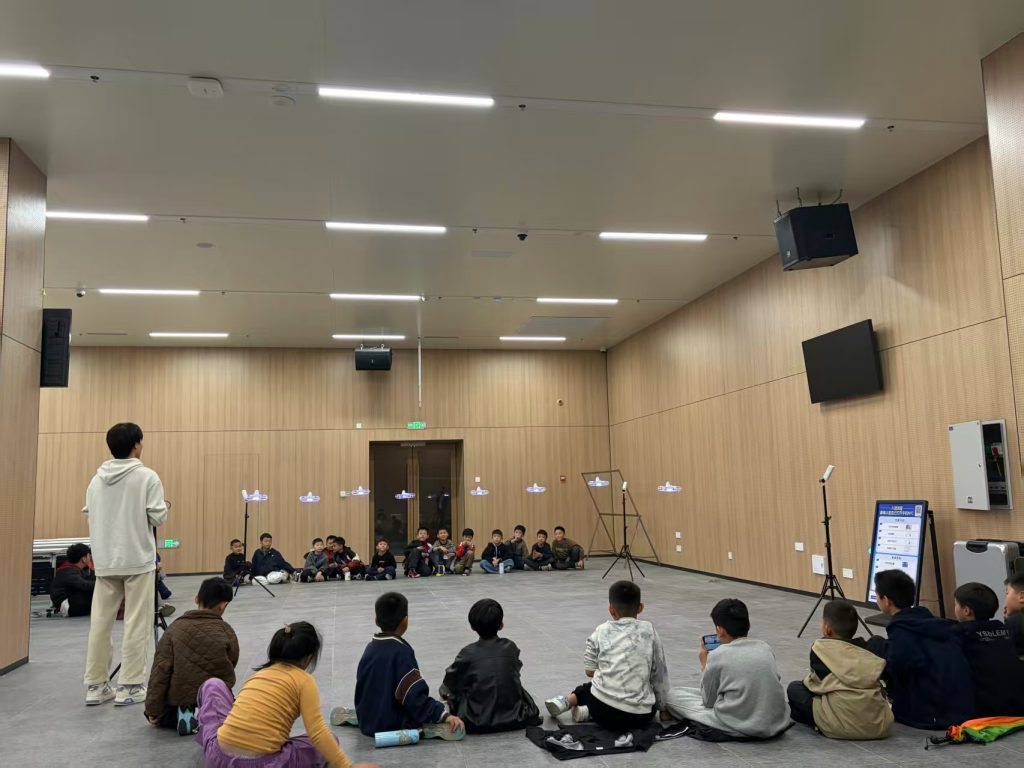
The visual system is the primary interface for immersion and is critical for effective drone training. We constructed a multi-layered 3D environment comprising terrain, dynamic skies, and detailed models. Key to achieving a sense of vast scale required for long-range drone training missions is the use of a hybrid modeling approach. The near-field area where the drone operates is built using geometric models created with tools like Blender or 3ds Max, allowing for real-time interaction and collision detection. For distant terrain and skyboxes, we employ panoramic image-based rendering. A series of photographs taken on-site are stitched and projected onto a large cylindrical or spherical surface surrounding the scene, providing a high-detail, performant backdrop.
A sophisticated viewpoint management system is implemented to support various perspectives crucial for drone training. The trainee can switch between views to develop situational awareness.
| Viewpoint Mode | Mathematical/Logical Description | Training Purpose |
|---|---|---|
| Fixed (Global) | Camera position \( \mathbf{C}_{world} \) and orientation are constant in world coordinates. | Observing overall mission progress, understanding airspace. |
| Bound (Chase) | Camera is rigidly attached to the drone’s body frame. \( \mathbf{C}_{body} \) is constant. Transform to world: \( \mathbf{C}_{world} = \mathbf{R} \cdot \mathbf{C}_{body} + \mathbf{P}_{drone} \). | Practicing formation flying, observing aircraft attitude from a third-person perspective. |
| Tracking (Follow) | Camera position \( \mathbf{C}_{world} \) is fixed, but its look-at target \( \mathbf{T} \) is the drone’s position \( \mathbf{P}_{drone} \). | Monitoring a drone’s approach or landing path from a tower perspective. |
| Pilot Eye (FPV) | Camera is positioned at the drone’s “eye,” simulating the feed from its primary camera. \( \mathbf{C}_{world} = \mathbf{P}_{drone} + \mathbf{R} \cdot \mathbf{offset}_{eye} \). | Core training for visual navigation, inspection tasks, and manual landing. |
Viewpoint control for free exploration is enabled via keyboard or VR controllers. The translation and rotation logic follows these equations, where \(\Delta h\) is the translation step, \(\Delta r\) is the rotation step, and \(\alpha\), \(\beta\) are the yaw and pitch angles of the camera in the world horizontal plane:
Translation: $$ \begin{aligned} x’ &= x \pm \Delta h \cdot \cos(\alpha) \\ z’ &= z \pm \Delta h \cdot \sin(\alpha) \\ y’ &= y \pm \Delta h_{vertical} \end{aligned} $$
Rotation: $$ \alpha’ = \alpha \pm \Delta r_{yaw}, \quad \beta’ = \beta \pm \Delta r_{pitch} $$
To create a believable world for immersive drone training, we implemented a range of environmental effects. Real-time lighting models (Phong or similar) calculate ambient, diffuse, and specular components for all objects. The lighting equation for a point is:
$$ I = k_a I_a + \sum_{\text{lights}} (k_d (\mathbf{L} \cdot \mathbf{N}) I_d + k_s (\mathbf{R} \cdot \mathbf{V})^n I_s) $$
Where \(k_a, k_d, k_s\) are material coefficients, \(I_a, I_d, I_s\) are light intensities, \(\mathbf{L}\) is the light direction, \(\mathbf{N}\) is the surface normal, \(\mathbf{R}\) is the reflection vector, \(\mathbf{V}\) is the view vector, and \(n\) is the shininess exponent.
Atmospheric effects like fog are critical for depth perception. We implemented exponential fog, where the blending factor \(f\) between the object color and the fog color is determined by the distance \(z\) from the viewer and a density parameter \(d\):
$$ f = e^{-(d \cdot z)} \quad \text{or} \quad f = e^{-(d \cdot z)^2} $$
The final pixel color is computed as: \( Color_{final} = f \cdot Color_{object} + (1 – f) \cdot Color_{fog} \).
A critical component of practical drone training is teaching obstacle avoidance. Our system integrates real-time collision detection. For performance, we use the Axis-Aligned Bounding Box (AABB) method for initial broad-phase detection. The collision condition between two objects A and B is:
$$ A_{min}^x \leq B_{max}^x \quad \text{and} \quad A_{max}^x \geq B_{min}^x \quad \text{and} $$
$$ A_{min}^y \leq B_{max}^y \quad \text{and} \quad A_{max}^y \geq B_{min}^y \quad \text{and} $$
$$ A_{min}^z \leq B_{max}^z \quad \text{and} \quad A_{max}^z \geq B_{min}^z $$
If this broad-phase test indicates a potential collision, a more precise algorithm can be invoked for selected objects. Upon collision detection, the system provides haptic feedback (through the VR controllers) and visual/auditory alerts, logging the event for post-mission debriefing—a vital part of the drone training feedback loop.
The system architecture is modular, ensuring flexibility and ease of maintenance for continuous drone training program development. The core modules and their interactions are summarized below:
| Module | Technology/Implementation | Primary Function in Drone Training |
|---|---|---|
| Flight Dynamics Engine | C++/Python, solving 6DOF nonlinear equations in real-time. | Generates accurate aircraft state (position, velocity, attitude, rates). |
| VR Rendering Engine | Unity3D with XR Interaction Toolkit / Unreal Engine. | Manages HMD head tracking, renders stereoscopic 3D scene, handles controller input. |
| Control Interface | Physical RC transmitter USB interface, or VR motion controllers mapped to virtual sticks. | Provides authentic or adapted control input methods for drone training. |
| Scenario & Mission Editor | Custom graphical tool with scripting (e.g., Lua, Python). | Allows instructors to create custom flight paths, weather conditions, and failure scenarios for targeted drone training. |
| Instructor Operating Station (IOS) | Separate desktop application with network link to simulator. | Enables real-time monitoring, parameter injection (e.g., wind gusts, sensor failure), and performance scoring. |
| Performance Analytics | Database (SQLite/MySQL) logging all flight parameters and events. | Quantifies trainee performance (e.g., tracking error, stabilization time, energy use) for objective assessment in drone training. |
The core software framework integrates these components. The flight model, often running on a deterministic simulation loop at 100-1000 Hz, outputs the drone’s state vector \(\mathbf{X}\). This data is packetized and sent via UDP or a shared memory interface to the visualization and IO subsystem, which runs at the display refresh rate (e.g., 90 Hz for VR). The control inputs from the pilot are fed back into the flight model, closing the loop. The decoupling of simulation rates ensures both numerical stability for the dynamics and smooth visual presentation, a key factor in preventing simulator sickness during extended drone training sessions.
The system’s effectiveness is measured by its ability to improve real-world piloting skills. We define key performance indicators (KPIs) for drone training that the simulator logs and evaluates:
1. Tracking Accuracy: Measures the pilot’s ability to follow a predefined path \(P_{ref}(t)\). The error is often calculated as the Root Mean Square (RMS) of the cross-track error (CTE):
$$ CTE_{RMS} = \sqrt{ \frac{1}{T} \int_0^T d(t)^2 \, dt } $$
where \(d(t)\) is the minimum distance from the drone’s position \(\mathbf{P}_{drone}(t)\) to the reference path.
2. Stabilization Performance: After a disturbance (e.g., a simulated wind gust), the system measures the time \(T_{settle}\) it takes for attitude errors \(|\phi_{error}|, |\theta_{error}|\) to fall and remain below a threshold (e.g., 2°).
3. Energy Efficiency: For mission-oriented drone training, the total energy expenditure \(E\) can be estimated from motor commands or a proxy like integrated throttle setting:
$$ E \propto \int_0^T \delta_t(t) \, dt $$
4. Mission Success Metrics: Binary or graded scores for task completion (e.g., “object identified,” “landing within pad,” “inspection photos captured”).
By analyzing these metrics across multiple training sessions, both the trainee and the instructor can identify areas for improvement, making the drone training process highly data-driven and efficient. The ability to instantly replay a mission from any angle within the VR environment is an invaluable debriefing tool, allowing for detailed analysis of decisions and control inputs.
In conclusion, the integration of high-fidelity flight dynamics with immersive Virtual Reality technology creates a transformative platform for modern drone training. Our system addresses the core limitations of traditional training by providing a safe, cost-effective, and infinitely flexible environment. Trainees can experience and master normal procedures, emergency operations, and complex missions in photorealistic virtual worlds without risk to personnel or equipment. The mathematical rigor of the simulation engine ensures skill transferability to real drones, while the VR interface accelerates the development of spatial awareness and control precision. The modular architecture and comprehensive performance logging further enable the system to be adapted for a wide range of UAV platforms and specialized training curricula. As VR hardware continues to advance, offering higher resolution and wider fields of view, the fidelity and effectiveness of such simulators will only increase, solidifying their role as an indispensable cornerstone of professional drone training programs worldwide. The future of drone training is virtual, and it promises to produce a generation of pilots who are more skilled, safer, and better prepared for the challenges of real-world UAV operations.