
The rapid proliferation of unmanned aerial vehicle (UAV) technology across industries such as agriculture, logistics, surveying, and public safety has created an unprecedented demand for skilled professionals. This demand has catalyzed the establishment of “Drone Application Technology” programs in vocational colleges worldwide. However, the effectiveness of these drone training initiatives is often hampered by systemic challenges. The EPIP (Engineering, Practice, Innovation, Project) pedagogical model emerges as a powerful theoretical framework to address these issues. Originating from and refined through China’s engineering education practices, EPIP represents a holistic approach to cultivating the complex skill sets required in modern technical fields. This article, from my perspective as an educator engaged in this domain, explores the profound alignment between EPIP principles and the goals of effective drone training, proposing a comprehensive pathway for talent development.
UAV technology is inherently interdisciplinary, synthesizing knowledge from mechanical engineering, electronics, aeronautics, computer science, communications, and material science. This makes it an ideal vehicle for integrated engineering education. The core objective of drone training is to produce application-oriented, developmental, compound, and innovative talents who can operate, maintain, assemble, debug, and apply drone technology in real-world scenarios. The EPIP model, with its focus on authentic engineering contexts and competency development through project-based learning, offers a natural fit for achieving this objective. It places teaching and learning within genuine engineering environments, using complete projects to foster independent thinking, logical reasoning, self-management, and creative problem-solving—precisely the competencies needed for high-quality drone training.
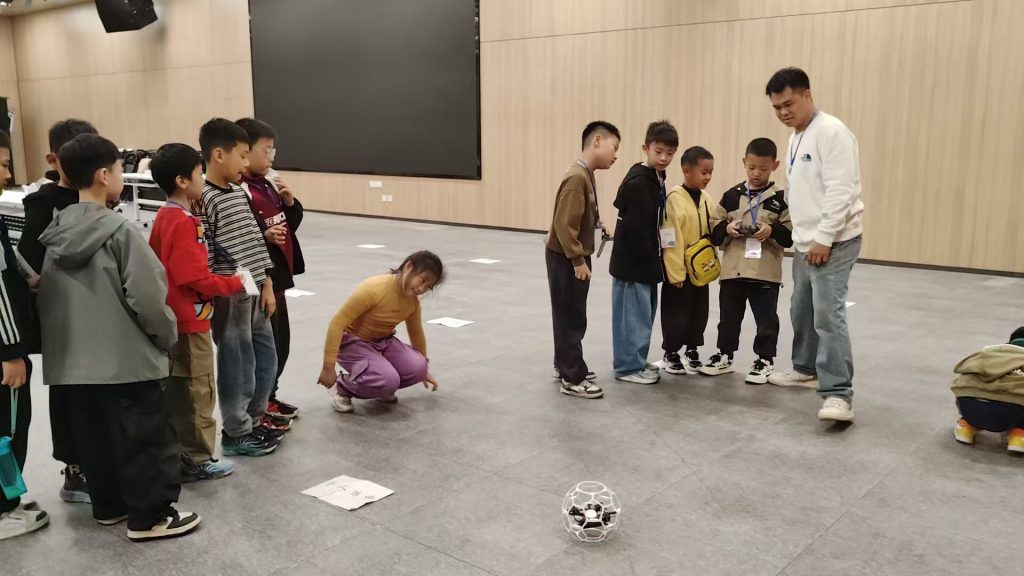
The EPIP framework is built upon four synergistic pillars: Engineering (E), Practice (P), Innovation (I), and Project (P). Their relationship can be conceptualized not as a simple sum, but as an integrated system where each element amplifies the others within the context of drone training:
$$EPIP = E \oplus P \oplus I \oplus P$$
Here, the operator \(\oplus\) denotes a deep integration rather than mere addition. Engineering provides the systemic knowledge and theoretical foundation. Practice offers the hands-on, repetitive skill-building. Innovation injects the mindset for improvement and novel solutions. The Project is the container that binds them all, providing the authentic, goal-oriented context for learning. This model ensures that drone training moves beyond isolated skill drills to encompass the complete workflow and cognitive demands of the profession.
Current Challenges in Drone Training Programs
Despite the urgency, the systemic construction of drone application technology programs remains in a nascent stage. Several interconnected challenges constrain the quality and output of drone training.
| Challenge Area | Specific Manifestations | Impact on Drone Training |
|---|---|---|
| Faculty Development | Insufficient number of qualified instructors; reliance on faculty from adjacent disciplines (e.g., mechanical, electronics) or industry practitioners; lack of integrated knowledge and innovative teaching capability. | Leads to unbalanced instruction, gaps in interdisciplinary knowledge transfer, and an inability to guide advanced project-based or innovative work effectively. |
| Curriculum & Pedagogy | Course systems borrowed from other majors lack distinctive drone-specific character; imbalance between theoretical instruction and practical application; limited course offerings due to equipment/space constraints. | Fails to match industry skill demands; fails to stimulate student interest; produces graduates with theoretical knowledge but inadequate operational and troubleshooting competence. |
| Infrastructure & Industry Links | Inadequate or outdated on-campus simulation and practice facilities; superficial industry-academia collaboration; lack of high-quality, managed off-campus internship bases. | Severely limits hands-on drone training hours and quality; disconnects learning from real-world applications and evolving industry standards. |
These challenges create a vicious cycle: weak faculty design weak curricula, which is then delivered with inadequate practical support, resulting in graduates who do not fully meet industry expectations. Breaking this cycle requires a systemic overhaul, for which the EPIP model provides a coherent blueprint.
The EPIP Framework: A Blueprint for Systemic Reform in Drone Training
Implementing EPIP requires re-engineering the key components of the talent development ecosystem. The following pathway outlines an integrated strategy.
1. Constructing a “Core Competency Integration” Curriculum System
The curriculum must be reconstructed from the ground up based on authentic occupational task analysis. The goal is to move from subject-centric knowledge transmission to a competency-centric, project-driven learning experience. This involves deconstructing typical drone service workflows (e.g., mission planning, assembly/calibration, flight operation, data acquisition, maintenance) into core skill clusters. These clusters then form the basis for modular courses that are integrated through overarching EPIP projects.
A progressive EPIP project cluster for a three-year program might be structured as follows, ensuring that Engineering, Practice, and Innovation are woven into each stage:
| Academic Stage | Sample EPIP Project Theme | Primary Engineering Focus (E) | Key Practice Skills (P) | Innovation Catalyst (I) |
|---|---|---|---|---|
| Year 1: Foundation | Miniature Quadcopter Assembly & Basic Flight | Basic aerodynamics, electronic circuits, radio control principles. | Soldering, mechanical assembly, transmitter calibration, basic LOS (Line-Of-Sight) piloting. | Optimizing component layout for balance; troubleshooting unsuccessful first flights. |
| Year 2: Application | Precision Agriculture Mapping Mission | Photogrammetry, GPS technology, sensor payloads, data transmission. | Mission planning software (e.g., UGCS, DJI Pilot), autonomous flight, image capture, basic data processing. | Designing an efficient flight path for a given field; comparing outcomes of different overlap/sidelap settings. |
| Year 3: Integration | End-to-End Infrastructure Inspection Solution | Systems integration, data analysis software, report generation, regulatory compliance. | Advanced BVLOS (Beyond Visual Line of Sight) procedures, thermal camera operation, detailed defect analysis, client reporting. | Developing a customized inspection protocol for a specific asset (e.g., wind turbine, bridge); proposing a new data analysis algorithm for automatic defect detection. |
The curriculum time allocation must reflect this practical emphasis. A proposed balanced structure for a core applied course could be:
$$T_{total} = T_{theory} + T_{practice\_lab} + T_{project}$$
$$T_{theory} : T_{practice\_lab} : T_{project} \approx 3 : 3 : 4$$
This ratio ensures that project work, which inherently integrates theory and practice while demanding innovation, occupies the largest share of instructional time, fundamentally reshaping the drone training experience.
2. Cultivating “Dual-Quality” Faculty Through EPIP Adoption
The success of EPIP implementation hinges on faculty who are both proficient educators (“teaching quality”) and capable engineering practitioners (“technical quality”). The strategy must be two-pronged: upgrading existing faculty and strategically recruiting new talent.
For existing faculty, professional development must move beyond generic training to focused EPIP adoption programs. This involves workshops where instructors themselves experience the EPIP cycle by completing a mini-drone project. Furthermore, mandatory, sustained industry secondments are crucial. A formalized mechanism can be established:
$$F_{updated} = F_{initial} + \int_{t_0}^{t_1} (I(t) + E(t)) \, dt$$
Where \(F_{updated}\) represents the faculty’s updated competency, integrated over time through \(I(t)\) (Industry immersion) and \(E(t)\) (EPIP pedagogical training). Recruitment policies must also shift, valuing demonstrated project experience and industry credentials alongside academic qualifications. Building a faculty team capable of leading advanced drone training requires incentivizing and recognizing this blended expertise.
3. Deepening Industry-Education Integration via a Governance Model
Effective integration requires moving beyond ad-hoc agreements to structured, win-win collaboration. A proposed model involves establishing a joint “Drone Technology Program Committee” with representatives from the college and partner enterprises. This committee has shared authority in key areas:
- Curriculum Co-Design: Ensuring course content reflects the latest tools, regulations, and techniques used in the field.
- Project Portfolio Management: Sourcing, vetting, and defining the scope of real or simulated industry projects used for EPIP courses.
- Faculty & Mentor Exchange: Formalizing the flow of industry experts into the classroom and teachers into enterprise R&D or operations teams.
- Quality Assurance: Jointly developing assessment rubrics for student projects based on professional standards.
The collaboration’s effectiveness can be evaluated using a metric that considers input, process, and output factors:
$$CI_{effectiveness} = \alpha \cdot \frac{R_{shared}}{R_{total}} + \beta \cdot \frac{P_{live}}{P_{total}} + \gamma \cdot \frac{S_{employed}}{S_{graduated}}$$
where \(CI_{effectiveness}\) is the Collaboration Index, \(R_{shared}/R_{total}\) is the ratio of shared resources (e.g., equipment, data), \(P_{live}/P_{total}\) is the ratio of live industry projects to total projects, and \(S_{employed}/S_{graduated}\) is the graduate employment rate in the field. Weights \(\alpha\), \(\beta\), \(\gamma\) are assigned based on institutional priorities. This model ensures industry partnership is deep, accountable, and directly tied to drone training outcomes.
4. Building a Tiered, Multi-Functional Practice Base Ecosystem
The practice base is the physical and operational heart of the EPIP model. It cannot be a single lab but must be an ecosystem that supports different stages of learning and innovation.
| Base Type | Primary Function | EPIP Element Emphasized | |
|---|---|---|---|
| On-Campus Teaching & Simulation Base | Foundational skill acquisition, procedure rehearsal, and theoretical visualization. | Computer-based flight simulators (e.g., DJI Sim, RealFlight), assembly benches, electronic diagnostic stations, indoor micro-drone flying cage. | Practice (P), Engineering (E) |
| On-Campus Integrated Project Base | Execution of semester-long EPIP projects, prototyping, and interdisciplinary collaboration. | Large workshop with dedicated project bays, 3D printers, CNC for custom parts, outdoor netted flight area, ground control station workstations. | Project (P), Innovation (I) |
| Off-Campus Enterprise-Embedded Base | Immersion in real work environments, professional networking, and capstone project completion. | Located at partner companies (e.g., surveying firms, agricultural tech providers, inspection service companies). Students follow company workflows under mentor supervision. | All (EPIP) – Authentic Engineering context drives integrated application. |
| Innovation & Incubation Base | Fostering entrepreneurship and advanced R&D, turning student innovations into prototypes or startups. | Supported by college and venture partners, provides business mentorship, seed funding, and advanced R&D tools alongside technical workspace. | Innovation (I), Project (P) |
This tiered approach ensures a seamless progression for students, from safe, controlled practice to fully authentic professional experience, which is the ultimate goal of high-quality drone training.
Conclusion: A Path Forward for Excellence in Drone Training
The challenges facing drone application technology education are significant but not insurmountable. The EPIP model provides a coherent and powerful framework for systemic reform. By recentering the curriculum on integrated projects, cultivating a dual-quality faculty, establishing governed deep industry partnerships, and constructing a tiered practice ecosystem, vocational colleges can transform their drone training programs. This transformation will produce graduates who are not merely operators but adaptable, innovative problem-solvers capable of growing with the technology. The future of the industry depends on such a robust, practice-embedded, and innovation-focused approach to talent development. The path outlined here provides a concrete roadmap for institutions committed to playing a pivotal role in shaping that future.
| Strategic Action Area | Key EPIP-Aligned Initiatives | Expected Outcome for Drone Training |
|---|---|---|
| Curriculum Reform | Develop a “Core Competency Integration” system driven by progressive EPIP project clusters. | Students master integrated skill sets through authentic, goal-oriented learning, improving employability and adaptability. |
| Faculty Development | Implement mandatory EPIP pedagogy training and sustained industry immersion programs. | Instructors become effective facilitators of project-based learning and maintain cutting-edge industry relevance. |
| Industry Collaboration | Establish joint governance committees for co-design, project sourcing, and quality assurance. | Drone training remains dynamically aligned with market needs, and student projects have real-world value. |
| Infrastructure Investment | Build a tiered ecosystem of simulation, project, enterprise, and innovation bases. | Provides a seamless, scaffolded pathway from foundational practice to professional innovation. |