
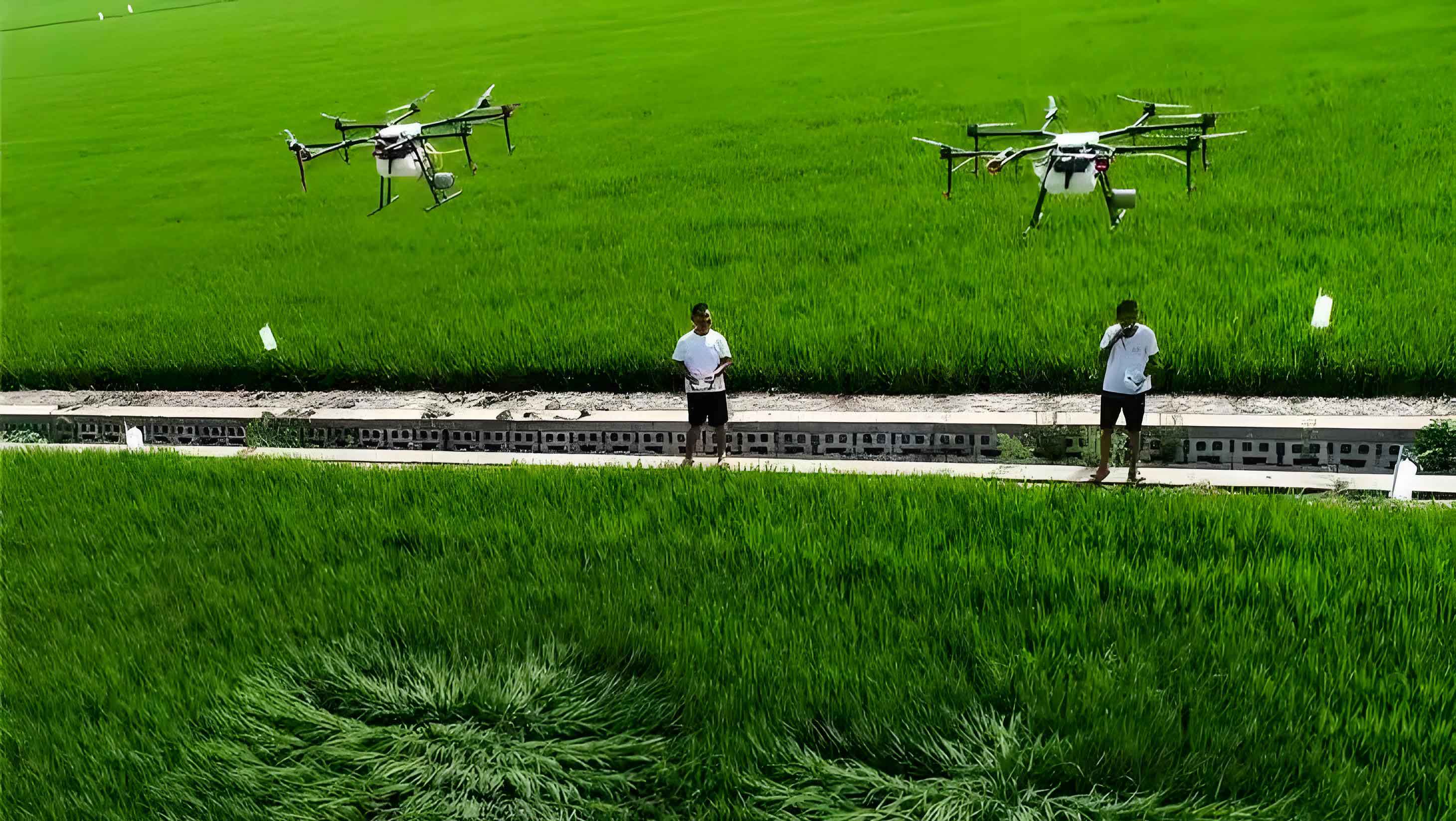
The advancement of application technology is a critical component of modern agriculture. In many regions, the technology for applying crop protection products lags significantly behind that of developed nations, often relying on manual or inefficient sprayers. This results in low work efficiency and high labor intensity. The rapid development of agricultural UAV (Unmanned Aerial Vehicle) technology presents a transformative opportunity for achieving mechanization in plant protection. Aerial application offers broad adaptability across diverse terrains, with operational efficiency potentially up to 30 times that of motorized sprayers and 100 times that of manual sprayers. This capability effectively addresses the challenges posed by labor shortages in rural areas and has become a vital tool for ensuring national food security and ecological safety.
Previous studies have demonstrated that agricultural UAVs can achieve high efficacy in controlling wheat weeds, powdery mildew, and aphids, showcasing clear operational advantages. However, comprehensive reports on their application throughout the entire wheat growing season for integrated pest management are scarce. To accelerate the adoption of mechanized plant protection, this investigation was conducted to evaluate the performance of a new type of agricultural UAV for full-season wheat disease, pest, and weed control. The results were compared directly with traditional manual application using electric sprayers. The goal is to explore the practical effects and provide a scientific basis for developing standardized operational protocols for agricultural UAV deployment in integrated crop management.
1. Materials and Methods
1.1 Experimental Site
The field trial was established on a large-scale farm in Hebei Province. The total area was 2.668 hectares. Wheat (variety ‘Cangmai 119’) was sown on October 15, 2018, at a seeding rate of 225 kg/ha in uniform row spacing. The field was flat with irrigation available. The soil was sandy loam with a pH of 7.5, organic matter content of 15 g/kg, and medium fertility.
1.2 Experimental Design
The experiment compared two primary application methods for full-season pest control: full-mechanized operation using an agricultural UAV and manual operation using an electric sprayer. An untreated control plot was also included. The layout consisted of 9 plots arranged in a randomized complete block design.
- Agricultural UAV Treatment Plot Area: 4,280 m²
- Electric Sprayer Treatment Plot Area: 4,280 m²
- Untreated Control Plot Area: 334 m²
1.2.1 Application Equipment
- Agricultural UAV: Model DJI T16, equipped with centrifugal nozzles for ultra-low volume (ULV) spraying.
- Electric Sprayer: Model 3WBD-16, equipped with conical fan nozzles for conventional high-volume spraying.
1.2.2 Application Timing and Materials
Applications were made at two critical stages for major wheat pests:
- Spring Weed Control: At the green-up and stem elongation stage (March 7, 2019).
- Flowering/Grain-Filling Spray (“Three-in-One” Protection): At the flowering to early grain-filling stage (May 4, 2019). This spray targets aphids, diseases like powdery mildew, and promotes plant health.
| Growth Stage | Pesticide Formulation | Dosage (per hectare) | Spray Volume |
|---|---|---|---|
| Green-up / Stem Elongation | 44% 2-methyl-4-chlorophenoxyacetic acid + Florasulam SE | 1.2 L | UAV: 15 L/ha Sprayer: 300 L/ha |
| Organosilicone Surfactant | 75 mL | ||
| Flowering / Grain-filling | 2.5% Lambda-cyhalothrin ME | 750 mL | UAV: 15 L/ha Sprayer: 300 L/ha |
| 5% Imidacloprid EC | 600 mL | ||
| 5% Oligosaccharins | 300 mL | ||
| 25% Tebuconazole EW | 375 mL | ||
| Organosilicone Surfactant | 75 mL |
The agricultural UAV was operated at a flight speed of 5–6 m/s and a height of 1.5 m above the crop canopy.
1.3 Investigation Methods
1.3.1 Weed Control Assessment
Weed density was assessed 30 days after application (DAA). Five sampling points of 1 m² each were selected per plot. The control efficacy was calculated based on weed counts. Phytotoxicity to wheat was visually assessed at 3, 7, 10, and 30 DAA.
The formula for weed control efficacy is:
$$ \text{Weed Control Efficacy (\%)} = \left( \frac{W_c – W_t}{W_c} \right) \times 100 $$
where $W_c$ is the weed count in the untreated control and $W_t$ is the weed count in the treatment plot.
1.3.2 “Three-in-One” Protection Assessment
Aphids: Live aphid counts were conducted pre-application and at 3 and 7 DAA. At each plot, 100 wheat stems (20 stems from each of five sampling points) were examined.
Powdery Mildew: Disease severity was assessed on the flag leaf and the two leaves below it from the same 100 stems at 7 DAA. A 0–9 scale was used for rating, and the disease index was calculated.
Formulas for efficacy calculation:
$$ \text{Aphid Population Reduction Rate (\%)} = \left( \frac{N_{pre} – N_{post}}{N_{pre}} \right) \times 100 $$
$$ \text{Corrected Aphid Control Efficacy (\%)} = \left( \frac{PR_t – PR_c}{100 – PR_c} \right) \times 100 $$
where $N_{pre}$ and $N_{post}$ are pre- and post-treatment counts, $PR_t$ is the reduction rate in the treatment, and $PR_c$ is the reduction rate in the control (often negative due to population increase).
$$ \text{Disease Control Efficacy (\%)} = \left( \frac{DI_c – DI_t}{DI_c} \right) \times 100 $$
where $DI_c$ is the disease index in the control and $DI_t$ is the disease index in the treatment.
1.3.3 Operational Efficiency and Yield
The time required for application per unit area was recorded for both methods. At maturity, wheat yield was measured from each plot.
2. Results and Analysis
2.1 Efficacy of Weed Control Operation
Visual symptoms on major broadleaf weeds (e.g., Descurainia sophia, Chenopodium album) appeared similarly for both application methods: leaf twisting and yellowing by 3 DAA, leading to plant death by 10 DAA.
| Treatment | Weed Species | Weed Count (30 DAA) | Control Efficacy (%) | Overall Control Efficacy (%) |
|---|---|---|---|---|
| Agricultural UAV | Descurainia sophia | 1 | 96.97 a | 91.20 a |
| Chenopodium album | 1 | 91.67 a | ||
| Galium spurium | 2 | 87.88 a | ||
| Electric Sprayer | Descurainia sophia | 2 | 93.64 a | 88.02 a |
| Chenopodium album | 2 | 80.56 a | ||
| Galium spurium | 3 | 84.13 a | ||
| Control | Descurainia sophia | 29 | – | – |
| Chenopodium album | 11 | – | ||
| Galium spurium | 18 | – |
Note: Values within a column followed by the same letter are not significantly different (P<0.05).
As shown in Table 2, at 30 DAA, the agricultural UAV treatment achieved an overall weed control efficacy of 91.20%, which was 3.18 percentage points higher than the electric sprayer treatment (88.02%). Although numerically higher, the difference was not statistically significant. Both methods provided satisfactory control of major broadleaf weeds, with the agricultural UAV showing a marginally superior performance. No phytotoxicity symptoms were observed on wheat plants in any treated plots at all assessment intervals.
2.2 Efficacy of the “Three-in-One” Protection Operation
| Treatment | Wheat Aphid | Powdery Mildew | ||||
|---|---|---|---|---|---|---|
| Pre-count | 3 DAA: Corrected Efficacy (%) | 7 DAA: Corrected Efficacy (%) | Population Trend | 7 DAA: Disease Index | 7 DAA: Control Efficacy (%) | |
| Agricultural UAV | 556.0 | 97.11 a | 99.58 a | Rapid decline and sustained control | 1.28 | 71.79 a |
| Electric Sprayer | 535.7 | 87.16 b | 93.18 b | Slower initial knock-down | 1.98 | 56.09 b |
| Control | 543.3 | – | – | Rapid population increase | 4.52 | – |
Note: Values within a column followed by a different letter are significantly different (P<0.05). DAA: Days After Application.
The results in Table 3 highlight the superior performance of the agricultural UAV. For aphid control, the agricultural UAV treatment achieved a significantly higher corrected efficacy of 97.11% at 3 DAA and 99.58% at 7 DAA, compared to 87.16% and 93.18% for the electric sprayer, respectively. This indicates that the agricultural UAV application provided not only excellent final control but also a faster initial knockdown effect.
Against powdery mildew, a single application via agricultural UAV at the grain-filling stage resulted in a control efficacy of 71.79%, which was 15.7 percentage points higher and statistically superior to the 56.09% efficacy achieved by the electric sprayer. This demonstrates that the agricultural UAV was more effective in suppressing disease development.
2.3 Comprehensive Operational and Economic Benefits
The efficiency analysis revealed a dramatic advantage for the agricultural UAV. The operational efficiency can be expressed as:
$$ \text{Application Efficiency} = \frac{\text{Total Application Time}}{\text{Number of Operators} \times \text{Area Covered}} $$
| Treatment | Area (ha) | Operators | Total Time (min) | Efficiency (min/operator/ha) | Grain Yield (kg/ha) |
|---|---|---|---|---|---|
| Agricultural UAV | 6.0 | 4 | 80 | 3.33 | 9037.5 |
| Electric Sprayer | 6.0 | 4 | 920 | 38.33 | 8175.0 |
Based on the data in Table 4:
$$ \text{Efficiency Ratio} = \frac{\text{Electric Sprayer Time per ha}}{\text{Agricultural UAV Time per ha}} = \frac{38.33}{3.33} \approx 11.5 $$
This calculation confirms that the agricultural UAV was approximately 11.5 times more efficient in terms of operator time per hectare compared to the manual electric sprayer, drastically reducing labor requirements.
The yield results were equally compelling. The plot managed with the agricultural UAV for full-season protection yielded 9037.5 kg/ha, which was 862.5 kg/ha (approximately 10.6%) higher than the yield from the electric sprayer plot (8175.0 kg/ha). This significant yield increase can be attributed to more effective pest control and the complete absence of crop damage from foot traffic, which was visibly present in the manually sprayed plots. Furthermore, the agricultural UAV used an ultra-low volume application of 15 L/ha, representing a water savings of over 90% compared to the 300 L/ha used by the electric sprayer, an important ecological benefit in water-scarce regions.
3. Discussion and Conclusion
This study demonstrates that deploying an agricultural UAV for integrated pest management at key growth stages effectively controls major wheat weeds, aphids, and powdery mildew throughout the season. The agricultural UAV consistently achieved equal or superior efficacy compared to conventional manual spraying. Notably, it excelled in the speed and completeness of aphid knockdown and provided significantly better suppression of powdery mildew. These findings align with and extend previous research on the use of agricultural UAVs for specific wheat pests, confirming their suitability for holistic crop protection programs.
The advantages of the agricultural UAV system extend beyond biological efficacy. The most profound benefit is operational efficiency. By reducing the application time per hectare by an order of magnitude, agricultural UAVs alleviate labor intensity, address workforce shortages, and lower operational costs. This allows farmers and workers to allocate time to other essential farm management activities, generating substantial social benefits. The shift from manual, labor-intensive spraying to automated, mechanized application represents a critical step in modernizing agricultural practices.
From an environmental stewardship perspective, the ultra-low volume technology intrinsic to most agricultural UAV systems leads to dramatic reductions in water consumption—over 90% in this trial. In arid and semi-arid agricultural zones like the North China Plain, this is a significant advantage, contributing to more sustainable water resource management. Additionally, the precision of UAV flight paths and spray swaths can potentially enhance pesticide use efficiency and reduce environmental footprint compared to less controlled manual methods.
In conclusion, the full-season mechanized application using an agricultural UAV presents distinct and multifaceted advantages over traditional electric sprayer operations. It delivers effective, safe, and timely pest control, leading to measurable yield increases. Simultaneously, it offers transformative gains in labor productivity, operational efficiency, and resource conservation. Therefore, the agricultural UAV is validated as a powerful and effective tool for achieving high yields and realizing the broader goal of advanced plant protection mechanization. Its widespread adoption is recommended for large-scale wheat production systems.