
As a researcher and practitioner in the field of precision agriculture, I have witnessed the rapid adoption of agricultural UAVs (Unmanned Aerial Vehicles) globally. These devices, often referred to as drones, have revolutionized crop protection and monitoring by offering unparalleled efficiency and adaptability. In this analysis, I will delve into the current state of agricultural UAV applications, identify critical safety issues, and propose detailed measures for safe operation, all from my firsthand experience and observations. The term ‘agricultural UAV’ will be central to our discussion, as it represents a transformative technology in modern farming.
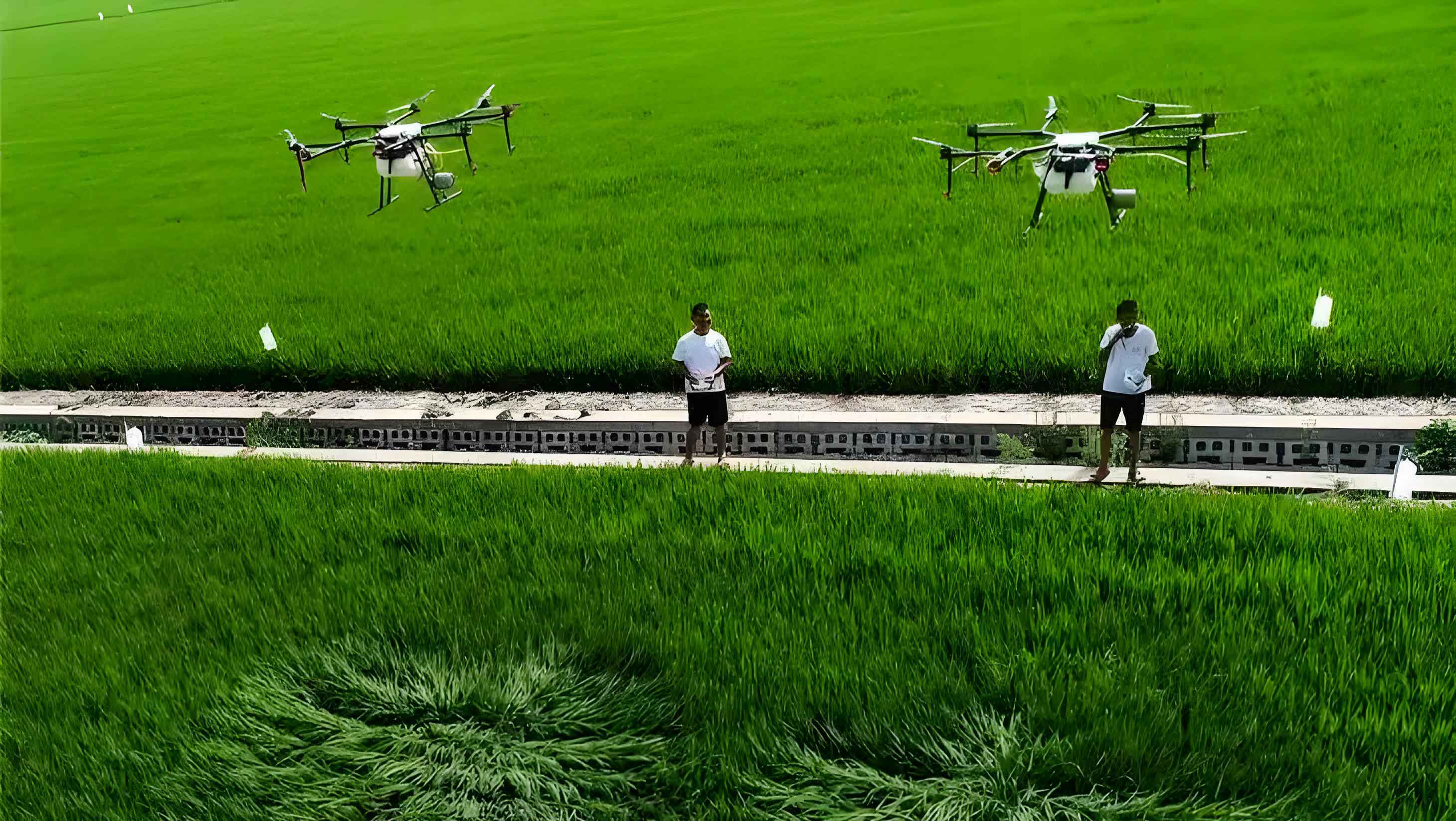
The introduction of agricultural UAVs has marked a significant shift from traditional ground-based spraying methods. Compared to manual or tractor-mounted equipment, agricultural UAVs boast higher operational efficiency, superior mobility, and the ability to navigate challenging terrains. For instance, the operational efficiency of an agricultural UAV can be up to 20 times greater than that of backpack mist sprayers, making them ideal for large-scale and emergency pest control scenarios. This efficiency can be modeled using a simple formula for area coverage rate: $$ E = \frac{A}{t} $$ where \( E \) is the efficiency in hectares per hour, \( A \) is the area covered, and \( t \) is the time taken. In practice, agricultural UAVs can achieve \( E \) values exceeding 10 ha/h under optimal conditions, depending on factors like payload and flight speed.
To understand the global footprint of agricultural UAVs, let’s examine the application现状. Initially dominated by countries like China, the use of agricultural UAVs has expanded worldwide. Below is a table summarizing the adoption rates and key metrics in various regions as of recent years:
| Region | Estimated Market保有量 (Units) | Annual Operational Area (Million Hectares) | Primary Crops | Growth Rate (%) |
|---|---|---|---|---|
| Asia-Pacific | 50,000 | 25 | Rice, Wheat | 30 |
| North America | 20,000 | 15 | Corn, Soybeans | 25 |
| Europe | 15,000 | 10 | Grapes, Olives | 20 |
| Africa | 5,000 | 3 | Maize, Cotton | 40 |
| South America | 10,000 | 8 | Sugarcane, Coffee | 35 |
This table illustrates that agricultural UAVs are becoming integral to farming systems globally, with Asia-Pacific leading in both保有量和作业面积. The growth rates indicate a rising trend, driven by the need for efficient pest management and resource optimization. However, as the deployment of agricultural UAVs increases, so do the associated safety concerns, which I will analyze in detail.
Safety issues related to agricultural UAVs have emerged as a critical challenge. From my perspective, these problems can be categorized into two main areas: interference with aviation and risks to human life and property. Firstly, agricultural UAVs operating near airports pose a significant threat to民航运行. The proximity of agricultural UAVs to flight paths can lead to near-miss incidents or even collisions. The risk probability can be expressed using a formula: $$ R_{aviation} = P_{encounter} \times C_{impact} $$ where \( R_{aviation} \) is the aviation risk, \( P_{encounter} \) is the probability of an agricultural UAV entering restricted airspace, and \( C_{impact} \) is the consequence of a collision, which could be catastrophic. For example, in 2017, multiple incidents in cities like成都 and Shanghai resulted in flight cancellations and delays, highlighting the urgency of addressing this issue.
Secondly, agricultural UAVs can危害人身财产安全 through accidents such as crashes or chemical drift. During spraying operations, if an agricultural UAV malfunctions or is operated improperly, it may fall onto populated areas, causing injuries or damage. Additionally, pesticide drift from agricultural UAVs can affect non-target crops or environments, leading to economic losses and health hazards. A risk assessment model for this can be defined as: $$ R_{property} = \int_{0}^{T} (H_{human} + D_{damage}) \, dt $$ where \( R_{property} \) is the property risk over time \( T \), \( H_{human} \) represents human health impacts, and \( D_{damage} \) denotes material damage. Instances like the 2018 incident in Hunan, where herbicide drift damaged adjacent crops, underscore the need for stringent controls.
To mitigate these risks, I propose a comprehensive framework for safe operation of agricultural UAVs, encompassing作业环境, personnel, chemicals, field procedures, and maintenance. Starting with作业环境, it is crucial to operate agricultural UAVs under favorable weather conditions. Ideally, agricultural UAVs should be deployed in windless conditions to minimize drift. If winds are present, spraying should be directed downwind. The following table outlines recommended environmental parameters for agricultural UAV operations:
| Environmental Factor | Safe Range | Risk Level | Action Required |
|---|---|---|---|
| Wind Speed | < 3 m/s | Low | Proceed with caution |
| Wind Speed | 3-5 m/s | Medium | Adjust spray direction |
| Wind Speed | High | Postpone operation | |
| Rainfall | 0 mm/h | Low | Ideal for spraying |
| Rainfall | High | Avoid operation | |
| Temperature | 10-30°C | Low | Optimal range |
| Temperature | < 0°C or > 35°C | High | Risk to equipment |
Regarding作业人员, operators of agricultural UAVs must undergo certified training and obtain relevant licenses. Individuals who are allergic to pesticides, intoxicated, minors, or lacking knowledge should not operate agricultural UAVs. Safety gear, including gloves, long sleeves, masks, and goggles, is essential. Furthermore, agricultural UAV operators should invest in第三者责任险 to cover potential damages. The competency of an operator can be quantified using a skill index: $$ S_{operator} = \frac{T_{training} + E_{experience}}{A_{accidents}} $$ where \( S_{operator} \) is the skill score, \( T_{training} \) is training hours, \( E_{experience} \) is field experience years, and \( A_{accidents} \) is past accident count—higher scores indicate safer operators.
When it comes to药液, strict adherence to pesticide regulations is vital for agricultural UAV applications. Only labeled and approved chemicals should be used, with concentrations and doses controlled precisely. If standard doses are ineffective, alternatives should be considered rather than increasing amounts. A formula for optimal dosage calculation can be: $$ D_{optimal} = \frac{C_{target} \times V_{spray}}{E_{coverage}} $$ where \( D_{optimal} \) is the optimal dosage in liters per hectare, \( C_{target} \) is the target concentration, \( V_{spray} \) is the spray volume, and \( E_{coverage} \) is the coverage efficiency of the agricultural UAV. Proper handling and disposal of chemicals are necessary to prevent contamination.
For田间作业, I emphasize a structured approach divided into preparation and execution phases. During作业准备, each agricultural UAV should be clearly marked with identifiers like model, serial number, and owner contact for traceability. Control systems must display real-time data such as position, altitude, and speed. In sensitive areas, agricultural UAVs should be equipped with电子围栏 to prevent entry into restricted zones. Pre-flight checks should include verifying fuel or battery levels, communication links, and environmental conditions. An emergency预案 should be established, detailing备降地点. The readiness level can be assessed as: $$ R_{readiness} = \sum_{i=1}^{n} C_{i} \times W_{i} $$ where \( R_{readiness} \) is a readiness score, \( C_{i} \) are checklist items (e.g., battery charge, GPS signal), and \( W_{i} \) are their weights based on importance.
During作业要求, agricultural UAVs should generally operate within visual line-of-sight (VLOS) during daylight, yielding right-of-way to other aircraft. For beyond visual line-of-sight (BVLOS) operations, priority must be given to manned aircraft. Operators must maintain constant control, and in autonomous modes, override capability is essential. The safety margin during flight can be expressed as: $$ M_{safety} = \frac{D_{separation}}{V_{closure}} $$ where \( M_{safety} \) is the safety margin in seconds, \( D_{separation} \) is the distance from hazards, and \( V_{closure} \) is the closure rate. If \( M_{safety} \) falls below a threshold, the agricultural UAV should be halted immediately.
Finally, the维护与存放 of agricultural UAVs are critical for long-term safety. Operators should maintain detailed records, including service dates, UAV models, chemical types, and operator information. After each use, agricultural UAVs must be cleaned thoroughly to remove pesticide residues. Batteries should be stored according to standards, and the UAV kept in dry, ventilated areas away from corrosive substances. A maintenance schedule can be modeled as: $$ F_{maintenance} = \frac{H_{operation}}{M_{interval}} $$ where \( F_{maintenance} \) is the maintenance frequency, \( H_{operation} \) is operational hours, and \( M_{interval} \) is the manufacturer-recommended interval. Regular inspections help prevent failures that could compromise safety.
In conclusion, the safe application of agricultural UAVs requires a multifaceted approach combining technology, regulation, and best practices. From my analysis, the key lies in rigorous training, environmental awareness, proper equipment handling, and adherence to operational protocols. As agricultural UAVs continue to evolve, ongoing research and policy development will be essential to address emerging risks. By prioritizing safety, we can harness the full potential of agricultural UAVs to enhance global food security while minimizing adverse impacts. The future of farming depends on our ability to integrate these tools responsibly, and I am committed to advancing this cause through continued study and advocacy.