
In my ongoing research into modern pest management strategies, I have focused on the invasive fall armyworm (Spodoptera frugiperda) and its devastating impact on corn crops. Originating from the tropical and subtropical regions of the Americas, this polyphagous pest has rapidly spread, including an incursion into China in 2019, where it poses a severe threat to corn quality and yield, particularly in northern regions. Climate change, leading to warmer temperatures, has facilitated its northward migration and proliferation throughout the entire corn growth cycle. Traditionally, control has relied heavily on chemical pesticides, which, while somewhat effective, raise concerns about environmental impact and residue. This has driven my investigation into advanced application technologies, notably the use of agricultural UAVs (unmanned aerial vehicles), which offer high operational efficiency, precision, and reduced labor intensity. My study specifically evaluates the field efficacy of an agricultural UAV versus traditional knapsack sprayers in applying insecticides against fall armyworm in corn.
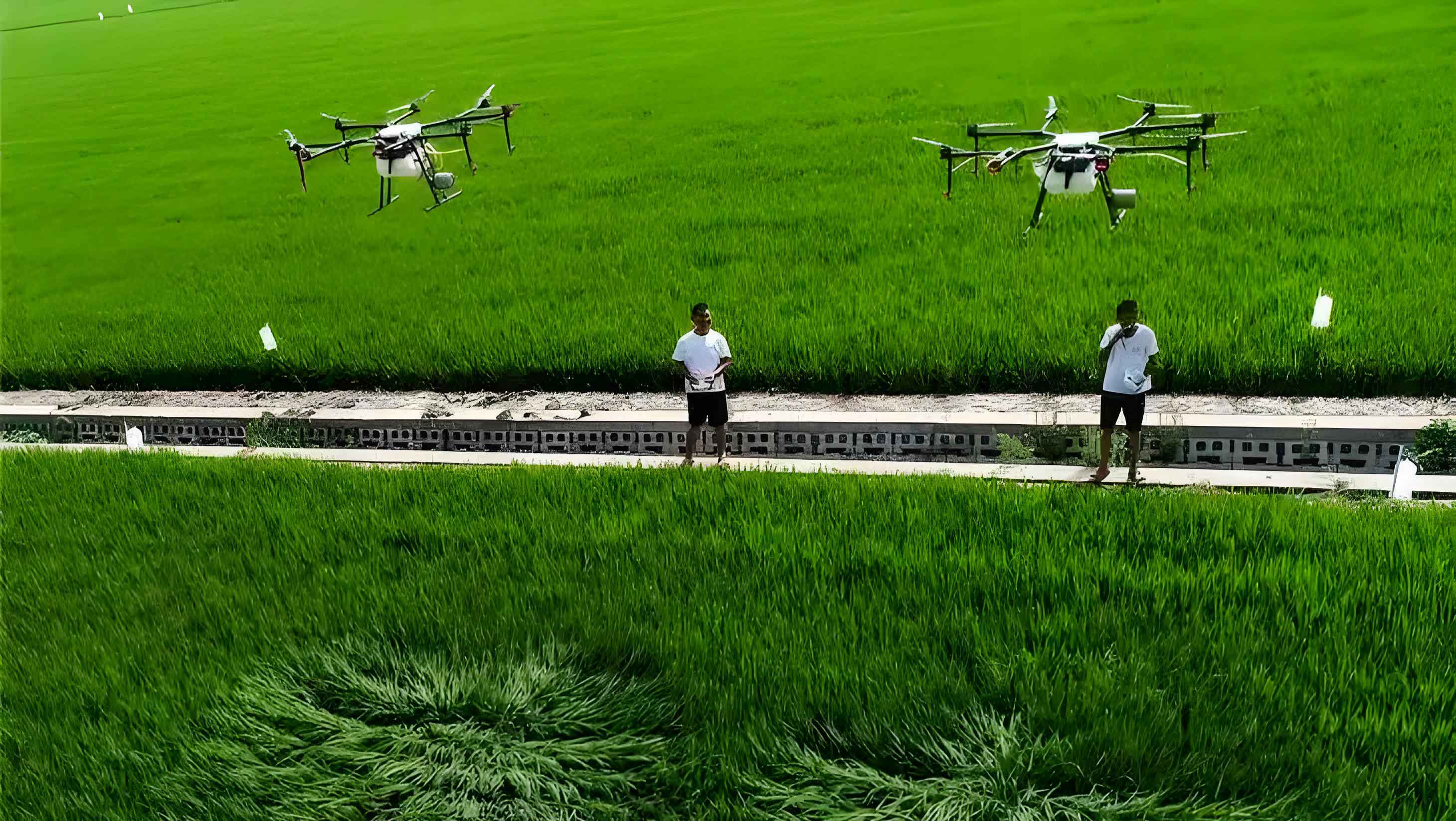
The core of my experiment was conducted in a northern Chinese corn planting base, using the hybrid variety Zhongdi 88. I selected two key insecticides: chlorantraniliprole suspension concentrate (SC) and indoxacarb emulsifiable concentrate (EC). The application technologies compared were an electric knapsack sprayer (3WBD-18 type) and an agricultural UAV model 3WWDZ-15A. The experimental design comprised five treatments, each replicated three times to ensure statistical robustness: Treatment A (chlorantraniliprole via knapsack sprayer), Treatment B (chlorantraniliprole via agricultural UAV), Treatment C (indoxacarb via knapsack sprayer), Treatment D (indoxacarb via agricultural UAV), and Treatment E (an untreated control). Each plot covered 300 m², with 2-meter buffers to prevent cross-contamination. Additionally, larger-scale validation plots were established: 3,334 m² for the agricultural UAV, 667 m² for the knapsack sprayer, and 337 m² for the control, all under consistent conditions.
The corn was sown on May 7th, with pesticide applications timed for the late-June trumpet stage (whorl stage), a critical window for fall armyworm control. Preliminary scouting confirmed a severe infestation, predominantly with 3rd to 4th instar larvae. No prior insecticides had been used in these plots. Foliar sprays were uniformly applied. Efficacy assessments were conducted at 3, 7, and 10 days post-application (DPA). Using a five-point “Z” pattern sampling method within three evenly distributed areas per plot, I marked specific plants pre-application for consistent monitoring. Live larval counts and instar stages were recorded. The key metrics calculated were the population reduction rate and the control efficacy (corrected mortality). The formulas used are central to analyzing such entomological data:
The larval population reduction rate ($R$) is given by:
$$ R = \frac{N_0 – N_t}{N_0} \times 100\% $$
where $N_0$ is the initial mean live larval count before application and $N_t$ is the mean count at time $t$ days after application.
The corrected control efficacy ($E$), accounting for natural population changes in the control plot, is calculated using Abbott’s formula:
$$ E = \left(1 – \frac{N_t \times N_{c0}}{N_0 \times N_{ct}}\right) \times 100\% $$
Here, $N_{c0}$ and $N_{ct}$ represent the mean live larval counts in the control plot (Treatment E) at pre-application and time $t$, respectively. This correction is vital for accurate interpretation, as it isolates the insecticide effect from natural mortality or migration.
The results, systematically collected, are best summarized in the following tables. Table 1 presents the mean live larval counts across treatments and intervals, while Table 2 details the calculated control efficacy and leaf protection rates—a measure of undamaged foliage.
| Treatment | Application Method | Insecticide | Pre-Application (N₀) | 3 DPA | 7 DPA | 10 DPA |
|---|---|---|---|---|---|---|
| A | Knapsack Sprayer | Chlorantraniliprole SC | 35.2 ± 2.1 | 6.5 ± 0.8 | 2.9 ± 0.5 | 4.3 ± 0.7 |
| B | Agricultural UAV | Chlorantraniliprole SC | 34.8 ± 1.9 | 6.9 ± 0.9 | 3.8 ± 0.6 | 3.5 ± 0.6 |
| C | Knapsack Sprayer | Indoxacarb EC | 36.1 ± 2.3 | 5.2 ± 0.7 | 11.7 ± 1.2 | 28.4 ± 2.5 |
| D | Agricultural UAV | Indoxacarb EC | 35.5 ± 2.0 | 4.9 ± 0.6 | 10.0 ± 1.1 | 29.8 ± 2.7 |
| E (Control) | Untreated | — | 34.9 ± 1.8 | 36.5 ± 2.4 | 45.2 ± 3.1 | 52.7 ± 3.8 |
The data from Table 1 clearly shows the rapid knockdown effect of indoxacarb (Treatments C & D) by 3 DPA, but also a notable resurgence of larvae by 7 and 10 DPA. In contrast, chlorantraniliprole (Treatments A & B) maintained lower counts throughout. The performance of the agricultural UAV was statistically on par with the knapsack sprayer for each insecticide.
| Treatment | Parameter | 3 DPA | 7 DPA | 10 DPA |
|---|---|---|---|---|
| A (Chlor. + Knapsack) | Control Efficacy (E) | 81.3% | 91.7% | 87.9% |
| Leaf Protection | 82.5% | 88.4% | 76.3% | |
| B (Chlor. + Agricultural UAV) | Control Efficacy (E) | 80.0% | 89.1% | 89.8% |
| Leaf Protection | 81.0% | 86.4% | 73.2% | |
| C (Indox. + Knapsack) | Control Efficacy (E) | 85.7% | 67.7% | 14.5% |
| Leaf Protection | 78.1% | 76.5% | 16.6% | |
| D (Indox. + Agricultural UAV) | Control Efficacy (E) | 86.0% | 71.8% | 12.8% |
| Leaf Protection | 79.3% | 75.7% | 14.4% |
Analysis of Table 2 reveals critical insights. At 3 DPA, indoxacarb treatments (C & D) showed superior initial efficacy (~85.9% average) compared to chlorantraniliprole (~80.7% average). However, by 7 DPA, a dramatic reversal occurred. The control efficacy for chlorantraniliprole applied via the agricultural UAV (Treatment B) remained high at 89.1%, nearly matching the knapsack sprayer’s 91.7%. In stark contrast, indoxacarb’s efficacy plummeted to an average of 69.8% by 7 DPA and fell below 15% by 10 DPA, indicating very poor residual activity and likely a failure to prevent new egg hatches or early instar survival. The leaf protection rate, calculated as the percentage of undamaged leaf area, followed a similar trend, with chlorantraniliprole providing significantly longer-lasting protection.
The statistical comparison between application methods for each insecticide showed no significant difference (p > 0.05) at any interval. This is a pivotal finding, mathematically expressed by comparing the mean efficacies. For instance, at 7 DPA for chlorantraniliprole, the difference in efficacy ($\Delta E$) between methods is:
$$ \Delta E_{Chlor} = |E_A – E_B| = |91.7\% – 89.1\%| = 2.6\% $$
A t-test (assuming pooled variance) yielded a p-value > 0.05, confirming non-significance. Similarly, for indoxacarb at 3 DPA:
$$ \Delta E_{Indox} = |E_C – E_D| = |85.7\% – 86.0\%| = 0.3\% $$
(p > 0.05). This robustly demonstrates that the agricultural UAV delivers statistically equivalent pest control to the conventional knapsack sprayer.
My discussion centers on the implications of these results. The operational advantages of the agricultural UAV are immense—covering large areas like the 3,334 m² plot rapidly, with consistent spray droplet deposition and minimal operator exposure. The key finding is that this technological advantage does not come at the cost of efficacy. For chlorantraniliprole, the agricultural UAV achieved a sustained control efficacy above 89% for at least 7 days, with a slow decline thereafter. The relationship between efficacy ($E$) and time ($t$) for chlorantraniliprole can be modeled with a decay function, which I approximate from the data:
$$ E_{Chlor}(t) \approx E_{max} \cdot e^{-k(t-t_{max})} $$
Where $E_{max}$ is the peak efficacy (~90.4% at ~7 DPA), $k$ is a decay constant (estimated ~0.02 per day from 7 to 10 DPA), and $t$ is time in days. For indoxacarb, a much sharper decay is observed post-3 DPA, indicating a different pharmacokinetic profile. The rapid loss of efficacy suggests it may primarily affect early instars or have limited translaminar or systemic activity compared to chlorantraniliprole, which is known for its systemic movement within plant tissues.
From an integrated pest management (IPM) perspective, the choice of insecticide becomes crucial when deploying an agricultural UAV. My data suggests that for a 10-14 day spray interval common in corn, chlorantraniliprole would require only one follow-up application, whereas indoxacarb would likely necessitate two or more to maintain protection, increasing cost and environmental load. The economic model for using an agricultural UAV must factor in these product differences. A simplified cost-benefit ratio ($CBR$) per hectare per application cycle can be considered:
$$ CBR = \frac{C_{UAV} + C_{Chemical} + C_{Labor}}{Y_{saved} \cdot P_{corn}} $$
Here, $C_{UAV}$ is the operational cost of the agricultural UAV (lower than manual sprayer labor $C_{Labor}$ over large areas), $C_{Chemical}$ is insecticide cost, $Y_{saved}$ is the yield preserved from pest damage, and $P_{corn}$ is corn market price. My study shows that $Y_{saved}$ is equivalent for both application methods when using an effective insecticide like chlorantraniliprole, making the agricultural UAV economically favorable due to lower $C_{Labor}$ and higher operational speed.
Furthermore, I observed no phytotoxicity or adverse effects on corn plants in any treatment, including those sprayed by the agricultural UAV, indicating that the droplet size and distribution from the UAV are suitable for corn canopy penetration. This is essential for targeting pests like fall armyworm that feed in the whorl and later on the ear. The precision of an agricultural UAV also minimizes off-target drift, a significant environmental benefit compared to broad-scale blanket spraying.
In conclusion, my research substantiates that the agricultural UAV is a highly effective and viable tool for fall armyworm control in corn. It matches the efficacy of traditional ground sprayers while offering superior operational efficiency, reduced labor, and potential environmental benefits through precise application. The integration of an agricultural UAV into IPM programs should be paired with the selection of insecticides possessing good residual activity and systemic properties, such as chlorantraniliprole, to maximize the interval between sprays and ensure sustainable crop protection. Future work should optimize spray parameters (e.g., droplet size, flight altitude, adjuvants) specifically for the agricultural UAV to further enhance canopy penetration and deposition uniformity on difficult targets like corn ears during the reproductive stage.