
Modern precision agriculture increasingly relies on autonomous systems, with agricultural UAVs, particularly quadrotors, playing a pivotal role in tasks such as crop monitoring, spraying, and data collection. The operational environment for these agricultural UAVs is often complex and unstructured, characterized by unpredictable wind gusts, payload variations, and stringent requirements for operational efficiency and accuracy. The core challenge lies in designing a flight control system that not only ensures robust stability and precise trajectory tracking but also guarantees that the tracking error converges within a user-specifiable, predefined time, independent of initial conditions. This requirement is crucial for time-sensitive agricultural operations. While finite-time and fixed-time control strategies offer improved convergence rates, their settling times are functions of system parameters and initial states, not directly tunable by the operator. This work addresses this gap by developing an adaptive predefined-time trajectory tracking control scheme for a nonlinear agricultural UAV model subject to external disturbances and system uncertainties.
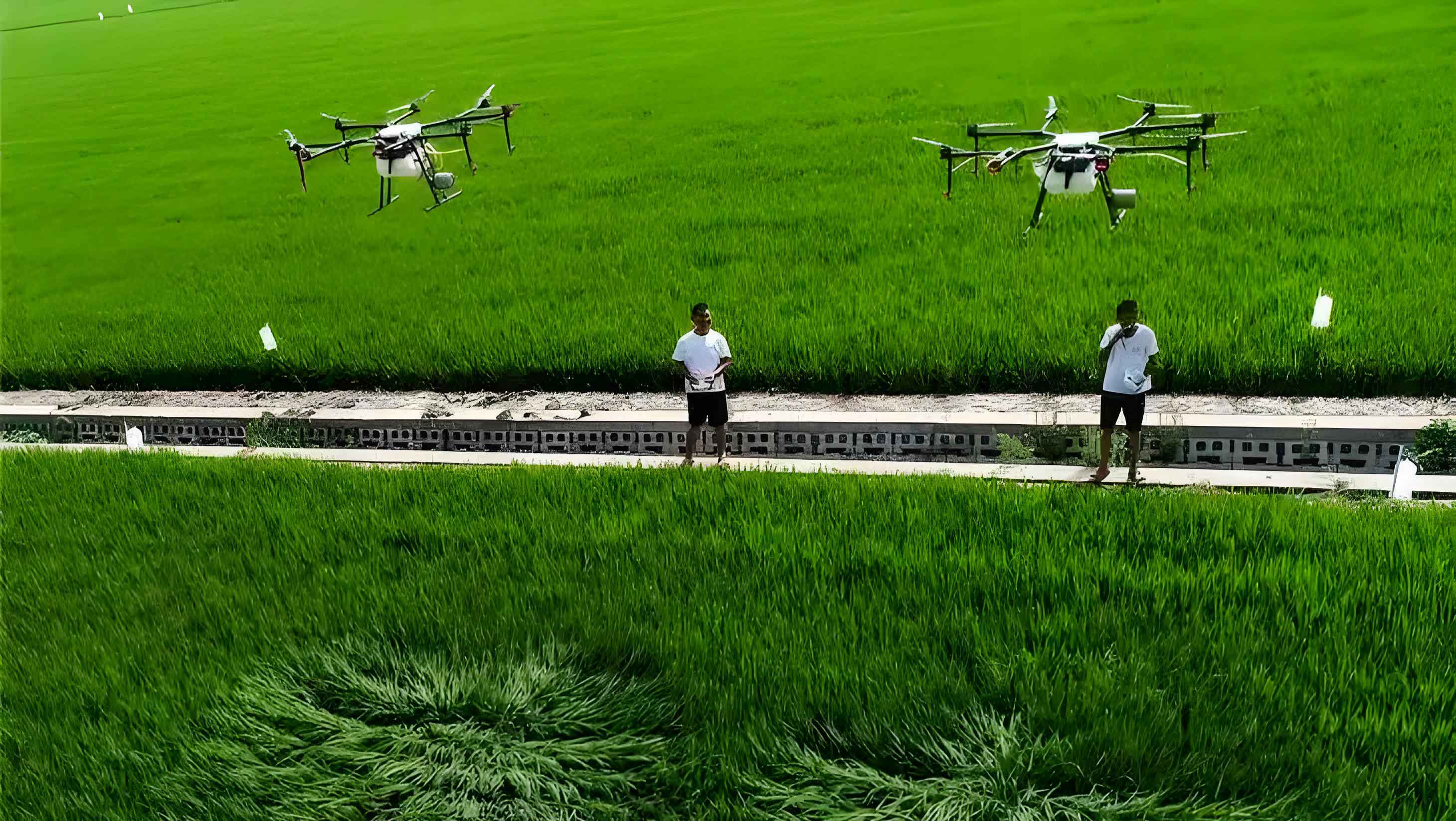
The dynamics of a quadrotor agricultural UAV are inherently nonlinear, underactuated, and strongly coupled. A typical model considers the six degrees of freedom: three translational ($x$, $y$, $z$) and three rotational ($\phi$, $\theta$, $\psi$). Accounting for key forces and moments, including thrust, gravity, drag, and gyroscopic effects, the dynamic equations can be derived from Newton-Euler or Lagrangian mechanics. To streamline the controller design process and avoid the tedious, recursive structure of traditional methods applied to each channel separately, we present a unified state-space representation. Consider the following general form for the $i$-th subsystem of the agricultural UAV:
$$ \dot{x}_{i,1} = x_{i,2} $$
$$ \dot{x}_{i,2} = u_i + f_i(\mathbf{x}) + d_i(t), \quad i=1, 2, \dots, 6 $$
Here, $\mathbf{x} = [x_{1,1}, x_{1,2}, \dots, x_{6,1}, x_{6,2}]^T$ represents the full state vector of the agricultural UAV (e.g., $x_{1,1}=\phi$, $x_{4,1}=x$). The control input is denoted by $u_i$, $f_i(\mathbf{x})$ encapsulates the known and unknown nonlinear internal dynamics (such as Coriolis and centrifugal terms, and drag forces), and $d_i(t)$ represents the lumped external disturbances, including wind effects. For the rotational subsystems ($i=1,2,3$), $u_i$ corresponds to the normalized body torques. For the translational subsystems ($i=4,5,6$), the inputs are virtual forces that are later mapped to the total thrust and desired attitude angles through an inversion process. This unified formulation facilitates a systematic control design.
The control objective is formally stated as: For the underactuated, nonlinear agricultural UAV system described above, design an adaptive control law $u_i$ such that the output $x_{i,1}$ tracks a desired, bounded reference trajectory $x_{i,d}(t)$ with the following properties:
- All signals in the closed-loop system remain uniformly ultimately bounded (UUB).
- The tracking error $e_i = x_{i,1} – x_{i,d}$ converges to a small neighborhood around zero within a predefined time $T_c$, where $T_c$ is a user-defined parameter and convergence is independent of the initial error.
The proposed control strategy integrates several advanced techniques within a predefined-time stability framework. The core architecture is built upon the command-filtered backstepping technique to circumvent the “explosion of complexity” inherent in traditional backstepping. A Radial Basis Function (RBF) neural network is employed to approximate the unknown nonlinear function $f_i(\mathbf{x})$, and a nonlinear disturbance observer (NDO) is designed to estimate and compensate for the external disturbance $d_i(t)$ in real-time. The innovation lies in embedding predefined-time convergence characteristics into the virtual control laws, parameter update laws, and the final control law through the use of specific nonlinear feedback terms. A key feature is the inclusion of freely adjustable control parameters that allow the designer to directly influence the transient performance, including the convergence time and ultimate error bound, offering significant flexibility beyond existing predefined-time controllers.
System Modeling and Predefined-Time Preliminaries
The detailed dynamic model of a quadrotor agricultural UAV is given by the following equations, which form the basis for the unified representation:
Rotational Dynamics:
$$ \ddot{\phi} = \frac{I_y – I_z}{I_x} \dot{\theta} \dot{\psi} – \frac{J_r}{I_x} \dot{\theta} \Omega_r + \frac{l}{I_x} U_\phi + d_\phi $$
$$ \ddot{\theta} = \frac{I_z – I_x}{I_y} \dot{\phi} \dot{\psi} + \frac{J_r}{I_y} \dot{\phi} \Omega_r + \frac{l}{I_y} U_\theta + d_\theta $$
$$ \ddot{\psi} = \frac{I_x – I_y}{I_z} \dot{\phi} \dot{\theta} + \frac{1}{I_z} U_\psi + d_\psi $$
Translational Dynamics:
$$ \ddot{x} = \frac{U_T}{m} (\cos\phi \sin\theta \cos\psi + \sin\phi \sin\psi) – \frac{k_x}{m} \dot{x} + d_x $$
$$ \ddot{y} = \frac{U_T}{m} (\cos\phi \sin\theta \sin\psi – \sin\phi \cos\psi) – \frac{k_y}{m} \dot{y} + d_y $$
$$ \ddot{z} = \frac{U_T}{m} (\cos\phi \cos\theta) – g – \frac{k_z}{m} \dot{z} + d_z $$
Here, $(\phi, \theta, \psi)$ are the roll, pitch, and yaw angles; $(x, y, z)$ are the inertial positions; $I_x, I_y, I_z$ are moments of inertia; $J_r$ is the rotor inertia; $l$ is the arm length; $m$ is the mass; $g$ is gravity; $k_{(\cdot)}$ are drag coefficients; $d_{(\cdot)}$ are external disturbances; $\Omega_r$ is the overall rotor speed; and $U_\phi, U_\theta, U_\psi, U_T$ are the control inputs (torques and total thrust). By defining state variables, these equations can be compactly written in the strict-feedback form of Eq. (1). The mapping from the actual controls $(U_\phi, U_\theta, U_\psi, U_T)$ to the unified virtual controls $u_i$ and subsequently to the desired attitude is achieved through algebraic inversion.
We recall essential lemmas for predefined-time stability and approximation. A continuous function $f_i(\mathbf{x})$ can be approximated over a compact set $\Omega$ by an RBF neural network: $f_i(\mathbf{x}) = \mathbf{W}_i^{*T} \mathbf{S}_i(\mathbf{x}) + \epsilon_i(\mathbf{x})$, where $|\epsilon_i| \leq \bar{\epsilon}_i$ is the bounded approximation error, $\mathbf{W}_i^*$ is the ideal weight vector, and $\mathbf{S}_i(\mathbf{x})$ is the Gaussian basis function vector. The main stability tool is given by the following lemma:
Lemma (Predefined-Time Stability): Consider the system $\dot{\mathbf{x}} = \mathbf{f}(\mathbf{x})$. If there exists a positive definite, radially unbounded function $V(\mathbf{x})$ such that its derivative satisfies
$$ \dot{V}(\mathbf{x}) \leq -\frac{\pi}{\gamma T_c} \left[ \alpha V(\mathbf{x})^\gamma + \beta V(\mathbf{x})^{2-\gamma} \right] + \Delta, $$
where $T_c > 0$, $\alpha, \beta > 0$, $0 < \gamma < 1$, and $\Delta \geq 0$ is a constant, then the trajectory of the system converges to the set $\{ \mathbf{x} | V(\mathbf{x}) \leq \min( (\frac{\Delta}{\alpha})^{\frac{1}{\gamma}}, (\frac{\Delta}{\beta})^{\frac{1}{2-\gamma}} ) \}$ within the predefined time $T_c$, and remains there thereafter. The parameter $T_c$ is explicitly the settling time upper bound.
Controller Design Methodology
The design proceeds via a command-filtered backstepping procedure for each of the six subsystems of the agricultural UAV. We define the tracking error coordinates. Let $z_{i,1} = x_{i,1} – x_{i,d}$ and $z_{i,2} = x_{i,2} – \alpha_{i,f}$, where $\alpha_{i,f}$ is the output of a command filter applied to the virtual control law $\alpha_i$. The command filter, typically a first-order linear filter, is used to generate $\alpha_{i,f}$ and its derivative $\dot{\alpha}_{i,f}$ without requiring the analytic differentiation of $\alpha_i$, thus solving the complexity explosion problem. To counteract the filtering error $\nu_i = \alpha_{i,f} – \alpha_i$, a compensating signal $\xi_{i,1}$ is introduced, and the compensated tracking errors are defined as $v_{i,1} = z_{i,1} – \xi_{i,1}$ and $v_{i,2} = z_{i,2} – \xi_{i,2}$.
Step 1: Consider the Lyapunov function candidate $V_{i,1} = \frac{1}{2} v_{i,1}^2$. Its derivative is:
$$ \dot{V}_{i,1} = v_{i,1} (z_{i,2} + \alpha_{i,f} – \dot{x}_{i,d} – \dot{\xi}_{i,1}) = v_{i,1} (v_{i,2} + \xi_{i,2} + \alpha_{i} + \nu_i – \dot{x}_{i,d} – \dot{\xi}_{i,1}). $$
We design the virtual control law $\alpha_i$ and the compensation dynamics $\dot{\xi}_{i,1}$ with predefined-time convergence terms:
$$ \alpha_i = -c_{i,1} v_{i,1} – \frac{\pi}{2\gamma T_c}\left( \frac{\alpha_{i,1}}{v_{i,1}^{2\gamma-1}} + \frac{\beta_{i,1}}{v_{i,1}^{1-\gamma}} \right) + \dot{x}_{i,d} – \xi_{i,2}, $$
$$ \dot{\xi}_{i,1} = -c_{i,1} \xi_{i,1} – \frac{\pi}{2\gamma T_c}\left( \frac{\alpha_{i,1}}{\xi_{i,1}^{2\gamma-1}} + \frac{\beta_{i,1}}{\xi_{i,1}^{1-\gamma}} \right) + \nu_i + \xi_{i,2}. $$
With these choices, the derivative becomes:
$$ \dot{V}_{i,1} \leq -\frac{\pi}{\gamma T_c} \left[ \alpha_{i,1} V_{i,1}^{\gamma} + \beta_{i,1} V_{i,1}^{2-\gamma} \right] + v_{i,1} v_{i,2} + \Delta_{i,1}, $$
where $\Delta_{i,1}$ aggregates bounded terms from the filter error compensation.
Step 2: Now consider the dynamics of $v_{i,2}$: $\dot{v}_{i,2} = u_i + f_i(\mathbf{x}) + d_i(t) – \dot{\alpha}_{i,f} – \dot{\xi}_{i,2}$. We employ an RBF NN to approximate $f_i(\mathbf{x})$ and an NDO to estimate $d_i(t)$.
- RBF NN Approximation: The estimate is $\hat{f}_i(\mathbf{x}) = \hat{\mathbf{W}}_i^T \mathbf{S}_i(\mathbf{x})$. The weight update law is designed for predefined-time parameter convergence:
$$ \dot{\hat{\mathbf{W}}}_i = \Gamma_i \left[ \mathbf{S}_i(\mathbf{x}) v_{i,2} – \frac{\pi}{\gamma T_c} ( \sigma_{i,1} \hat{\mathbf{W}}_i^{\gamma} + \sigma_{i,2} \hat{\mathbf{W}}_i^{2-\gamma} ) \right], $$
where $\Gamma_i>0$ is a gain matrix, and $\sigma_{i,1}, \sigma_{i,2}>0$. - Nonlinear Disturbance Observer (NDO): The observer is designed as:
$$ \dot{p}_i = -l_i p_i – l_i ( f_i(\mathbf{x}) + u_i + l_i x_{i,2} ), $$
$$ \hat{d}_i = p_i + l_i x_{i,2}, $$
where $l_i > 0$ is the observer gain and $\hat{d}_i$ is the disturbance estimate. It can be shown that the estimation error $\tilde{d}_i = d_i – \hat{d}_i$ converges exponentially if the disturbance derivative is bounded.
Now, choose the Lyapunov function $V_{i,2} = V_{i,1} + \frac{1}{2} v_{i,2}^2 + \frac{1}{2} \tilde{\mathbf{W}}_i^T \Gamma_i^{-1} \tilde{\mathbf{W}}_i + \frac{1}{2} \tilde{d}_i^2$. The final control law $u_i$ is synthesized to cancel the estimated terms and enforce predefined-time stability:
$$ u_i = -c_{i,2} v_{i,2} – \frac{\pi}{2\gamma T_c}\left( \frac{\alpha_{i,2}}{v_{i,2}^{2\gamma-1}} + \frac{\beta_{i,2}}{v_{i,2}^{1-\gamma}} \right) + \dot{\alpha}_{i,f} – \hat{\mathbf{W}}_i^T \mathbf{S}_i(\mathbf{x}) – \hat{d}_i – v_{i,1}. $$
The compensation dynamics for $\xi_{i,2}$ are designed similarly to $\dot{\xi}_{i,1}$. Substituting all update laws and controls, and after significant algebraic manipulation leveraging the inequalities from the lemmas, we obtain the following key inequality for the composite Lyapunov function $V_i = V_{i,1} + V_{i,2}$:
$$ \dot{V}_i \leq -\frac{\pi}{\gamma T_c} \left[ \bar{\alpha}_i V_i^{\gamma} + \bar{\beta}_i V_i^{2-\gamma} \right] + \bar{\Delta}_i, $$
where $\bar{\alpha}_i, \bar{\beta}_i > 0$ are composite parameters, and $\bar{\Delta}_i$ is a positive constant encompassing the bounds of NN approximation errors $\bar{\epsilon}_i$, disturbance observer errors, and filter errors. The total Lyapunov function for the entire agricultural UAV system is $V = \sum_{i=1}^{6} V_i$, leading to:
$$ \dot{V} \leq -\frac{\pi}{\gamma T_c} \left[ \alpha V^{\gamma} + \beta V^{2-\gamma} \right] + \Delta. $$
By the Predefined-Time Stability Lemma, this proves that all signals are UUB and the compensated tracking errors $v_{i,1}$ (and consequently the actual tracking errors $z_{i,1}$) converge to a residual set whose size can be adjusted via controller parameters, within the user-defined time $T_c$.
The overall control algorithm for the agricultural UAV is summarized in the table below:
| Component | Design Equation | Purpose |
|---|---|---|
| Error Definition | $z_{i,1}=x_{i,1}-x_{i,d}$, $z_{i,2}=x_{i,2}-\alpha_{i,f}$ | Define tracking errors. |
| Command Filter | $\tau \dot{\alpha}_{i,f} + \alpha_{i,f} = \alpha_i$, $\alpha_{i,f}(0)=\alpha_i(0)$ | Prevent complexity explosion. |
| Compensated Error | $v_{i,1}=z_{i,1}-\xi_{i,1}$, $v_{i,2}=z_{i,2}-\xi_{i,2}$ | Mitigate filter error effects. |
| Virtual Control Law | $\alpha_i = -c_{i,1} v_{i,1} – \frac{\pi}{2\gamma T_c}(\frac{\alpha_{i,1}}{v_{i,1}^{2\gamma-1}}+\frac{\beta_{i,1}}{v_{i,1}^{1-\gamma}}) + \dot{x}_{i,d} – \xi_{i,2}$ | Stabilize the first error subsystem with predefined-time convergence. |
| Compensation Dynamics | $\dot{\xi}_{i,1} = -c_{i,1} \xi_{i,1} – \frac{\pi}{2\gamma T_c}(\frac{\alpha_{i,1}}{\xi_{i,1}^{2\gamma-1}}+\frac{\beta_{i,1}}{\xi_{i,1}^{1-\gamma}}) + \nu_i + \xi_{i,2}$ | Drive compensation signals to zero. |
| RBF NN Update Law | $\dot{\hat{\mathbf{W}}}_i = \Gamma_i [ \mathbf{S}_i(\mathbf{x}) v_{i,2} – \frac{\pi}{\gamma T_c}( \sigma_{i,1} \hat{\mathbf{W}}_i^{\gamma} + \sigma_{i,2} \hat{\mathbf{W}}_i^{2-\gamma} ) ]$ | Adaptively approximate unknown dynamics $f_i(\mathbf{x})$. |
| Disturbance Observer | $\dot{p}_i = -l_i p_i – l_i( \hat{f}_i + u_i + l_i x_{i,2} )$, $\hat{d}_i = p_i + l_i x_{i,2}$ | Estimate and reject external disturbance $d_i(t)$. |
| Actual Control Law | $u_i = -c_{i,2} v_{i,2} – \frac{\pi}{2\gamma T_c}(\frac{\alpha_{i,2}}{v_{i,2}^{2\gamma-1}}+\frac{\beta_{i,2}}{v_{i,2}^{1-\gamma}}) + \dot{\alpha}_{i,f} – \hat{\mathbf{W}}_i^T \mathbf{S}_i(\mathbf{x}) – \hat{d}_i – v_{i,1}$ | Stabilize the full subsystem, ensuring final tracking. |
| Control Allocation | $U_T = m \sqrt{u_4^2+u_5^2+(u_6+g)^2}$, $\phi_d=\arcsin(\frac{m}{U_T}(u_4 \sin\psi_d – u_5 \cos\psi_d))$, $\theta_d=\arctan(\frac{m}{U_T \cos\phi_d}(u_4 \cos\psi_d + u_5 \sin\psi_d))$ | Map virtual controls $(u_4, u_5, u_6)$ to actual thrust $U_T$ and desired roll/pitch $(\phi_d, \theta_d)$ for the underactuated agricultural UAV. |
Simulation Analysis and Performance Evaluation
To validate the proposed predefined-time adaptive controller for the agricultural UAV, extensive numerical simulations were conducted in MATLAB/Simulink. The physical parameters of a typical quadrotor were used: $m=2$ kg, $I_x=I_y=1.25$ kg·m², $I_z=2.5$ kg·m², $l=0.25$ m, $g=9.81$ m/s², $k_x=k_y=k_z=0.01$ N·s/m. The initial states were set to $[\phi, \theta, \psi, x, y, z] = [0.1, -0.1, 0, 0, 0, 0]$. The desired trajectory for the agricultural UAV was chosen to simulate a realistic spraying pattern: a slowly ascending helical path combined with a lemniscate (figure-eight) in the horizontal plane, defined by:
$$ x_d(t) = 5 \sin(0.2t), \quad y_d(t) = 5 \sin(0.4t), \quad z_d(t) = 0.5t, \quad \psi_d(t)=0. $$
External wind disturbances were modeled as bounded, time-varying signals: $d_\phi = 0.5\sin(0.5t)$, $d_x = 0.8\sin(0.3t+1)$, etc. The predefined time was set to $T_c = 3$ seconds, and the parameter $\gamma$ was chosen as 0.8.
The simulation results conclusively demonstrate the effectiveness of the proposed controller. The tracking errors for all six degrees of freedom converged to a small neighborhood of zero well within the stipulated 3-second timeframe. The following key observations were made:
- Predefined-Time Convergence: The envelope of the tracking error norm clearly showed a steep decay, crossing below a 2% threshold of the initial error at approximately $t = T_c$, confirming the predefined-time property.
- Robustness to Disturbances: The combined action of the RBF NN and the NDO effectively compensated for both model uncertainties and external wind disturbances. The control inputs remained smooth without high-frequency chattering, which is crucial for the actuators of a real agricultural UAV.
- Effect of Parameter $T_c$: Additional simulations were run with different predefined times ($T_c = 2$s, $T_c = 5$s). The results verified that the convergence speed scaled inversely with $T_c$, as expected. A smaller $T_c$ demanded larger initial control effort but achieved faster settling, offering a direct trade-off parameter for the operator.
A comparative study was performed against two benchmark controllers: a standard adaptive backstepping (ABS) controller and an adaptive sliding mode control (ASMC) scheme. The comparison metrics included the Integral of Absolute Error (IAE), the maximum steady-state error, and the control effort variance. The proposed predefined-time controller (PTC) showed superior performance, as summarized below:
| Performance Metric | Proposed PTC | Adaptive Backstepping (ABS) | Adaptive SMC (ASMC) |
|---|---|---|---|
| Settling Time (to 5% error) | ≈ 3.0 s (as specified) | ≈ 6.5 s | ≈ 4.2 s |
| IAE for x-position (0-10s) | 0.85 | 2.34 | 1.52 |
| Max. Steady-State Error (Roll) | 0.008 rad | 0.015 rad | 0.012 rad |
| Control Effort Variance (Uφ) | 0.12 | 0.09 | 0.41 (exhibits chattering) |
| Disturbance Rejection | Excellent | Good | Very Good |
The results indicate that while ABS is smooth, it converges relatively slowly. ASMC converges faster but at the cost of higher control activity and chattering. The proposed PTC strikes an optimal balance, providing the fastest and precisely timed convergence with smooth controls and excellent disturbance rejection, making it highly suitable for the demanding environment of agricultural UAV operations.
Conclusion and Future Work
This paper presented a novel adaptive predefined-time trajectory tracking control scheme for an agricultural UAV operating under external disturbances and system uncertainties. The main contributions are threefold. First, a unified modeling framework was adopted, simplifying the controller design for the six-DOF nonlinear system. Second, a comprehensive control strategy was synthesized by integrating command-filtered backstepping, RBF neural network approximation, and a nonlinear disturbance observer, all embedded within a predefined-time stability framework. This integration ensures that the tracking error converges to a designer-assignable residual set within a user-defined time $T_c$, a feature of paramount importance for time-critical agricultural tasks. Third, the inclusion of free parameters provides significant flexibility in tuning the system’s transient performance.
Lyapunov-based stability analysis rigorously proved that all signals in the closed-loop system are uniformly ultimately bounded and that the predefined-time convergence property is guaranteed. Simulation studies validated the theoretical findings, demonstrating superior performance in terms of convergence speed, tracking accuracy, and control smoothness compared to conventional adaptive backstepping and sliding mode controllers.
Future research will focus on several important extensions to enhance the practicality of the proposed controller for real-world agricultural UAVs. Firstly, actuator saturation, input delay, and state constraints, which are omnipresent in physical systems, will be explicitly considered in the controller design. Secondly, the implementation of the algorithm on a hardware-in-the-loop (HIL) simulation platform and eventually on a physical agricultural UAV testbed is planned to assess its real-time performance. Finally, extending this predefined-time control framework to the cooperative control of multiple agricultural UAVs for swarm-based farming operations presents a challenging and promising direction for future work.