
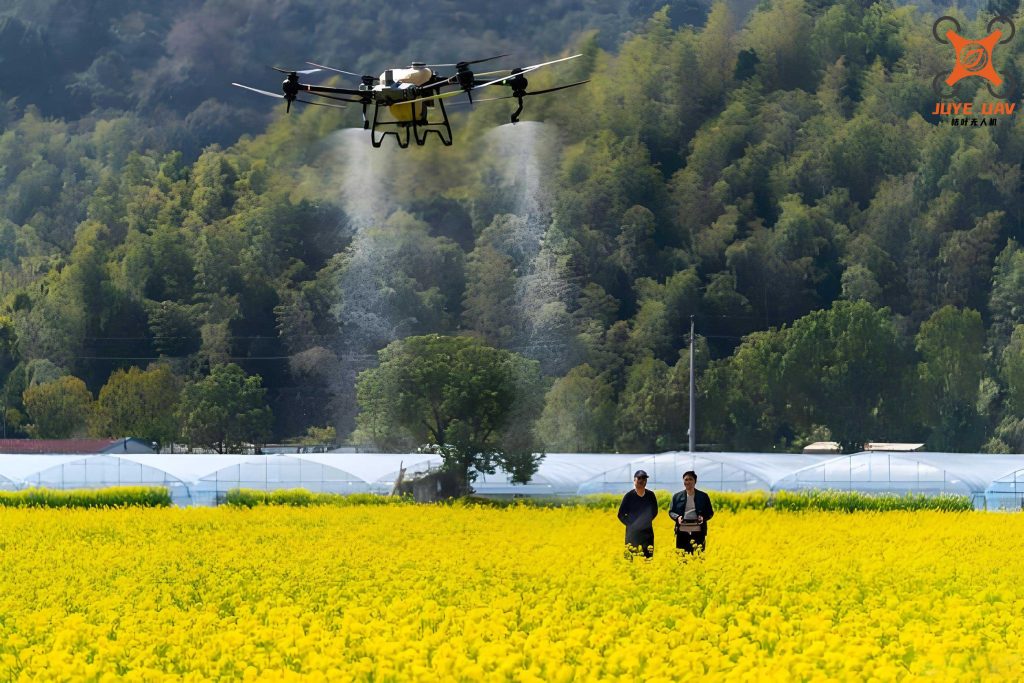
In modern agriculture, the application of agricultural UAV technology represents a significant leap forward in crop protection methodologies. The terrain in many regions, characterized by undulating hills and fragmented fields, poses considerable challenges for traditional ground-based sprayers. This report documents a comprehensive field trial conducted to evaluate the operational efficacy, economic viability, and practical challenges associated with the use of agricultural UAV systems. The primary objectives were to validate their performance in real-world conditions, analyze key parameters, and accumulate experience to inform broader promotion strategies.
1. Materials and Methodology
1.1 Trial Materials
Two prevalent models of electric multi-rotor agricultural UAV were selected from the demonstration equipment pool for detailed analysis:
- Model A: DJI MG-1S
- Model B: Quanfeng Free Eagle 1S
1.2 Experimental Design
The field trial was structured with three distinct treatments applied to designated plots:
- Treatment with DJI MG-1S agricultural UAV.
- Treatment with Quanfeng Free Eagle 1S agricultural UAV.
- Untreated control plot (Blank).
The trial focused on evaluating control efficacy against two specific threats: Wheat Scab (Fusarium head blight) and Tea Red Spider Mite (Acaphylla theae). Professional plant protection personnel determined the specific pesticides, dosage, and mixing ratios based on prevailing pest and disease pressure. Throughout the operations, detailed data on flight parameters, operational logistics, fault incidents, and associated costs were meticulously recorded for both agricultural UAV models.
1.3 Measurement Items and Methods
1.3.1 Operational Data Recording
Key flight and application parameters were logged for each agricultural UAV mission. These included:
- Flight Altitude (H, in meters)
- Flight Speed (V, in meters per second)
- Effective Spray Swath (W, in meters)
- Theoretical Area Coverage Rate (A_t, in acres per minute)
- Theoretical Spray Time (T_theoretical, in minutes)
- Total Operational Time (T_total, in minutes), which encompasses T_theoretical plus time spent on maintenance, battery swaps, and tank refilling.
A critical efficiency metric, the Effective Operation Time Ratio (EOTR), was calculated using the following formula:
$$ \text{EOTR} = \frac{T_{\text{theoretical}}}{T_{\text{total}}} \times 100\% $$
This metric highlights the proportion of time the agricultural UAV spent actively applying chemicals versus total field time.
1.3.2 Control Efficacy Assessment
Prior to application, baseline surveys were conducted. Five random sample points were selected in both the treatment and control areas to assess initial pest population or disease severity. Standard grading scales were used to calculate pre-application disease or pest indices. Post-application surveys were conducted after a predetermined interval. The control efficacy (CE) was then calculated. For diseases, the formula based on the disease index is:
$$ \text{CE}_{\text{disease}} (\%) = \left(1 – \frac{DI_{\text{post-treatment}}}{DI_{\text{pre-treatment}}}\right) \times 100\% $$
For insect pests, the formula based on pest population is often used:
$$ \text{CE}_{\text{insect}} (\%) = \left(1 – \frac{N_{\text{post-treatment}}}{N_{\text{pre-treatment}}}\right) \times 100\% $$
Where \( DI \) represents the Disease Index and \( N \) represents the pest population count.
1.3.3 Fault and Downtime Statistics
All incidents that halted or impeded the operation of the agricultural UAV were recorded. This included the type of fault, time required for troubleshooting and repair, the resolution method, and a preliminary analysis of the root cause.
3.4 Operational Cost Analysis
A comprehensive cost model was applied, tracking all variable costs associated with the agricultural UAV operation on a per-unit-area basis (e.g., per acre). The major cost components included:
- Labor Cost (C_l)
- Energy/Charging Cost (C_e)
- Maintenance & Repair Cost (C_m)
The Total Operational Cost per Acre (C_total) is the sum:
$$ C_{\text{total}} = C_{l} + C_{e} + C_{m} $$
This analysis provides a clear picture of the economic footprint of the agricultural UAV service.
2. Results and Analysis
2.1 Agricultural UAV Parameters and Field Performance
The recorded operational parameters and derived efficiency metrics for a standardized 100-acre operation are summarized in Table 1. Notably, while the theoretical spraying times were similar, the significant addition of non-spraying tasks led to a substantial reduction in overall field efficiency, as captured by the EOTR.
| Agricultural UAV Model | Total Area (acres) | Tank Volume (L) | Swath (m) | Height (m) | Speed (m/s) | Theor. Spray Time (min) | Theor. Coverage (acres/min) | Total Field Time (min) | EOTR (%) |
|---|---|---|---|---|---|---|---|---|---|
| DJI MG-1S | 100 | 10 | 3.0 | 1.7 | 4.8 | 76.9 | 0.70 | 202 | 38.1 |
| Quanfeng Free Eagle 1S | 100 | 8 | 3.8 | 2.0 | 4.3 | 71.4 | 0.68 | 210 | 34.0 |
2.2 Pest and Disease Control Efficacy
The application via agricultural UAV demonstrated statistically significant and agronomically valuable control levels for both targeted problems, as shown in Table 2. Both models achieved satisfactory results, with Model A showing a marginally higher efficacy in this trial.
| Treatment | Wheat Scab | Tea Red Spider Mite | ||
|---|---|---|---|---|
| Final Disease Index | Control Efficacy (%) | Residual Pest Count | Control Efficacy (%) | |
| DJI MG-1S | 0.4 | 85.7 | 4.5 | 80.1 |
| Quanfeng Free Eagle 1S | 0.5 | 80.0 | 5.7 | 75.1 |
| Untreated Control | 2.6 | — | 22 | — |
2.3 Analysis of Operational Faults
Fault incidents, though not catastrophic, were a primary factor reducing the Effective Operation Time Ratio. The frequency and nature of these faults are detailed in Table 3. Two major fault categories dominated: nozzle clogging and propeller damage.
| Agricultural UAV Model | Total Faults (count) | Fault Type | Avg. Resolution Time | Primary Cause | Resolution Action |
|---|---|---|---|---|---|
| DJI MG-1S | 2 | Nozzle Clogging | 4 min | Impurities in water/chemical mix | Clean nozzle and filter |
| 1 | Propeller Damage | 90 min | Collision with obstacle (tree) | Replace propeller set | |
| Quanfeng Free Eagle 1S | 3 | Nozzle Clogging | 5 min | Residual chemical crystallization | Clean nozzle and filter |
| 2 | Propeller Damage | 30 min | Collision with obstacle (wire) | Replace propeller set |
Root Cause Analysis:
- Nozzle Clogging: Primarily attributed to: a) Use of unfiltered water from field sources containing sediment; b) Accumulation of dust and debris during transport and field handling; c) Inadequate cleaning of filters and nozzles post-operation, leading to chemical residue hardening.
- Propeller/Physical Damage: Caused by: a) Complex field perimeters with numerous obstacles like trees, utility wires, and uneven terrain; b) Insufficient pilot skill or situational awareness, especially in challenging environments; c) Lack of seamless coordination between the pilot and ground support crew.
2.4 Operational Cost Analysis
The cost breakdown per acre, as summarized in Table 4, reveals that while energy costs are low, labor constitutes a significant portion of the direct operating expense. The cost difference between models was influenced primarily by the incurred repair costs during the trial period.
| Agricultural UAV Model | Crew Size (persons) | Labor Cost ($/acre) | Energy Cost ($/acre) | Repair Cost ($/acre) | Total Op. Cost ($/acre) |
|---|---|---|---|---|---|
| DJI MG-1S | 2 | 2.0 | 1.0 | 0.5 | 3.5 |
| Quanfeng Free Eagle 1S | 2 | 2.0 | 0.8 | 0.0 | 2.8 |
3. Identified Challenges and Strategic Recommendations
The trial conclusively demonstrated that agricultural UAV technology offers a viable, efficient, and effective solution for crop protection in topographically complex regions. However, several key challenges must be addressed to unlock its full potential for widespread adoption.
3.1 Persistent Challenges
- Limited Scale of Adoption: The current low fleet density of agricultural UAV units hinders the ability to mount rapid, large-scale responses to sudden pest outbreaks and limits the demonstration effect needed to motivate broader farmer investment.
- High Incidence of Field Accidents: Collisions with obstacles remain a frequent occurrence, leading to downtime, repair costs, and eroded user confidence.
- Scarcity of Optimized Formulations: A critical bottleneck is the lack of widely available, cost-effective ULV (Ultra-Low Volume) formulations specifically designed for aerial application. These formulations need enhanced properties like superior droplet deposition, anti-drift additives, and rainfastness to maximize the efficacy of agricultural UAV sprays.
- Non-Standardized Operational Practices: Deficiencies exist in two areas: a) Pilot Skill: Inadequate training leads to suboptimal flight paths, improper altitude/speed control, and poor obstacle avoidance. b) Agronomic Knowledge: Pilots and operators often lack deep understanding of pest life cycles, chemical compatibility, and application timing, leading to decisions that compromise efficacy (e.g., incorrect chemical mixing, improper droplet size selection for the target).
3.2 Recommendations for Promotion and Improvement
- Enhance Policy and Financial Support: Governments and agricultural agencies should increase subsidy amounts and broaden eligibility criteria for agricultural UAV purchases. Targeted support for establishing agricultural UAV service cooperatives can help aggregate demand and improve service accessibility for smallholder farmers.
- Accelerate Technological R&D: Investment should focus on: a) Developing more robust and intelligent obstacle detection and avoidance systems (e.g., using LiDAR, advanced computer vision) to enhance safety. b) Reducing the manufacturing cost of reliable agricultural UAV platforms to lower the entry barrier. c) Establishing clear regulatory standards and encouraging agrochemical companies to develop and register a wider range of high-performance ULV and nano-formulations specifically labeled for agricultural UAV use.
- Improve Field Readiness: Agricultural extension services should promote and assist in field consolidation and the removal of unnecessary obstacles along field boundaries. Developing basic “drone-ready” field standards can significantly reduce operational risks.
- Implement Comprehensive Training and Certification: Establish mandatory, standardized training programs for agricultural UAV pilots. Curriculum must cover: a) Advanced Flight Proficiency: Including manual recovery procedures, operation in GNSS-denied environments, and efficient mission planning. b) Core Agronomic Training: Fundamentals of integrated pest management (IPM), pesticide chemistry, mode of action, tank-mix compatibility, and the critical importance of application timing and weather conditions. Certified pilots should be recognized as skilled agricultural technicians.
- Foster Integrated Service Models: Encourage agricultural UAV service providers to expand beyond simple spraying. Business models can include: a) “Full-cycle” mechanization contracts covering tillage, planting, protection, and harvest logistics. b) Offering crop health monitoring and mapping services using multispectral sensors on agricultural UAV platforms to enable precision application. c) Partnering with agronomists to provide complete crop management solutions, positioning the agricultural UAV as a central tool in digital farming.
4. Conclusion
This field trial provided robust, data-driven insights into the practical deployment of agricultural UAV technology. The results confirm that agricultural UAV systems are capable of delivering high-quality, effective crop protection with distinct advantages in terrain accessibility and operational speed compared to conventional methods. The quantified performance metrics—such as the Effective Operation Time Ratio, control efficacy percentages, and per-acre operational costs—offer valuable benchmarks for farmers, service providers, and policymakers.
The comparative analysis of the two agricultural UAV models reveals trade-offs in tank capacity, operational speed, and susceptibility to specific faults, providing practical guidance for potential users based on their specific needs and local conditions. Ultimately, the successful integration of agricultural UAV technology into mainstream agriculture hinges on a synergistic approach: continuous technological refinement to improve robustness and intelligence, the development of a supportive regulatory and agrochemical ecosystem, targeted investment in field infrastructure, and, most importantly, the development of a highly skilled and knowledgeable workforce of pilots and technicians. Addressing the identified challenges through the proposed recommendations will be crucial in scaling up the adoption of agricultural UAV technology, thereby enhancing the sustainability, resilience, and productivity of agricultural systems.