
Based on extensive experience in promoting and conducting agricultural UAV operations for rice plant protection, this article aims to provide a comprehensive technical overview. The adoption of agricultural UAV technology represents a significant shift from traditional methods, offering a new paradigm for modern, precision agriculture. I will outline the technical architecture, selection criteria, and detailed operational protocols specifically tailored for paddy field environments, providing a reference framework for wider application.
Introduction and Technological Overview
The core of this modern plant protection method is the agricultural UAV itself. Typically a multi-rotor electric vehicle, it integrates several advanced subsystems to form a cohesive aerial application platform.
Technical Composition of an Agricultural UAV System
A standard agricultural UAV system for plant protection consists of three primary modules and integrates six core technologies. This synergy is what enables precise, efficient, and safe application.
| System Module | Key Components | Integrated Core Technology | Primary Function |
|---|---|---|---|
| Flight Platform | Airframe, Motors, Electronic Speed Controllers (ESCs), Propellers, Battery | Modern Aviation Technology | Provides stable, maneuverable flight. |
| Flight Controller, Inertial Measurement Unit (IMU) | Modern Automatic Control Technology | Maintains attitude stability and executes flight commands. | |
| Navigation & Guidance System | Global Navigation Satellite System (GNSS) Module, RTK/PPK Module | GPS Navigation Technology | Enables autonomous route planning and centimeter-level positioning. |
| Spraying System | Tank, Pump, Piping, Nozzles (Rotary or Fan) | Ultra-Low Volume (ULV) Spraying Technology; Spraying Equipment Platform Technology | Meters and atomizes the liquid agent for targeted deposition. |
| Data & Control Link | Remote Controller, Telemetry System | Digital Information Technology | Facilitates real-time manual control and data transmission. |
| Cloud Platform | Mission Planning Software, Fleet Management | Cloud Service & Big Data | Enables operational planning, data analysis, and record-keeping. |
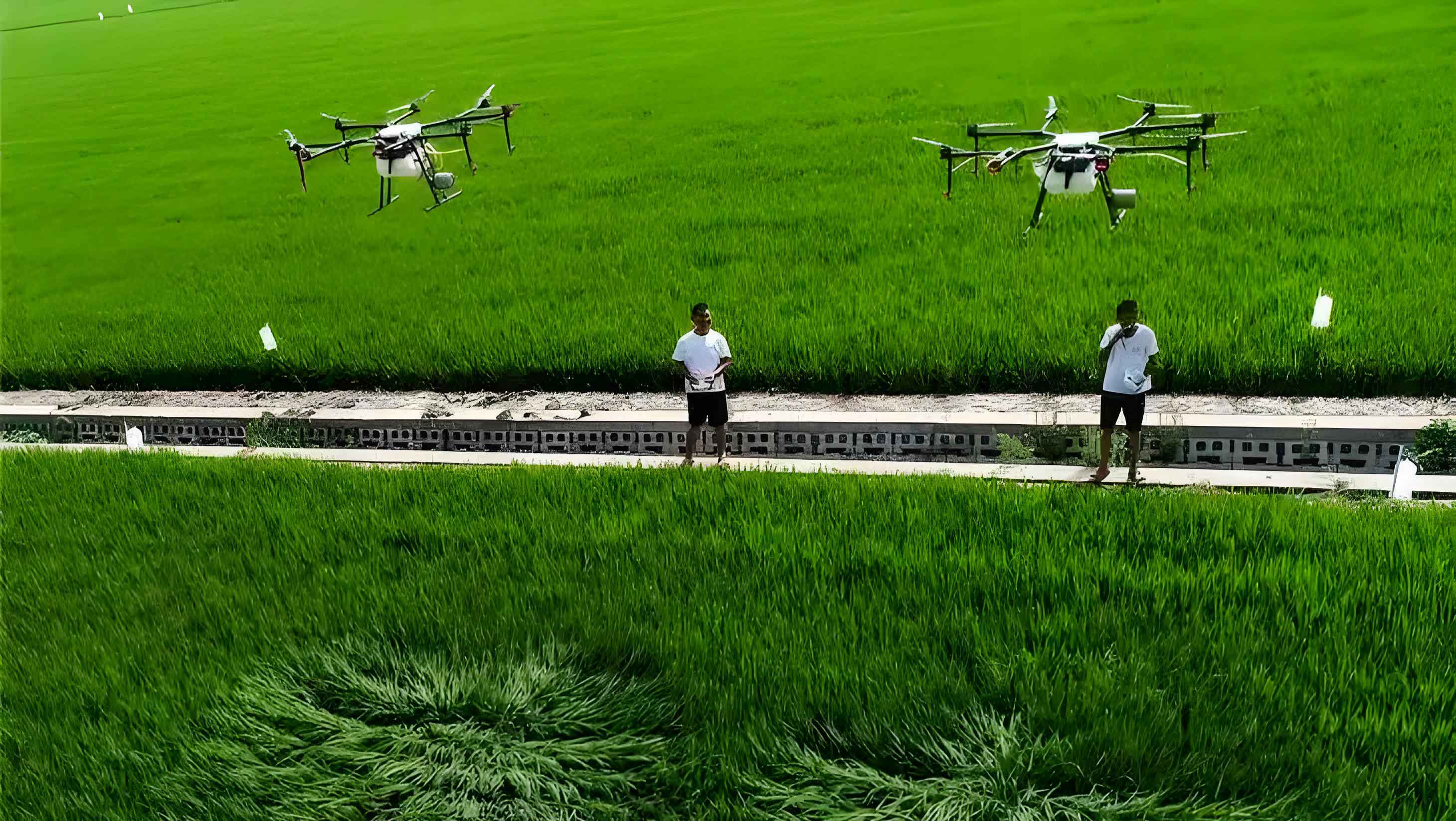
The operational principle revolves around these integrated components. The flight controller, guided by pre-programmed GNSS coordinates, autonomously navigates the agricultural UAV along a precise swath path. Simultaneously, it regulates the spray pump’s flow rate, often dynamically adjusting it based on real-time flight speed to maintain a consistent application rate (in L/ha) across the field. The downwash airflow generated by the rotors plays a critical role in enhancing canopy penetration and droplet deposition.
Distinctive Characteristics and Advantages
The agricultural UAV offers a unique set of advantages that address key limitations of ground-based machinery and manned aircraft:
- High Operational Efficiency and Adaptability: With an effective working width of 3-6 meters and speeds of 3-6 m/s, a single agricultural UAV can cover 4-8 hectares per hour, dramatically outperforming manual methods. Its vertical take-off and landing (VTOL) capability and small turning radius allow it to operate in fragmented, irregular, or terraced paddy fields inaccessible to large ground rigs.
- Precision Application and Enhanced Efficacy: By utilizing ULV spraying (typically 10-30 L/ha), the technology reduces water consumption by over 90% compared to conventional high-volume spraying. The downward air current assists in depositing droplets on the underside of leaves and within the dense rice canopy, improving the control of pests and diseases. This targeted approach can increase pesticide utilization efficiency to 35-50%, reducing environmental load.
- Improved Safety and Reduced Labor Intensity: Operators conduct missions remotely from the field edge, minimizing direct exposure to chemicals. The automation of flight and spraying significantly reduces the physical strain associated with backpack sprayers.
- Multifunctional Platform Potential: Beyond spraying, the same agricultural UAV platform can be equipped with multispectral or RGB cameras for remote sensing, facilitating tasks like crop health monitoring, nitrogen status assessment, and yield prediction.
Principles for Selecting an Agricultural UAV and Service Provider
The performance and reliability of the agricultural UAV and the skill of its operator are the most critical factors determining the success and safety of an operation. A systematic selection process is essential.
UAV Hardware Evaluation
Firstly, any agricultural UAV considered must comply with relevant national or international agricultural aviation standards, which specify requirements for structural safety, spraying system performance, and electromagnetic compatibility. Key hardware specifications to evaluate include:
| Specification Category | Typical Range/Feature | Importance for Paddy Fields |
|---|---|---|
| Payload Capacity | 10-40 kg | Determines tank size and operational endurance per sortie. |
| Endurance (per battery) | 10-20 minutes | Affects operational logistics and number of battery swaps needed. |
| Spray System Type | Centrifugal (Rotary) / Pressure (Fan) Nozzles | Affects droplet spectrum (size distribution). Centrifugal nozzles often produce a more uniform, fine-to-medium droplet spectrum suitable for insecticides/fungicides. |
| Liquid Flow Rate Range | 0.3-2.0 L/min | Must be adjustable to achieve target application rates across different flight speeds. |
| Positioning System | GNSS, RTK/PPK High-Precision | RTK/PPK is crucial for repeatable, centimeter-level accuracy, preventing gaps or overlaps, especially important for herbicide application. |
| Intelligent Features | Terrain Follow, Automatic Obstacle Avoidance, Variable Rate Control | Enhances safety and adaptability in complex paddy landscapes. |
It is advisable to prioritize established brands with proven track records in reliability, after-sales support, and continuous software updates. The robustness of the system against high humidity and occasional minor impacts common in field operations is a key practical consideration.
Service Provider and Operator Qualification
The human element is equally important. A reputable service provider should possess valid business licenses and relevant operational permits. The pilots (operators) must have undergone certified training, not only in UAV flight proficiency but also in agronomy and safe pesticide handling. They should understand the principles of Integrated Pest Management (IPM), pesticide mode of action, and the impact of environmental conditions on spray efficacy and drift.
Comprehensive Technical Protocol for Paddy Field Operations
Executing a successful agricultural UAV mission in a rice paddy requires meticulous attention to a sequence of interrelated factors. This protocol synthesizes standard requirements with practical field experience.
1. Determination of Optimal Application Timing
Precision in timing is more critical than precision in placement. The agricultural UAV enables rapid response, which should be aligned with the pest/disease’s Economic Threshold (ET) or the critical growth stage of weeds. For example, controlling the rice stem borer (Chilo suppressalis) is most effective during the egg mass and early larval stages before larvae bore into stems. Fungicide applications for blast disease are most effective as preventative treatments just before forecasted favorable conditions (high humidity, moderate temperatures). Relying on regular field scouting and weather-based disease prediction models is essential for timely intervention.
2. Meteorological and Environmental Conditions
Weather is the single most volatile factor affecting agricultural UAV spray quality. Strict operating windows must be observed.
- Wind Speed and Direction: Operations should be conducted when wind speeds are between 0 and 3 m/s (Beaufort scale 0-2). Wind speeds exceeding 3 m/s significantly increase droplet drift risk, leading to uneven coverage and potential off-target damage. The flight path should be oriented parallel to the wind direction to maintain consistent swath alignment. A simplified model for drift potential (DP) can be conceptualized as:
$$DP \propto \frac{U \cdot d_{v}^{2}}{H}$$
where \(U\) is wind speed, \(d_{v}\) is the droplet’s volumetric median diameter (VMD), and \(H\) is release height. This illustrates why low wind and appropriate droplet size are crucial. - Temperature and Humidity: Ideal temperatures range from 15°C to 30°C. High temperatures (>35°C) increase evaporation of fine droplets before they reach the target, reducing efficacy. Low humidity exacerbates this evaporation. Conversely, very high humidity can promote droplet coalescence on the leaf surface.
- Precipitation and Radiation: Operations must cease at least 2 hours before forecasted rain to ensure adequate adsorption of the pesticide. Intense solar radiation can degrade some pesticides; early morning or late afternoon operations are often optimal.
3. Pest and Disease Resistance Management
The efficiency of an agricultural UAV should not lead to over-reliance on a single chemical mode of action. A resistance management strategy is integral:
– **Rotate and Mix:** Regularly rotate pesticides with different biochemical modes of action (e.g., different FRAC, IRAC, HRAC groups). Use pre-mixed tank mixes or sequential applications of products with different modes of action.
– **Use Full, Recommended Doses:** Sub-lethal doses, sometimes applied inadvertently due to poor coverage, strongly select for resistant pest populations. The agricultural UAV‘s precision helps ensure the correct dose reaches the target.
– **Integrate with Non-Chemical Controls:** Combine chemical applications from the agricultural UAV with cultural, biological, and physical controls as part of a holistic IPM program.
4. Field Preparation and Safety Assessment
A pre-flight field survey is mandatory. Key checks include:
– **Airspace and Obstacles:** Confirm the area is not a no-fly zone. Identify and map permanent obstacles (power lines, tall trees, poles). Modern agricultural UAV systems allow for digital boundary marking and obstacle inclusion in the flight plan.
– **Non-Target Crops and Sensitive Areas:** Identify the location of nearby sensitive crops (e.g., mulberry, aquaculture ponds, beehives, organic farms), water bodies, and residential areas. Establish adequate buffer zones (often 10-50 meters depending on the product’s hazard and wind conditions) and plan flight paths to minimize drift towards these areas.
– **Field Conditions:** Ensure the paddy has consistent water levels and that the crop is not lodged, which could impede the downwash airflow and spray penetration.
5. Pesticide Selection and Tank Mix Preparation
Compatibility and atomization characteristics are paramount for agricultural UAV applications.
– **Formulation Preference:** Water-based formulations like Suspension Concentrates (SC), Oil-in-Water Emulsions (EW), and soluble concentrates (SL) are ideal as they minimize abrasive wear on pumps and nozzles and reduce clogging. Wettable Powders (WP) and Water-Dispersible Granules (WG) should be used with caution and only with excellent agitation and filtration systems.
– **Droplet Size Spectrum:** The choice of systemic vs. contact pesticides influences the target droplet size. Systemic products can be effective with smaller droplets (fine to medium spectrum, VMD 100-200 µm) that provide high coverage density. Contact products, especially herbicides, often require larger droplets (coarse spectrum, VMD 250-400 µm) to minimize drift and ensure sufficient deposit.
– **Adjuvants:** The use of spray adjuvants (deposition aids, anti-evaporants, drift reduction agents) is highly recommended. They can modify droplet size, improve retention on waxy rice leaves, and enhance the biological efficacy of the active ingredient.
6. Operational Safety Procedures
Rigorous safety protocols protect operators, bystanders, and the environment.
– **Personal Protective Equipment (PPE):** Pilots and ground crew handling chemicals must wear appropriate PPE: chemical-resistant coveralls, gloves, goggles, and a respirator mask.
– **Exclusion Zones:** Clear all personnel and animals from the immediate operational area (a minimum 15-meter radius from the take-off/landing and refilling point). Use signage to warn bystanders.
– **Safe Handling:** Pesticide mixing and loading should be done in a well-ventilated area using dedicated equipment. Follow all label instructions for disposal of rinsate and empty containers.
7. Optimization of Key Flight and Spray Parameters
These interlinked parameters must be calibrated for each specific mission to achieve the label-recommended dose (in g ai/ha) and desired coverage. The fundamental relationship is given by:
$$Q = \frac{R \cdot W \cdot 600}{V}$$
where:
– \(Q\) is the required nozzle flow rate (L/min).
– \(R\) is the target application rate (L/ha).
– \(W\) is the effective swath width (m).
– \(V\) is the ground speed (km/h).
– The constant 600 is used for unit conversion.
Calibration involves setting these parameters based on field conditions and desired outcomes:
| Parameter | Typical Range / Recommended Value | Rationale and Adjustment Principle |
|---|---|---|
| Application Rate (R) | 12 – 22.5 L/ha (0.8 – 1.5 L/667 m²) | Must meet minimum droplet deposition density for the target pest (see Table 4). Lower rates increase efficiency but risk insufficient coverage. Never go below 12 L/ha for paddy fields. |
| Flight Height (H) | 1.8 – 2.2 m above crop canopy | Optimizes swath pattern overlap (30-50%) and downwash penetration. Reduce to ~1.5 m in windy conditions (>2 m/s) to reduce drift. Advanced UAVs with finer atomization may operate at 3m. |
| Effective Swath Width (W) | 3.0 – 5.0 m | Determined by flight height and nozzle spray angle. Must be validated using water-sensitive paper placed on the ground/canopy. It is not the same as the rotor span. |
| Ground Speed (V) | 3.0 – 5.0 m/s (10.8 – 18 km/h) | Higher speed increases area coverage but may reduce deposition in lower canopy. Slower speed (3-4 m/s) is preferred for contact pesticides or dense infestations. The UAV’s control system should auto-adjust flow rate (Q) to maintain constant (R). |
| Droplet Size (VMD) | Fine-Medium: 100-200 µm (Insect/Fungicide) Coarse: 250-400 µm (Herbicide) |
Controlled by nozzle type and rotational speed (for centrifugal). Larger VMD reduces drift but may lower coverage density (droplets/cm²). The choice is a trade-off between drift risk and biological efficacy needs. |
8. Quality Control and Performance Metrics
The final measure of a successful agricultural UAV operation is quantifiable coverage quality. This is assessed using sampling tools like water-sensitive paper (WSP) or potassium fluorescein tracer.
| Pesticide Type / Mode of Action | Minimum Droplet Density (droplets/cm²) | Maximum Coefficient of Variation (CV) for Uniformity | Notes |
|---|---|---|---|
| Systemic Insecticide | ≥ 25 | ≤ 45% | Lower density may be acceptable due to translocation within plant. |
| Contact Insecticide | ≥ 30 | Higher density required for direct contact with pest. | |
| Systemic Fungicide | ≥ 25 | Similar to systemic insecticides. | |
| Contact Fungicide (Protectant) | ≥ 50 | Requires very high, uniform coverage to protect leaf surface. | |
| Systemic Herbicide | ≥ 30 | ≤ 40% (More critical) | Uniformity is crucial to avoid weed escapes. |
| Contact Herbicide | ≥ 50 | Requires high density for complete weed burn-down; drift risk must be strictly managed. |
The Coefficient of Variation (CV), calculated from droplet counts across multiple sample cards within a swath, measures uniformity. A lower CV indicates more even distribution. The formula is:
$$CV (\%) = \frac{\sigma}{\mu} \times 100$$
where \(\sigma\) is the standard deviation and \(\mu\) is the mean of droplet density samples.
Conclusion and Future Perspectives
The agricultural UAV has unequivocally established itself as a transformative tool for paddy field plant protection. Its core value lies in delivering precision, efficiency, and safety. Mastering its operation, however, requires a synthesis of knowledge from aviation, agronomy, meteorology, and plant pathology. Adherence to a structured technical protocol—encompassing meticulous planning, parameter calibration based on scientific principles, and rigorous quality assessment—is non-negotiable for achieving consistent, high-quality results that justify the investment and ensure environmental stewardship.
The future of agricultural UAV technology points towards greater intelligence and integration. Developments in machine vision and artificial intelligence will enable real-time, on-the-go target detection (e.g., spot-spraying weeds or disease foci), moving from uniform application to true variable-rate prescription spraying. Improved battery technology will extend flight times, and enhanced swarm control will allow fleets of agricultural UAV to collaborate on large-scale operations. Furthermore, the fusion of remote sensing data from UAVs with other farm data streams will cement the agricultural UAV‘s role as a central node in the digital farm management ecosystem, enabling truly data-driven, sustainable crop production.