
As a researcher deeply engaged in the field of precision agriculture, I find the challenge of pesticide droplet drift from Unmanned Aerial Vehicles (UAVs) to be a critical frontier. The application of agricultural UAV technology has revolutionized crop protection, offering unparalleled efficiency and accessibility, especially in terrains hostile to conventional machinery. However, the very nature of low-volume aerial spraying introduces a significant challenge: the off-target movement of spray droplets, known as drift. This phenomenon not only represents a direct economic loss through wasted agrochemicals but also poses substantial environmental and ecological risks. Therefore, developing robust, accurate, and practical methods to detect and quantify this drift is paramount for optimizing application protocols, ensuring regulatory compliance, and promoting sustainable farming practices. This article synthesizes the current state of knowledge, evaluates prevalent detection methodologies, and explores integrative technological futures for drift management.
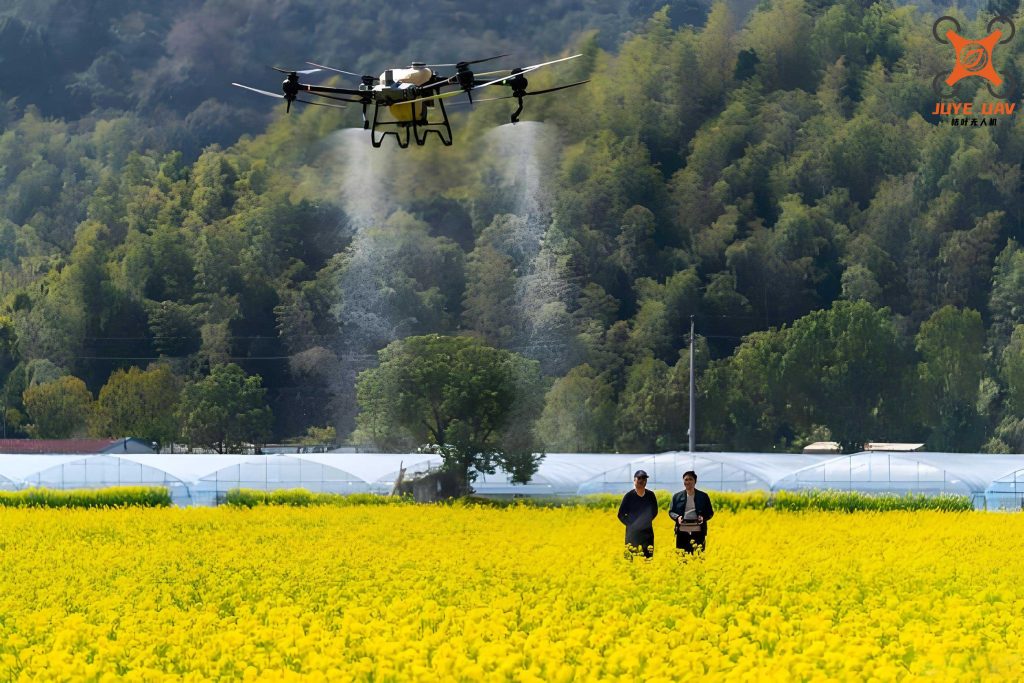
The core of the drift problem lies in the dynamic interplay between released droplets and the atmospheric environment. When an agricultural UAV operates, it creates a complex airflow system combining its downwash, forward motion, and ambient wind. Droplets emitted from spray nozzles are instantaneously subjected to these forces. Their trajectory ceases to be a simple ballistic descent and becomes a stochastic path influenced by drag, turbulence, and evaporation. The fundamental physics can be described by a force balance on a single droplet. The equation of motion in the vertical direction, considering gravity and drag, is often simplified for analysis:
$$
m_d \frac{dv_z}{dt} = m_d g – \frac{1}{2} C_d \rho_a A_d v_z^2
$$
Here, \( m_d \) is the droplet mass, \( v_z \) is its vertical velocity, \( g \) is acceleration due to gravity, \( C_d \) is the drag coefficient, \( \rho_a \) is air density, and \( A_d \) is the droplet’s cross-sectional area. The drag force, proportional to the square of the velocity, becomes significant for small droplets, drastically reducing their terminal velocity and extending their airborne time, thus increasing drift potential. Droplet size, characterized by metrics like the Volume Median Diameter (VMD), is the most influential parameter. The relationship between drift potential and VMD is inversely proportional and highly non-linear.
To systematically understand the factors, they can be categorized as shown in the table below:
| Category | Specific Factors | Influence on Drift |
|---|---|---|
| Droplet Characteristics | Volume Median Diameter (VMD), droplet spectrum, density, volatility | Smaller VMD (<150 µm) drastically increases drift. A narrow spectrum is desirable. Evaporative volatile droplets form “vapor drift.” |
| Spray System & UAV Parameters | Nozzle type (hydraulic, air-induction, rotary), flow rate, pressure, release height, UAV forward speed, rotor downwash | Air-induction nozzles produce larger droplets. Higher release height and speed increase drift. Downwash can both deposit and disturb droplets. |
| Meteorological Conditions | Wind speed & direction, air temperature, relative humidity, atmospheric turbulence | Wind speed is the primary external driver. Low humidity/high temperature enhances evaporation. Turbulence disperses droplets. |
| Operational & Formulation | Spray solution viscosity, adjuvant use, flight path planning, buffer zones | Adjuvants can increase droplet size or reduce evaporation. Strategic flight planning minimizes cross-wind exposure. |
The detection and measurement of droplet drift are therefore attempts to quantify the outcome of this complex system. Methods broadly fall into two paradigms: collective methods that measure the deposited fraction (both on-target and off-target), and diagnostic methods that attempt to characterize the airborne spray cloud or individual droplet dynamics.
Established Detection and Measurement Methodologies
A significant portion of research, particularly in field validation, relies on indirect collection methods. These techniques are grounded in standardized protocols (e.g., ISO 22866) and provide quantifiable data on deposition and downwind drift flux.
1. Passive Collectors and Tracer Analysis: This is the most common field method. Passive samplers, such as water-sensitive paper (WSP), polyester strings, or plastic cards, are strategically placed within the target canopy, on the ground downwind, and at various heights on poles to create a three-dimensional collection matrix. After the agricultural UAV spray pass, these collectors are retrieved. For WSP, the stains left by droplets are scanned and analyzed using image processing software (e.g., DepositScan, ImageJ) to determine droplet density, coverage percentage, and sometimes size distribution via stain diameter conversion models. The fundamental analysis involves counting stains \( N \) per unit area \( A \):
$$
\text{Droplet Density} = \frac{N}{A}
$$
For strings or cards used with a fluorescent tracer (e.g., Pyranine), the collectors are washed, and the tracer concentration in the rinsate is measured with a fluorometer. The mass of tracer recovered is directly proportional to the deposition volume. The downwind drift potential is often expressed as the percentage of the applied spray rate found at a specific downwind distance. The table below compares these common collection methods:
| Method | Collector Type | Tracer/Analysis | Advantages | Disadvantages |
|---|---|---|---|---|
| Water-Sensitive Paper (WSP) | Paper coated with yellow dye | Color change upon contact; image analysis. | Inexpensive, simple, provides spatial pattern and density. | Stain size not equal to droplet size (splatter), affected by humidity, qualitative for volume. |
| Fluorescent Tracer + Cards/Strings | Plastic, paper, or polyester | Fluorescent dye (e.g., Pyranine); fluorometry. | Highly quantitative, sensitive, good for mass balance studies. | Requires lab equipment, more expensive, does not give instantaneous droplet size info. |
| Natural/Artificial Canopy | Real leaves, artificial plants | Wash-off + fluorometry or chemical analysis. | Most realistic for canopy deposition studies. | Labor-intensive, variable leaf surface properties. |
2. Wind Tunnel and Controlled Environment Testing: To isolate specific variables (e.g., wind speed, nozzle type, formulation), wind tunnel testing is invaluable. A scaled or full-size agricultural UAV spray system can be mounted in a wind tunnel, creating a stable, reproducible airflow. Drift is measured using lines of collectors (like strings or tubes) at the tunnel’s exhaust. This allows for precise measurement of the “Drift Potential Reduction” of different nozzle or setup configurations. The data often fits an exponential decay model relative to downwind distance \( x \):
$$
D(x) = D_0 \cdot e^{-k x}
$$
where \( D(x) \) is the deposition at distance \( x \), \( D_0 \) is a constant, and \( k \) is a decay coefficient dependent on droplet size and wind speed.
3. Computational Fluid Dynamics (CFD) Simulation: CFD has emerged as a powerful predictive tool. It involves solving the Navier-Stokes equations for the complex airflow around the UAV and coupling them with a Lagrangian particle-tracking model for the droplets. The governing equations for fluid flow are:
$$
\rho \left( \frac{\partial \mathbf{u}}{\partial t} + \mathbf{u} \cdot \nabla \mathbf{u} \right) = -\nabla p + \mu \nabla^2 \mathbf{u} + \mathbf{F}
$$
$$
\nabla \cdot \mathbf{u} = 0
$$
where \( \mathbf{u} \) is the velocity vector, \( p \) is pressure, \( \rho \) and \( \mu \) are air density and viscosity, and \( \mathbf{F} \) represents body forces. Droplets are tracked by solving their equation of motion, including drag and gravitational forces. While computationally intensive, CFD allows for “virtual testing” of countless scenarios—changing UAV designs, flight patterns, and weather conditions—to visualize drift plumes and optimize systems before physical prototypes are built.
Emerging and Integrative Detection Technologies
While collection methods are essential for validation, they are inherently post-application and lack real-time capability. The future of drift management for agricultural UAV lies in direct, dynamic sensing and adaptive control. Several promising technologies are converging to make this possible.
1. Optical and Laser-Based Diagnostic Systems: These methods probe the spray cloud directly. Phase Doppler Interferometry (PDI) and Laser Diffraction (e.g., Malvern Spraytec) can measure the droplet size and velocity distribution in real-time at a specific point in space. By positioning these instruments downwind of the spray path, one can characterize the changing spectrum of the drifting fraction. More advanced planar imaging techniques like Particle Image Velocimetry (PIV) and Particle Tracking Velocimetry (PTV) use laser sheets and high-speed cameras to capture two-dimensional velocity vector fields of the droplet-laden air, revealing the complex vortical structures generated by the UAV rotors that entrain and transport droplets.
2. LiDAR and Remote Sensing: Light Detection and Ranging (LiDAR) offers the potential for long-range, wide-area mapping of spray clouds. A scanning LiDAR system can emit laser pulses and detect the backscatter from droplets, creating a 3D point cloud of the aerosol concentration. This technology could map the entire drift plume in real-time, providing unprecedented data on its spatial extent and density under actual field conditions.
3. Onboard and Networked Sensing: The next generation of intelligent agricultural UAV will likely integrate miniaturized environmental sensors (anemometers, hygrometers) and perhaps even simple optical droplet sensors into their frames. Coupled with Real-Time Kinematic (RTK) GPS for precise positioning, the UAV can log its exact flight path alongside instantaneous wind data. When this information is streamed via 5G networks and processed with machine learning algorithms, it can be used to create predictive drift risk maps for the field or even trigger immediate compensatory actions, such as dynamically adjusting nozzle flow rates or temporarily shutting off sections of the spray boom when crossing a sensitive boundary.
The integration of these technologies points toward a holistic system. Imagine a scenario where a pre-flight CFD simulation, informed by a weather forecast, suggests an optimal flight altitude and speed. During the mission, onboard sensors validate the wind conditions, while a ground-based LiDAR monitors the plume boundaries. This real-time data feeds into a control algorithm that makes micro-adjustments to the UAV’s operation. Simultaneously, a following scout UAV equipped with multispectral cameras could later assess the deposition uniformity on the crop, closing the loop on application quality assurance.
Synthesis and Forward-Looking Perspective
The evolution of drift detection for agricultural UAV is moving from discrete, labor-intensive sampling toward continuous, intelligent sensing. The traditional methods—tracer collection, wind tunnels, and water-sensitive paper—remain the bedrock for scientific validation and regulatory testing. Their strength lies in providing tangible, quantitative data under controlled or real-world conditions. However, they are snapshot techniques that cannot capture the full temporal dynamics of drift.
The promise lies in the fusion of diagnostic technologies (LiDAR, PIV), real-time data acquisition (onboard sensors, 5G), and predictive digital twins (CFD, AI models). The ultimate goal is to transition from detecting drift after it happens to predicting and preventing it during the operation. This requires models that are not just physically accurate but also computationally efficient enough to run in near-real-time on field computers.
A significant challenge remains the development of standardized metrics and protocols for these new sensing modalities. How does a LiDAR backscatter signal correlate to a mass of drift per unit area? Creating these bridges between indirect signals and quantitative biological or environmental impact is the next major research hurdle. Furthermore, the cost and complexity of advanced systems like LiDAR must decrease for widespread adoption.
In conclusion, effective management of spray drift is not merely a technical objective for agricultural UAV operations; it is a societal imperative for environmental stewardship and sustainable food production. The ongoing research into sophisticated detection methods is fundamentally about gaining a deeper, more precise understanding of the micro-physics of aerial spraying. By combining the proven reliability of collective methods with the dynamic insight of emerging diagnostic technologies, the path forward leads to smarter, more responsive, and ultimately more precise aerial application systems that maximize efficacy on-target while minimizing footprint off-target.