
As someone deeply engaged in the advancement of modern agricultural technologies, I have witnessed a transformative shift in crop protection practices. The rapid development and adoption of agricultural drone technology, particularly low-volume spraying systems, stands as a paramount example of innovation driving sustainable intensification. This technology is not merely a new tool; it represents a fundamental change in how we approach plant protection, aligning efficiency with environmental stewardship. The core promise of the agricultural drone lies in its ability to deliver pesticides precisely, reduce overall chemical input, and enhance control efficacy—a trilogy of benefits crucial for modern agriculture. In this analysis, I will delve into the mechanisms and multifaceted benefits of agricultural drone low-volume spray technology, using rice cultivation as a primary case study, to elucidate its pivotal role in achieving pesticide reduction and efficiency gain goals.
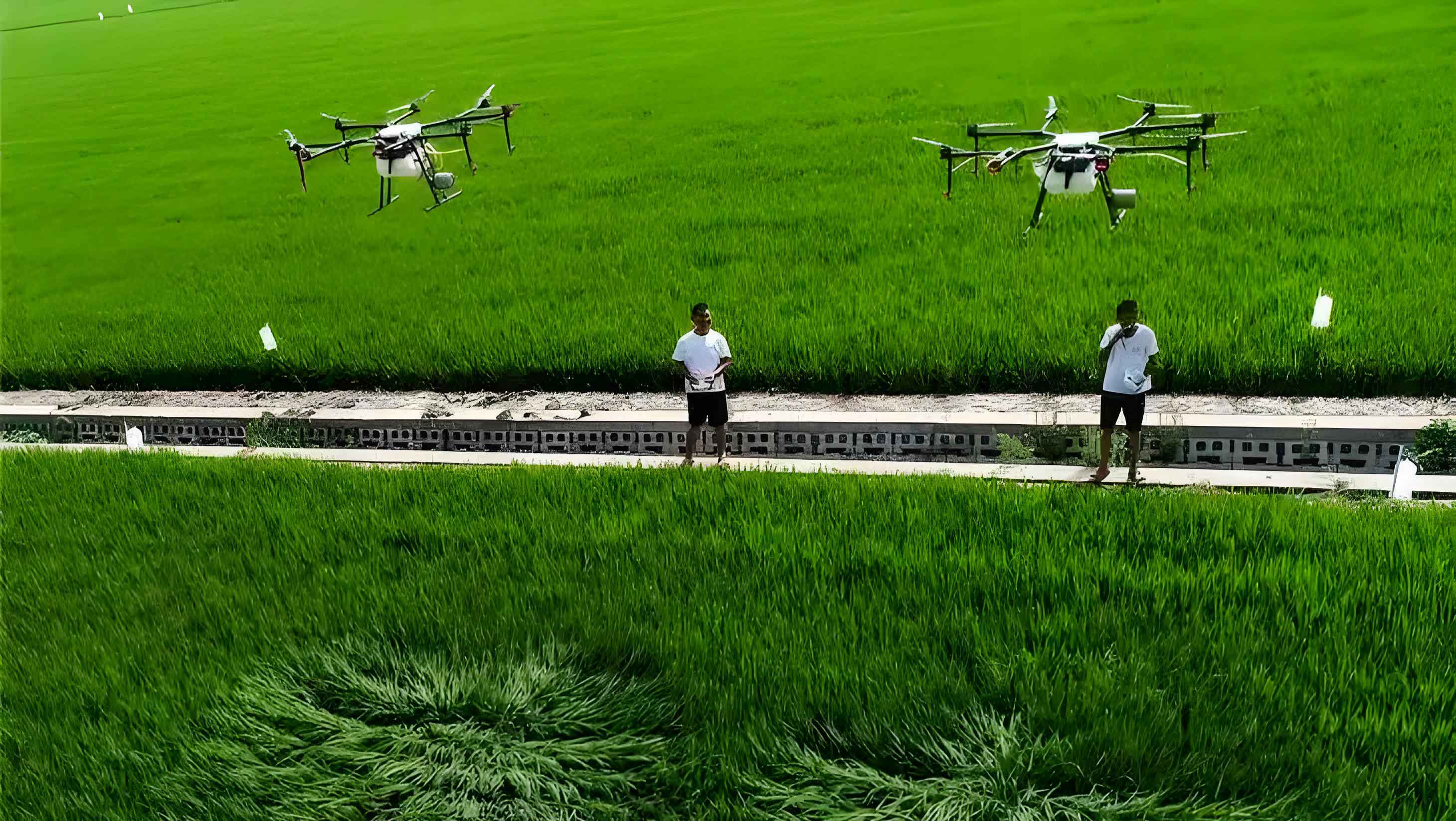
The impetus for adopting agricultural drone technology is clear. Traditional ground-based sprayers, while effective in their time, often face limitations related to labor intensity, application efficiency, and field accessibility, especially in challenging terrains or during critical crop growth stages. Rice paddies, with their unique muddy and flooded conditions, exemplify an environment where ground machinery operation is difficult, inefficient, and potentially damaging to the crop. The agricultural drone elegantly bypasses these constraints. By operating from the air, it achieves a clear separation between the operator and the application zone, significantly reducing dermal exposure risks and pesticide poisoning hazards for farmers. More importantly, it introduces unprecedented operational efficiency. The speed of an agricultural drone allows it to cover vast areas in a fraction of the time required by manual or tractor-mounted sprayers, making timely applications feasible even across large, consolidated farms.
However, the true value of the agricultural drone extends far beyond labor savings. The technological heart of its benefit lies in the principle of low-volume spraying. Unlike high-volume sprays that drench the crop canopy, low-volume applications deliver a concentrated spray mixture in the form of a fine droplet spectrum. This approach, when executed correctly by a well-calibrated agricultural drone, optimizes the interaction between the spray droplet and the target plant surface. The key metrics here are droplet deposition density and coverage uniformity. Successful pest and disease control often depends on achieving a sufficient number of droplets per unit area on the critical zones of the plant, such as the underside of leaves for sucking insects or the stem base for certain diseases. The flight control systems, nozzle configurations, and spray parameters of modern agricultural drones are engineered to maximize this deposition on the target while minimizing losses due to drift or runoff.
The quantitative benefits of this targeted approach can be captured in the concept of Pesticide Utilization Rate (PUR). PUR is defined as the percentage of the total applied pesticide dose that is ultimately deposited and retained on the target crop canopy. It is a critical measure of application precision and efficiency. Empirical studies consistently show that agricultural drone low-volume spraying achieves a significantly higher PUR compared to conventional backpack or boom sprayers in rice fields. While traditional methods may exhibit PURs ranging from 20% to 40%, with substantial losses to the soil and water, agricultural drone applications have been documented to achieve PURs between 40% and 60%, and in optimized settings, even higher. This direct enhancement in efficiency is the first pillar supporting pesticide reduction.
The relationship between application parameters and deposition can be conceptualized. The effective deposition (D) on a target canopy layer is a function of multiple agricultural drone and environmental variables:
$$ D = f(Q, V, H, d_v, \rho, \eta, U, \theta) $$
Where:
$Q$ = Spray application rate (L/ha)
$V$ = Agricultural drone flight velocity (m/s)
$H$ = Flight height above canopy (m)
$d_v$ = Volume median droplet diameter (µm)
$\rho$ = Spray liquid density and formulation properties
$\eta$ = Canopy architecture and leaf area index
$U$ = Ambient wind speed (m/s)
$\theta$ = Environmental temperature and humidity
Optimizing this function is the key to unlocking the full potential of the agricultural drone. For instance, flying too high or too fast with an inappropriate droplet size can lead to excessive drift and poor canopy penetration, negating the benefits. Therefore, the sophistication of an agricultural drone system lies not just in its ability to fly, but in its integrated capacity to manage these variables through intelligent control systems, appropriate nozzle selection, and informed operational protocols.
Comprehensive Benefit Assessment: The Case of Rice Cultivation
To systematically evaluate the impact of agricultural drone technology, we can construct a multi-criteria assessment model. This model quantifies the “benefit increment” offered by the drone technology relative to conventional application methods. The total benefit increment (P) is the weighted sum of improvements across key performance indicators:
$$ P = \sum_{i=A}^{L} (\Delta I_i \times W_i) $$
Where $\Delta I_i$ is the percentage change (improvement) in a specific benefit indicator, and $W_i$ is its assigned weight reflecting relative importance. The indicators and their proposed weights, based on agronomic and socioeconomic priorities, are summarized in the table below.
| Code | Benefit Indicator | Description / Annotation | Weight (Wi) % |
|---|---|---|---|
| A | Control Efficacy | Effectiveness against target pests, diseases, and weeds. | 15 |
| B | Chemical Input Reduction | Decrease in total active ingredient applied per unit area. | 20 |
| C | Operational Simplicity | Labor time savings (40%) and user acceptance level (60%). | 10 |
| D | Crop Yield | Increase in grain or biomass yield per unit area. | 6 |
| E | Pesticide Utilization Rate (PUR) | Percentage of applied pesticide deposited on the target crop. | 16 |
| F | Resistance Risk Mitigation | Potential to slow pest resistance development via precision. | 6 |
| G | Exposure Risk Reduction | Lowered risk of operator pesticide exposure (dermal, inhalation). | 5 |
| H | Cost-Benefit Improvement | Net economic gain considering all costs and yield value. | 5 |
| I | Product Quality Enhancement | Improvement in harvest quality (e.g., lower residue, better grade). | 4 |
| J | Technology Adoption Rate | Percentage of total cropping area where the technology is used. | 5 |
| K | Large-Scale Farmer Adoption | Uptake rate among commercial-scale farming operations. | 3 |
| L | Farmer Awareness Elevation | Increase in understanding and acceptance of precision application. | 5 |
| TOTAL | 100 |
Applying this model to aggregated data from numerous field trials on rice provides a quantitative snapshot of the agricultural drone‘s performance. The following table synthesizes the average observed improvements (ΔI) for key measurable indicators and calculates their contribution to the total benefit score.
| Benefit Indicator | Average Improvement (ΔI %) * | Weight (Wi) % | Contribution to Total Benefit (ΔI × Wi) % |
|---|---|---|---|
| Chemical Input Reduction | ~9.3 | 20 | 1.86 |
| Control Efficacy | ~5.1 | 15 | 0.77 |
| Operational Simplicity | ~65.3 | 10 | 6.53 |
| Crop Yield | ~2.0 | 6 | 0.12 |
| Pesticide Utilization Rate (PUR) | ~26.6 | 16 | 4.26 |
| Cost-Benefit Improvement | ~1.8 | 5 | 0.09 |
| Partial Total (Measured Indicators) | 72 | 13.63 |
* Values represent mean estimates derived from comparative field study data.
This analysis reveals compelling insights. The most dramatic quantitative improvement is in Operational Simplicity, primarily due to the extraordinary labor time savings afforded by the agricultural drone. It is not uncommon for a single agricultural drone team to cover 15-20 times the area per day compared to a farmer with a backpack sprayer. This directly addresses rural labor shortages and high labor costs. The second most significant contributor is the enhancement in Pesticide Utilization Rate (PUR). A ~26% relative improvement in PUR is a direct translation of environmental and economic savings—less chemical is wasted, meaning less potential pollution and more cost-effective use of inputs.
Furthermore, the data indicates that the agricultural drone enables a measurable Chemical Input Reduction of around 9% while maintaining or slightly improving Control Efficacy. This is a crucial finding. It demonstrates that precision application via an agricultural drone can achieve the same or better pest suppression with less active ingredient, debunking the notion that reducing pesticide volume necessarily compromises control. The marginal gains in Yield and Cost-Benefit, while positive, are often secondary to the primary drivers of efficiency and input savings. It is important to note that benefits like Exposure Risk Reduction (a fundamental safety advantage of the agricultural drone) and Resistance Risk Mitigation are inherently high but difficult to quantify in short-term trials; their full value accrues over the long term.
Mechanisms of Enhancement and Critical Enablers
The positive outcomes summarized above are not automatic; they are contingent upon several technical and agronomic factors that enable the agricultural drone to perform optimally.
1. The Role of Spray Adjuvants: The low-volume sprays emitted by an agricultural drone are particularly susceptible to evaporation and rebound due to their fine droplets. Specially formulated tank-mix adjuvants are often critical enablers. These additives can modify the physicochemical properties of the spray solution:
$$ \gamma_{solution} = \gamma_{water} + \Delta \gamma_{adjuvant} $$
Where $\gamma_{solution}$ is the surface tension of the final spray mix. By lowering surface tension, adjuvants increase droplet spread and adhesion on waxy or hairy leaf surfaces. They can also act as humectants to retard evaporation, or as drift control agents to increase droplet size. The use of adjuvants has been shown to allow for further pesticide dose reductions—sometimes up to 30%—while preserving efficacy against pests like rice leaf roller or diseases like rice blast, making them a synergistic partner to agricultural drone technology.
2. Flight and Spray Parameter Optimization: The performance of an agricultural drone is highly sensitive to its operational parameters. An integrated optimization model can be conceptualized to maximize effective deposition:
$$ \text{Maximize } D(Q, V, H, d_v) $$
$$ \text{Subject to: } V_{min} \leq V \leq V_{max}, \quad H_{min} \leq H \leq H_{max}, \quad d_{v,min} \leq d_v \leq d_{v,max}, \quad \text{Drift} \leq \text{Threshold} $$
Finding this optimum requires understanding the interaction between parameters. For example, a higher flight speed ($V$↑) may require a higher flow rate ($Q$↑) to maintain dose, but could also alter the droplet spectrum and deposition pattern. Modern intelligent agricultural drone systems are increasingly equipped with sensors and control algorithms to automatically adjust these parameters in real-time based on pre-set flight maps and environmental feedback.
3. Development of UAV-Formulated Pesticides: Conventional pesticide formulations are designed for high-volume dilution in ground sprayers. They may be too viscous, prone to crystallization, or foam excessively when used in the low-water-volume tanks of an agricultural drone. This has spurred the development of dedicated “UAV-formulated” products. These formulations are engineered for rapid dissolution, high stability in concentrated mixes, and optimal biological efficacy when applied as a fine droplet cloud. The proliferation of the agricultural drone is thus catalyzing innovation in the agrochemical sector itself.
Future Trajectories and Emerging Challenges
The journey of the agricultural drone is one of continuous evolution. Current trends point toward several key development vectors that will further solidify its role in sustainable agriculture.
1. Advancements in Intelligence and Autonomy: The next generation of agricultural drone will move beyond simple pre-programmed route following. Integration with AI, machine vision, and multispectral imaging will enable “see-and-spray” capabilities. Imagine an agricultural drone that can identify weed patches or disease hotspots using real-time image analysis and apply herbicide or fungicide only to those specific spots, achieving unprecedented levels of chemical reduction. This targeted spot-spraying function could be described as:
$$ Q_{total} = Q_{background} + \sum_{i=1}^{n} (A_{spot,i} \times R_{spot}) $$
Where $Q_{total}$ is the total volume applied, $Q_{background}$ is a possible uniform low dose, $A_{spot,i}$ is the area of each detected infestation, and $R_{spot}$ is the application rate for spot treatment. This represents the ultimate form of precision agriculture.
2. System Integration and Swarm Technology: Future farm management will likely involve integrated systems where agricultural drone fleets (“swarms”) operate in coordination. A central control system could deploy multiple agricultural drone units to cover a large field simultaneously, optimizing flight paths to avoid interference and ensure complete, non-overlapping coverage. This swarm efficiency ($E_{swarm}$) could scale logarithmically with the number of units (n) for very large areas:
$$ E_{swarm} \propto n \cdot \log(n) $$
This makes the agricultural drone technology scalable for the largest agricultural enterprises.
3. Addressing Drift Risk and Environmental Safety: As with any spray technology, drift of droplets outside the target zone is a concern for the agricultural drone. Future development must prioritize drift mitigation through improved nozzle design, electrostatic charging systems to attract droplets to the plant, and advanced meteorological modeling integrated into flight control software to avoid spraying during high-risk wind conditions. Establishing scientifically robust buffer zones and safe operation protocols is essential for the responsible and sustainable use of agricultural drone technology.
4. Capacity Building and Service Ecosystem: The complexity of optimizing an agricultural drone system underscores the need for skilled operators and agronomists. The growth of a professional, service-oriented ecosystem—where farmers can access expert drone application as a service—will be more critical than the mere sale of hardware. This professionalization ensures that the theoretical benefits of the agricultural drone are consistently realized in the field.
In conclusion, the agricultural drone, specifically through its low-volume spray application modality, has firmly established itself as a cornerstone technology for modern, sustainable plant protection. By demonstrably enhancing pesticide utilization efficiency, enabling meaningful chemical input reductions, and revolutionizing operational logistics, it delivers on the core promise of “reducing use and boosting efficacy.” The quantitative benefit assessment, particularly in staple crops like rice, confirms its multi-faceted value. While challenges related to optimization, drift management, and professional training persist, the trajectory of innovation is decisively upward. The integration of AI, advanced sensing, and swarm intelligence will soon transform the agricultural drone from a precise spraying tool into an intelligent field scout and targeted intervention system. Therefore, the ongoing adoption and refinement of agricultural drone technology is not merely an option but a necessary pathway to align agricultural productivity with environmental responsibility and economic viability for future generations.