
In modern agriculture, one of the significant obstacles to productivity is the prevalence of crop diseases, pests, and weeds. The use of plant protection machinery to control these threats is a crucial measure for ensuring stable and increased crop yields. In recent years, agricultural drones have gained popularity among farmers due to their advantages such as high operational efficiency, pesticide savings, enhanced safety, and notable cost-effectiveness. From our perspective at the agricultural mechanization technology promotion center, the adoption of agricultural drones has been instrumental in advancing crop pest control efforts and driving the development of agricultural mechanization in our region. This article, based on our firsthand experience and observations, explores the current application status of agricultural drones, analyzes the necessity and feasibility of their promotion, identifies existing problems in their application, and proposes countermeasures and recommendations for wider adoption.
Our region is located in the southwestern part of the country, characterized as a border agricultural county with diverse ethnic minorities. It comprises nine townships, 68 village committees, and one state-owned farm, with a total population of approximately 181,300. The area enjoys favorable climatic conditions, including an average annual temperature of 18.9°C, average rainfall of 1,600 mm, and sunshine duration of 2,316 hours. These conditions are conducive to agricultural production but also create an environment prone to the occurrence and spread of crop diseases, pests, and weeds.
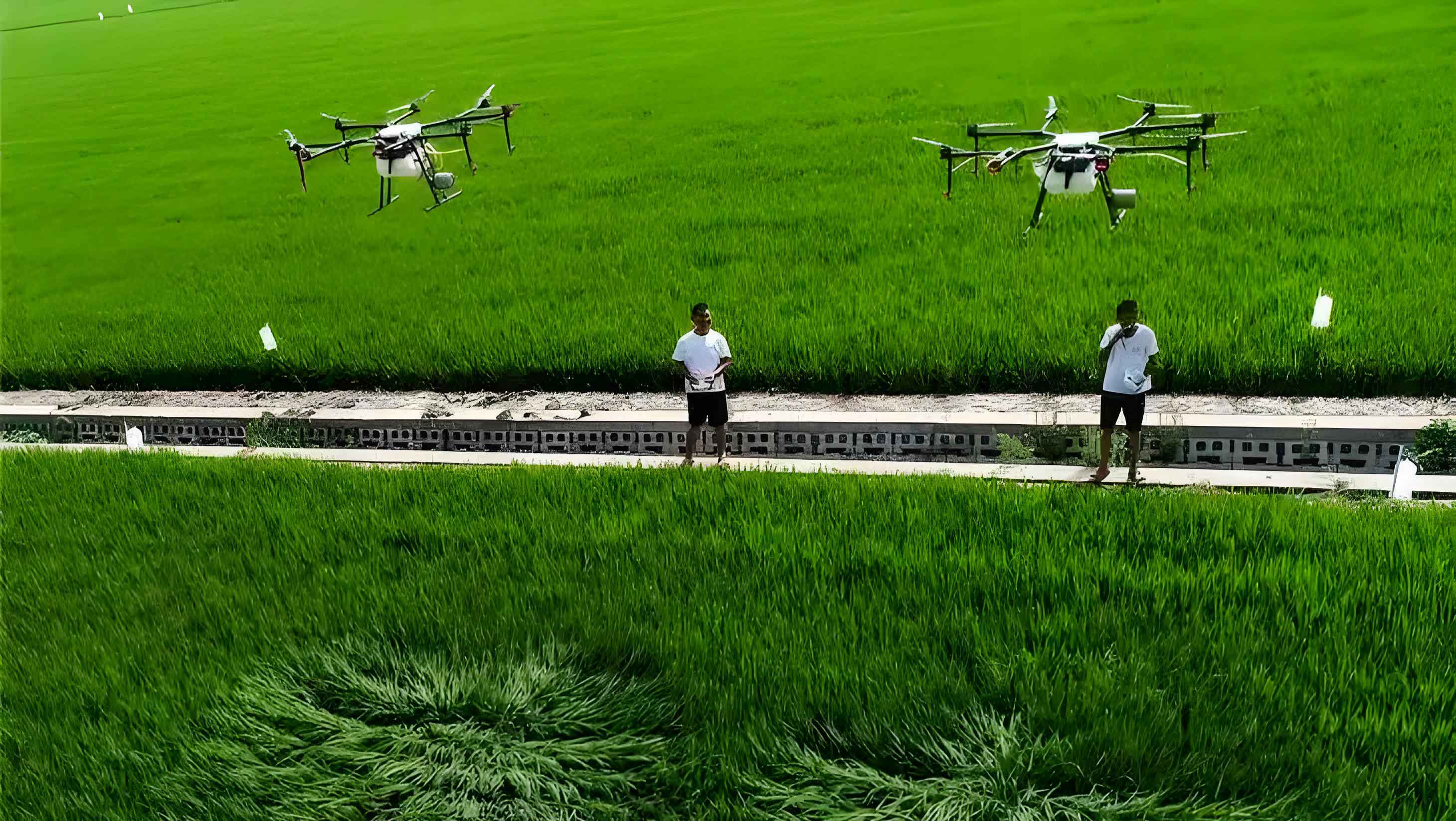
An agricultural drone is an unmanned aerial vehicle designed for plant protection operations. It is a high-tech device used to ensure effective crop pest control, primarily operated via ground remote control by personnel to conduct pesticide spraying. Utilizing agricultural drones for aerial spraying operations can mitigate the impact of pests and diseases during crop growth, significantly increase crop yields, enable precise pesticide application, reduce pesticide residues, and minimize environmental pollution. Since 2016, the domestic agricultural drone industry has entered a phase of rapid development, with major manufacturers investing in research and development, leading to improvements in product performance and cost-effectiveness. Government support through policies and purchase subsidies, along with the establishment of industry standards, has further standardized and accelerated the adoption of agricultural drones.
In our agricultural development journey, plant protection operations have evolved from entirely manual pesticide application to semi-mechanical methods using spray cans and hand-pumped sprayers, and now to a combination of backpack electric sprayers and agricultural drones. This progression has resulted in increasing production efficiency and cost savings. In 2014, our agricultural department first invited companies to demonstrate electric agricultural drones for aerial spraying in a local town. The advantages of these agricultural drones gradually gained recognition among farmers and cooperatives, leading to their acceptance and promotion. In 2019, purchase subsidies for agricultural drones were piloted in our province, and our center began accepting subsidy applications for the first agricultural drone on September 29 of that year. From 2019 to 2020, 11 cooperatives in our county utilized agricultural machinery purchase subsidies to acquire 42 agricultural drones from six manufacturers, including models from leading companies, with subsidy funds amounting to 672,000 yuan. Specifically, 27 units were subsidized in 2019 and 15 in 2020. By the end of 2021, the total number of agricultural drones in our county had reached 60 units.
The main crops in our region include sugarcane, rice, corn, tobacco, and potatoes. In 2021, the total sown area of crops was 60,700 hectares, with pest and disease occurrence area reaching 107,700 hectare-times and comprehensive control area at 167,200 hectare-times. Since the introduction of agricultural drones for control operations in 2018, the treated area has grown rapidly, with a cumulative total of 31,620 hectares. The annual breakdown is as follows: 2,400 hectares in 2018 (973 hectares for sugarcane, 1,361 hectares for rice, and 95 hectares for other crops), 5,793 hectares in 2019 (3,900 hectares for sugarcane, 1,346 hectares for rice, and 253 hectares for other crops), 8,393 hectares in 2020 (3,608 hectares for sugarcane and 4,713 hectares for rice), and 15,038 hectares in 2021 (including cross-regional operations by drones from outside the county).
| Aspect | Backpack Electric Sprayer | Agricultural Drone (Small, 8 kg payload) |
|---|---|---|
| Daily Operational Area per Person | Approximately 0.7 hectares | Up to 4.7 hectares per hour (with 2 operators) |
| Pesticide Usage per Hectare | ≥30 kg of liquid | Approximately 0.5 kg of liquid |
| Operational Cost per Hectare (2021 average) | 450 yuan | 225 yuan |
| Pesticide Attachment Rate | Up to 15% (often below 10%) | Enhanced due to downdraft, reducing drift |
| Environmental Adaptability | Limited by terrain and ground conditions | Suitable for hills, slopes, and complex terrain |
| Training Duration for Operators | Minimal, but labor-intensive | 7–30 days of specialized training |
The advantages of using agricultural drones for aerial spraying are manifold. Firstly, operational efficiency is high. A strong laborer using a backpack electric sprayer can cover about 0.7 hectares per day, whereas a small agricultural drone with an 8 kg payload, operated by two people, can complete approximately 4.7 hectares per hour under continuous crop conditions. This makes the agricultural drone dozens of times more efficient, allowing for timely pesticide application during favorable weather and supporting large-scale production. Secondly, agricultural drones save pesticides. While backpack sprayers require over 30 kg of liquid per hectare, agricultural drones use only about 0.5 kg per hectare, demonstrating significant pesticide reduction. Thirdly, cost savings and increased benefits are achieved. In 2021, the average operational cost per hectare was 450 yuan for backpack sprayers and 225 yuan for agricultural drones, resulting in savings of 225 yuan per hectare and indirect income gains for farmers.
Fourthly, safety is enhanced, and ecological benefits are evident. Manual pesticide spraying is labor-intensive and risky, with frequent incidents of pesticide poisoning due to inadequate protection and exposure. Agricultural drones allow remote operation, minimizing human contact with pesticides and improving safety. Moreover, the fine mist generated by agricultural drones improves pesticide attachment and penetration, reduces runoff, and lowers environmental pollution from pesticides, contributing to ecological sustainability. Fifthly, operational quality is superior. Backpack sprayers typically achieve pesticide attachment rates below 15%, leading to significant loss into soil, water, and air. In contrast, the downdraft from agricultural drone rotors accelerates pesticide droplets, improving attachment and penetration, thus achieving better control with less pesticide. Sixthly, environmental adaptability is better; agricultural drones are suitable for complex terrains like hills and slopes,不受地形限制. Seventhly, costs are relatively low, and operation is straightforward. Electric agricultural drones are compact, lightweight, have low depreciation, are easy to maintain, and operators can master basics after 7–30 days of training.
From our analysis, the necessity of promoting agricultural drones in our region stems from demographic shifts. With an aging population and rural labor migration, agricultural labor costs are rising rapidly. Census data shows a decline in the working-age population and a reduction in rural residents, making mechanization essential to alleviate labor shortages and reduce costs. Since 2014, the proven efficiency, cost savings, and safety of agricultural drones have made their adoption increasingly necessary. The feasibility is supported by several factors: our region has a solid agricultural mechanization foundation, with major crops like sugarcane and rice achieving multi-stage or full mechanization; farmers have high acceptance of machinery; crop planting areas are substantial, with sugarcane at 20,013 hectares, rice at 10,540 hectares, corn at 8,720 hectares, and others in 2021, creating demand for agricultural drones; land is relatively flat and concentrated, with improved infrastructure from projects; and climatic conditions, such as average humidity of 79% and low wind speeds, favor agricultural drone operations.
| Crop Type | Planting Area (hectares) |
|---|---|
| Sugarcane | 20,013 |
| Rice | 10,540 |
| Corn | 8,720 |
| Legumes | 960 |
| Wheat | 773 |
| Potatoes and Tubers | 2,113 |
| Tobacco | 3,106 |
| Mulberry | 3,533 |
To estimate the required number of agricultural drones, we can use a formula based on operational efficiency and crop area. Let \( A \) be the total crop area needing protection, \( E \) be the daily operational area per agricultural drone, and \( D \) be the number of operating days. The required number of agricultural drones \( N \) can be approximated as:
$$ N = \frac{A}{E \times D} $$
For instance, with major crops covering around 50,000 hectares and an agricultural drone operating 4.7 hectares per hour over 8 hours daily, \( E = 37.6 \) hectares per day. Assuming a 30-day window for pest control, \( D = 30 \), then:
$$ N = \frac{50000}{37.6 \times 30} \approx 44.3 $$
Factoring in downtime and multiple applications, we estimate a need for about 160 agricultural drones to meet regional demands, highlighting the growth potential.
Despite the advantages, several shortcomings hinder the widespread application of agricultural drones. Firstly, electric agricultural drones generally have limited endurance, with pure operational time often between 8 to 15 minutes, and lithium battery packs are relatively expensive. Secondly, due to the rotor downdraft, the effectiveness of agricultural drones for weed control in dry crops like sugarcane and corn is suboptimal. Thirdly, agricultural drones spray from above, making it difficult to reach the lower stems of tall, densely planted crops like sugarcane, reducing efficacy against stem pests. Fourthly, operations are highly susceptible to convective weather conditions such as wind, rain, and thunderstorms. Fifthly, crop production areas are often fragmented, with mixed cropping patterns and uncoordinated agronomic practices, complicating aerial spraying. For example, mulberry crops are sensitive to pesticides, and imprecise spraying can lead to contamination and economic losses. Sixthly, the high purchase price of agricultural drones, ranging from 60,000 to 200,000 yuan, is a major barrier. Seventhly,配套技术服务 and personnel training systems are inadequate. After-sales services are limited in border areas like ours, with diverse drone models and low market share per brand, hindering timely repairs. Training provided by sales companies is often non-standardized and of low quality. Eighthly, purchase subsidies have not been常态化; while subsidies were available in 2019 and 2020, agricultural drones were excluded from the subsidy list in 2021, affecting farmer willingness to invest.
| Challenge | Description | Impact on Adoption |
|---|---|---|
| Limited Endurance | Short flight times (8–15 min) and costly batteries | Reduces continuous operation capability |
| Weed Control Efficacy | Poor performance in dry crops due to downdraft | Limits use for certain applications |
| Tall Crop Limitations | Inability to treat lower stems of dense crops | Decreases effectiveness for specific pests |
| Weather Dependency | Sensitive to wind, rain, and thunderstorms | Causes operational delays and inefficiencies |
| Fragmented Landholding | Small, mixed plots with varied crops | Complicates large-scale aerial spraying |
| High Purchase Price | Costs from 60,000 to 200,000 yuan per unit | Deters individual farmers and small cooperatives |
| Inadequate Services | Lack of local repair points and standardized training | Leads to downtime and skill gaps |
| Unstable Subsidies | Subsidies not consistently included in programs | Reduces financial incentive for purchase |
To address these issues, we propose the following countermeasures and recommendations. First, strengthen demonstration and training to promote plant protection mechanization technology. Agricultural and plant protection departments should recommend high-quality agricultural drone products suited to local conditions. Increase experimental demonstrations to推广 efficient and precise machinery. In plain areas and for short-stature crops like rice, phase out low-efficiency sprayers. Utilize rural night schools and farmer training programs to conduct sessions on the use, maintenance, and repair of agricultural drones.
Second, enhance collaboration to foster professional services. Focus on cultivating and developing农民专业合作社, providing guidance and support to build基层专业化防治组织. Encourage cooperatives to adopt agricultural drones, improve utilization rates, and increase operational benefits. Integrate promotion efforts with cooperative development, seek projects and funds, and leverage the complementary strengths of plant protection, agricultural machinery management, and human resource training departments to prioritize the growth of professional service organizations.
Third, conduct rigorous screening of plant protection equipment brands to increase market share of quality products. Secure funding for equipment trials and demonstrations. Perform comparative tests of various sprayers and new models across different crops, followed by large-scale demonstrations. From existing equipment, select agricultural drones that offer good quality and affordability,加大宣传力度 to guide purchases, build market share, and incentivize manufacturers to establish维修网点 for after-sales service.
Fourth, advocate for financial support. The inclusion of agricultural drones in routine agricultural machinery purchase subsidy programs significantly influences farmer adoption. We should actively push for agricultural drones to be纳入常态化补贴项目, with逐年提高补贴金额 to expand ownership. Additionally, pilot programs could include agricultural drones in报废购置补贴范围 to accelerate model upgrades. A cost-benefit formula can illustrate the impact: let \( C_d \) be the cost of an agricultural drone, \( S \) be the subsidy rate, and \( B \) be the annual benefit from use. The net benefit \( NB \) is:
$$ NB = B – (C_d \times (1 – S)) $$
With higher \( S \), \( NB \) increases, making agricultural drones more attractive. For example, if \( C_d = 100,000 \) yuan, \( S = 30\% \), and \( B = 50,000 \) yuan annually, then:
$$ NB = 50000 – (100000 \times 0.7) = 50000 – 70000 = -20000 $$
但 with \( S = 50\% \):
$$ NB = 50000 – (100000 \times 0.5) = 50000 – 50000 = 0 $$
And with \( S = 70\% \):
$$ NB = 50000 – (100000 \times 0.3) = 50000 – 30000 = 20000 $$
This shows how subsidies can turn losses into profits, underscoring their importance.
In conclusion, modern agriculture demands efficient plant protection equipment, and enhancing the mechanization level of pest control is imperative. The development and application of agricultural drones as新型植保机械 are essential. Based on the current challenges in our region, we must improve and refine efforts through intensified technical training and demonstrations, active pursuit of financial subsidy projects, and gradual promotion of complementary tools like solar insecticidal lamps. This will help farmers align with agricultural modernization requirements, continuously enhance农产品质量安全, promote ecological environmental safety, and ultimately achieve increased farmer income and agricultural efficiency. From our experience, the strategic adoption of agricultural drones not only addresses immediate pest control needs but also paves the way for sustainable agricultural practices. As we move forward, continued innovation in agricultural drone technology, coupled with supportive policies and community engagement, will be key to unlocking their full potential in our region and beyond.
To further quantify the benefits, consider the cumulative effect of agricultural drone adoption over time. Let \( A_t \) be the treated area in year \( t \), \( \Delta C \) be the cost saving per hectare, and \( \Delta Y \) be the yield increase per hectare. The total economic impact \( I \) over \( n \) years can be expressed as:
$$ I = \sum_{t=1}^{n} (A_t \times (\Delta C + \Delta Y)) $$
For instance, with \( A_t \) growing from 2,400 hectares in 2018 to 15,038 hectares in 2021, \( \Delta C = 225 \) yuan/hectare, and \( \Delta Y \) estimated at 500 yuan/hectare from reduced pest damage, the impact becomes substantial, reinforcing the value of investing in agricultural drones.
In summary, our journey with agricultural drones highlights both promise and hurdles. By addressing the identified shortcomings through targeted strategies, we can harness the power of agricultural drones to transform plant protection, boost productivity, and ensure a greener future for agriculture. We remain committed to leading this change, fostering collaborations, and advocating for policies that support the widespread use of agricultural drones across diverse agricultural landscapes.