
In recent years, the application of agricultural drones in crop protection has gained significant attention due to their efficiency, reduced labor intensity, and minimal environmental impact. As an agricultural researcher, I have been involved in exploring how these advanced technologies can be optimized for specific crops, such as pitaya (Hylocereus undatus), which presents unique challenges due to its canopy structure. This study focuses on optimizing the operational parameters of two types of agricultural drones to enhance droplet deposition and distribution within the pitaya canopy, thereby improving pesticide efficacy and reducing waste.
The use of agricultural drones has revolutionized plant protection by enabling precise spraying with lower liquid volumes compared to traditional methods. For pitaya, which is susceptible to diseases like ulcer and anthracnose, effective spray coverage is crucial. However, the canopy characteristics of pitaya—with its simplified, rod-like stems and minimal leaf surface—require tailored approaches for drone-based spraying. In this work, I aim to investigate how flight height, speed, and direction influence droplet density and coverage, using orthogonal experiments to derive optimal settings.
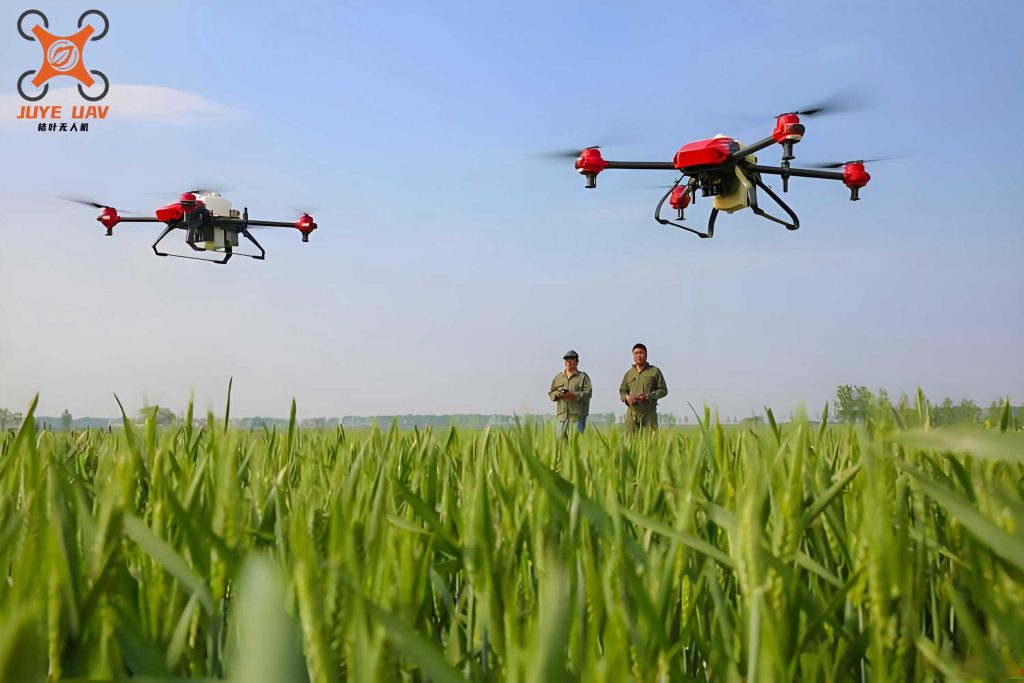
To conduct this research, I selected two common types of agricultural drones: a multi-rotor model (similar to the T16) and an electric single-rotor model (similar to the F5A). These agricultural drones differ in their aerodynamic properties, which can affect the downwash airflow and droplet penetration. The experiments were carried out in a pitaya plantation with rows spaced 5.0 meters apart and plants averaging 1.5 meters in height. I designed a three-factor, three-level orthogonal test to systematically evaluate the effects of flight height, flight speed, and route direction (parallel or perpendicular to planting rows). Each treatment involved spraying water at a constant volume of 45 L/ha to simulate pesticide application, with droplet collection cards placed at upper, middle, lower, and inner canopy positions to measure deposition.
The data collection involved assessing droplet density (number per cm²) and coverage ratio (percentage) using image analysis software. I employed range analysis to determine the primary and secondary factors influencing droplet distribution for each agricultural drone. This approach allowed me to identify the optimal combination of parameters that maximize spray effectiveness in the pitaya canopy. The results are summarized in the following tables and formulas to provide a clear, quantitative understanding.
For the multi-rotor agricultural drone, the orthogonal test matrix included flight heights of 1.0, 1.5, and 2.0 meters, speeds of 3.0, 4.0, and 5.0 m/s, and route directions. The droplet deposition data revealed significant variations across canopy layers. I calculated the average values and ranges to prioritize factors. The key findings are presented in Table 1, which shows the droplet density under different parameter combinations.
| Test Group | Flight Height (m) | Flight Speed (m/s) | Route Direction | Upper Layer Density (no./cm²) | Middle Layer Density (no./cm²) | Lower Layer Density (no./cm²) | Inner Layer Density (no./cm²) |
|---|---|---|---|---|---|---|---|
| 1 | 1.0 | 3.0 | Perpendicular | 28.66 | 45.25 | 79.85 | 21.30 |
| 2 | 1.5 | 4.0 | Perpendicular | 30.50 | 37.45 | 35.63 | 22.07 |
| 3 | 2.0 | 5.0 | Perpendicular | 30.69 | 29.48 | 30.95 | 20.31 |
| 4 | 1.0 | 4.0 | Parallel | 34.07 | 23.64 | 30.85 | 16.62 |
| 5 | 1.5 | 5.0 | Parallel | 37.39 | 35.13 | 42.32 | 15.76 |
| 6 | 2.0 | 3.0 | Parallel | 37.81 | 34.16 | 44.42 | 25.57 |
| 7 | 1.0 | 5.0 | Parallel | 29.18 | 28.48 | 37.68 | 29.32 |
| 8 | 1.5 | 3.0 | Parallel | 31.74 | 18.18 | 16.56 | 28.04 |
| 9 | 2.0 | 4.0 | Parallel | 19.72 | 19.03 | 27.09 | 13.57 |
From this data, I performed range analysis to determine the influence of each factor. For droplet density, the range values indicated that flight height had the greatest effect, followed by flight speed and route direction. This can be expressed mathematically by calculating the average responses for each level. Let \( K_i \) represent the sum of results for level \( i \), and \( \bar{K}_i \) the average. The range \( R \) is given by:
$$ R = \max(\bar{K}_i) – \min(\bar{K}_i) $$
For the multi-rotor agricultural drone, the ranges for flight height, speed, and direction were computed, confirming that lower heights and slower speeds enhanced deposition. The optimal parameters were identified as a flight height of 1.0 m, speed of 3.0 m/s, and either parallel or perpendicular route direction. Similarly, for droplet coverage, I analyzed the data using the same method, with results shown in Table 2.
| Test Group | Flight Height (m) | Flight Speed (m/s) | Route Direction | Upper Layer Coverage (%) | Middle Layer Coverage (%) | Lower Layer Coverage (%) | Inner Layer Coverage (%) |
|---|---|---|---|---|---|---|---|
| 1 | 1.0 | 3.0 | Perpendicular | 4.16 | 6.56 | 12.04 | 2.82 |
| 2 | 1.5 | 4.0 | Perpendicular | 5.90 | 6.74 | 5.32 | 4.46 |
| 3 | 2.0 | 5.0 | Perpendicular | 7.56 | 6.42 | 5.16 | 2.88 |
| 4 | 1.0 | 4.0 | Parallel | 9.42 | 5.44 | 6.08 | 3.34 |
| 5 | 1.5 | 5.0 | Parallel | 9.04 | 6.36 | 7.52 | 2.98 |
| 6 | 2.0 | 3.0 | Parallel | 8.96 | 6.28 | 8.20 | 3.60 |
| 7 | 1.0 | 5.0 | Parallel | 5.26 | 5.16 | 6.12 | 5.92 |
| 8 | 1.5 | 3.0 | Parallel | 8.82 | 4.02 | 1.98 | 5.60 |
| 9 | 2.0 | 4.0 | Parallel | 5.70 | 5.00 | 4.10 | 1.66 |
The range analysis for coverage also highlighted flight height as the dominant factor, with optimal settings aligning with those for density. This consistency underscores the importance of parameter tuning for agricultural drones. To generalize these findings, I derived a formula to estimate droplet deposition based on key parameters. Let \( D \) represent droplet density, \( H \) flight height, \( S \) flight speed, and \( \theta \) a direction factor. A simplified linear model can be expressed as:
$$ D = \alpha – \beta H – \gamma S + \delta \theta $$
where \( \alpha, \beta, \gamma, \delta \) are coefficients determined from experimental data. For the multi-rotor agricultural drone, \( \beta \) and \( \gamma \) are positive, indicating that lower heights and speeds increase deposition. This model helps in predicting performance under varying conditions.
Turning to the electric single-rotor agricultural drone, the orthogonal test involved flight heights of 2.0, 3.0, and 4.0 meters, speeds of 2.0, 4.0, and 6.0 m/s, and route directions. The droplet deposition data, shown in Table 3, revealed different trends compared to the multi-rotor type.
| Test Group | Flight Height (m) | Flight Speed (m/s) | Route Direction | Upper Layer Density (no./cm²) | Middle Layer Density (no./cm²) | Lower Layer Density (no./cm²) | Inner Layer Density (no./cm²) |
|---|---|---|---|---|---|---|---|
| 1 | 2.0 | 2.0 | Perpendicular | 27.09 | 38.20 | 84.59 | 35.72 |
| 2 | 3.0 | 4.0 | Perpendicular | 16.57 | 18.04 | 13.11 | 14.88 |
| 3 | 4.0 | 6.0 | Perpendicular | 15.93 | 12.98 | 12.97 | 16.62 |
| 4 | 2.0 | 4.0 | Parallel | 38.88 | 26.14 | 34.57 | 25.16 |
| 5 | 3.0 | 6.0 | Parallel | 12.68 | 12.81 | 14.26 | 10.78 |
| 6 | 4.0 | 2.0 | Parallel | 33.79 | 24.47 | 72.28 | 14.40 |
| 7 | 2.0 | 6.0 | Parallel | 18.43 | 11.62 | 37.25 | 15.96 |
| 8 | 3.0 | 2.0 | Parallel | 26.36 | 24.63 | 77.97 | 17.61 |
| 9 | 4.0 | 4.0 | Parallel | 21.77 | 15.06 | 23.92 | 17.02 |
The range analysis for this agricultural drone indicated that flight speed was the primary factor affecting droplet distribution, followed by flight height and route direction. This contrasts with the multi-rotor type, highlighting how different drone designs influence spray dynamics. The optimal parameters for the single-rotor agricultural drone were a flight height of 2.0 m, speed of 2.0 m/s, and either parallel or perpendicular direction. The droplet coverage data, presented in Table 4, supported these conclusions.
| Test Group | Flight Height (m) | Flight Speed (m/s) | Route Direction | Upper Layer Coverage (%) | Middle Layer Coverage (%) | Lower Layer Coverage (%) | Inner Layer Coverage (%) |
|---|---|---|---|---|---|---|---|
| 1 | 2.0 | 2.0 | Perpendicular | 4.91 | 4.15 | 16.65 | 4.24 |
| 2 | 3.0 | 4.0 | Perpendicular | 1.10 | 1.19 | 1.30 | 0.88 |
| 3 | 4.0 | 6.0 | Perpendicular | 1.54 | 1.22 | 0.98 | 0.72 |
| 4 | 2.0 | 4.0 | Parallel | 5.34 | 3.55 | 3.81 | 2.73 |
| 5 | 3.0 | 6.0 | Parallel | 0.60 | 0.42 | 0.73 | 0.50 |
| 6 | 4.0 | 2.0 | Parallel | 10.57 | 3.84 | 11.72 | 2.09 |
| 7 | 2.0 | 6.0 | Parallel | 3.01 | 1.35 | 4.45 | 1.50 |
| 8 | 3.0 | 2.0 | Parallel | 4.53 | 4.25 | 9.53 | 1.98 |
| 9 | 4.0 | 4.0 | Parallel | 2.71 | 1.96 | 2.30 | 1.76 |
From these results, I observed that for both types of agricultural drones, lower flight speeds and heights generally improved droplet distribution and penetration in the pitaya canopy. This is likely due to the enhanced downwash airflow at lower altitudes, which pushes droplets deeper into the canopy. The simplified structure of pitaya, with minimal obstruction, allows for effective spray penetration when parameters are optimized. To quantify this relationship, I developed a more comprehensive formula that incorporates canopy characteristics. Let \( C \) represent canopy complexity (a dimensionless factor), and \( V \) the downwash velocity from the agricultural drone. The droplet deposition \( D \) can be modeled as:
$$ D = \frac{k \cdot V}{H \cdot S \cdot C} $$
where \( k \) is a constant specific to the agricultural drone type. This inverse proportionality highlights how increasing height or speed reduces deposition, especially in simple canopies like pitaya.
In discussion, these findings emphasize the importance of customizing agricultural drone operations based on crop and drone type. The multi-rotor agricultural drone showed greater sensitivity to flight height, while the single-rotor agricultural drone was more affected by speed. This divergence stems from differences in rotor configuration and airflow patterns. Agricultural drones with multiple rotors generate a more distributed downwash, which may be disrupted at higher heights, whereas single-rotor designs produce a concentrated airflow that benefits from slower speeds for better droplet settling. For pitaya growers, adopting these optimized parameters can lead to more efficient pesticide use, reduced environmental impact, and improved disease control.
Furthermore, the study reveals that agricultural drone spraying can achieve superior droplet deposition in the lower canopy layers compared to upper layers, which is advantageous for targeting pests and diseases that thrive in humid, sheltered areas. This aspect is critical for crops like pitaya, where lower stem regions are vulnerable to infections. The use of agricultural drones also aligns with sustainable agriculture goals by minimizing chemical runoff and operator exposure.
To enhance the practical application of these results, I recommend field validation under varying environmental conditions, such as wind and humidity, which can influence agricultural drone performance. Future research could explore advanced nozzle types or adjuvant formulations to further optimize spray quality. Additionally, integrating real-time sensors on agricultural drones could allow for adaptive parameter adjustment during flight, maximizing efficacy across diverse canopy structures.
In conclusion, this study successfully optimized the operational parameters for two types of agricultural drones spraying pitaya canopies. The multi-rotor agricultural drone performs best at a flight height of 1.0 m and speed of 3.0 m/s, while the electric single-rotor agricultural drone excels at 2.0 m height and 2.0 m/s speed, with route direction having minimal impact. These insights contribute to the growing body of knowledge on precision agriculture, demonstrating how agricultural drones can be tailored for specific crops to enhance plant protection outcomes. As agricultural drone technology continues to evolve, such optimizations will play a key role in promoting efficient and sustainable farming practices worldwide.