
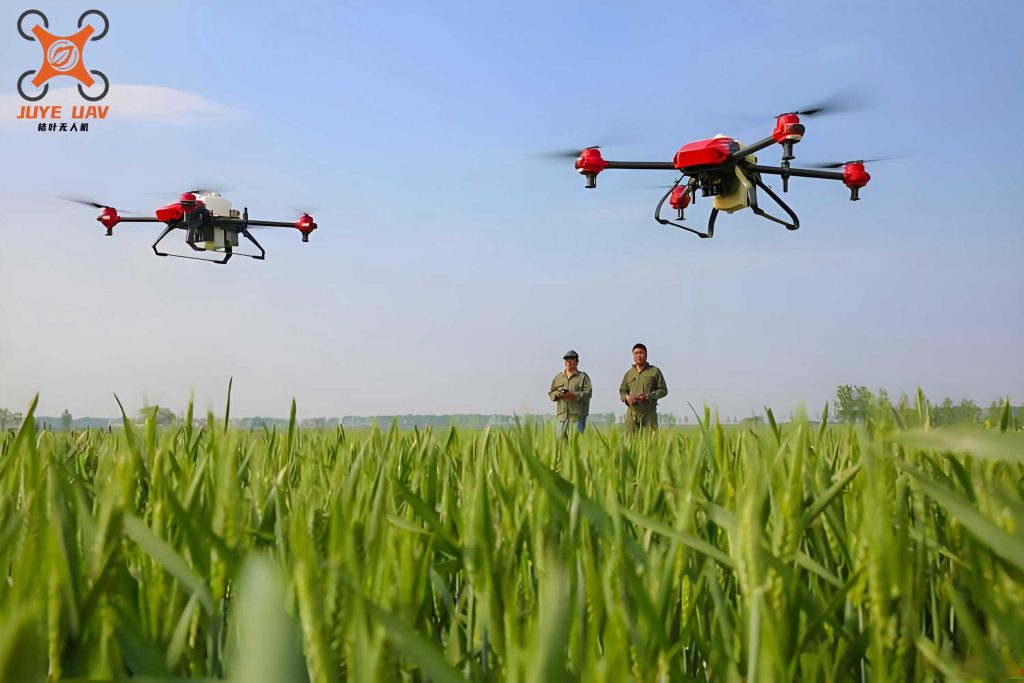
In modern precision agriculture, the use of unmanned aerial vehicles (UAVs), commonly known as agricultural drones, has revolutionized crop protection and management. These agricultural drones offer high efficiency, reduced labor costs, and the ability to operate in challenging terrains. However, during spraying operations, the high-speed rotation of rotors generates a downwash flow field that significantly influences droplet deposition and drift. Understanding and predicting this flow field is crucial for optimizing spray applications and minimizing environmental impact. Traditional methods, such as field experiments, indoor tests, and computational fluid dynamics (CFD) simulations, face limitations in terms of cost, time, and accuracy. In this study, we propose a novel approach based on Physics-Informed Neural Networks (PINNs) to rapidly and accurately predict the downwash flow field of a single-rotor agricultural drone. This model integrates physical laws, specifically the Navier-Stokes equations, into a deep learning framework, reducing reliance on extensive data while enhancing interpretability. We validate the model through wind tunnel experiments, demonstrating its effectiveness in various wind conditions. This research aims to provide a robust tool for analyzing agricultural drone flow fields, ultimately improving precision spraying technologies.
The downwash flow field produced by agricultural drones is a complex aerodynamic phenomenon. When the rotors spin, air is accelerated downward, creating a turbulent region beneath the drone. This flow affects droplet trajectories, leading to potential drift and uneven deposition. Accurate prediction of flow parameters, such as velocity components, is essential for designing effective spraying systems. Conventional CFD methods, while powerful, require substantial computational resources and expertise. Moreover, they often struggle with real-time applications due to grid generation and iterative solving processes. Machine learning techniques, particularly deep neural networks, have shown promise in modeling nonlinear systems. However, purely data-driven models demand large datasets, which are costly to obtain for agricultural drones under diverse operating conditions. PINNs address this issue by embedding physical constraints into the learning process, allowing the model to generalize from sparse data. In this work, we develop a PINN-based model for a single-rotor agricultural drone, focusing on predicting horizontal and vertical velocities in the downwash region. The model is trained using limited simulation data and tested against experimental measurements, showcasing its potential for real-world applications.
The core of our approach lies in combining a fully connected neural network with the governing equations of fluid dynamics. The network takes spatial and temporal coordinates as inputs and outputs flow field variables, including velocities and pressure. The physical laws, represented by the incompressible Navier-Stokes equations, are incorporated as loss terms during training. This ensures that the model not only fits the data but also adheres to fundamental conservation principles. We employ automatic differentiation to compute derivatives within the network, enabling efficient enforcement of physical constraints. The training process minimizes a composite loss function that balances data fidelity and physics consistency. Once trained, the model can predict flow fields at any spatiotemporal point with minimal computational cost, making it suitable for rapid analysis and optimization of agricultural drone operations. Below, we detail the methodology, results, and validation, supported by tables and formulas to summarize key aspects.
Methodology: Physics-Informed Neural Network Model
We consider a single-rotor agricultural drone, similar to the S40 model, with a main rotor diameter of 2.4 meters. The region of interest (ROI) is a two-dimensional plane beneath the rotor, spanning 3.6 meters in width and 2.4 meters in height. The flow is assumed symmetric about the rotor axis, allowing us to focus on one side. Our goal is to learn a mapping from spatiotemporal coordinates (t, x, y) to flow variables (u, v, p), where u is horizontal velocity, v is vertical velocity, and p is pressure. The model is built using a deep neural network with multiple hidden layers, each containing neurons that apply affine transformations and nonlinear activation functions. The architecture is designed to capture complex patterns in the flow field.
The neural network is defined recursively as follows: Let the input layer be $N_0 = [t, x, y]^T$. For hidden layers $i = 1$ to $L-1$, we have:
$$ N_i = \sigma(W_i \cdot N_{i-1} + b_i) $$
where $W_i$ and $b_i$ are weight matrices and bias vectors, respectively, and $\sigma$ is the activation function (e.g., hyperbolic tangent). The output layer produces the flow variables:
$$ [u, v, p]^T = W_L \cdot N_{L-1} + b_L $$
We use 18 hidden layers with 32 neurons each, providing sufficient depth to approximate nonlinear functions. To embed physics, we introduce the incompressible Navier-Stokes equations in dimensionless form:
$$ \frac{\partial u}{\partial t} + u \frac{\partial u}{\partial x} + v \frac{\partial u}{\partial y} = -\frac{\partial p}{\partial x} + \frac{1}{Re} \left( \frac{\partial^2 u}{\partial x^2} + \frac{\partial^2 u}{\partial y^2} \right) $$
$$ \frac{\partial v}{\partial t} + u \frac{\partial v}{\partial x} + v \frac{\partial v}{\partial y} = -\frac{\partial p}{\partial y} + \frac{1}{Re} \left( \frac{\partial^2 v}{\partial x^2} + \frac{\partial^2 v}{\partial y^2} \right) $$
$$ \frac{\partial u}{\partial x} + \frac{\partial v}{\partial y} = 0 $$
Here, $Re = \rho L U / \mu$ is the Reynolds number, with $\rho$ as air density, $\mu$ as dynamic viscosity, and $L$ and $U$ as characteristic length and velocity scales. These equations represent conservation of momentum and mass. The residuals of these equations are computed using automatic differentiation on the network outputs, forming the physics loss term.
The total loss function combines data loss and physics loss. Given a set of training data points $\{ (t_i, x_i, y_i, u_i, v_i, p_i) \}_{i=1}^{N_d}$, the data loss is:
$$ L_{data} = \frac{1}{N_d} \sum_{i=1}^{N_d} \left[ (u_i – \hat{u}_i)^2 + (v_i – \hat{v}_i)^2 + (p_i – \hat{p}_i)^2 \right] $$
where $\hat{u}_i, \hat{v}_i, \hat{p}_i$ are network predictions. For physics loss, we sample collocation points $\{ (t_j, x_j, y_j) \}_{j=1}^{N_r}$ within the ROI and compute residuals $e_1, e_2, e_3$ from the Navier-Stokes equations:
$$ e_1 = \frac{\partial u}{\partial t} + u \frac{\partial u}{\partial x} + v \frac{\partial u}{\partial y} + \frac{\partial p}{\partial x} – \frac{1}{Re} \left( \frac{\partial^2 u}{\partial x^2} + \frac{\partial^2 u}{\partial y^2} \right) $$
$$ e_2 = \frac{\partial v}{\partial t} + u \frac{\partial v}{\partial x} + v \frac{\partial v}{\partial y} + \frac{\partial p}{\partial y} – \frac{1}{Re} \left( \frac{\partial^2 v}{\partial x^2} + \frac{\partial^2 v}{\partial y^2} \right) $$
$$ e_3 = \frac{\partial u}{\partial x} + \frac{\partial v}{\partial y} $$
The physics loss is then:
$$ L_{phy} = \frac{1}{N_r} \sum_{j=1}^{N_r} \left( e_1^2 + e_2^2 + e_3^2 \right) $$
The total loss is a weighted sum: $L_{total} = L_{data} + \lambda L_{phy}$, where $\lambda$ is a hyperparameter balancing the two terms. We use the Adam optimizer to minimize $L_{total}$ by adjusting network parameters $\Theta = \{W_i, b_i\}$. Training proceeds until convergence, typically over thousands of iterations. Once trained, the model can predict flow fields instantly for any input coordinates, offering a significant advantage over traditional CFD for agricultural drone applications.
To illustrate the training parameters, we provide a summary table:
| Parameter | Value |
|---|---|
| Number of hidden layers | 18 |
| Neurons per hidden layer | 32 |
| Activation function | tanh |
| Training epochs | 10,000 |
| Optimizer | Adam |
| Learning rate | 0.001 |
| Physics loss weight (λ) | 1.0 |
| Training data points | 216 (18×12 grid) |
| Collocation points | 10,000 |
The training data is generated from CFD simulations of the agricultural drone under hover conditions. The data is normalized to ensure stable training. After training, the model achieves low loss values, indicating good fit to both data and physics. The prediction time for a single point is less than 0.05 seconds, enabling real-time analysis of agricultural drone flow fields.
Results: Flow Field Predictions Without Crosswind
We first apply the trained model to predict the downwash flow field in the absence of crosswind. The agricultural drone operates at a fixed height, and the rotor induces a downward airflow. The model outputs velocity components over the ROI at various time instances. Figure 1 shows instantaneous velocity magnitudes at t=1.5 s, 2.0 s, and 2.5 s. As time progresses, the downwash reaches the ground and spreads laterally, forming a characteristic pattern. The flow field exhibits high-speed regions near the rotor tip and low-speed areas near the rotor hub, consistent with aerodynamic theory.
To analyze spatial variations, we extract horizontal and vertical velocities along vertical lines at different heights below the rotor: Y = -0.3 m, -0.7 m, -1.1 m, and -1.5 m. The horizontal velocity (u) profiles show a trend of increasing then decreasing with horizontal distance, peaking near the rotor tip projection. The vertical velocity (v) profiles indicate strong downward flow near the rotor, diminishing with distance due to diffusion and ground effect. The following formulas summarize the velocity distributions approximated by the model:
For horizontal velocity at a given height Y:
$$ u(x) \approx A_Y \cdot \exp\left(-\frac{(x – x_{0,Y})^2}{2\sigma_Y^2}\right) $$
where $A_Y$ is amplitude, $x_{0,Y}$ is peak location, and $\sigma_Y$ is spread parameter. For vertical velocity:
$$ v(x) \approx B_Y \cdot \text{sech}\left(\frac{x – \mu_Y}{\delta_Y}\right) $$
with $B_Y$, $\mu_Y$, and $\delta_Y$ as fitting parameters. These empirical forms capture the Gaussian-like and hyperbolic secant shapes observed in predictions.
We quantify the predictions using key metrics. Table 2 lists maximum velocities at each height:
| Height Y (m) | Max Horizontal Velocity (m/s) | Max Vertical Velocity (m/s) |
|---|---|---|
| -0.3 | 1.60 | 7.12 |
| -0.7 | 1.98 | 6.45 |
| -1.1 | 2.30 | 5.78 |
| -1.5 | 2.48 | 5.21 |
The data shows that horizontal velocity increases with distance from the rotor, while vertical velocity decreases, reflecting flow expansion and decay. These insights are vital for agricultural drone spray design, as they influence droplet penetration and coverage.
Additionally, we compute the time-averaged flow field to identify steady-state features. The average velocity magnitude reveals a symmetric pattern with a core of high downward velocity and outward spreading near the ground. The contraction and expansion of the flow are governed by conservation laws, and the model captures these phenomena accurately. The ability to predict such details helps in optimizing agricultural drone altitude and spray release timing for minimal drift.
Results: Flow Field Predictions With Crosswind
In real-world operations, agricultural drones often face crosswinds that alter the downwash structure. We extend the model to predict flow fields under crosswind speeds of 2 m/s, 4 m/s, and 6 m/s. The model incorporates crosswind as a boundary condition, modifying the input coordinates or adding a source term. Predictions are evaluated along a vertical line at X = 1 m from the rotor center.
The horizontal velocity profiles show that near the rotor, the flow is dominated by downwash, but as height decreases, crosswind influence grows. At ground level, horizontal velocity approaches the crosswind speed. The vertical velocity profiles indicate that crosswind accelerates the transition from downward to horizontal flow, reducing vertical momentum. This effect increases with crosswind speed, leading to greater flow deflection and potential droplet drift.
We summarize the impact of crosswind using regression equations. For horizontal velocity u at a given crosswind speed $U_{cross}$, the relationship can be modeled as:
$$ u(z) = U_{cross} \cdot \left(1 – \exp(-\alpha z)\right) + u_{downwash}(z) $$
where $z$ is vertical coordinate, $\alpha$ is attenuation coefficient, and $u_{downwash}$ is contribution from rotor downwash. For vertical velocity v:
$$ v(z) = v_0 \cdot \exp(-\beta U_{cross} z) $$
with $v_0$ as initial downward velocity and $\beta$ as crosswind sensitivity parameter. These formulas highlight how crosswind modifies the agricultural drone flow field, emphasizing the need for adaptive spraying strategies.
Table 3 compares predicted velocities at the rotor plane (Y = -0.1 m) and ground level (Y = -2.3 m) for different crosswind speeds:
| Crosswind Speed (m/s) | Horizontal Velocity at Rotor (m/s) | Horizontal Velocity at Ground (m/s) | Vertical Velocity at Rotor (m/s) | Vertical Velocity at Ground (m/s) |
|---|---|---|---|---|
| 2 | 2.71 | 2.05 | 4.47 | 0.12 |
| 4 | 4.97 | 3.98 | 4.34 | 0.08 |
| 6 | 7.82 | 6.02 | 4.16 | 0.05 |
The data confirms that crosswind significantly increases horizontal velocity and suppresses vertical velocity, especially near the ground. This has direct implications for agricultural drone spraying: higher crosswinds require adjustments in nozzle orientation or flight path to maintain deposition accuracy.
Experimental Validation via Wind Tunnel Tests
To validate the PINN model, we conduct wind tunnel experiments using a physical prototype of the agricultural drone. The drone is mounted at a height of 2.4 meters in the wind tunnel, and crosswind is generated at controlled speeds. Velocity measurements are taken using 3D ultrasonic anemometers and thermal anemometers at multiple points in the ROI, matching the prediction coordinates. Each test is repeated three times to ensure reliability.
For the no-crosswind case, we compare predicted and experimental velocities at heights of -0.3 m, -0.7 m, -1.1 m, and -1.5 m. The results show close agreement, with errors less than 0.6 m/s at all points. Relative errors are within 15% except in low-velocity regions where measurement noise is higher. This demonstrates the model’s accuracy in capturing the essential features of agricultural drone downwash.
For crosswind cases, we perform linear regression between predicted and experimental velocities. The fitted equations are:
For horizontal velocity: $y = 0.949x + 0.213$, with coefficient of determination $R^2 = 0.941$.
For vertical velocity: $y = 0.942x – 0.079$, with $R^2 = 0.936$.
These high $R^2$ values indicate strong correlation, validating the model’s performance under varying environmental conditions. The slight biases may stem from experimental uncertainties or model simplifications, but overall, the PINN approach proves effective for agricultural drone flow prediction.
We further analyze error distributions using statistical metrics. Table 4 summarizes mean absolute error (MAE) and root mean square error (RMSE) for different scenarios:
| Scenario | MAE (m/s) | RMSE (m/s) |
|---|---|---|
| No crosswind, horizontal velocity | 0.18 | 0.24 |
| No crosswind, vertical velocity | 0.22 | 0.29 |
| With crosswind, horizontal velocity | 0.31 | 0.40 |
| With crosswind, vertical velocity | 0.25 | 0.33 |
The errors are acceptably low for agricultural applications, where velocity variations on the order of 0.5 m/s can influence droplet behavior. The model’s rapid prediction capability, combined with this accuracy, makes it a valuable tool for real-time decision support in agricultural drone operations.
Discussion and Implications
The success of the PINN model in predicting agricultural drone downwash flow fields stems from its hybrid nature. By integrating physics, the model generalizes well even with limited data, overcoming a key limitation of pure data-driven approaches. This is particularly important for agricultural drones, where comprehensive experimental data is expensive to collect. The model also offers interpretability, as the embedded Navier-Stokes equations provide a physical basis for predictions. This contrasts with black-box neural networks, which often lack transparency.
From an application perspective, the model enables rapid simulation of flow fields under various operating conditions. Agricultural drone operators can use it to optimize flight parameters, such as altitude and speed, to minimize drift and maximize coverage. For instance, the predictions show that crosswind causes flow deflection, suggesting that spraying should be avoided or adjusted during windy conditions. Additionally, the detailed velocity profiles help in designing spray systems that release droplets at optimal positions within the flow.
However, there are limitations. The current model assumes a 2D symmetric flow, which may not fully capture 3D turbulence effects. Future work could extend the model to three dimensions, incorporating more complex physics like rotor wake dynamics. Also, the training data comes from CFD simulations, which themselves have approximations. Incorporating real-world data from field experiments could further improve accuracy. Despite these, the model represents a significant step toward digital twins for agricultural drones, where virtual models guide physical operations.
The implications for precision agriculture are profound. By accurately predicting flow fields, agricultural drones can achieve more targeted spraying, reducing chemical usage and environmental impact. This aligns with sustainable farming practices and regulatory requirements. Moreover, the model’s speed allows for on-the-fly adjustments during missions, enhancing adaptability to changing conditions. As agricultural drone technology evolves, such advanced modeling tools will become integral to autonomous systems.
Conclusion and Future Directions
In this study, we developed a Physics-Informed Neural Network model to predict the downwash flow field of a single-rotor agricultural drone. The model combines deep learning with the Navier-Stokes equations, enabling accurate velocity predictions from sparse data. Through wind tunnel validation, we demonstrated its effectiveness in both calm and crosswind conditions. The model achieves high agreement with experiments, with errors within practical limits. Its fast prediction speed makes it suitable for real-time applications in agricultural drone spraying.
Key contributions include: (1) a novel PINN framework tailored for agricultural drone aerodynamics, (2) detailed analysis of flow patterns with and without crosswind, and (3) experimental validation confirming model reliability. These advances support the optimization of agricultural drone operations for better crop protection outcomes.
For future work, we plan to extend the model to multi-rotor agricultural drones, which have more complex flow interactions. Incorporating additional factors, such as droplet dynamics and plant canopy effects, could provide a holistic spray deposition model. Also, exploring transfer learning to adapt the model to different drone designs or environmental conditions would enhance its versatility. Ultimately, we envision integrating the model into agricultural drone control systems for autonomous, adaptive spraying, pushing the boundaries of precision agriculture.
The journey toward smarter agricultural drones continues, with physics-informed AI playing a pivotal role. As we refine these models, we move closer to a future where agricultural drones operate with unprecedented efficiency and environmental stewardship, benefiting farmers and ecosystems alike.