
As a researcher in agricultural technology, I have observed the rapid evolution of agricultural drones and their transformative impact on modern farming. The integration of drones into seeding operations represents a significant leap forward, addressing long-standing challenges such as labor shortages, terrain limitations, and resource inefficiencies. In this article, I will delve into the current state of agricultural drone seeding technology, with a focus on strip-seeding devices, and explore their applications across various crops. The keyword “agricultural drone” will be frequently emphasized to underscore its centrality in this discussion. I aim to provide a comprehensive analysis, incorporating tables and formulas to summarize key points, while adhering to a first-person perspective as an observer and analyst in the field.
The global agricultural sector is undergoing a profound transformation, driven by the need for sustainability and efficiency. Traditional seeding methods, often reliant on manual labor or heavy machinery, face limitations in complex terrains and large-scale operations. Agricultural drones have emerged as a versatile solution, offering precision, speed, and adaptability. These unmanned aerial vehicles (UAVs) are equipped with specialized seeding devices that enable both broadcast and strip-seeding. Strip-seeding, in particular, has gained traction due to its ability to plant seeds in ordered rows, which enhances crop management and yield. In my analysis, I will examine the design and functionality of these strip-seeding devices, their performance in real-world applications, and future directions for innovation.
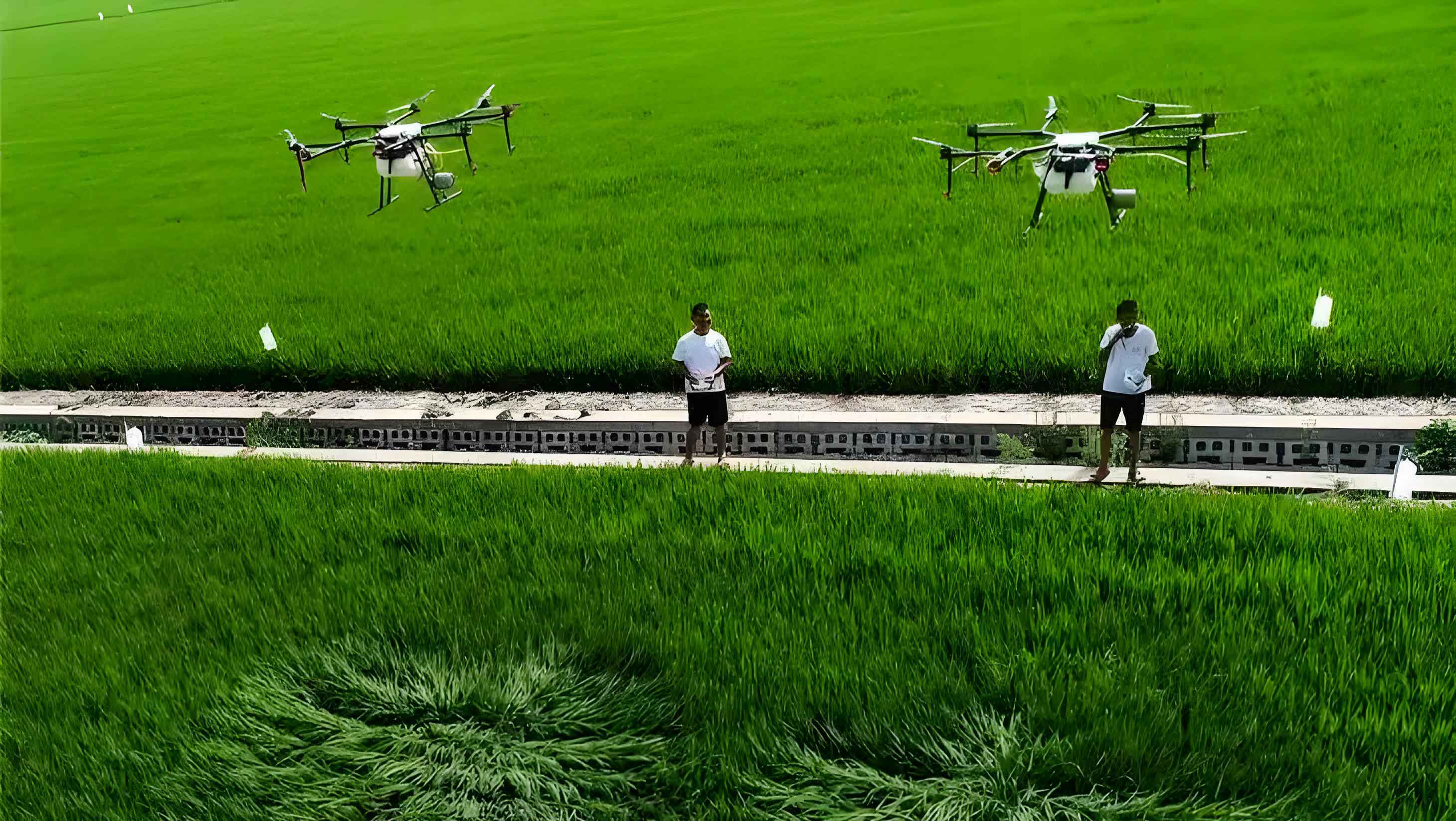
Agricultural drone seeding devices typically consist of several key components: a seed box, a seed-metering mechanism, and delivery tubes. The power source for seed ejection can be pneumatic or centrifugal. Pneumatic systems use air pressure to propel seeds, while centrifugal systems rely on rotating wheels to generate centrifugal force. Based on the design of the seeding units, these devices are categorized into two main types:单体排种 (single-unit seeding) and集体排种 (centralized seeding). I will use the terms “single-unit seeding” and “centralized seeding” throughout this article to avoid confusion. The choice between these types depends on factors such as crop requirements, terrain, and operational efficiency.
Single-unit seeding devices feature multiple independent seeding units, each with its own seed box and metering mechanism. These units are modular, allowing for flexible attachment and spacing adjustment on the agricultural drone platform. For instance, one design for rice and rapeseed seeding uses横杆 (crossbars) to fix units beneath a 15 kg agricultural drone. Each unit includes a seed box, seed-metering device, and delivery tube, with extended tubes to mitigate the effects of rotor downwash. Field trials have shown that this agricultural drone setup achieves good row formation for seedlings. However, rotor wind field disturbance remains a critical issue. To address this, some researchers have optimized seed plates with electromagnetic controls to adjust ejection velocity, though this adds complexity. Another approach focuses on versatility, with adjustable seed wheels to handle different seed sizes and shapes, enhancing the agricultural drone’s adaptability to multiple crops.
Centralized seeding devices, on the other hand, utilize a single seed box connected to multiple delivery tubes. This design simplifies structure and allows for uniform seed distribution across rows. One example involves a fixed frame with adjustable outlet spacings, enabling high-speed operations. However, it may suffer from limited row spacing adjustability and installation challenges. Rotor wind field disturbance is also prevalent here. Innovative solutions include leveraging the downwash wind to drive seed ejection, reducing energy consumption, or using mechanical systems like friction wheels to provide initial seed velocity. These advancements highlight the ongoing efforts to optimize agricultural drone seeding for precision and stability.
To summarize the differences between single-unit and centralized seeding devices, I have compiled the following table:
| Feature | Single-Unit Seeding | Centralized Seeding |
|---|---|---|
| Structure | Modular, independent units | Integrated, single seed box |
| Flexibility | High (easy to adjust spacing) | Moderate (limited row spacing) |
| Complexity | Higher due to multiple units | Lower, simpler design |
| Wind Field Impact | Addressed via extended tubes or ejection velocity control | Mitigated through wind utilization or mechanical acceleration |
| Applicability | Versatile for various crops | Efficient for high-speed operations |
The rotor wind field of agricultural drones significantly influences seeding accuracy. This disturbance can be modeled using fluid dynamics equations. For instance, the downwash velocity $v_d$ of an agricultural drone can be approximated by:
$$v_d = \sqrt{\frac{T}{2 \rho A}}$$
where $T$ is the thrust, $\rho$ is air density, and $A$ is the rotor disk area. The impact on seed trajectory can be described by modifying the equations of motion. If a seed is ejected with initial velocity $v_e$ at an angle $\theta$, its position over time $t$ under wind influence is:
$$x = v_e \cos(\theta) t + \int_0^t v_w(t) \, dt$$
$$y = v_e \sin(\theta) t – \frac{1}{2} g t^2$$
where $v_w(t)$ represents the wind velocity component from rotor downwash, and $g$ is gravity. Optimizing $v_e$ and $\theta$ can minimize deviation, which is crucial for agricultural drone seeding precision. Empirical studies show that with proper design, seeding accuracy can achieve centimeter-level precision, enhancing crop uniformity.
In terms of applications, agricultural drone seeding has been widely adopted for crops like rice, rapeseed, and wheat. The efficiency gains are substantial. For rice seeding, agricultural drones in regions like Wuhan have demonstrated an efficiency of 3.33 hectares per hour, 30 times faster than manual broadcasting. Cost savings exceed 150 yuan per mu, with yield increases around 8.5%. In Xinjiang, agricultural drones cover over 100,000 mu of rice fields daily, showcasing scalability. Similarly, for rapeseed, agricultural drones in Anhui province have achieved high yields of 3.561 tons per hectare through precise strip-seeding. In Hubei, an agricultural drone can seed 1.3 hectares in 8 minutes, significantly reducing labor. For wheat, agricultural drones in Sichuan province operate at 40 mu per hour, saving costs and ensuring timely planting.
To quantify the benefits of agricultural drone seeding across these crops, consider the following table comparing key metrics:
| Crop | Efficiency (hectares/hour) | Cost Savings (per unit area) | Yield Improvement | Key Regions |
|---|---|---|---|---|
| Rice | 3.33 | ~150 yuan/mu | ~8.5% | Wuhan, Xinjiang, Guangdong |
| Rapeseed | ~10 (estimated) | Significant labor reduction | Up to 3.561 t/ha | Anhui, Hubei |
| Wheat | ~2.67 (40 mu/hour) | >150 yuan/mu | Improved timeliness | Sichuan, Anhui |
The adoption of agricultural drone seeding is driven by its alignment with precision agriculture principles. The seeding rate $S_r$ can be optimized based on soil conditions and crop requirements. A common formula for determining the optimal seed count per area is:
$$S_r = \frac{D_s \times E_f}{G_r}$$
where $D_s$ is the desired plant density, $E_f$ is the expected germination efficiency, and $G_r$ is the germination rate. Agricultural drones enable real-time adjustment of $S_r$ using sensors and AI algorithms, enhancing resource utilization. For example, by integrating soil nutrient data, the agricultural drone can perform variable rate seeding, minimizing waste and maximizing yield.
Looking ahead, the future of agricultural drone seeding lies in lightweight, modular, and intelligent upgrades. Lightweight materials like carbon fiber can reduce the overall weight of the seeding device, improving the agricultural drone’s flight stability and endurance. Modular designs facilitate quick assembly and customization for different crops. Intelligent systems incorporate北斗 (Beidou) satellite navigation and AI for cm-level positioning and dynamic control. This allows the agricultural drone to adapt to complex terrains and optimize seeding paths autonomously. Furthermore, multifunctional integration is emerging, where agricultural drones combine seeding with fertilization, irrigation, and monitoring. For instance, an agricultural drone might simultaneously seeds and sprays fertilizers, reducing multiple passes over the field. The synergy between农机 (agricultural machinery) and农艺 (agronomy) is crucial; by tailoring seeding parameters to agronomic practices, agricultural drones can achieve better crop establishment and management.
In terms of technological advancements, the use of AI in agricultural drone seeding can be modeled through machine learning algorithms. For pattern recognition in field conditions, a neural network might process input data $X$ (e.g., soil moisture, topography) to output optimal seeding parameters $Y$. The learning process minimizes a loss function $L$:
$$L = \frac{1}{N} \sum_{i=1}^N (Y_i – \hat{Y}_i)^2 + \lambda \| \theta \|^2$$
where $N$ is the number of samples, $\hat{Y}_i$ is the predicted output, $\theta$ represents model parameters, and $\lambda$ is a regularization term. This enables the agricultural drone to make data-driven decisions, improving seeding accuracy over time. Additionally, the integration of IoT sensors allows for continuous monitoring, creating a feedback loop for adaptive control.
The economic impact of agricultural drone seeding can be analyzed using cost-benefit models. The total cost $C_t$ of seeding per hectare includes fixed costs $C_f$ (e.g., agricultural drone purchase) and variable costs $C_v$ (e.g., energy, maintenance). The benefit $B$ is derived from yield increase and labor savings. The net profit $P$ per hectare is:
$$P = B – C_t = (Y \times P_y + S_l) – (C_f + C_v)$$
where $Y$ is yield, $P_y$ is crop price, and $S_l$ is labor savings. Studies indicate that agricultural drone seeding can reduce costs by up to 45.65% in rice planting, making it a viable investment for farmers. As the technology matures, economies of scale are expected to further lower $C_f$, accelerating adoption.
To illustrate the progression of agricultural drone seeding technology, I have prepared a timeline table highlighting key developments:
| Year | Development | Impact on Agricultural Drone Seeding |
|---|---|---|
| 2019 | Initial推广 (promotion) in Wuhan for rice | Demonstrated 30x efficiency gain over manual methods |
| 2020 | Design of versatile single-unit devices for rice and rapeseed | Enhanced adaptability to multiple crops |
| 2022 | Integration of AI and北斗 navigation | Improved precision and autonomous operation |
| 2024 | Large-scale application in Xinjiang rice fields | Scalability proven for over 100,000 mu |
| 2025 | Focus on lightweight and multifunctional designs | Reduced costs and increased versatility |
In conclusion, as an advocate for agricultural innovation, I believe that agricultural drone seeding technology represents a cornerstone of modern farming. The research on strip-seeding devices has evolved from basic designs to sophisticated systems that address challenges like rotor wind field disturbance. Applications in rice, rapeseed, and wheat have validated the efficiency and cost-effectiveness of agricultural drones. Future trends point toward smarter, more integrated solutions that align with sustainable agriculture goals. By leveraging advancements in materials, AI, and agronomy, agricultural drones will continue to revolutionize seeding practices, contributing to food security and rural prosperity. The keyword “agricultural drone” encapsulates this journey—a tool that not only enhances productivity but also paves the way for a more resilient agricultural ecosystem.
To further elaborate on the technical aspects, let’s consider the design optimization of seed-metering mechanisms. The performance of a centrifugal seed-metering wheel can be evaluated using the ejection velocity $v_e$, which depends on the angular velocity $\omega$ and radius $r$:
$$v_e = \omega r$$
The required $\omega$ to overcome wind drag $F_d$ can be derived from Newton’s second law. If $m_s$ is the seed mass, the force balance is:
$$m_s \frac{dv_e}{dt} = F_c – F_d$$
where $F_c = m_s \omega^2 r$ is the centrifugal force, and $F_d = \frac{1}{2} C_d \rho A_s v_e^2$ is the drag force, with $C_d$ as drag coefficient and $A_s$ as seed cross-sectional area. Solving this differential equation helps in designing wheels that maintain consistent $v_e$ for accurate seeding by the agricultural drone.
Moreover, the uniformity of seed distribution can be quantified using the coefficient of variation $CV$:
$$CV = \frac{\sigma}{\mu} \times 100\%$$
where $\sigma$ is the standard deviation of seed spacing, and $\mu$ is the mean spacing. For agricultural drone seeding, a low $CV$ indicates high precision. Field tests have reported $CV$ values below 10% for well-designed systems, rivaling traditional mechanical seeders.
Another critical factor is battery life and energy consumption. The power $P_d$ required by an agricultural drone for seeding operations includes lift power $P_l$ and seeding device power $P_s$:
$$P_d = P_l + P_s = \frac{T v_h}{\eta} + P_s$$
where $v_h$ is the horizontal velocity, and $\eta$ is the propulsion efficiency. Lightweight seeding devices reduce $P_s$, extending flight time. For instance, using carbon fiber components can cut device weight by 30%, directly enhancing the agricultural drone’s endurance for large-area seeding.
In terms of environmental impact, agricultural drone seeding reduces soil compaction compared to tractors, preserving soil health. The reduction in fuel usage also lowers carbon emissions. A simple model for emissions savings $E_s$ per hectare is:
$$E_s = F_t \times EF – F_d \times EF_d$$
where $F_t$ and $F_d$ are fuel consumption for tractors and agricultural drones, respectively, and $EF$ are emission factors. Studies suggest that agricultural drones can cut emissions by up to 90% in seeding operations, aligning with green farming initiatives.
As I reflect on the trajectory of agricultural drone seeding, it is clear that interdisciplinary collaboration is key. Engineers, agronomists, and data scientists must work together to refine these systems. For example, calibrating seeding depth $d_s$ for different soil types involves understanding soil mechanics. The optimal $d_s$ can be expressed as:
$$d_s = k \cdot \sqrt{\frac{\sigma_t}{\rho_s g}}$$
where $k$ is a crop-specific constant, $\sigma_t$ is soil tensile strength, and $\rho_s$ is soil density. Agricultural drones equipped with sensors can measure $\sigma_t$ in real-time and adjust $d_s$ accordingly, ensuring better seed germination.
To encapsulate the broader benefits, I present a final table summarizing the advantages of agricultural drone seeding over conventional methods:
| Aspect | Conventional Seeding | Agricultural Drone Seeding |
|---|---|---|
| Efficiency | Low (manual) or moderate (tractor) | High (3-10 ha/hour) |
| Precision | Variable, often low | High (cm-level accuracy) |
| Terrain Adaptability | Limited to flat areas | Excellent for complex terrains |
| Labor Dependency | High | Low (automated operations) |
| Environmental Impact | Higher soil compaction and emissions | Lower impact, sustainable |
| Cost Over Time | High operational costs | Reduced costs after initial investment |
In summary, the journey of agricultural drone seeding from niche experimentation to mainstream application underscores its potential. As I continue to monitor this field, I am optimistic about innovations such as swarm robotics, where multiple agricultural drones collaborate for large-scale seeding, and advanced AI models that predict crop outcomes based on seeding patterns. The keyword “agricultural drone” will undoubtedly remain at the forefront of agricultural discourse, symbolizing a shift toward smarter, more efficient farming. By embracing these technologies, we can address global food challenges and foster a sustainable future for agriculture.
Finally, I encourage stakeholders to invest in research and development for agricultural drone seeding. Collaborative efforts can lead to standardized protocols and regulatory frameworks, ensuring safe and effective deployment. As the technology evolves, the agricultural drone will not only be a tool for seeding but a central component of the digital farm, integrating with other smart systems for holistic crop management. The possibilities are vast, and I look forward to witnessing further breakthroughs that enhance the role of agricultural drones in feeding the world.