
In recent years, the application of agricultural drone technology has rapidly expanded, driven by advancements in performance and the pressing need to address labor shortages and aging populations in farming. As an enthusiast and researcher in this field, I have observed how agricultural drones offer efficient and labor-saving solutions, yet their integration into agriculture is fraught with challenges. This article aims to delve into the current state of agricultural drone adoption, analyze the associated risks, and propose comprehensive management strategies. Through detailed discussions, tables, and formulas, we will explore how to foster the healthy and orderly development of agricultural drone technology, ensuring its sustainability in modern agriculture.
The proliferation of agricultural drones is undeniable. By the end of 2022, China alone had a保有量 of 1.5 million植保 drones, covering a防治面积 of 1.04 billion hectares—nearly a quarter of the total crop pest control area nationwide. This dominance highlights the global leadership in both the number and application scale of agricultural drones. Beyond traditional plant protection, these devices are now integral to seeding, fertilization, and monitoring through搭载 sensors like spectrometers and high-resolution cameras. For instance, agricultural drones enable precision variable-rate applications of fertilizers and pesticides, significantly enhancing resource efficiency and reducing environmental impact. The following table summarizes key application scenarios and their benefits:
| Application Scenario | Description | Efficiency Gain |
|---|---|---|
| Plant Protection | Spraying pesticides via low-volume雾化 | Up to 50% reduction in water and chemical usage |
| Seeding | Precise播撒 of seeds using dedicated systems | Improves uniformity and reduces seed waste by 30% |
| Fertilization | Variable-rate application based on soil sensors | Boosts fertilizer utilization by 25-40% |
| Crop Monitoring | Real-time data collection on growth and pests | Enables early intervention, cutting losses by 20% |
The efficiency of agricultural drones can be quantified using formulas such as the operational efficiency metric:
$$ E = \frac{A}{T \times C} $$
where \( E \) is the efficiency (hectares per hour per unit cost), \( A \) is the area covered, \( T \) is the time taken, and \( C \) is the operational cost. This underscores the economic appeal of agricultural drones.
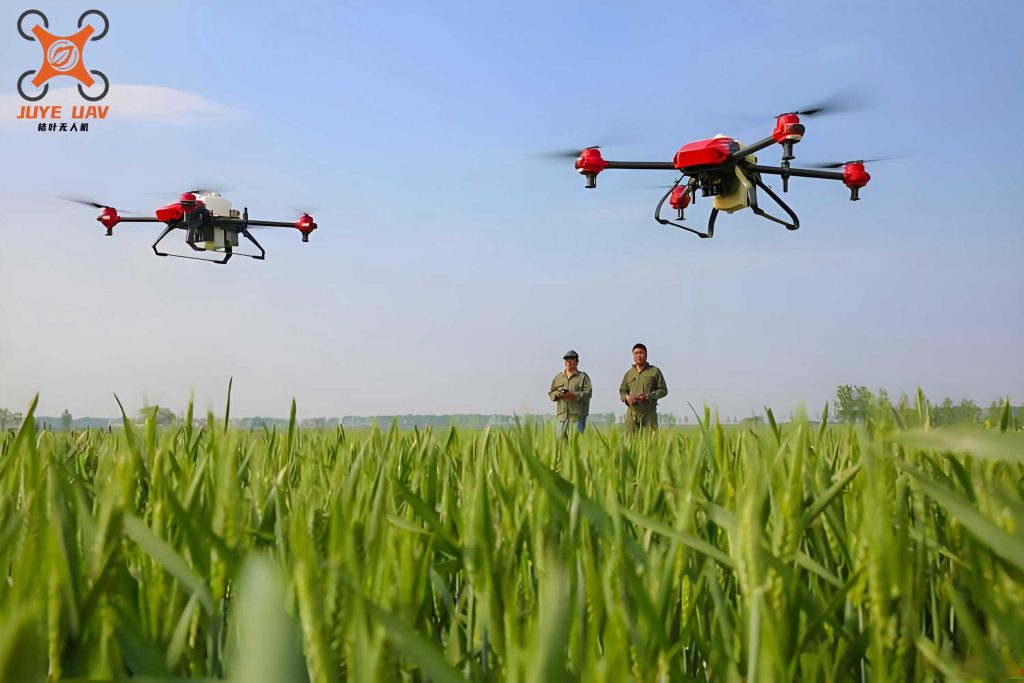
Despite these advancements, the use of agricultural drones introduces significant risks that demand attention. First, the absence of专用药剂 for drone applications is a critical gap. Current pesticide regulations, based on traditional equipment, do not account for the unique characteristics of agricultural drones, such as reduced water volume and enhanced droplet deposition. This mismatch can lead to over- or under-application, affecting efficacy and safety. For example, the deposition rate \( D_r \) for an agricultural drone can be modeled as:
$$ D_r = k \times \frac{Q}{v \times h} $$
where \( k \) is a constant, \( Q \) is the flow rate, \( v \) is the drone speed, and \( h \) is the飞行高度. Without tailored guidelines, this may延长安全间隔期, posing residue risks. The table below contrasts traditional and drone-based application parameters:
| Parameter | Traditional Sprayer | Agricultural Drone |
|---|---|---|
| Water Volume (L/ha) | 200-500 | 10-30 |
| Droplet Size (μm) | 200-400 | 100-200 |
| Deposition Rate (%) | 30-50 | 60-80 |
| Recommended Dosage | Based on label | Lacks standardization |
Second, the risk assessment体系 for agricultural drone operations remains underdeveloped.漂移 of pesticides due to factors like side winds poses threats to non-target organisms and the environment. Current models, such as the飘移 potential \( P_d \), can be expressed as:
$$ P_d = \alpha \times \frac{w \times s}{h^2} $$
where \( \alpha \) is an environmental factor, \( w \) is wind speed, \( s \) is drone speed, and \( h \) is height. However, data on ecological impacts, like effects on bees, are scarce. A comprehensive risk framework should integrate multiple variables, as shown in this risk score formula:
$$ R = \sum_{i=1}^{n} (W_i \times X_i) $$
where \( R \) is the total risk score, \( W_i \) are weights for factors (e.g., toxicity, exposure), and \( X_i \) are measured values. This highlights the need for robust studies to refine such models.
Third, regulatory oversight is often inadequate, leading to safety hazards. The rapid growth of agricultural drone usage has outpaced the establishment of national standards, with many regions relying on fragmented local guidelines. This results in inconsistent training and operational practices, increasing accidents. The table illustrates common监管 gaps:
| Area of Concern | Current Status | Potential Risk |
|---|---|---|
| Operator Certification | Varies by manufacturer training | Incompetent handling causing crashes |
| Equipment Standards | Limited national specifications | Mechanical failures during flight |
| Flight Regulations | Lack of统一 airspace rules | Collisions with other aircraft or structures |
| Environmental Compliance | Minimal monitoring of漂移 | Contamination of adjacent fields |
Fourth, pesticide drift from agricultural drones frequently causes crop damage disputes, complicating farmer维权.漂移 incidents are influenced by meteorological conditions, and even with safety buffers,非靶标 exposure occurs. The drift distance \( D \) can be estimated using:
$$ D = \beta \times \frac{w \times t}{h} $$
where \( \beta \) is a coefficient, \( w \) is wind velocity, \( t \) is time, and \( h \) is release height. This variability makes accountability challenging, especially in mixed farming landscapes. The lack of specialized agricultural forensic services exacerbates the issue, leaving farmers without recourse.
To mitigate these risks, I propose several规范化管理对策. First,完善农药登记管理制度 is essential. This involves establishing drone-specific pesticide registrations with clear dosage recommendations and safety intervals. A phased approach could include labeling requirements and efficacy trials for agricultural drones. The formula for adjusted dosage \( D_a \) might be:
$$ D_a = D_t \times \frac{E_t}{E_d} $$
where \( D_t \) is the traditional dosage, \( E_t \) is传统 efficacy, and \( E_d \) is drone efficacy. This ensures alignment with实际 needs.
Second,建立健全飞防风险评价体系 requires integrating scientific data into评估 models. We can adopt frameworks from countries like Japan, incorporating ecological and health metrics. For instance, a飘移 risk index \( I_d \) could be:
$$ I_d = \frac{C \times P_d}{T} $$
where \( C \) is chemical concentration, \( P_d \) is飘移 potential, and \( T \) is toxicity threshold. Regular updates based on field studies will enhance accuracy.
Third,拟定适合当地的无人机地方标准 should address regional agricultural diversity. Standards must cover technical specifications, operational protocols, and quality control. Below is a template for a local standard table:
| Component | Requirement | Example for Rice Paddies |
|---|---|---|
| Drone Performance | Minimum flight stability in winds ≤ 5 m/s | Tested in coastal regions |
| Spraying Accuracy | ≥90% deposition on target | Verified via tracer dyes |
| Operator Training | Certification hours ≥ 20 | Includes local pest modules |
| Environmental Safeguards | Buffer zones based on crop sensitivity | 50m for herbicide applications |
Fourth,农业相关部门加强监管 necessitates setting准入门槛 for operators and organizations. Regulatory bodies should mandate licensing, periodic audits, and incident reporting. A监管 effectiveness score \( S_r \) can be calculated as:
$$ S_r = \frac{N_c}{N_t} \times 100 $$
where \( N_c \) is number of compliant operations and \( N_t \) is total operations. This metric helps track progress.
Fifth,组建农业司法鉴定中心 is crucial for fair dispute resolution. These centers, possibly under agricultural departments or research institutes, would provide expert assessments of drone-related incidents. The process could involve standardized protocols, such as using公式 to quantify damage extent. For example, crop loss \( L \) might be:
$$ L = A \times Y \times P $$
where \( A \) is affected area, \( Y \) is yield potential, and \( P \) is market price. This透明 approach supports justice for farmers.
In conclusion, while agricultural drone technology holds immense promise for sustainable agriculture, its risks cannot be overlooked. Through systematic management—including regulatory refinements, risk assessment enhancements, local standards, stricter oversight, and judicial support—we can harness the benefits of agricultural drones while minimizing drawbacks. As we move forward, continuous innovation and collaboration will be key to ensuring that agricultural drones contribute positively to global food security and environmental stewardship. The journey ahead requires diligence, but with these strategies, I am optimistic about the future of agricultural drones in transforming farming practices.
To further illustrate the interplay of factors, consider this comprehensive risk-benefit analysis formula for agricultural drone adoption:
$$ B/R = \frac{\sum (E_i \times W_i)}{\sum (R_j \times V_j)} $$
where \( B/R \) is the benefit-risk ratio, \( E_i \) are economic and environmental benefits, \( W_i \) are weights, \( R_j \) are risks, and \( V_j \) are their severities. This holistic view underscores the need for balanced policies.
Ultimately, the success of agricultural drones depends on our ability to adapt and regulate. By embracing these对策, we can pave the way for safer, more efficient agricultural systems powered by advanced drone technology. Let us commit to this path, ensuring that every flight of an agricultural drone brings us closer to a greener and more productive world.