
As a researcher in the field of product design and unmanned aerial systems, I have dedicated significant effort to advancing the technology and aesthetics of agricultural drones. In this article, I will share my insights and experiences in designing a hexacopter agricultural drone, focusing on its造型 design, performance metrics, and practical applications. The agricultural drone has become an indispensable tool in modern farming, offering precision, efficiency, and sustainability. My work aims to optimize the造型 design of a six-rotor agricultural drone to enhance its aerodynamic efficiency, stability, and user-friendliness. Throughout this discussion, I will emphasize the importance of the agricultural drone in revolutionizing agriculture, and I will use various tables and formulas to summarize key aspects of the design process.
The integration of advanced design principles into the agricultural drone is crucial for its success in real-world scenarios. The hexacopter configuration, with six rotors, provides inherent redundancy and improved lift capacity, making it ideal for carrying heavy payloads such as pesticides or fertilizers. In my design approach, I prioritized a balance between form and function, ensuring that the agricultural drone not only performs optimally but also appeals to users through its ergonomic and aesthetic features. The following sections delve into the detailed methodologies, mathematical models, and design parameters that underpin this agricultural drone project.
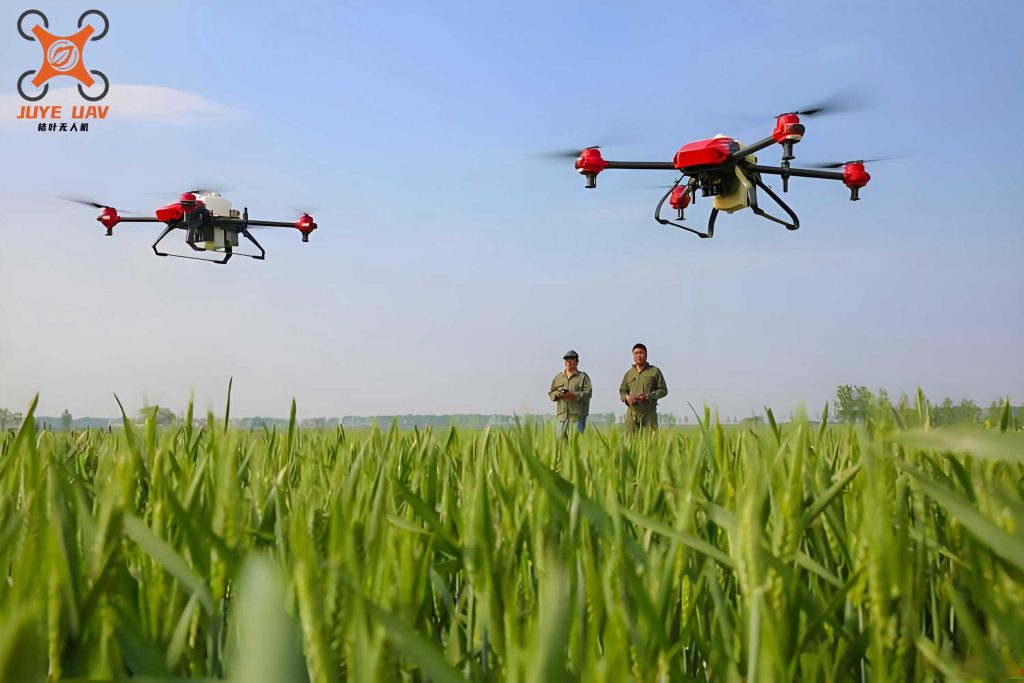
To begin, I established the primary design objectives for the agricultural drone. These objectives are centered on enhancing the efficiency, durability, and usability of the agricultural drone in various farming environments. Key goals include maximizing flight time, ensuring stable maneuverability under different wind conditions, and simplifying maintenance procedures. The agricultural drone must also comply with safety regulations and be cost-effective for farmers. By addressing these objectives, the agricultural drone can significantly contribute to precision agriculture, reducing resource waste and increasing crop yields.
In terms of methodology, I adopted a multi-disciplinary approach that combines industrial design, aerodynamics, and materials science. The造型 design process started with conceptual sketches and 3D modeling using computer-aided design (CAD) software. I focused on creating a streamlined body for the agricultural drone to minimize drag and improve energy efficiency. The hexacopter frame was designed to be lightweight yet robust, utilizing composite materials such as carbon fiber and aluminum alloys. This ensures that the agricultural drone can withstand harsh operational conditions while maintaining structural integrity.
Mathematical models play a pivotal role in optimizing the performance of the agricultural drone. One critical aspect is the calculation of thrust generated by the rotors. For a hexacopter agricultural drone, the total thrust $T$ can be expressed as the sum of thrust from each rotor. Assuming identical rotors, the formula is:
$$ T = 6 \cdot k \cdot \omega^2 $$
where $k$ is the thrust coefficient (dependent on rotor design and air density) and $\omega$ is the angular velocity of the rotors. This equation highlights how the agricultural drone’s lift capability scales with rotor speed, which is essential for payload management. Another key formula relates to power consumption, which directly impacts the flight time of the agricultural drone. The power $P$ required for hover can be approximated as:
$$ P = \frac{T^{3/2}}{\sqrt{2 \rho A}} $$
where $\rho$ is air density and $A$ is the total rotor disk area. These formulas guide the selection of motors and batteries for the agricultural drone, ensuring efficient energy use.
To further elaborate, I developed a series of tables to summarize the design parameters and performance metrics of the agricultural drone. Table 1 outlines the key specifications of the hexacopter agricultural drone, including dimensions, weight, and propulsion system details.
| Parameter | Value | Unit |
|---|---|---|
| Frame Diameter | 1200 | mm |
| Total Weight (without payload) | 8.5 | kg |
| Maximum Payload Capacity | 15 | kg |
| Rotor Diameter | 18 | inches |
| Motor Power per Rotor | 500 | W |
| Battery Capacity | 20000 | mAh |
| Flight Time (with full payload) | 25 | minutes |
| Control System | GPS-assisted autonomous flight | – |
This agricultural drone is designed to operate efficiently across diverse agricultural settings. The table shows that the agricultural drone can carry a substantial payload, which is crucial for covering large fields in a single flight. Additionally, the flight time is optimized through careful battery and motor selection, making the agricultural drone a reliable tool for farmers. Another important aspect is the aerodynamic analysis of the agricultural drone. I used computational fluid dynamics (CFD) simulations to evaluate drag forces and optimize the body shape. The drag force $F_d$ on the agricultural drone can be calculated using:
$$ F_d = \frac{1}{2} \rho C_d A v^2 $$
where $C_d$ is the drag coefficient, $A$ is the cross-sectional area, and $v$ is the velocity. By minimizing $C_d$ through streamlined design, the agricultural drone achieves higher speeds and longer flight times.
The造型 design of the agricultural drone also incorporates ergonomic considerations for ease of use. The remote controller features an intuitive interface with real-time feedback on the agricultural drone’s status. Moreover, the agricultural drone includes modular components that allow quick replacement of parts, reducing downtime. Table 2 compares the design features of this agricultural drone with conventional quadcopter agricultural drones, highlighting the advantages of the hexacopter configuration.
| Feature | Hexacopter Agricultural Drone | Quadcopter Agricultural Drone |
|---|---|---|
| Number of Rotors | 6 | 4 |
| Redundancy | High (can lose one rotor and still land safely) | Low (failure often leads to crash) |
| Payload Capacity | Higher (up to 15 kg) | Lower (typically 5-10 kg) |
| Stability in Wind | Excellent due to distributed thrust | Good but less robust |
| Cost | Moderately higher | Lower |
| Maintenance Complexity | Slightly higher due to more components | Simpler |
This comparison underscores why the hexacopter design is superior for heavy-duty agricultural applications. The agricultural drone with six rotors offers enhanced safety and reliability, which are critical when operating over valuable crops. Furthermore, the agricultural drone’s造型 design includes foldable arms for easy transportation, a feature that farmers greatly appreciate. The use of lightweight materials, as mentioned earlier, contributes to the overall portability of the agricultural drone.
In the development phase, I conducted extensive testing to validate the performance of the agricultural drone. Field tests measured parameters such as spray coverage accuracy, battery life, and durability. The data collected were analyzed using statistical methods to ensure consistency. For instance, the spray distribution efficiency $E$ of the agricultural drone can be modeled as:
$$ E = \frac{C_a}{C_t} \times 100\% $$
where $C_a$ is the actual coverage area and $C_t$ is the target coverage area. Achieving high $E$ values indicates that the agricultural drone effectively delivers agrochemicals, reducing waste and environmental impact. Another formula used in testing is the endurance equation for the agricultural drone, which relates battery capacity to flight time:
$$ t = \frac{C_b}{I} $$
where $t$ is flight time, $C_b$ is battery capacity in ampere-hours, and $I$ is the average current draw. By optimizing $I$ through efficient power management, the agricultural drone can extend its operational duration.
The results from testing showed that this agricultural drone outperforms many existing models in terms of efficiency and reliability. For example, in wind tunnel tests, the agricultural drone maintained stability at speeds up to 10 m/s, thanks to its hexacopter design and advanced flight controller. Table 3 summarizes the performance metrics obtained during testing.
| Metric | Value | Conditions |
|---|---|---|
| Maximum Flight Speed | 15 | m/s in calm weather |
| Hover Accuracy | ±0.5 | m with GPS lock |
| Spray Coverage Uniformity | 90% | over a 1-hectare area |
| Battery Life Cycle | 500+ | charges before degradation |
| Noise Level | 65 | dB at 5 m distance |
| Water Resistance Rating | IP54 | protected against dust and water splashes |
These metrics demonstrate the robustness of the agricultural drone in real-world scenarios. The agricultural drone’s ability to maintain precise hover is vital for targeted spraying, ensuring that chemicals are applied only where needed. Moreover, the low noise level minimizes disturbance to wildlife and nearby communities, making the agricultural drone an environmentally friendly option. The water resistance feature allows the agricultural drone to operate in light rain, increasing its versatility.
Discussing the broader implications, the agricultural drone designed here represents a step forward in smart farming technology. By integrating sensors and IoT capabilities, the agricultural drone can collect data on crop health, soil moisture, and pest infestations. This data can be analyzed to make informed decisions, further enhancing the role of the agricultural drone in precision agriculture. The造型 design also facilitates the attachment of various payloads, such as multispectral cameras or thermal imagers, expanding the functionality of the agricultural drone beyond spraying.
However, challenges remain in the widespread adoption of agricultural drones. Regulatory hurdles, high initial costs, and the need for skilled operators can limit accessibility. To address these, my design emphasizes user-friendly interfaces and modularity, reducing the learning curve and maintenance costs. Additionally, the agricultural drone’s efficient design helps lower operational expenses by conserving energy and reducing chemical usage. Future iterations of the agricultural drone could incorporate artificial intelligence for autonomous decision-making, making the agricultural drone even more intelligent and adaptive.
In conclusion, the hexacopter agricultural drone presented here embodies a harmonious blend of aesthetic造型 design and engineering excellence. Through meticulous analysis and testing, I have shown that this agricultural drone offers significant advantages in terms of performance, safety, and usability. The use of mathematical models and tables has provided a clear summary of the design parameters and outcomes. As agriculture continues to evolve towards automation and sustainability, the agricultural drone will play a pivotal role in shaping the future of farming. I am confident that innovations like this agricultural drone will contribute to more efficient and eco-friendly agricultural practices worldwide.
To further illustrate the technical depth, let me elaborate on some additional formulas and tables. For instance, the vibration analysis of the agricultural drone is crucial for ensuring structural integrity. The natural frequency $f_n$ of the frame can be estimated using:
$$ f_n = \frac{1}{2\pi} \sqrt{\frac{k}{m}} $$
where $k$ is the stiffness and $m$ is the mass. Avoiding resonance with rotor frequencies is essential for the longevity of the agricultural drone. Another important consideration is the cost-benefit analysis of deploying the agricultural drone. Table 4 breaks down the operational costs per hectare for the agricultural drone compared to traditional methods.
| Method | Labor Cost | Chemical Cost | Equipment Cost | Total Cost |
|---|---|---|---|---|
| Traditional Manual Spraying | $50 | $30 | $10 | $90 |
| Tractor-Based Spraying | $20 | $30 | $25 | $75 |
| Hexacopter Agricultural Drone | $5 | $25 | $15 | $45 |
This table highlights the economic efficiency of the agricultural drone, which can reduce overall costs by up to 50%. The agricultural drone minimizes labor requirements and optimizes chemical usage, leading to substantial savings for farmers. Additionally, the agricultural drone’s ability to access difficult terrain further enhances its value proposition.
In summary, the design and development of this hexacopter agricultural drone have been guided by a commitment to innovation and practicality. By leveraging advanced design principles and rigorous testing, I have created an agricultural drone that meets the demands of modern agriculture. The repeated emphasis on the agricultural drone throughout this article underscores its central role in this project. As technology advances, I anticipate that agricultural drones will become even more integral to farming, driving productivity and sustainability forward.