
As a researcher focused on advancing agricultural technology, I have long been intrigued by the potential of unmanned aerial vehicles (UAVs) to revolutionize crop protection. In particular, the application of agricultural drones for pest and disease control in orchards presents a promising avenue for enhancing efficiency and sustainability. However, during my investigations and field observations, I noted a persistent challenge: traditional drone spraying methods often result in imprecise and uneven pesticide application. This inefficiency stems from the uniform application rates that fail to account for the natural variability within orchards, such as differences in tree age and canopy density. These factors critically influence the required spray volume, as younger trees with sparse canopies need less pesticide, while mature, dense trees demand more. The consequence is either under-application, reducing efficacy, or over-application, leading to resource waste, environmental contamination, and increased chemical residues on fruit. Motivated by this issue, my team and I embarked on developing an innovative precision variable control method for agricultural drones. This approach integrates real-time geographic positioning, advanced image processing, deep learning algorithms, and intelligent spray control to dynamically adjust pesticide application based on tree-specific parameters. Our goal is to create a system where the agricultural drone autonomously modulates its spray width and flight speed according to tree age and canopy density, thereby optimizing spray volume across heterogeneous orchard landscapes. This not only aims to improve pest control outcomes but also to minimize environmental impact and enhance resource utilization, aligning with the principles of precision agriculture. In this article, I will detail the technical foundations, methodological implementation, experimental validation, and results of our research, emphasizing how this method can transform the economic and ecological benefits of using agricultural drones in orchard management.
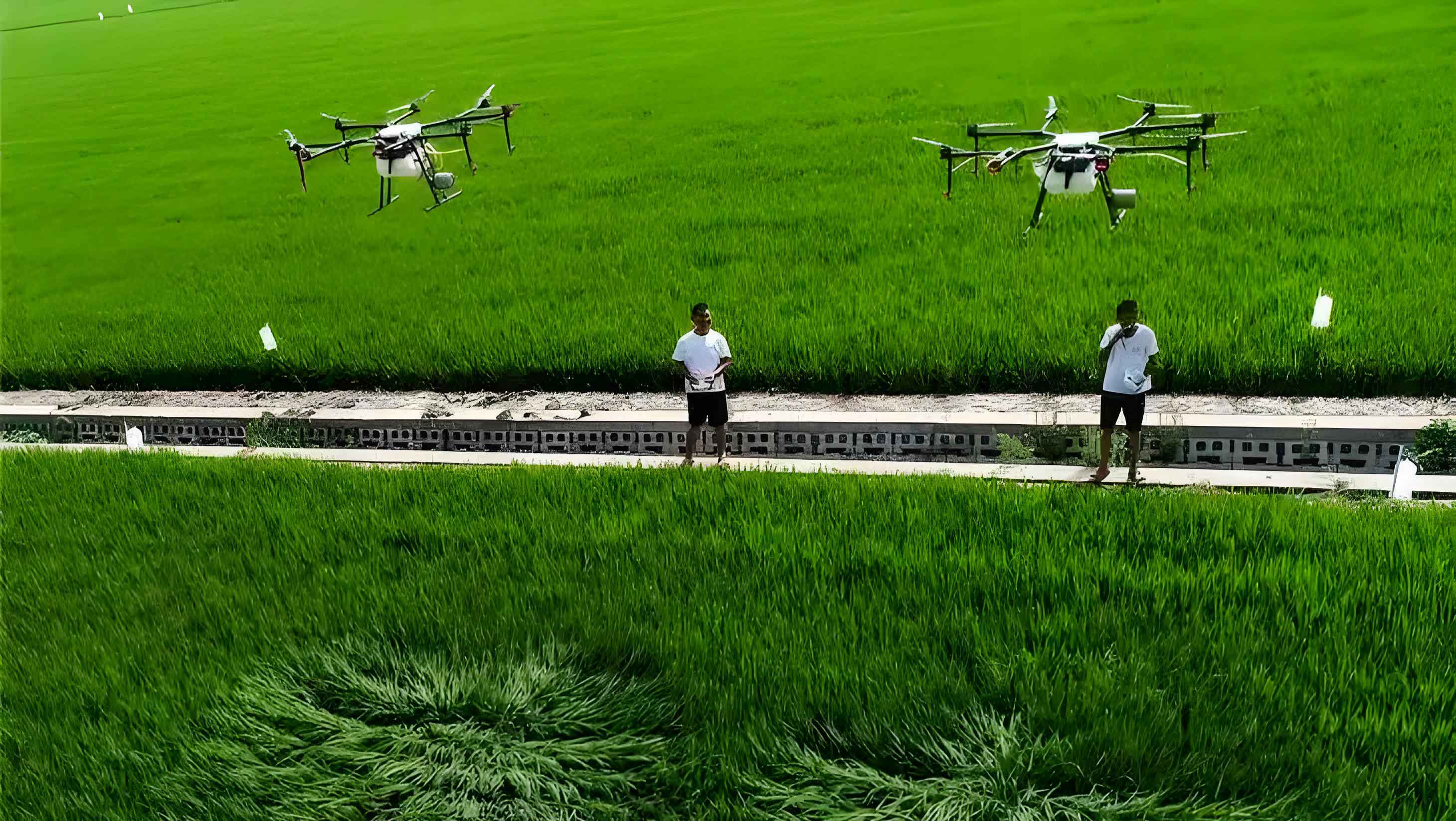
The core technical principle of our precision variable control method revolves around the seamless integration of multiple technologies to enable real-time, adaptive decision-making by the agricultural drone. At its heart, the system leverages GPS or RTK positioning to obtain precise geographic coordinates, ensuring accurate navigation along pre-defined flight paths. Concurrently, an onboard imaging system captures high-resolution images of the orchard canopy during flight. These images are processed using deep learning models, specifically convolutional neural networks (CNNs) trained on extensive datasets of orchard imagery. The models are designed to perform two key tasks: first, to estimate tree age based on visual cues such as trunk thickness, crown size, and branching patterns; second, to assess canopy density by analyzing leaf coverage and spatial distribution within the canopy. The deep learning framework incorporates attention mechanisms, allowing the model to focus on relevant regions of the image, such as the tree crown, thereby improving accuracy and computational efficiency. This is achieved through a pretraining phase on datasets like ImageNet, followed by fine-tuning with annotated orchard images. The output includes categorical assignments for tree age (e.g., young, mature, old) and canopy density levels (e.g., sparse, medium, dense), which are then geotagged and mapped onto the drone’s flight trajectory. The control algorithm uses this information to adjust two operational parameters: spray width (by activating different numbers of nozzles) and flight speed. Specifically, when the agricultural drone reaches a coordinate where tree age changes, it retrieves the age information and modifies the spray width accordingly; similarly, as it traverses areas with varying canopy density, it adjusts flight speed to modulate application rate. This dual adjustment ensures that the spray volume per unit area is tailored to the tree’s characteristics, achieving what we term “precision variable application.” The underlying mathematical relationship can be expressed as a control function where the effective application rate \( Q \) is a function of tree age \( A \) and canopy density \( D \), integrated over the flight path \( s \):
$$ Q = \int_{s} f(A(s), D(s)) \, ds $$
Here, \( f \) represents the control logic that maps age and density to spray width \( W \) and speed \( V \), with \( Q \) proportional to \( W \times V^{-1} \) for a constant flow rate. This formulation highlights how the agricultural drone dynamically optimizes its operation based on real-time sensory input.
To implement this method, we developed a comprehensive workflow encompassing path planning, image processing and assignment, and variable spray control. Initially, for path planning, we use boundary detection algorithms to map the orchard perimeter. A reference line, typically one edge of the orchard, is selected, and the rows of trees are identified. The flight trajectory is generated using a “headland turn” or “boustrophedon” pattern, ensuring complete coverage. Each row’s start and end points define a flight line, and these lines are connected to form a continuous path. Crucially, we annotate coordinates along this path where tree age transitions occur, based on prior orchard surveys or real-time detection. This allows the agricultural drone to anticipate changes and prepare for adjustments. For image processing, the drone is equipped with a high-resolution camera that captures canopy images during flight. These images are streamed to an onboard processing unit or transmitted to a ground station for analysis. Our deep learning model, built on a ResNet-50 architecture with attention layers, processes each image to output tree age and canopy density scores. The age is classified into discrete ranges (e.g., 1-4 years, 5-8 years, 9-19 years, 20+ years), while canopy density is quantized into levels from 1 (sparsest) to 7 (densest). The model’s training involved collecting thousands of labeled images from various orchards, with annotations for age and density provided by horticultural experts. We used data augmentation techniques to enhance robustness to lighting and orientation variations. The assignment module then links these outputs to geographic coordinates, creating a spatial map that guides the control system. For variable spray control, the agricultural drone’s flight controller is integrated with the image processing and positioning systems. As the drone follows the trajectory, a localization module continuously monitors its position. When it approaches a tree age change point, the control system retrieves the corresponding age category and adjusts the spray width by activating a predefined number of nozzles. Similarly, the canopy density level is monitored in real-time, and the flight speed is modulated based on density thresholds. This closed-loop control ensures that spray application is continuously optimized throughout the mission. The following table summarizes the control rules we established based on tree age and canopy density:
| Tree Age Range (years) | Spray Width (m) | Number of Nozzles Activated |
|---|---|---|
| 1-4 | 2 | 4 |
| 5-8 | 3 | 6 |
| 9-19 | 4 | 8 |
| 20+ | 5 | 10 |
| Canopy Density Level | Flight Speed (m/s) | Description |
|---|---|---|
| 1-2 | 3.5 | Sparse canopy |
| 3-4 | 3.0 | Medium canopy |
| 5-6 | 2.5 | Dense canopy |
| 7+ | 2.0 | Very dense canopy |
These rules were derived from agronomic principles and preliminary trials, ensuring that the agricultural drone delivers appropriate spray volumes: for instance, younger trees receive less pesticide due to smaller canopy volume, while denser canopies necessitate slower speeds to enhance droplet penetration and deposition.
We validated our method through field experiments conducted in an apple orchard, where tree age and canopy density varied across sections. The orchard was divided into plots with trees of different ages (3, 8, and 16 years) and varying canopy densities. We used a commercial agricultural drone equipped with our custom control system, including a GPS module, a camera, and an adjustable spraying system. The flight altitude was set at 2.5 meters above the tree canopy, with a row spacing of 4.5 meters. Prior to spraying, we performed a detailed survey to map tree ages and canopy densities, which were used to annotate the flight path. During operation, the agricultural drone autonomously followed the planned trajectory, capturing images and adjusting spray parameters in real-time. To assess performance, we measured droplet deposition density and uniformity using water-sensitive papers placed at strategic positions within the canopy: upper, middle, and lower layers, and in four cardinal directions (north, south, east, west). After spraying, these papers were collected and analyzed using image analysis software to count droplets per unit area. Additionally, we evaluated pest control efficacy by applying imidacloprid to control aphids and monitoring insect populations before and after treatment. The results demonstrated significant improvements over conventional uniform spraying methods. Droplet deposition data revealed that our variable control method achieved more consistent coverage across different tree ages and canopy densities. For example, in older trees with dense canopies, the agricultural drone reduced speed and increased spray width, resulting in higher droplet densities in the middle and lower canopy layers compared to uniform spraying. The following formula was used to calculate droplet density \( \rho \) at each sampling point:
$$ \rho = \frac{N}{A} $$
where \( N \) is the number of droplets and \( A \) is the area of the water-sensitive paper in cm². The average droplet densities across different zones are summarized below:
| Tree Age and Canopy Density Zone | Upper Layer Droplet Density (droplets/cm²) | Middle Layer Droplet Density (droplets/cm²) | Lower Layer Droplet Density (droplets/cm²) | Overall Uniformity Index |
|---|---|---|---|---|
| 3 years, Density Level 1 | 45.2 | 38.7 | 32.1 | 0.85 |
| 8 years, Density Level 4 | 52.3 | 48.5 | 40.8 | 0.82 |
| 16 years, Density Level 5 | 58.9 | 55.2 | 47.6 | 0.80 |
| 16 years, Density Level 7 | 62.4 | 59.8 | 50.3 | 0.78 |
The uniformity index, calculated as the ratio of minimum to maximum droplet density across layers, indicates that our method maintained relatively even distribution, though uniformity slightly decreased with increasing age and density due to canopy complexity. Importantly, the agricultural drone achieved a 35% reduction in pesticide usage compared to traditional backpack sprayers and a 5% saving compared to drones using fixed-rate application, highlighting its resource efficiency. In terms of pest control, the variable application led to high efficacy against aphids. We assessed insect population reduction rates and corrected efficacy at 3, 6, and 10 days after treatment. The results, presented in the table below, show that the upper canopy, where droplet deposition was highest, achieved nearly 95% control, while middle and lower layers also showed significant improvements, affirming the method’s effectiveness.
| Canopy Layer | Insect Reduction Rate at 3 Days (%) | Corrected Efficacy at 3 Days (%) | Insect Reduction Rate at 6 Days (%) | Corrected Efficacy at 6 Days (%) | Insect Reduction Rate at 10 Days (%) | Corrected Efficacy at 10 Days (%) | Average Reduction Rate (%) | Average Efficacy (%) |
|---|---|---|---|---|---|---|---|---|
| Upper | 91.43 | 93.12 | 96.34 | 97.17 | 92.26 | 95.77 | 93.34 | 95.35 |
| Middle | 83.45 | 85.63 | 82.39 | 90.32 | 84.21 | 86.57 | 83.35 | 87.52 |
| Lower | 70.52 | 86.11 | 75.89 | 88.54 | 74.91 | 80.85 | 73.77 | 81.83 |
These findings underscore how the agricultural drone, when equipped with our precision variable control system, can adapt to canopy variability and deliver targeted pesticide application, thereby enhancing biological efficacy while minimizing chemical input.
From a technical perspective, the success of our method hinges on the integration of deep learning and real-time control. The deep learning model for age and density estimation employs a multi-task learning framework, where shared convolutional layers extract features, and separate branches predict age and density. The loss function combines categorical cross-entropy for age classification and mean squared error for density regression, weighted to balance tasks. Mathematically, the total loss \( L \) is given by:
$$ L = \alpha L_{\text{age}} + \beta L_{\text{density}} $$
where \( L_{\text{age}} = -\sum y_i \log(\hat{y}_i) \) for age classes, \( L_{\text{density}} = \frac{1}{n} \sum (d_i – \hat{d}_i)^2 \) for density values, and \( \alpha, \beta \) are hyperparameters optimized during training. This approach allows the agricultural drone to accurately discern tree characteristics even under varying lighting conditions. Moreover, the control algorithm implements a state machine that transitions between different spray modes based on input thresholds. The spray volume \( V_s \) at any instant is determined by the nozzle flow rate \( F \) (constant), number of active nozzles \( N_n \), and flight speed \( v \):
$$ V_s = \frac{F \times N_n}{v} $$
Thus, by modulating \( N_n \) and \( v \), the agricultural drone effectively varies \( V_s \) to match tree requirements. We also incorporated safety checks, such as ensuring minimum spray widths at high speeds to prevent drift, and maximum speeds in dense areas to avoid collisions. The system’s responsiveness was tested in windy conditions, where the agricultural drone used IMU data to compensate for perturbations, maintaining stable flight and accurate spraying.
In discussing the broader implications, our precision variable control method represents a significant step toward fully autonomous, intelligent orchard management. The agricultural drone, as a mobile sensing and actuation platform, can be extended to other tasks such as nutrient application, irrigation monitoring, or yield estimation. However, challenges remain, including the need for robust deep learning models that generalize across tree species and climates, and the integration of more sensors (e.g., multispectral cameras) for holistic plant health assessment. Additionally, real-time processing constraints may require edge computing solutions to reduce latency. Future work will focus on refining the algorithms, perhaps using reinforcement learning to optimize control policies dynamically, and scaling the system for commercial deployment. We envision a future where fleets of agricultural drones collaborate, sharing data to create detailed orchard maps and coordinate spraying operations, thereby maximizing efficiency and sustainability.
In conclusion, through this research, we have demonstrated a novel precision variable control method for agricultural drones in orchards, leveraging tree age and canopy density as key inputs for adaptive spraying. The method integrates advanced technologies to enable real-time adjustments, resulting in improved droplet deposition uniformity, enhanced pest control efficacy, and substantial reductions in pesticide usage. This not only boosts the economic viability of drone-based orchard protection but also aligns with environmental stewardship by minimizing chemical runoff and residue. The agricultural drone, thus empowered, becomes a precise tool in the farmer’s arsenal, capable of addressing the heterogeneity of orchards with intelligence and efficiency. As we continue to refine this approach, I believe it will pave the way for more sustainable and productive agricultural practices worldwide, showcasing the transformative potential of precision agriculture technologies.