
In the face of a growing global population and a relative decline in agricultural labor, the demand for efficient and sustainable food production has never been more critical. As an observer and participant in the evolution of modern agriculture, I have witnessed firsthand how the overreliance on pesticides, while boosting yields, has led to severe environmental degradation, soil contamination, and food safety concerns. Traditional methods of pesticide application, such as manual spraying and ground-based machinery, are often inefficient, labor-intensive, and prone to uneven coverage, resulting in excessive chemical use. However, a transformative solution has emerged: the integration of agricultural drone technology with low-volume spray techniques. This article explores how this innovation is driving pesticide reduction and efficiency enhancement, paving the way for a more sustainable agricultural future.
The journey of spray technology in agriculture has evolved from rudimentary handheld devices to sophisticated automated systems. Initially, in the mid-20th century, aerial spraying using manned aircraft gained popularity for large-scale crop treatment, but it was marred by significant pesticide drift, waste, and environmental pollution. In the 1990s, the advent of low-volume spray technology marked a turning point, focusing on reducing liquid output per nozzle to below 50 milliliters per second. This approach minimized chemical usage while improving targeting. The real breakthrough came in the 2000s with the convergence of GPS, ground control systems, and unmanned aerial vehicles, giving rise to the modern agricultural drone. These drones have since become pivotal in precision agriculture, offering a leap in spray efficiency and ecological stewardship.
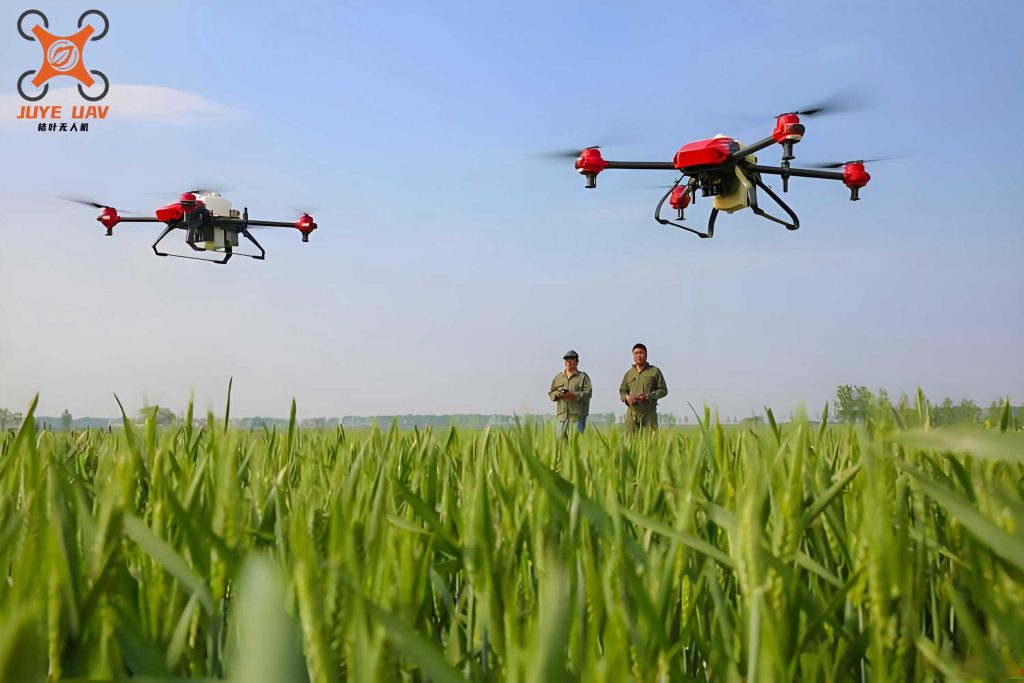
At the core of this revolution lies the principle of low-volume spray technology. Unlike conventional high-volume methods that drench crops with large droplets, low-volume spraying employs high-pressure atomization to break down pesticide liquids into fine, uniform droplets. This process can be described mathematically using the Weber number (We), which relates the forces disrupting a liquid droplet:
$$We = \frac{\rho v^2 d}{\sigma}$$
where $\rho$ is the fluid density, $v$ is the relative velocity between the liquid and air, $d$ is the droplet diameter, and $\sigma$ is the surface tension. By optimizing these parameters, agricultural drone systems achieve droplet sizes typically ranging from 50 to 150 micrometers, ensuring even coverage and minimal drift. The spray volume per unit area (Q) is given by:
$$Q = \frac{n \cdot f \cdot t}{A}$$
where $n$ is the number of nozzles, $f$ is the flow rate per nozzle (often less than 50 mL/s), $t$ is the spray time, and $A$ is the treatment area. This formula highlights how low-volume systems drastically reduce chemical input compared to traditional methods. Key characteristics include small spray volumes, uniform droplet distribution, and high liquid utilization rates, often exceeding 90% in controlled conditions. Nozzles made from ceramics or stainless steel are preferred for their durability and precision, further enhancing performance.
The adoption of agricultural drone low-volume spray technology varies globally, reflecting differences in agricultural practices and technological infrastructure. Below is a table summarizing its application status in key regions as of recent years:
| Region/Country | Primary Crops Treated | Estimated Market Size (USD) | Penetration Rate | Key Benefits Observed |
|---|---|---|---|---|
| China | Rice, wheat, vegetables, fruits, tea | Over 15 billion | High, with widespread use | Pesticide reduction by 30-50%, labor savings |
| United States | Corn, soybeans, cotton, orchards | Approx. 300 billion (projected for 2025) | Rapidly increasing | Improved spray accuracy, environmental protection |
| European Union | Olives, grapes, cereals | Growing steadily | Moderate, with regulatory support | Reduced chemical runoff, enhanced food safety |
| India | Cotton, sugarcane, pulses | Expanding | Emerging | Cost-effectiveness, accessibility in remote areas |
| Australia | Wheat, barley, vineyards | Significant investment | High in precision farming | Water conservation, drift minimization |
As illustrated, China leads in deployment, leveraging agricultural drone fleets for diverse crops, while the U.S. focuses on large-scale row crops. The technology’s scalability allows it to adapt to various agronomic needs, from smallholder farms to industrial plantations. In my analysis, this global footprint underscores the versatility and acceptance of drone-based solutions in addressing pesticide management challenges.
The advantages of using agricultural drone low-volume spray technology are multifaceted, contributing directly to the goal of “reducing input while increasing efficiency.” Firstly, spray precision is greatly enhanced through integrated GPS and real-time kinematic (RTK) positioning, which enables centimeter-level accuracy. This minimizes overspray and underspray, as described by the deposition efficiency (η_d):
$$\eta_d = \frac{C_a}{C_t} \times 100\%$$
where $C_a$ is the actual pesticide deposited on target crops and $C_t$ is the total pesticide sprayed. With drones, η_d can exceed 85%, compared to 40-60% for traditional methods. Secondly, pesticide usage is reduced significantly—often by 30% to 70%—due to the optimized droplet spectrum and targeted application. This reduction aligns with integrated pest management (IPM) principles, lowering residues in produce and ecosystems. Thirdly, environmental and human health risks are mitigated, as drone operations limit operator exposure to chemicals and reduce atmospheric drift, which can be quantified by the drift potential (D_p):
$$D_p = k \cdot \frac{v_w \cdot d_{drop}}{\rho_{air}}$$
where $k$ is a constant, $v_w$ is wind speed, $d_{drop}$ is droplet diameter, and $\rho_{air}$ is air density. By producing smaller, more stable droplets, drones lower $D_p$, safeguarding adjacent areas. Lastly, operational efficiency is boosted; a single agricultural drone can cover 10-20 hectares per hour, far outpacing manual labor. This efficiency gain translates to cost savings and timely interventions during pest outbreaks.
To delve deeper, the technical parameters of low-volume spray systems on agricultural drone platforms vary based on design and crop requirements. The following table compares key metrics across different drone models and traditional methods:
| Parameter | Traditional Ground Sprayer | Rotary-wing Agricultural Drone | Fixed-wing Agricultural Drone | Optimal Range for Low-Volume Spray |
|---|---|---|---|---|
| Spray Volume (L/ha) | 200-500 | 10-30 | 15-40 | 5-50 |
| Droplet Size (µm) | 200-500 | 80-150 | 100-200 | 50-150 |
| Work Efficiency (ha/h) | 1-5 | 8-20 | 20-50 | Depends on drone type |
| Pesticide Savings (%) | Baseline (0%) | 30-60 | 25-55 | 30-70 |
| Energy Consumption (kWh/ha) | 2-10 | 0.5-2 | 1-3 | Minimized with efficient motors |
This comparative analysis highlights how agricultural drone systems excel in resource conservation. For instance, the reduced spray volume directly correlates with lower chemical input, while the finer droplets improve canopy penetration. In my experience, these metrics are crucial for farmers seeking to adopt sustainable practices without compromising productivity.
The practical application of agricultural drone technology extends beyond mere spray operations; it involves sophisticated data analytics and adaptive control. For example, drone-mounted sensors can detect pest hotspots using multispectral imaging, allowing for variable-rate application (VRA). The pesticide dose (D) can be dynamically adjusted based on the normalized difference vegetation index (NDVI):
$$D = D_{base} \times \left(1 + \alpha \cdot (1 – NDVI)\right)$$
where $D_{base}$ is the baseline dose, $\alpha$ is a calibration factor, and NDVI values indicate plant health. This precision approach ensures that chemicals are applied only where needed, further amplifying reduction benefits. Additionally, wind compensation algorithms in drone flight controllers adjust spray release to maintain deposition accuracy, modeled by:
$$\Delta x = v_w \cdot t_{fall}$$
where $\Delta x$ is the lateral displacement of droplets, $v_w$ is wind velocity, and $t_{fall}$ is the droplet settling time. By integrating such real-time corrections, agricultural drone operations achieve remarkable consistency even in breezy conditions.
Looking ahead, the future of agricultural drone low-volume spray technology is bright, driven by advancements in artificial intelligence, battery life, and regulatory frameworks. However, challenges remain, such as standardizing protocols for different crops and climates, ensuring affordability for small-scale farmers, and addressing airspace regulations. In my view, continuous innovation in nozzle designs, perhaps using electrostatic charging to enhance droplet adhesion, could push efficiency boundaries further. The potential for swarm robotics, where multiple drones coordinate over vast fields, promises even greater scalability.
In conclusion, as I reflect on the transformative impact of agricultural drone low-volume spray technology, it is clear that this innovation is a cornerstone of modern sustainable agriculture. By enhancing spray precision, slashing pesticide usage, protecting ecosystems, and boosting operational efficiency, drones are not just tools but allies in the quest for food security and environmental stewardship. The journey from traditional sprayers to intelligent aerial systems exemplifies how technology can harmonize productivity with planetary health. As adoption grows globally, I am confident that this technology will continue to evolve, offering tailored solutions that empower farmers and safeguard our collective future.