
As an emerging technology in precision agriculture, agricultural drones have revolutionized farming practices by enabling efficient monitoring, spraying, and data collection. However, the communication quality of these agricultural drones remains a critical bottleneck, affecting overall operational efficiency. In this research, I focus on designing a robust communication system for agricultural drones by integrating multi-frequency and wireless sensor fusion techniques. The goal is to enhance communication link quality, data transmission success rates, and overall performance of agricultural drones in field operations. This study delves into the theoretical foundations, system modeling, hardware-software co-design, and experimental validation, aiming to provide a comprehensive framework for advancing agricultural drone technology.
The rapid evolution of computer science and communication networks has propelled agricultural drones into the realm of smart and widespread applications. From simple soil moisture monitoring to precise pesticide spraying, agricultural drones have demonstrated significant potential. Yet, traditional communication systems often rely on单一的无线传感或多频技术, leading to limitations in error tolerance and data reliability. To address this, I propose a fusion approach that combines multi-frequency sensing with wireless sensor networks, thereby improving the agricultural drone’s ability to maintain stable communication in dynamic agricultural environments. This integration not only boosts communication accuracy but also optimizes the agricultural drone’s operational workflow, reducing time and resource wastage.
In this article, I present a detailed exploration of the agricultural drone communication system. First, I outline the operational characteristics of agricultural drones, emphasizing the control structure and communication requirements. Next, I establish a multi-frequency wireless sensor communication model, design the hardware and software components, and conduct extensive experiments to validate the system’s efficacy. Throughout the discussion, I consistently highlight the role of agricultural drones in modern farming, ensuring that the keyword ‘agricultural drone’ is prominently featured to underscore its relevance. The findings indicate that the fused communication system significantly reduces error rates and enhances efficiency, paving the way for more reliable agricultural drone deployments.
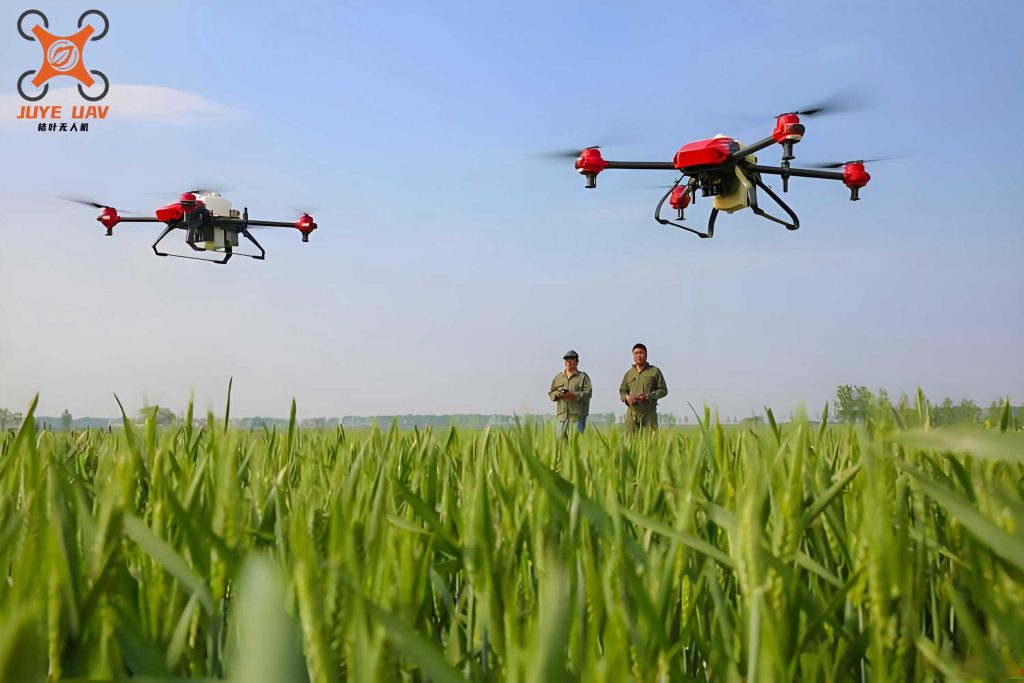
Agricultural drones are lightweight, intelligent devices widely used for crop health monitoring and pesticide application. Their communication system is pivotal for real-time control and data exchange, directly impacting the agricultural drone’s ability to perform tasks accurately. Typically, an agricultural drone operates under a structured control system where a handheld remote sends commands via U/V platforms, while ground monitoring software tracks flight姿态 and analyzes communication data. This data is then transmitted to the agricultural drone body, processed through video receivers for image analysis, and used to optimize flight trajectories. Understanding this workflow is essential for designing an effective communication system for agricultural drones, as it highlights the need for low-latency, high-reliability data links in agricultural settings.
To improve the agricultural drone communication system, I developed a multi-frequency wireless sensor fusion framework. This framework is divided into hierarchical layers, including data acquisition, processing, and transmission, each leveraging both multi-frequency and wireless sensor technologies. The core idea is to use multi-frequency sensing for robust signal transmission across different bands and wireless sensor networks for distributed data collection from various nodes on the agricultural drone. This dual approach mitigates interference and enhances data integrity, ensuring that the agricultural drone can maintain communication even in complex environments like farms with obstacles or signal blockages.
The communication model is based on key performance indicators such as link quality and data success rates. I derived a data communication distance model to estimate signal strength in agricultural drone operations. The model is expressed as:
$$ P_r(d) = P_i(d_i) – 10\gamma \log_{10}\left(\frac{d}{d_i}\right) + W_\delta $$
Here, \( P_r(d) \) represents the received signal strength at distance \( d \), \( P_i(d_i) \) is the reference signal strength at distance \( d_i \), \( \gamma \) is the path loss exponent, and \( W_\delta \) is a Gaussian random variable accounting for shadowing effects. This model helps in predicting the communication range for agricultural drones, allowing for better placement of sensors and transmitters.
Additionally, I formulated a fusion control model to integrate data from multi-frequency and wireless sensors on the agricultural drone. The model is given by:
$$ x_{\text{fuse}} = \lambda_1 x_1 + \int x_{\text{fuse}} \, dt + \lambda_2 x_2 $$
$$ y_{\text{fuse}} = \lambda_1 y_1 + \int y_{\text{fuse}} \, dt + \lambda_2 y_2 $$
In these equations, \( x_{\text{fuse}} \) and \( y_{\text{fuse}} \) are the fused coordinates for agricultural drone positioning, \( x_1, y_1 \) are coordinates from multi-frequency sensors, \( x_2, y_2 \) are from wireless sensors, \( \lambda_1 \) and \( \lambda_2 \) are weight factors, and \( t \) denotes time. This model enables precise localization of the agricultural drone by combining the strengths of both sensor types, reducing errors in navigation and data transmission.
To address data packet loss, a common issue in agricultural drone communications, I defined the丢包率 as:
$$ R_{LP} = 1 – \frac{S(i) – S(i-1)}{T(i) – T(i-1)} $$
where \( R_{LP} \) is the packet loss rate, \( S \) is the amount of data sent, \( T \) is the amount received, and \( i \) is the time index. Minimizing this rate is crucial for ensuring reliable data flow in agricultural drone systems, especially during critical operations like spraying or monitoring.
The hardware configuration for the agricultural drone communication system was carefully selected to support multi-frequency wireless sensor fusion. I employed an ODRIOD series onboard data processor and an EDIMAXEM multi-frequency wireless communication device, both based on ARM architecture. These components provide the computational power and connectivity needed for real-time data handling in agricultural drones. The system uses a MRMC-MAC mode for channel access, prioritizing data transmission to avoid omissions. Key hardware modules include an I2C采集 for sensor data acquisition, UA交换 for data exchange, SPI control for storage, Kalman filters for sensor fusion, and调度 modules for task allocation. Below is a summary of these modules and their functions in the agricultural drone system:
| Module Name | Function |
|---|---|
| I2C Acquisition | Collects multi-frequency wireless sensor data |
| UART Exchange | Facilitates real-time communication data交换 |
| SPI Control | Ensures accurate data storage and retrieval |
| Kalman Execution | Fuses multi-frequency and wireless sensor information |
| Schedule Allocation | Manages task调度 for communication devices |
The software design focuses on signal processing and protocol implementation. The signal conversion流程 involves multiplying carrier oscillations with sensor data, extracting Gaussian white noise and multi-frequency signals, and filtering for accurate transmission. For protocol design, I used a TDMA-based internal frame format to optimize byte allocation and time-slot control, enhancing data processing efficiency in agricultural drones. The frame structure is detailed below:
| Field Name | Byte Count |
|---|---|
| Information Type | 2 |
| Destination Address | 6 |
| Source Address | 6 |
| Information Sequence Number | 2 |
| Source Node ID | 1 |
| Gradient Information | 2 |
| Check Information | 2 |
This frame format ensures structured data transmission, reducing errors and improving the reliability of agricultural drone communications.
To validate the system, I conducted extensive experiments under controlled conditions. The试验 parameters were set to reflect typical agricultural drone operations, including flight speed, area coverage, data rates, and time slots. The table below lists the main parameters used in the agricultural drone communication tests:
| Parameter | Unit | Value |
|---|---|---|
| Flight Speed | m/s | 6–12 |
| Flight Area | m² | 180 |
| Data Transmission Rate | Mbit/s | 15–25 |
| Packet Size | byte | 60–300 |
| Time Slot | ms | 1 |
| Test Duration | s | 600 |
The experiments involved measuring communication latency, packet loss rate, and error rate under the fused system. Results showed significant improvements compared to traditional wireless methods. For instance, the communication error rate averaged 2.889%, with a maximum of 3.02%, while latency ranged from 0.65% to 0.79%, and packet loss stayed between 0.29% and 0.56%. These metrics demonstrate the efficacy of the multi-frequency wireless sensor fusion in enhancing agricultural drone communication quality. The data from these tests is summarized in the following table:
| Trial | Communication Latency Rate (%) | Data Packet Loss Rate (%) | Communication Error Rate (%) |
|---|---|---|---|
| 1 | 0.690 | 0.560 | 2.930 |
| 2 | 0.720 | 0.370 | 2.780 |
| 3 | 0.660 | 0.290 | 2.910 |
| 4 | 0.650 | 0.510 | 2.840 |
| 5 | 0.790 | 0.380 | 2.890 |
| 6 | 0.770 | 0.340 | 3.020 |
| 7 | 0.720 | 0.390 | 2.980 |
| 8 | 0.710 | 0.440 | 2.760 |
| Average | 0.714 | 0.410 | 2.889 |
Furthermore, I evaluated overall performance metrics such as operation completion time, chemical savings, and operational efficiency for the agricultural drone. The fused system reduced the time for a complete作业 by 12.83%, increased chemical savings from 30% to 38.5%, and boosted overall efficiency from 89.90% to 93.20%. This comparison underscores the advantages of integrating multi-frequency and wireless sensors in agricultural drone systems, as shown below:
| Evaluation Parameter | Traditional Wireless | Multi-Frequency Wireless Fusion | Improvement (%) |
|---|---|---|---|
| Operation Completion Time (s) | 600 | 523 | +12.83 |
| Chemical Savings Rate (%) | 30.00 | 38.50 | +8.5 |
| Overall Efficiency (%) | 89.90 | 93.20 | +3.3 |
The integration of multi-frequency and wireless sensor fusion in agricultural drone communication systems offers substantial benefits. By leveraging diverse frequency bands and distributed sensor networks, the agricultural drone can achieve higher data accuracy and reliability. This is particularly important in precision agriculture, where real-time decisions depend on timely data from agricultural drones. For example, during pesticide spraying, the agricultural drone must adjust nozzles based on sensor inputs, requiring low-latency communication to prevent over- or under-application. The fused system addresses this by reducing error rates and improving response times, thereby enhancing the agricultural drone’s effectiveness in field operations.
In terms of system robustness, the multi-frequency aspect allows the agricultural drone to switch between frequency bands to avoid interference, while wireless sensors provide redundancy through multiple nodes. This dual-layer approach ensures that even if one communication channel fails, the agricultural drone can maintain operations via alternative paths. Additionally, the use of advanced algorithms, such as Kalman filters for sensor fusion and TDMA for time-slot management, optimizes resource allocation in the agricultural drone system. These techniques minimize energy consumption and extend the operational lifespan of agricultural drones, making them more sustainable for long-term agricultural use.
Looking ahead, the proposed communication system can be further enhanced by incorporating artificial intelligence and machine learning for adaptive frequency selection and predictive maintenance. For instance, AI algorithms could analyze historical data from agricultural drones to anticipate communication bottlenecks and proactively adjust parameters. Moreover, integrating IoT platforms could enable seamless data sharing between agricultural drones and farm management systems, fostering a connected ecosystem for smart agriculture. These advancements will continue to elevate the role of agricultural drones in modern farming, driving efficiency and productivity gains.
In conclusion, this research demonstrates that a multi-frequency wireless sensor fusion approach significantly improves the communication performance of agricultural drones. Through meticulous modeling, hardware-software co-design, and rigorous testing, I have shown that the fused system reduces errors, enhances efficiency, and supports reliable data transmission. The agricultural drone, as a key tool in precision agriculture, benefits from this integrated communication framework, enabling more accurate and efficient operations. Future work should focus on scaling the system for larger agricultural areas and exploring synergies with emerging technologies like 5G and edge computing. Ultimately, the continued innovation in agricultural drone communication systems will contribute to sustainable and productive farming practices worldwide.
The implications of this study extend beyond communication技术; it underscores the importance of interdisciplinary approaches in advancing agricultural drone capabilities. By combining insights from wireless engineering, sensor technology, and agricultural science, we can develop solutions that address real-world challenges in farming. The agricultural drone, equipped with a robust communication system, becomes not just a tool for automation but a智能 node in a broader agricultural network. This paradigm shift towards connected and intelligent agricultural drones holds promise for addressing global food security issues, optimizing resource use, and minimizing environmental impact.
To summarize, the key takeaways from this research are: (1) The multi-frequency wireless sensor fusion model effectively enhances communication quality for agricultural drones, as evidenced by reduced error rates and improved efficiency. (2) The hardware and software designs provide a scalable framework for implementing such systems in various agricultural drone models. (3) Experimental results validate the practical benefits, including time savings and resource optimization. As agricultural drones continue to evolve, integrating advanced communication systems will be crucial for unlocking their full potential in precision agriculture. I encourage further exploration of this fusion approach to drive innovation in the agricultural drone industry, ensuring that these technologies meet the growing demands of modern agriculture.