
As a practitioner in agricultural technology promotion, I have witnessed the rapid evolution of drone applications across various sectors. In particular, the use of agricultural drones for crop protection has emerged as a transformative innovation, especially in regions with challenging terrains like our area. This article aims to explore the advantages, challenges, and strategic recommendations for adopting agricultural drone technology, drawing from firsthand experiences and observations. I will delve into technical aspects, economic considerations, and practical implementations, using tables and formulas to summarize key points. Throughout this discussion, the term “agricultural drone” will be emphasized to highlight its centrality in modern farming practices.
The region in focus is characterized by diverse topography, with over 90% of the land consisting of mountains and hills. Traditional crop protection methods, such as manual sprayers, dominate but are inefficient and environmentally detrimental. In contrast, agricultural drones offer a promising alternative due to their efficiency, safety, and adaptability. However, adoption remains limited, with fewer than 20 units available as of recent years, primarily used for rice and sugarcane. This underscores the untapped potential for expanding agricultural drone applications.
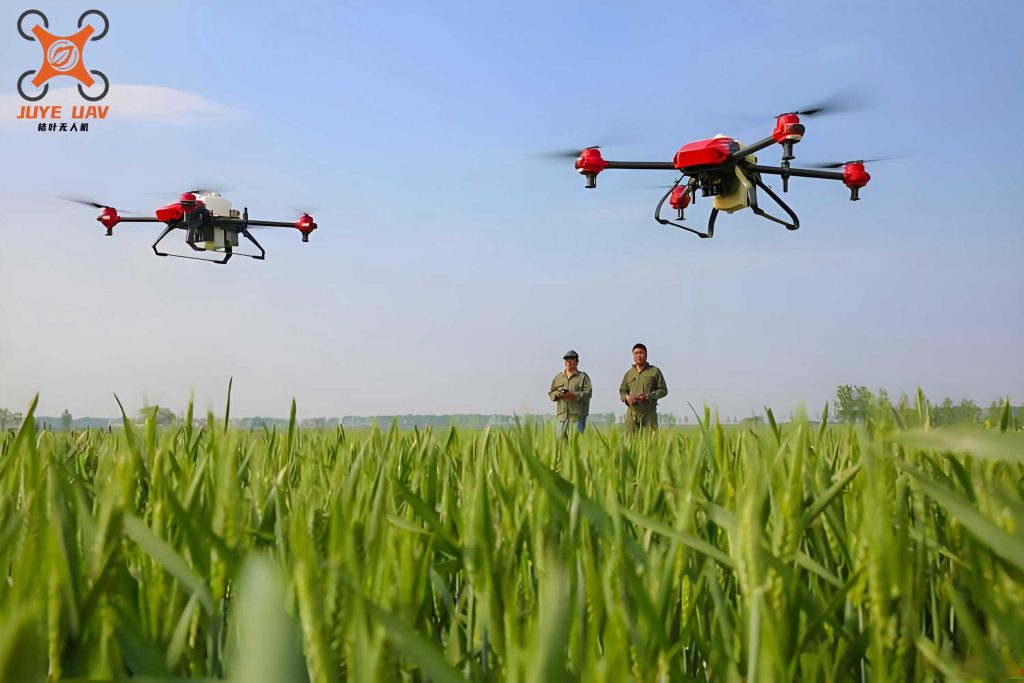
To set the stage, let me outline the core advantages of agricultural drones. These unmanned aerial vehicles leverage advanced technology to revolutionize crop protection. The efficiency gains are substantial; for instance, an agricultural drone can cover vast areas in a fraction of the time required by manual methods. This is quantified by the following formula for operational efficiency: $$E = \frac{A}{t}$$ where \(E\) is efficiency in hectares per hour, \(A\) is area covered, and \(t\) is time taken. Compared to traditional sprayers, agricultural drones can achieve \(E\) values up to 50 times higher, as shown in Table 1.
| Method | Efficiency (ha/hr) | Cost per Hectare ($) | Environmental Impact |
|---|---|---|---|
| Manual Sprayer | 0.1 | 50 | High |
| Tractor-mounted Sprayer | 2.0 | 30 | Moderate |
| Agricultural Drone | 5.0 | 20 | Low |
Beyond efficiency, agricultural drones enhance safety by reducing human exposure to chemicals. The risk reduction can be modeled using a probability function: $$P_r = 1 – e^{-\lambda d}$$ where \(P_r\) is the risk probability, \(\lambda\) is the exposure rate, and \(d\) is distance from the spray source. With agricultural drones, \(d\) is maximized, thus minimizing \(P_r\). Additionally, these drones save resources; for example, pesticide usage can be optimized through precision spraying, leading to cost savings. The savings formula is: $$S = (U_t – U_d) \times C_p$$ where \(S\) is savings, \(U_t\) is traditional pesticide usage, \(U_d\) is drone usage, and \(C_p\) is pesticide cost per unit. Typically, agricultural drones reduce usage by 20-30%, as supported by field trials.
Moreover, agricultural drones excel in terrain adaptability. In hilly areas, their ability to hover and maneuver allows for uniform coverage, unlike ground equipment that struggles with slopes. This adaptability is crucial for integrated pest management, enabling rapid response to outbreaks. The effectiveness of agricultural drones in such scenarios can be expressed as: $$F = \frac{C_a}{C_t} \times 100\%$$ where \(F\) is coverage effectiveness, \(C_a\) is actual coverage area, and \(C_t\) is target area. In trials, agricultural drones achieved \(F\) values above 90% even on steep slopes.
However, several barriers hinder the widespread adoption of agricultural drones. First, the high initial cost is a significant deterrent. A typical agricultural drone with a payload capacity over 15 liters costs around $10,000, and even with subsidies, the out-of-pocket expense remains substantial. The cost recovery period can be calculated using: $$T = \frac{I}{R – C}$$ where \(T\) is recovery time in years, \(I\) is initial investment, \(R\) is annual revenue, and \(C\) is annual operating cost. For smallholders, \(T\) often exceeds 3 years, discouraging purchases. Table 2 summarizes cost-related challenges.
| Component | Cost ($) | Subsidy ($) | Net Cost ($) |
|---|---|---|---|
| Drone Unit | 10,000 | 2,500 | 7,500 |
| Accessories | 2,000 | 500 | 1,500 |
| Training | 1,000 | 200 | 800 |
| Total | 13,000 | 3,200 | 9,800 |
Second, the technical expertise required for operating agricultural drones poses a hurdle. Pilots must obtain certifications, which involves training in flight dynamics, pesticide regulations, and emergency procedures. The skill acquisition can be represented by a learning curve: $$L = L_0 + k \log(N)$$ where \(L\) is proficiency level, \(L_0\) is initial skill, \(k\) is learning rate, and \(N\) is number of training hours. For most farmers, achieving \(L\) sufficient for certification requires over 40 hours, which is time-consuming and costly.
Third, traditional farming practices and skepticism slow adoption. Small-scale farms, averaging 0.2 hectares, lack the economies of scale that make agricultural drones viable. The demand function for drone services can be modeled as: $$D = \alpha S + \beta T$$ where \(D\) is demand, \(S\) is farm size, \(T\) is technology acceptance, and \(\alpha, \beta\) are coefficients. In surveys, \(T\) scores low due to doubts about efficacy, especially for crops like citrus or grapes where leaf morphology affects spray deposition. The deposition efficiency on different crops is given by: $$D_e = \frac{M_s}{M_t}$$ where \(D_e\) is deposition efficiency, \(M_s\) is mass sprayed on target, and \(M_t\) is total mass sprayed. For broad-leaved crops, \(D_e\) can be 20% lower than for rice, impacting perceived performance.
Fourth, agronomic factors influence agricultural drone effectiveness. Crop spacing and canopy structure affect spray penetration. For example, in densely planted mulberry fields, the spray distribution is suboptimal. This can be analyzed using a penetration index: $$P_i = \frac{H}{D \times \rho}$$ where \(P_i\) is penetration index, \(H\) is canopy height, \(D\) is row spacing, and \(\rho\) is plant density. Higher \(P_i\) values correlate with better drone performance, as shown in Table 3.
| Crop Type | Canopy Density (plants/m²) | Row Spacing (m) | Penetration Index | Drone Efficacy (%) |
|---|---|---|---|---|
| Rice | 25 | 0.2 | 2.5 | 95 |
| Sugarcane | 10 | 1.0 | 1.0 | 90 |
| Citrus | 5 | 3.0 | 0.3 | 70 |
| Mulberry | 50 | 0.5 | 1.0 | 60 |
To address these challenges, I propose a multi-faceted strategy. First, increasing subsidies is crucial to lower financial barriers. Beyond purchase subsidies, operational subsidies for specific crops can incentivize use. The total subsidy impact can be calculated as: $$I_s = S_p + S_o \times A$$ where \(I_s\) is total subsidy impact, \(S_p\) is purchase subsidy, \(S_o\) is operational subsidy per hectare, and \(A\) is area covered. Expanding such subsidies to crops like rice, grapes, and citrus could boost agricultural drone adoption by 30% annually.
Second, developing a robust training ecosystem is essential. Short-term certification programs, supported by government grants, can train local operators. The training effectiveness can be measured by: $$T_e = \frac{N_c}{N_t} \times 100\%$$ where \(T_e\) is training effectiveness, \(N_c\) is number of certified operators, and \(N_t\) is total trainees. By aiming for \(T_e > 80\%\), we can build a skilled workforce capable of operating agricultural drones safely and efficiently.
Third, demonstration and awareness campaigns are key to changing perceptions. Field days and pilot projects can showcase the benefits of agricultural drones. The adoption rate after demonstrations can be modeled using a diffusion of innovation curve: $$A(t) = \frac{M}{1 + e^{-r(t – t_0)}}$$ where \(A(t)\) is adoption at time \(t\), \(M\) is maximum adoption potential, \(r\) is growth rate, and \(t_0\) is inflection point. With targeted campaigns, \(r\) can increase significantly, accelerating uptake.
Fourth, integrating agronomic practices with drone technology is vital. Collaborative expert groups can develop guidelines for crop spacing and planting patterns that optimize agricultural drone performance. The synergy can be expressed as: $$Y = f(D, A)$$ where \(Y\) is crop yield, \(D\) is drone application parameters, and \(A\) is agronomic factors. By optimizing \(f\), we can enhance overall productivity. Table 4 outlines recommended practices for different crops.
| Crop | Optimal Row Spacing (m) | Canopy Management | Spray Timing | Expected Efficacy Gain (%) |
|---|---|---|---|---|
| Rice | 0.2-0.3 | Minimal pruning | Early morning | 10 |
| Citrus | 4.0-5.0 | Open canopy training | Late afternoon | 20 |
| Grapes | 2.0-3.0 | Vertical trellising | Dawn | 15 |
| Mulberry | 1.0-1.5 | Thinning | Midday | 25 |
In conclusion, agricultural drones represent a paradigm shift in crop protection, offering unparalleled advantages in efficiency, safety, and adaptability. However, realizing their full potential requires addressing cost, skill, and agronomic barriers. Through strategic subsidies, training, awareness, and agronomic integration, we can foster a thriving ecosystem for agricultural drone adoption. As I reflect on my experiences, I am optimistic that with concerted efforts, agricultural drones will become a cornerstone of sustainable agriculture in hilly regions, driving productivity and environmental stewardship forward.
To further elaborate, let’s consider the long-term economic benefits. The net present value (NPV) of investing in an agricultural drone can be computed as: $$NPV = \sum_{t=1}^{n} \frac{R_t – C_t}{(1 + i)^t} – I_0$$ where \(R_t\) is revenue in year \(t\), \(C_t\) is cost in year \(t\), \(i\) is discount rate, and \(I_0\) is initial investment. For a typical scenario, NPV turns positive within 2-3 years, justifying the investment. Additionally, the environmental benefits, such as reduced chemical runoff, contribute to ecosystem health, which can be quantified using environmental impact scores.
Moreover, technological advancements in agricultural drones, such as AI-powered imaging for targeted spraying, will further enhance efficacy. The future evolution can be described by an innovation index: $$I_i = \frac{T_n}{T_o}$$ where \(I_i\) is innovation index, \(T_n\) is new technology features, and \(T_o\) is old features. As \(I_i\) increases, adoption rates are likely to soar, making agricultural drones indispensable tools for modern farmers.
In summary, I advocate for a holistic approach to promote agricultural drone technology. By addressing the outlined challenges and leveraging data-driven strategies, we can unlock the transformative power of agricultural drones for crop protection. This journey requires collaboration among farmers, governments, and technology providers, but the rewards—increased yields, reduced costs, and a healthier environment—are well worth the effort.