
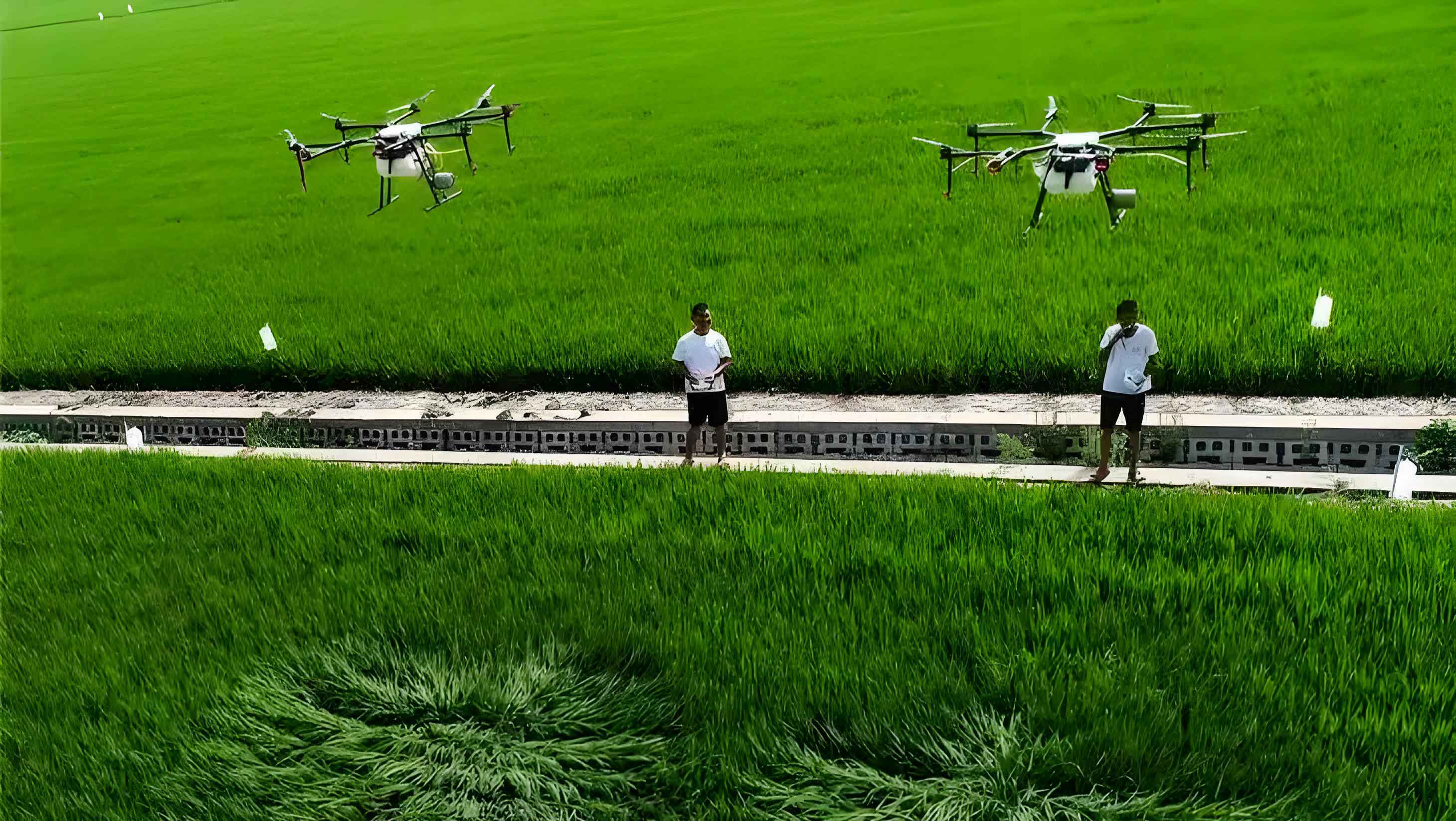
The modern agricultural landscape is undergoing a significant transformation, driven by the integration of advanced technologies. Among these, the agricultural drone, or Unmanned Aerial Vehicle (UAV) for plant protection, has emerged as a pivotal tool. These agricultural drones offer unparalleled advantages in tasks like pesticide spraying, including remarkable precision, reduced chemical usage, and enhanced operator safety by minimizing direct exposure to harmful substances. As the market for these agricultural drones expands rapidly, consumers are faced with a bewildering array of brands and models, each boasting different specifications. This proliferation makes the selection process a complex challenge, involving a trade-off between numerous factors such as performance metrics, cost, operational parameters, and environmental adaptability. This challenge fundamentally constitutes a Multi-Criteria Decision-Making (MCDM) problem. Therefore, developing a systematic, quantitative evaluation model is crucial. It empowers consumers to make scientifically-informed purchasing decisions, mitigates the risk of suboptimal investments, and provides manufacturers with valuable insights for product optimization and configuration.
Existing research on UAV evaluation has primarily focused on areas like design aesthetics or specific military/training applications. There is a notable gap in dedicated methodologies for selecting agricultural drones based on comprehensive user-centric criteria. Traditional MCDM methods applied in product selection, such as the Analytic Hierarchy Process (AHP) combined with the Technique for Order Preference by Similarity to Ideal Solution (TOPSIS), present several limitations. AHP involves constructing multiple pairwise comparison matrices and consistency checks, leading to cumbersome calculations. More critically, the TOPSIS method is susceptible to the rank reversal phenomenon, where the addition or removal of an alternative can alter the existing ranking order, thus compromising the robustness of the decision. Furthermore, these methods often fail to adequately capture the inherent hesitancy and ambiguity in human judgment when evaluating qualitative attributes.
To address these shortcomings, we propose a novel hybrid decision-making framework for agricultural drone selection. Our model integrates the Order Relation Analysis (G1) method, the Entropy Weight method, and an extended Probabilistic Hesitant Fuzzy Reference Ideal Method (PHFRIM). The process, as illustrated in the workflow diagram, begins with establishing a comprehensive evaluation index system. Subsequently, a combination weighting approach is employed to determine criterion importance. Finally, the PHFRIM is utilized to rank the alternative agricultural drones. This integrated approach effectively combines subjective preferences with objective data dispersion, ensures robust rankings free from reversals, and meticulously models the uncertainty in expert assessments.
1. Constructing the Evaluation Index System for Agricultural Drones
The selection of an optimal agricultural drone necessitates a holistic consideration of factors influencing its efficacy, practicality, and total cost of ownership. Through a thorough review of technical specifications, consultation with industry experts, manufacturers, and end-users, we have identified and categorized 15 critical evaluation criteria into four primary dimensions. This structured hierarchy forms the basis for a systematic comparison. The complete evaluation index system is presented in Table 1.
| Primary Dimension | Secondary Criterion (Unit) | Code | Attribute Type |
|---|---|---|---|
| Spraying Performance | Number of Spray Nozzles | u1 | Positive (Larger is better) |
| Spraying Rate (L/min) | u2 | Positive | |
| Tank Capacity (L) | u3 | Positive | |
| Operational Efficiency (Acres/hour) | u4 | Positive | |
| Aircraft Parameters | Total Weight (kg) | u5 | Negative (Smaller is better) |
| Battery Life (min) | u6 | Positive | |
| Charging Time (min) | u7 | Negative | |
| Power (kW) | u8 | Negative* | |
| Environmental Requirements | Operating Temperature Range (°C) | u9 | Positive (Wider is better) |
| Max Wind Resistance (m/s) | u10 | Positive | |
| Max Operational Range (m) | u11 | Positive | |
| Other Factors | Purchase Price (10k units) | u12 | Negative |
| Brand Reputation | u13 | Positive | |
| After-Sales Service Level | u14 | Positive | |
| Durability / Build Quality | u15 | Positive |
*Note: Power is considered a negative attribute as higher power often correlates with higher energy consumption and cost; an optimal range is typically preferred.
2. The Proposed Hybrid MCDM Methodology
2.1 Combined Weight Determination Model
Determining the relative importance (weights) of each criterion is a foundational step. To balance the decision-maker’s subjective judgment with the objective information contained in the evaluation data, we employ a combined weighting approach.
2.1.1 Determining Subjective Weights using Order Relation Analysis (G1)
The G1 method is a streamlined subjective weighting technique that avoids complex pairwise comparison matrices. For a set of criteria \( U = \{u_1, u_2, …, u_n\} \), the steps are:
Step 1: An expert ranks the criteria in descending order of perceived importance: \( u_1^* > u_2^* > … > u_n^* \).
Step 2: The expert assesses the relative importance ratio \( r_k \) between adjacent criteria \( u_{k-1}^* \) and \( u_k^* \).
$$ r_k = \frac{w_{k-1}^*}{w_k^*}, \quad k = n, n-1, …, 2 $$
The values for \( r_k \) are assigned based on a predefined scale (e.g., 1.0 for equal importance, 1.2 for slightly more important, up to 1.8 for extremely more important).
Step 3: Calculate the subjective weight \( z_n \) for the least important criterion and then recursively compute the others:
$$ z_n = \left(1 + \sum_{k=2}^{n} \prod_{i=k}^{n} r_i \right)^{-1} $$
$$ z_{k-1} = r_k \cdot z_k, \quad k = n, n-1, …, 2 $$
The resulting \( z_k \) are the subjective weights for the ordered criteria, which are then mapped back to the original criteria indices.
2.1.2 Determining Objective Weights using the Entropy Weight Method
The Entropy method derives weights from the data itself, assigning higher weight to criteria that show greater variation (discriminating power) across alternatives. For \( m \) alternatives and \( n \) criteria with a normalized decision matrix \( R = (r_{ij})_{m \times n} \):
Step 1: Normalize the original evaluation matrix. For a benefit criterion \( u_j \):
$$ r_{ij} = \frac{x_{ij} – \min_i(x_{ij})}{\max_i(x_{ij}) – \min_i(x_{ij})} $$
For a cost criterion \( u_j \):
$$ r_{ij} = \frac{\max_i(x_{ij}) – x_{ij}}{\max_i(x_{ij}) – \min_i(x_{ij})} $$
Step 2: Calculate the proportion \( p_{ij} \) and the entropy value \( e_j \) for each criterion.
$$ p_{ij} = \frac{r_{ij}}{\sum_{i=1}^{m} r_{ij}}, \quad e_j = -k \sum_{i=1}^{m} p_{ij} \ln(p_{ij}) $$
where \( k = 1 / \ln(m) \) is a constant to ensure \( 0 \le e_j \le 1 \).
Step 3: Compute the degree of divergence \( d_j \) and the objective entropy weight \( s_j \).
$$ d_j = 1 – e_j, \quad s_j = \frac{d_j}{\sum_{j=1}^{n} d_j} $$
2.1.3 Calculating the Combined Weight
The final combined weight \( w_j \) for criterion \( u_j \) synthesizes both subjective and objective perspectives:
$$ w_j = \frac{z_j \cdot s_j}{\sum_{j=1}^{n} z_j \cdot s_j} $$
2.2 Selection Model based on Probabilistic Hesitant Fuzzy Reference Ideal Method (PHFRIM)
The core of our ranking model is an extension of the Reference Ideal Method (RIM) into a Probabilistic Hesitant Fuzzy (PHF) environment. This is particularly suitable for agricultural drone selection because: (a) the ideal value for many criteria (e.g., tank capacity, weight) is often a user-defined range, not an extreme point; and (b) PHF sets elegantly handle the hesitancy and probabilistic nature of expert opinions on qualitative criteria.
Let \( P = \{p_1, p_2, …, p_m\} \) be the set of \( m \) alternative agricultural drones and \( U = \{u_1, u_2, …, u_n\} \) be the set of \( n \) criteria with combined weight vector \( W = (w_1, w_2, …, w_n)^T \).
Step 1: Define Feasible Domains and Reference Ideal Values.
For each criterion \( u_j \), define its feasible evaluation domain as \( [A_j, B_j] \). Based on the user’s specific requirements, define the reference ideal interval \( [A_j^r, B_j^r] \) such that \( [A_j^r, B_j^r] \subseteq [A_j, B_j] \). This interval represents the user’s “sweet spot” for that criterion.
Step 2: Construct the Hybrid Evaluation Matrix \( X \).
Quantitative criteria are evaluated with crisp or interval values. Qualitative criteria are evaluated using Probabilistic Hesitant Fuzzy Elements (PHFEs). A PHFE for alternative \( p_i \) on criterion \( u_j \) is denoted as:
$$ h_{ij}(p_{ij}) = \{ h_{ij}^{(l)}(p_{ij}^{(l)}) | l=1,2,…, \#h_{ij} \} $$
where \( h_{ij}^{(l)} \) is a possible membership degree (e.g., a score from 1 to 9) and \( p_{ij}^{(l)} \) is its associated probability, with \( \sum_l p_{ij}^{(l)} = 1 \). Matrix \( X = (x_{ij})_{m \times n} \) collects all evaluations.
Step 3: Standardize the Hybrid Matrix to obtain \( Y \).
A unified standardization function \( f^* \) maps all evaluations (crisp, interval, PHFE) onto a [0,1] scale based on their distance to the reference ideal interval. For a PHFE evaluation \( h_{ij}(p_{ij}) \), the standardized value \( y_{ij} \) is:
$$ y_{ij} = f^*(h_{ij}(p_{ij}), [A_j, B_j], [A_j^r, B_j^r]) = 1 – \frac{d(h_{ij}(p_{ij}), [A_j^r, B_j^r])}{\max\{ |A_j – A_j^r|, |B_j – B_j^r| \}} $$
The distance \( d(\cdot) \) between a PHFE and an interval is calculated using a generalized distance measure. Let the distance between a single value \( h \) and the interval be:
$$ d(h, [A_j^r, B_j^r]) = \begin{cases} 0, & \text{if } h \in [A_j^r, B_j^r] \\ \min\{ |A_j^r – h|, |B_j^r – h| \}, & \text{if } h \notin [A_j^r, B_j^r] \end{cases} $$
Then, for the PHFE \( h_{ij}(p_{ij}) \):
$$ d(h_{ij}(p_{ij}), [A_j^r, B_j^r]) = \left[ \alpha \sum_{l=1}^{\#h_{ij}} (p_{ij}^{(l)} \cdot d(h_{ij}^{(l)}, [A_j^r, B_j^r])^{\lambda}) + (1-\alpha) \max_l (p_{ij}^{(l)} \cdot d(h_{ij}^{(l)}, [A_j^r, B_j^r])^{\lambda}) \right]^{1/\lambda} $$
where \( \alpha \in [0,1] \) is a balancing parameter and \( \lambda > 0 \) is a distance parameter. For crisp or interval values, the calculation simplifies accordingly. This process yields the standardized matrix \( Y = (y_{ij})_{m \times n} \).
Step 4: Construct the Weighted Standardized Matrix \( Z \).
$$ Z = Y \otimes W^T = (z_{ij})_{m \times n}, \quad \text{where } z_{ij} = y_{ij} \cdot w_j $$
Step 5: Calculate Distances and Relative Closeness.
In RIM, the positive ideal solution (PIS) is defined as the vector of combined weights \( W \), and the negative ideal solution (NIS) is the zero vector \( \mathbf{0} \). This is because in the standardized matrix \( Y \), a score of 1 indicates the reference ideal is perfectly met (hence weighted as \( w_j \)), and 0 indicates maximum deviation (weighted as 0).
The distances of alternative \( p_i \) to the PIS (\( T_i^+ \)) and NIS (\( T_i^- \)) are:
$$ T_i^+ = \sqrt{ \sum_{j=1}^{n} (z_{ij} – w_j)^2 }, \quad T_i^- = \sqrt{ \sum_{j=1}^{n} (z_{ij})^2 } $$
The relative closeness coefficient \( R_i \) is:
$$ R_i = \frac{T_i^-}{T_i^+ + T_i^-} $$
Step 6: Rank Alternatives.
The alternative agricultural drone with the largest \( R_i \) value is the optimal choice, as it is closest to the user-defined reference ideal profile.
3. Numerical Example and Analysis
To demonstrate the applicability of our model, we consider a scenario where a farm operator needs to select one agricultural drone from four available models, labeled as Drone A, Drone B, Drone C, and Drone D. The user’s specific operational needs and preferences are used to define the feasible domains and reference ideal intervals for each criterion. The complete evaluation information is synthesized in Table 2.
| Criterion (Unit) | Feasible Domain | Reference Ideal | Drone A | Drone B | Drone C | Drone D | Type |
|---|---|---|---|---|---|---|---|
| u1 | [2, 10] | [6, 7] | 8 | 8 | 8 | 4 | + |
| u2 (L/min) | [2, 10] | [8, 9] | 2.4 | 6 | 7 | 5 | + |
| u3 (L) | [10, 30] | [25, 30] | 10 | 15.1 | 25 | 16 | + |
| u4 (acres/h) | [80, 200] | [170, 200] | 90 | 180 | 150 | 128 | + |
| u5 (kg) | [8, 25] | [10, 14] | 9.8 | 21.1 | 18.5 | 14.8 | – |
| u6 (min) | [8, 18] | [15, 18] | 9 | 10 | 10 | 15 | + |
| u7 (min) | [15, 25] | [23, 25] | 20 | 15 | 24 | 25 | – |
| u8 (kW) | [3.8, 8] | [3.5, 4.5] | 6.4 | 7 | 3.857 | 7 | – |
| u9 (°C) | [10, 25] | [13, 25] | 15 | 20 | 25 | 10 | + |
| u10 (m/s) | [2, 15] | [9, 11] | 8 | 8 | 6 | 8 | + |
| u11 (m) | [25, 50] | [40, 50] | 30 | 30 | 29.1 | 50 | + |
| u12 (Cost) | [3, 5] | [3, 3.5] | 3.12 | 3.9999 | 4.56 | 3.25 | – |
| u13 | [1, 9] | [8, 9] | {7(0.2), 8(0.8)} | {8(0.6), 9(0.4)} | {7(0.7), 8(0.3)} | {5(0.7), 6(0.3)} | + |
| u14 | [1, 9] | [7, 9] | {6(0.8), 7(0.2)} | {7(0.7), 8(0.3)} | {5(0.7), 6(0.3)} | {5(0.1), 6(0.9)} | + |
| u15 | [1, 9] | [7, 9] | {7(0.8), 8(0.2)} | {8(0.6), 9(0.4)} | {5(0.5), 6(0.5)} | {5(0.6), 6(0.4)} | + |
3.1 Calculating Criterion Weights
First, the G1 method is applied by experts to determine the subjective weights (\( z_j \)) for all criteria, considering the user’s priorities. Subsequently, the Entropy method processes the normalized data from Table 2 to derive the objective weights (\( s_j \)). The combined weights (\( w_j \)) are then computed. The results are consolidated in Table 3. We observe that criteria like Maximum Operational Range (u11) and Power (u8) receive significant weight due to high objective divergence (entropy), while user priorities also influence the final combined values.
| Primary Dimension | Secondary Criterion | Subjective Weight (zj) | Objective Weight (sj) | Combined Weight (wj) |
|---|---|---|---|---|
| Spraying Performance | u1 | 0.045 | 0.040 | 0.027 |
| u2 | 0.070 | 0.044 | 0.047 | |
| u3 | 0.060 | 0.057 | 0.051 | |
| u4 | 0.084 | 0.048 | 0.062 | |
| Aircraft Parameters | u5 | 0.060 | 0.061 | 0.055 |
| u6 | 0.086 | 0.091 | 0.118 | |
| u7 | 0.086 | 0.046 | 0.059 | |
| u8 | 0.078 | 0.132 | 0.157 | |
| Environmental Req. | u9 | 0.061 | 0.052 | 0.048 |
| u10 | 0.080 | 0.040 | 0.048 | |
| u11 | 0.055 | 0.147 | 0.124 | |
| Other Factors | u12 | 0.066 | 0.050 | 0.050 |
| u13 | 0.055 | 0.058 | 0.048 | |
| u14 | 0.042 | 0.090 | 0.057 | |
| u15 | 0.072 | 0.044 | 0.048 |
3.2 Ranking with the PHFRIM Model
Following the steps outlined in Section 2.2, the hybrid evaluation matrix from Table 2 is standardized using the reference ideals (with parameters \( \alpha=0.5, \lambda=2 \) for PHFE distance calculation). The weighted standardized matrix \( Z \) is then computed using the combined weights from Table 3. Finally, the distances \( T_i^+ \), \( T_i^- \), and the relative closeness \( R_i \) are calculated for each agricultural drone. The results are presented in Table 4.
| Agricultural Drone | Positive Ideal Distance (\( T_i^+ \)) | Negative Ideal Distance (\( T_i^- \)) | Relative Closeness (\( R_i \)) | Rank |
|---|---|---|---|---|
| Drone A | 0.029 | 0.022 | 0.437 | 4 |
| Drone B | 0.029 | 0.025 | 0.464 | 3 |
| Drone C | 0.017 | 0.043 | 0.717 | 1 |
| Drone D | 0.020 | 0.045 | 0.695 | 2 |
Based on the PHFRIM analysis, Drone C achieves the highest relative closeness score (\( R_C = 0.717 \)), indicating it best matches the user’s defined reference ideal across all criteria. Therefore, Drone C is recommended as the optimal agricultural drone for this specific user’s needs.
3.3 Robustness and Comparative Analysis
A key advantage of the RIM-based approach is its inherent robustness against rank reversal. To illustrate this, we compare our PHFRIM results with those from the traditional TOPSIS method. Furthermore, we test a scenario where the least-preferred alternative (Drone A) is removed from consideration. The comparative rankings are shown in Table 5.
| Method | Scenario | Ranking Order (1st to 4th) | |||
|---|---|---|---|---|---|
| PHFRIM | With all 4 Drones | Drone C (1st) | Drone D (2nd) | Drone B (3rd) | Drone A (4th) |
| After removing Drone A | Drone C (1st) | Drone D (2nd) | Drone B (3rd) | – | |
| TOPSIS | With all 4 Drones | Drone B (1st) | Drone C (2nd) | Drone D (3rd) | Drone A (4th) |
| After removing Drone A | Drone C (1st) | Drone D (2nd) | Drone B (3rd) | – | |
The results clearly demonstrate the robustness of PHFRIM. The ranking order among the remaining drones (C, D, B) remains perfectly stable when Drone A is removed. In contrast, the TOPSIS method produces a different initial ranking and exhibits rank reversal: Drone B falls from 1st to 3rd place after the removal of Drone A. This instability can lead to unreliable decisions in real-world agricultural drone selection processes, where the set of considered models may change. Our model, by using fixed, user-defined reference ideals, eliminates this source of inconsistency.
4. Conclusion
Selecting the most suitable agricultural drone is a critical decision that impacts operational efficiency and economic return for modern farms. This paper successfully developed and demonstrated a comprehensive, user-oriented evaluation model to address this complex multi-criteria decision problem. The proposed hybrid framework integrates a combined weighting strategy (G1-Entropy) with an advanced ranking technique (Probabilistic Hesitant Fuzzy Reference Ideal Method).
The primary contributions and findings are threefold. First, the weighting mechanism reliably captures both the subjective priorities of the decision-maker and the objective discriminative power of the data, leading to a balanced and credible importance assessment for each selection criterion. Second, the PHFRIM ranking model is specifically designed for scenarios where the ideal value is a desired range rather than an extreme. Its most significant practical benefit is its robustness; the ranking results are immune to the rank reversal phenomenon, providing stable and dependable recommendations even when the set of available agricultural drone models changes. Third, by employing probabilistic hesitant fuzzy sets to handle qualitative judgments, the model realistically accommodates the inherent uncertainty, hesitancy, and diversity of opinions among experts, ensuring the evaluation reflects collective judgment more accurately.
In summary, this model offers a scientifically-grounded, practical tool for consumers navigating the growing market of agricultural drones. It transforms a potentially overwhelming choice into a structured, transparent decision process. Future work could involve developing a user-friendly software interface based on this model and extending the framework to consider group decision-making scenarios with multiple stakeholders having potentially conflicting requirements.