
The rapid proliferation of Unmanned Aerial Vehicles (UAVs), particularly in the civilian sector, represents a paradigm shift in logistics, surveillance, agriculture, and disaster response. The global market valuation, projected to soar, underscores a transformative phase in aerial technology. However, this exponential growth brings forth a critical technical bottleneck: the inherent risk of mid-air collisions and ground impacts. Safe integration of civilian UAV fleets into increasingly congested low-altitude airspace, especially in urban environments, is contingent upon solving the autonomous collision avoidance problem. Traditional, rule-based systems struggle with the dynamic complexity and real-time decision-making required. This article, from my perspective as a researcher synthesizing current trends, explores how machine learning (ML) is revolutionizing civilian UAV collision avoidance, detailing its foundations, applications, comparative analyses, and the challenging road ahead.
The collision avoidance demand for civilian UAV operations is not merely growing; it is evolving in complexity. Early consumer drones, operated within visual line-of-sight, posed limited but tangible risks. The future, however, lies in Beyond Visual Line-of-Sight (BVLOS) operations for tasks like large-scale delivery and infrastructure inspection. In these scenarios, pilots cannot reliably perceive and react to conflicts. The airspace becomes a dense, dynamic environment with static obstacles (buildings, towers), dynamic obstacles (other UAVs, birds), and adverse meteorological conditions. The core challenge is to endow a civilian UAV with the cognitive ability to perceive its environment, predict the trajectory of intruders, and execute safe, efficient, and compliant avoidance maneuvers—all with limited onboard computational resources and under strict real-time constraints. This necessitates a shift from pre-programmed reactions to adaptive, learning-based intelligence.
Foundations of Machine Learning for Autonomous Systems
Machine learning provides the theoretical and practical toolkit for this shift. At its core, ML algorithms enable systems to learn patterns and make decisions from data without being explicitly programmed for every scenario. For a civilian UAV, the “learning” process involves ingesting vast amounts of sensor data (camera images, LiDAR point clouds, radar signals, telemetry) and associated successful/unsuccessful flight outcomes to derive a policy $\pi$ that maps states $s_t$ (e.g., position, velocity, sensor readings) to actions $a_t$ (e.g., turn left, ascend, decelerate). This process can be broadly categorized, with the most relevant paradigms for collision avoidance being Supervised Learning, Reinforcement Learning (RL), and Deep Learning (DL) as a powerful function approximator within these frameworks.
In supervised learning for perception, a model is trained on labeled datasets. For example, an object detection network like YOLO or Faster R-CNN learns to identify and localize “other UAVs,” “buildings,” or “trees” from images by being trained on thousands of pre-labeled examples. The learning objective is to minimize a loss function $L(\theta)$ between predictions and ground-truth labels:
$$L(\theta) = \frac{1}{N} \sum_{i=1}^{N} \ell(f(x_i; \theta), y_i)$$
where $\theta$ are model parameters, $f$ is the neural network, $x_i$ is an input image, and $y_i$ is its true label.
Reinforcement Learning, however, is the cornerstone of decision-making for avoidance. Here, the civilian UAV (the agent) learns by interacting with its environment. It receives a state $s_t$, takes an action $a_t$, receives a reward $r_t$ (positive for safe progress, negative for near-collision or energy cost), and transitions to a new state $s_{t+1}$. The goal is to learn a policy $\pi(a|s)$ that maximizes the expected cumulative reward, or return $G_t$:
$$G_t = \sum_{k=0}^{\infty} \gamma^k r_{t+k+1}$$
where $\gamma \in [0, 1]$ is a discount factor. Value-based methods like Deep Q-Networks (DQN) learn a Q-function $Q(s,a)$ estimating the expected return of taking action $a$ in state $s$, and act greedily upon it:
$$a_t = \arg\max_a Q(s_t, a; \theta)$$
Policy-based methods, like the Deep Deterministic Policy Gradient (DDPG), directly parameterize and optimize the policy $\pi(s; \theta)$ for continuous action spaces common in UAV control.
Machine Learning in Collision Avoidance: A Two-Phase Approach
The application of ML to civilian UAV collision avoidance logically bifurcates into two complementary phases: strategic pre-flight Path Planning and tactical in-flight Conflict Detection and Resolution (CD&R). A robust system synergistically combines both.
1. Path Planning: The Strategic Blueprint
Path planning involves computing a globally optimal or near-optimal trajectory from a start point to a goal, considering known static obstacles and airspace constraints. ML enhances traditional planning algorithms (A*, RRT) by optimizing for complex objectives and handling uncertainty.
a) Learning to Guide Search Algorithms: ML models can predict heuristics or “cost-to-go” estimates that dramatically improve the efficiency of graph-search algorithms. For instance, a neural network trained on various urban layouts can predict the approximate remaining distance to the goal, acting as a more informed heuristic than Euclidean distance, leading to faster planning for a civilian UAV.
b) End-to-End Learning for Path Generation: Deep neural networks can be trained to output entire flight paths or waypoint sequences directly from a map input and mission specification. This is often framed as a sequence generation problem. While promising, these methods require massive, diverse datasets for training and can lack the formal safety guarantees of classical planners.
c) Optimization via Meta-heuristics Integrated with Learning: Algorithms like Genetic Algorithms (GA) or Particle Swarm Optimization (PSO) are used for multi-objective path planning (minimizing time, energy, and risk). ML can accelerate these by learning good initial populations or adaptive mutation strategies based on the environment type. The fitness function $F$ for a candidate path $P$ might be:
$$F(P) = w_1 \cdot \text{Length}(P) + w_2 \cdot \text{Energy}(P) + w_3 \cdot \sum_{i} \text{Risk}(P, \text{Obstacle}_i)$$
where $w$ are weights, and ML helps in tuning these weights or estimating the risk term from sensory history.
| Method | Core Idea | Advantages for Civilian UAV | Key Challenges |
|---|---|---|---|
| Learned Heuristics | Use NN to predict search guidance (e.g., cost-to-go). | Faster planning in complex urban grids; efficient use of onboard compute. | Requires extensive training on representative maps; generalization to unseen layouts. |
| End-to-End Neural Planner | Direct mapping from environment input to trajectory. | Extremely fast inference; can capture complex patterns. | Black-box nature (safety concerns); data-hungry; difficult to incorporate hard constraints. |
| Meta-heuristic (GA/PSO) with ML | ML optimizes the search parameters or initialization of GA/PSO. | Finds good solutions in rugged cost landscapes; handles multi-objective optimization well. | Computationally heavy for real-time re-planning; convergence can be unpredictable. |
| Hybrid Global-Local (MPC + RL) | Global graph-based plan with local RL-based refinement. | Balances global optimality with local adaptability; robust to small environmental changes. | Integration complexity; ensuring smooth handoff between global and local modules. |
2. Real-Time Conflict Detection and Resolution (CD&R)
This is the real-time “reflex” system that handles dynamic, unpredicted threats. It perceives the immediate environment, detects loss of safe separation, and computes an avoidance maneuver.
a) Perception via Deep Learning: The first step is accurate perception. Convolutional Neural Networks (CNNs) are standard for processing camera feeds to detect and track other objects. A common pipeline involves object detection followed by monocular depth estimation or visual odometry to gauge distance. For a civilian UAV, the state $s_t^{perception}$ might be a vector of relative positions and velocities of nearby objects:
$$s_t^{perception} = [\Delta x_1, \Delta y_1, \Delta z_1, \dot{x}_1, \dot{y}_1, \dot{z}_1, …, \Delta x_n, \Delta y_n, \Delta z_n, \dot{x}_n, \dot{y}_n, \dot{z}_n]^T$$
These estimates are often fused with data from other sensors (e.g., ultrasonic, UWB) using filters like Kalman or Particle Filters, whose parameters can also be optimized using ML.
b) Decision-Making via Reinforcement Learning: This is where RL shines. The UAV’s policy $\pi$ is trained in simulation to handle encounter geometries. Algorithms like DQN (for discrete actions) and DDPG/PPO (for continuous control) learn complex avoidance strategies. The reward function $r_t$ is critical:
$$r_t = r_{progress} + r_{collision\_avoid} + r_{energy}$$
where $r_{collision\_avoid}$ is a large negative reward for a collision or violation of minimum separation $d_{min}$, and a smaller negative reward for entering a “warning zone”:
$$r_{collision\_avoid} = \begin{cases}
-R_{crash} & \text{if } d < d_{collision} \\
-\alpha \cdot (d_{safe} – d) & \text{if } d_{collision} < d < d_{safe} \\
0 & \text{if } d \ge d_{safe}
\end{cases}$$
Advanced methods like Multi-Agent RL (MARL) are explored for decentralized coordination among multiple civilian UAVs, where each agent learns a policy that considers the likely policies of others.
c) Monte Carlo Tree Search (MCTS) for Tactical Planning: MCTS is a powerful decision-time planning algorithm that simulates possible action sequences in a look-ahead tree. It’s particularly useful when combined with a learned value/policy network (as in AlphaZero). For a civilian UAV, MCTS can evaluate the outcomes of different turn/climb/descend options over a short horizon, selecting the branch with the highest estimated value, providing a balance between planning and learning.
| Algorithm/Model | Typical Input | Output/Action Space | Suitability for Civilian UAV Context |
|---|---|---|---|
| Deep Q-Network (DQN) | Processed sensor state (e.g., lidar bins, relative positions). | Discrete set of maneuver commands (e.g., “hard left”, “ascend”, “hover”). | Good for simpler scenarios; discrete actions may lead to jerky maneuvers; sample efficient. |
| DDPG / TD3 / SAC | Raw or processed state vector (positions, velocities). | Continuous control signals (pitch, roll, throttle, yaw rates). | High performance, smooth control; but more difficult to train and stabilize; requires careful reward shaping. |
| Proximal Policy Optimization (PPO) | Image pixels from onboard camera fused with inertial data. | Continuous or discrete actions. | Robust and stable policy gradient method; works well with visual inputs; good default choice for complex policies. |
| MCTS with Neural Guidance | Current state of self and predicted states of obstacles. | Optimal action sequence over a finite horizon. | Excellent for deliberative, safe decision-making; computationally intensive; good for “slow-time” tactical decisions. |
| Vision-Transformer (ViT) based Detector | Raw image frames from camera. | Bounding boxes, classes, and optionally depth for obstacles. | State-of-the-art perception; very high accuracy; computationally heavy, requiring potent onboard processing. |
Comparative Analysis: Strengths, Weaknesses, and Trade-offs
Each ML technology brings distinct advantages and limitations to the civilian UAV collision avoidance problem. The choice depends on the specific operational context, available hardware, and safety criticality.
| Technology | Core Advantages | Key Limitations & Risks | Best Suited For |
|---|---|---|---|
| Reinforcement Learning (RL) |
|
|
High-level tactical decision-making for dynamic obstacle avoidance; scenarios with well-modeled simulation environments. |
| Deep Learning (DL) for Perception |
|
|
The front-end sensing pipeline for any vision-based civilian UAV; essential for creating a reliable environmental state estimate. |
| Monte Carlo Tree Search (MCTS) |
|
|
Tactical decision aid for complex, “slow-moving” conflict scenarios (e.g., navigation in a tight canyon with limited options); often used offline or for pre-flight analysis. |
| Global Path Planners (A*, RRT*) with ML Heuristics |
|
|
Mission-level strategic planning for a civilian UAV; generating nominal, obstacle-free routes in known environments before takeoff. |
| Genetic Algorithms (GA) for Planning |
|
|
Offline, pre-mission optimization of flight paths considering multiple competing constraints (e.g., risk, energy, time, noise). |
Prevailing Challenges and Future Research Vectors
Despite remarkable progress, the journey towards fully autonomous, reliable, and certifiable ML-based collision avoidance for civilian UAVs is fraught with challenges. Future research must address these multifaceted issues to enable safe high-density operations.
1. The Sim-to-Real Transfer Gap: The most potent RL and DL models are trained in simulation. Bridging the reality gap—differences in physics, sensor noise, and visual rendering—is critical. Future work involves developing more photorealistic and physically accurate simulators, and domain adaptation/randomization techniques that expose the model to vast variability during training, forcing it to learn robust features. Techniques like progressive neural networks or meta-learning are promising for rapid online adaptation of a policy from simulation to a specific real-world civilian UAV platform.
2. Computational and Energy Constraints: State-of-the-art models (large transformers, complex RL policies) are computationally hungry. Future directions include:
- Model Compression & Quantization: Pruning, knowledge distillation, and low-precision arithmetic to shrink neural networks for deployment on edge devices.
- Hardware-Software Co-design: Developing specialized AI chips (TPUs, NPUs) for UAVs that optimize for performance-per-watt.
- Hierarchical & Modular Learning: Decomposing the avoidance task into simpler sub-tasks, each with a smaller, more efficient model.
3. Safety, Robustness, and Explainability: For regulatory approval and public trust, ML systems must be demonstrably safe.
- Formal Verification & Safe RL: Integrating methods from control theory (e.g., Control Barrier Functions) to provide hard safety guarantees around an ML policy. The policy might propose an action, but a verifiable safety filter $\Psi$ ensures the final command $a_{final}$ keeps the UAV in a safe set $C$:
$$a_{final} = \Psi(a_{ML}, s_t) \quad \text{s.t.} \quad h(s_{t+1}) \ge 0$$
where $h$ is a barrier function defining the safe set. - Adversarial Robustness: Training models to be resistant to adversarial sensor inputs designed to cause failure.
- Explainable AI (XAI): Developing methods to explain why a civilian UAV made a particular avoidance decision (e.g., “turned left because an intruder was approaching from the right at closing speed”).
4. Multi-Agent Coordination and Airspace Integration: The ultimate vision involves fleets of civilian UAVs sharing airspace. This requires:
- Decentralized MARL: Agents learning cooperative or competitive policies with limited communication.
- Learning Communication Protocols: UAVs learning to share succinct, relevant information (intent, trajectory) to deconflict efficiently.
- Integration with UTM (UAS Traffic Management): How does an ML-based onboard avoidance system interact with a centralized traffic manager? Hybrid approaches where strategic deconfliction is handled by UTM and tactical avoidance by the UAV are likely.
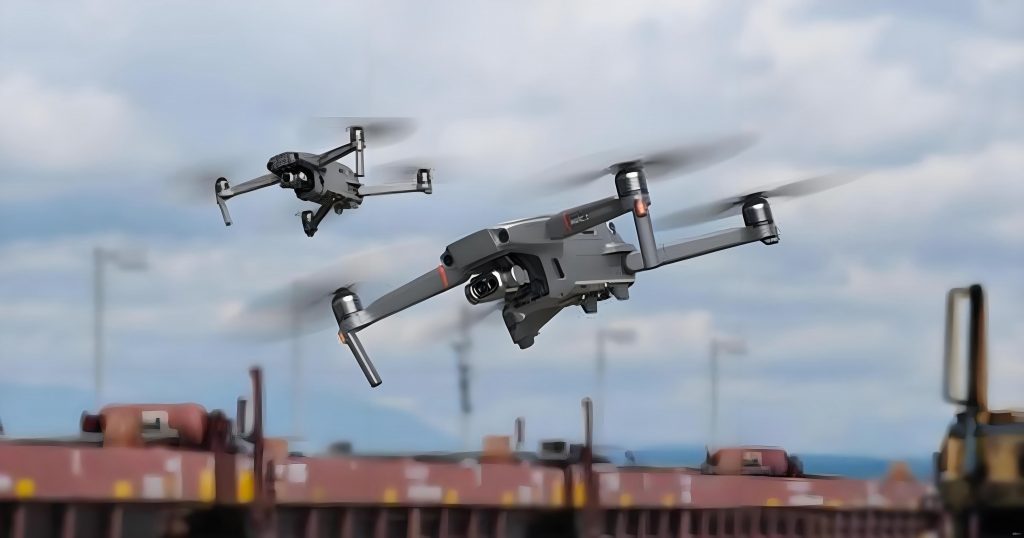
The image above encapsulates the operational environment for the next generation of civilian UAVs: complex, multi-layered, and requiring seamless autonomy. The convergence of more efficient algorithms, specialized hardware, and rigorous safety frameworks will be the key enabler. The future of civilian UAV collision avoidance lies not in a single monolithic ML algorithm, but in intelligently architected hybrid systems. These systems will combine the strategic foresight of formally verifiable planners, the perceptual acuity of efficient deep vision models, and the adaptive, tactical brilliance of safe reinforcement learning—all operating within a certifiable and explainable framework. This integrated intelligence is what will finally unlock the vast potential of dense, autonomous civilian UAV operations, transforming our skies and cities.