
In the evolving landscape of modern warfare and military operations, the integration of innovative, cost-effective technologies is paramount. As a professional engaged in military command studies, I have observed the rapid proliferation and advancement of small civilian drones. These platforms, originally designed for commercial and recreational purposes, present a significant opportunity to enhance military capabilities, particularly in reconnaissance and support roles. This article explores the potential operational applications of small civilian drones, examining their characteristics, feasibility in various missions, and future development directions. The core thesis is that by leveraging the strengths of civilian drones—such as low cost, versatility, and ease of deployment—military forces can reduce training and support costs, broaden reconnaissance methods, and increase battlefield flexibility. Throughout this discussion, the term ‘civilian drones’ will be emphasized to underscore their origin and transformative potential.
The use of unmanned aerial systems in military contexts is not new, but the focus has traditionally been on specialized, high-end military-grade platforms. However, the democratization of drone technology, driven by the civilian market, has led to the availability of sophisticated yet affordable systems. Small civilian drones, typically defined by their lightweight design (often under 25 kg), modular payloads, and consumer-grade components, have seen exponential growth in capabilities over the past decade. Their integration into military operations aligns with the broader concept of civil-military fusion, where commercial technological advancements are harnessed for defense purposes. This article will delve into the specifics of how these civilian drones can be employed, the challenges they face, and the pathways to overcoming these limitations to realize their full potential in enhancing operational effectiveness.
Characteristics of Small Civilian Drones
To understand the operational utility of civilian drones, one must first analyze their inherent features. These drones, primarily developed for photography, agriculture, surveying, and delivery, possess a unique set of advantages and disadvantages when considered for military use.
Prominent Advantages
The advantages of small civilian drones are multifaceted, contributing to their attractiveness for military adaptation:
- Compact Size and Low Observability: Civilian drones are typically small, making them easy to transport and deploy. They can be carried by individual soldiers or small teams without requiring dedicated logistical support. Their small cross-section and low acoustic signature reduce detectability. Camouflage techniques, such as painting them in sky-gray or disruptive patterns like fractal or spot camouflage, can further diminish visual identification. This allows for rapid deployment from vehicles or dismounted positions, enhancing reconnaissance timeliness and intelligence reliability.
- Low Cost and Easy Maintenance: The civilian drone industry, particularly in China, has matured with a complete supply chain and robust service ecosystem. Hardware is trending toward miniaturization and low power consumption. Procurement and maintenance are straightforward: components can be sourced independently or repaired quickly through manufacturers. The cost differential is staggering. Consumer-grade civilian drones cost around $1,000 to $1,500, while industrial-grade models range from several thousand to tens of thousands of dollars. In contrast, military-specific unmanned aerial vehicles (UAVs) can cost hundreds of thousands or even millions. This low cost allows for mass procurement and reduces concern over losses during training or combat, significantly improving the cost-effectiveness ratio. This can be summarized by a simple cost-benefit formula for unit procurement:
$$C_{eff} = \frac{\sum (P_{mission} \times S_{rate})}{N_{drone} \times C_{drone}}$$
where \(C_{eff}\) is the cost-effectiveness metric, \(P_{mission}\) is the probability of mission success, \(S_{rate}\) is the survival rate, \(N_{drone}\) is the number of drones, and \(C_{drone}\) is the unit cost. For civilian drones, low \(C_{drone}\) allows high \(N_{drone}\), boosting overall \(C_{eff}\) even if individual \(S_{rate}\) is lower. - Powerful and Diverse Functionality: Modern civilian drones are equipped with advanced payloads. Visible-light cameras offer sub-meter resolution, enabling clear identification of vehicle-sized targets. Thermal imaging and multispectral sensors are readily available, often with higher resolution than some legacy military systems. Emerging payloads under research include synthetic aperture radar (SAR), laser designators, and short-to-medium range communication relays. This modularity allows civilian drones to perform varied tasks, from surveillance to target designation.
- Ease of Procurement and Enhanced Operational Security: The global market, dominated by Chinese manufacturers, offers a vast array of civilian drone models. Anonymous online purchases can obscure the end-user, mitigating risks of compromise if a drone is lost or captured. This avoids potential intelligence leaks or diplomatic incidents that might arise from traceable military equipment.
Primary Disadvantages
Despite their advantages, civilian drones have inherent limitations that must be addressed for reliable military employment:
- Limited Range: The effective reconnaissance range is determined by the real-time video transmission distance. Due to size constraints, civilian drones cannot carry large, high-bandwidth communication systems. Consumer models typically have a nominal range of 7 km, but actual range in open terrain is about 4 km, dropping to 1 km in urban areas with signal obstruction. Industrial models may achieve over 10 km in ideal conditions. This range limitation constrains operational reach.
- Short Endurance: Battery capacity is limited by weight. Most small civilian drones are not aerodynamically optimized for endurance, resulting in flight times between 20 to 40 minutes. This necessitates portable charging systems or carrying multiple batteries, which adds to the logistical burden for dismounted operations. The endurance \(T\) can be modeled as:
$$T = \frac{E_{battery}}{P_{avg}}$$
where \(E_{battery}\) is the battery energy (in Watt-hours) and \(P_{avg}\) is the average power consumption (in Watts). For typical civilian drones, \(E_{battery}\) is low (e.g., 100-200 Wh), leading to short \(T\). - Lack of Electronic Warfare Resilience: Civilian drones typically use open-source flight control systems and commercial communication protocols (e.g., Wi-Fi, 4G/5G) without electromagnetic hardening. They are vulnerable to jamming, spoofing, and other electronic countermeasures, rendering them ineffective in contested electromagnetic environments.
The following table summarizes a comparative analysis between typical small civilian drones and a notional military mini-UAV:
| Feature | Small Civilian Drone (e.g., Consumer Grade) | Military Mini-UAV (Representative) | Implication for Military Use of Civilian Drones |
|---|---|---|---|
| Unit Cost | $800 – $15,000 | $50,000 – $500,000+ | Mass procurement feasible; acceptable attrition. |
| Endurance | 20 – 40 min | 1 – 6 hours | Limits continuous coverage; requires rotation or recovery points. |
| Range (Control/Video) | 4 – 10 km (actual) | 25 – 100 km | Sufficient for tactical, platoon/company-level ops; not for deep recon. |
| Typical Payloads | Visible-light, thermal, multispectral cameras | Military-grade EO/IR, SIGINT, laser designator | Adequate for basic ISR; lacks specialized military sensors. |
| EM Resilience | Very Low | High (with hardening) | Major vulnerability in peer conflicts; limits use to permissive/low-threat environments. |
| Logistics & Maintenance | Commercial supply chain; user-serviceable | Dedicated military logistics | Rapid repair/replacement; reduces burden on military depots. |
| Stealth/Detection | Small size; low acoustic signature; can be camouflaged | May have radar-absorbent materials, low-noise design | Good for covert, close-in surveillance if properly managed. |
Feasibility Analysis for Battlefield Reconnaissance and Support
The practical application of civilian drones in military scenarios hinges on matching their capabilities to specific mission requirements. Here, I explore several key areas where these drones can provide tangible benefits.
Application in Combat Operations
In the context of direct combat, civilian drones can serve as force multipliers for small units.
- Battlefield Target Identification: The high-resolution visible-light cameras on civilian drones enable precise target discrimination. When a suspected high-value target (e.g., armored vehicle, artillery piece) is detected via other means (e.g., signals intelligence, reports) but cannot be immediately accessed by ground scouts, a civilian drone can be rapidly launched for visual confirmation. The probability of correct identification \(P_{ID}\) can be expressed as a function of resolution \(R\) and range \(D\):
$$P_{ID} = k \cdot \frac{R}{D^2}$$
where \(k\) is a constant related to sensor quality and target contrast. For civilian drones with sub-meter \(R\) at tactical ranges (\(D < 5\) km), \(P_{ID}\) is high for vehicle-class targets. - Battlefield Surveillance and Target Guidance: The real-time video feed allows for persistent monitoring of a target area. Upon detecting a significant target, the drone operator can track its movement and relay continuous updates to command, enabling timely decision-making for engaging with other assets (e.g., artillery, aircraft). This provides a “poor man’s” persistent surveillance capability. Furthermore, with minimal modification, civilian drones can be equipped with lightweight explosive charges for harassment, low-altitude bombing, or even kamikaze strikes against soft targets, creating disruptive effects. However, such offensive use must be carefully weighed against the loss of the intelligence, surveillance, and reconnaissance (ISR) asset.
- Countering Forward Observer Positions (“Digging out Moles”): Enemy forward observers, often hidden in camouflaged positions, pose a significant threat by directing artillery fire. These positions are difficult to detect from the ground. Equipping special operations teams with civilian drones carrying thermal imaging payloads can reveal these observers based on heat signatures, especially if their overhead cover is minimal. Deploying multiple reconnaissance teams along advance routes, supported by civilian drone sweeps and electronic intelligence, can degrade the enemy’s ability to observe and target friendly forces, thereby increasing survivability during assault phases. The effectiveness \(E_{counter-FO}\) of such a tactic can be modeled as:
$$E_{counter-FO} = 1 – (1 – P_{detect})^{N_{sweeps}}$$
where \(P_{detect}\) is the probability of detecting an observer per drone sweep, and \(N_{sweeps}\) is the number of coordinated sweeps. Using multiple low-cost civilian drones increases \(N_{sweeps}\), thereby raising \(E_{counter-FO}\).
Application in Reconnaissance Missions
Beyond direct combat, civilian drones fill gaps in traditional reconnaissance.
Military reconnaissance units often face situations where signals are intercepted but visual confirmation is lacking. If dedicated military drone support is unavailable, a squad-carried civilian drone can provide immediate ad-hoc reconnaissance to locate and mark unknown or suspected targets. In border surveillance scenarios, civilian drones can document illegal activities (e.g., incursions, establishment of unauthorized outposts) from within one’s own territory, providing video evidence for diplomatic or legal actions. Crucially, operators must avoid crossing borders to prevent international incidents if the drone is shot down or captured. The value \(V_{recce}\) of such organic drone capability is high due to its immediacy:
$$V_{recce} = \frac{I_{gained}}{T_{delay} \cdot C_{risk}}$$
where \(I_{gained}\) is the intelligence value, \(T_{delay}\) is the time delay prevented by using the organic drone, and \(C_{risk}\) is the risk associated with its use. For civilian drones, low \(C_{risk}\) (due to low cost and deniability) and minimal \(T_{delay}\) maximize \(V_{recce}\).
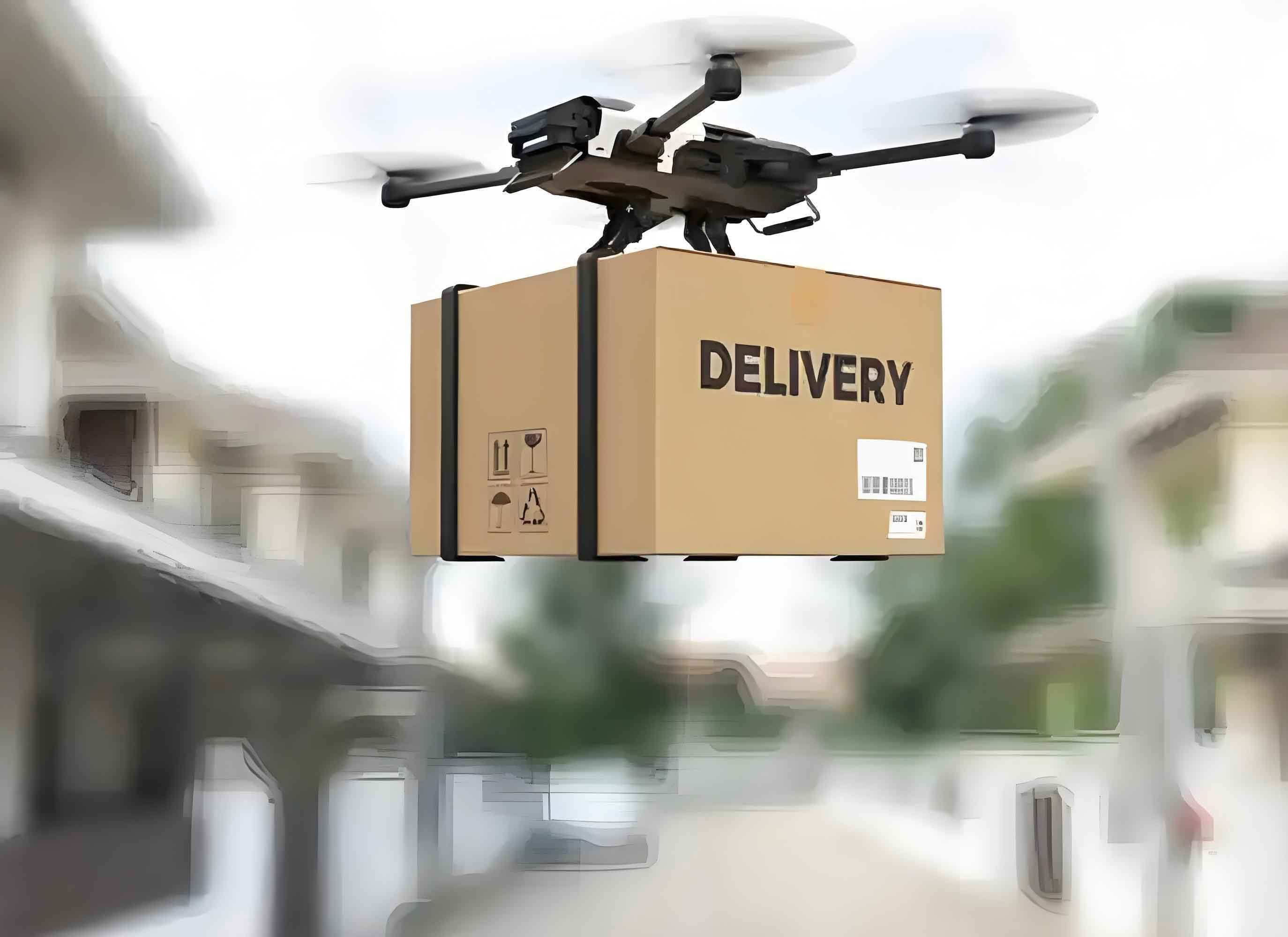
The image above illustrates a typical multi-rotor civilian drone, similar to those used in delivery services, which embodies the compact and versatile design that makes such platforms adaptable for military reconnaissance and light logistics roles in permissive environments.
Application in Non-War Military Operations
Civilian drones have already proven highly effective in disaster response and stability operations, areas where militaries are increasingly engaged.
- Disaster Relief: In missions like forest fire monitoring, flood assessment, and earthquake response, civilian drones equipped with visible-light and multispectral sensors can rapidly survey large areas, identifying hazards, locating survivors, and assessing damage. They can be fitted with modular payloads for specific needs: dropping emergency supplies (medicine, food), providing aerial loudspeaker announcements, or illuminating areas with powerful lights. This drastically improves the efficiency and safety of relief efforts. The coverage area \(A_{cover}\) for search and rescue can be approximated for a grid search pattern:
$$A_{cover} = v \cdot w \cdot T \cdot \eta$$
where \(v\) is drone speed, \(w\) is sensor swath width, \(T\) is endurance, and \(\eta\) is search pattern efficiency factor. Even with limited \(T\), multiple inexpensive civilian drones operating in parallel can cover significant \(A_{cover}\). - Counter-Terrorism and Stability Operations: In urban or complex terrain, civilian drones can navigate narrow alleys, enter buildings through windows, or peek over walls to provide interior situational awareness to commanders before committing personnel. They can also be armed with non-lethal or lethal payloads, such as flash-bang grenades or tear gas, to disorient and neutralize threats in confined spaces, creating a temporary tactical advantage.
Future Development Directions for Military Utilization of Civilian Drones
To fully harness the potential of civilian drones in military operations, a deliberate development strategy aligned with civil-military fusion is essential. Based on the analysis above, I propose several key directions for advancement.
First, training and talent development must be streamlined. Instead of creating wholly military-specific training pipelines, we should leverage the existing civilian ecosystem. This involves bulk procurement of commercial off-the-shelf (COTS) civilian drones and implementing simplified training programs for operators. Basic flight control can be self-taught or conducted through short courses, while more advanced skills—such as operating multi-sensor payloads and performing field maintenance—can be outsourced to civilian drone service companies or manufacturers. This reduces the training burden on the military and ensures access to the latest commercial expertise.
Second, development of new payloads and capabilities is critical. While current civilian drone payloads are capable, military-specific needs like synthetic aperture radar for all-weather/day-night imaging, secure laser designation for guiding precision munitions, and robust communication relays for tactical networks are not yet mature in the civilian market. By providing targeted funding and clear requirements to civilian research institutions and companies, these functionalities can be accelerated. A collaborative development model can be formalized. For instance, the required resolution \(R_{SAR}\) for a miniaturized SAR on a small civilian drone might be specified by:
$$R_{SAR} = \frac{c}{2B \sin(\theta)}$$
where \(c\) is the speed of light, \(B\) is the signal bandwidth, and \(\theta\) is the depression angle. Setting clear target values for \(R_{SAR}\) (e.g., 0.5m) guides civilian R&D.
Third, enhancing endurance and range is a fundamental limitation. Research should be encouraged into high-energy-density batteries (e.g., solid-state lithium), hybrid power systems, and improved aerodynamics. Additionally, the development of portable rapid-charging stations or mobile charging platforms (e.g., vehicle-based) is necessary. The goal is to increase the endurance \(T\) from the current 20-40 minutes to at least 60-90 minutes for typical tactical missions. This might involve a trade-off study captured in a table:
| Technology Approach | Potential Endurance Gain | Added Weight/Cost | Technology Readiness Level (TRL) | Suitability for Civilian Drone Adaptation |
|---|---|---|---|---|
| Higher Capacity Li-ion Batteries | +20-30% | Moderate weight increase | High (TRL 9) | Excellent; direct integration. |
| Fuel Cell Hybrid System | +100-200% | High cost, system complexity | Medium (TRL 6-7) | Moderate; requires miniaturization. |
| Solar Supplement | +10-20% (in daylight) | Low weight, area-dependent | Medium (TRL 7) | Good for certain reconnaissance drones. |
| Automated Battery Swapping | Effectively continuous with swaps | Requires ground station | High (TRL 9 for stationary) | Good for fixed site operations. |
Fourth, improving electromagnetic interference resistance is paramount for survivability in contested environments. Solutions include developing frequency-hopping digital control systems, integrating inertial navigation systems (INS) and GPS-denied navigation (e.g., visual odometry) for autonomous flight, and applying basic electromagnetic shielding. The objective is to increase the probability of mission completion \(P_{comp}\) in a jamming environment \(J\):
$$P_{comp} = P_{nav} \times P_{comm} \times P_{control}$$
where \(P_{nav}\) is the probability of maintaining navigation, \(P_{comm}\) is the probability of maintaining communication, and \(P_{control}\) is the probability of maintaining flight control. Enhancing autonomy boosts \(P_{nav}\) and \(P_{control}\) independently of vulnerable communication links.
Fifth, cost control must remain a priority to enable mass deployment. Economies of scale from civilian production should be leveraged. The military can specify certain ruggedization or modular interface standards without driving costs to military-grade levels. The target should be to keep the unit cost of a militarized civilian drone (with basic hardening and military interfaces) below $20,000 to allow for swarming tactics and widespread distribution at the company or platoon level.
Conclusion
The integration of small civilian drones into military operations represents a pragmatic and powerful avenue for innovation under the framework of civil-military fusion. These platforms offer a compelling blend of low cost, high functionality, and rapid deployability that can address specific tactical needs, particularly in reconnaissance, surveillance, and light support roles. While limitations in endurance, range, and electronic warfare resilience are real, they are not insurmountable. Through focused development in training, payloads, power systems, and hardening, the military utility of civilian drones can be significantly enhanced.
The current environment, where civilian technology outpaces traditional military development cycles in certain domains, presents a ripe opportunity. Procuring civilian drones in large numbers and experimenting with them in exercises and real-world missions can rapidly generate new tactics, techniques, and procedures. This iterative process of “learn by doing” will ultimately lead to a more agile and cost-effective force. The core principle is to maintain an unwavering focus on combat effectiveness as the sole criterion for evaluation. By boldly embracing commercial technology, we can forge new pathways to victory, ensuring that our forces are equipped with the tools needed to succeed in future conflicts, whether conventional or asymmetric. The humble civilian drone, therefore, is not just a piece of consumer electronics but a potential cornerstone of tomorrow’s distributed, resilient, and intelligent battlefield network.