
In recent years, the rapid proliferation of civilian drones has revolutionized numerous industries, from agriculture and logistics to surveillance and entertainment. As an active researcher in this field, I have witnessed firsthand how these unmanned aerial vehicles (UAVs) offer cost-effective, flexible, and wide-coverage solutions. However, this boom also introduces significant safety and security risks, necessitating robust regulatory frameworks. In this article, I delve into the application of radio technology for managing civilian drones, drawing from extensive analysis and real-world data. My focus is on leveraging radio signal characteristics to enable detection, localization, and countermeasures, thereby fostering a safer integration of civilian drones into our airspace.
The term “civilian drones” refers to unmanned aircraft operated without onboard human pilots, typically controlled via remote radio links or autonomous systems. According to regulatory definitions, these civilian drones are categorized based on parameters like mass, speed, and altitude. The classification, as outlined in aviation guidelines, is summarized in Table 1 below.
| Category | Definition |
|---|---|
| Micro Drones | Empty mass ≤ 7 kg |
| Light Drones | Empty mass > 7 kg but ≤ 116 kg, calibrated airspeed < 100 km/h, ceiling < 3000 m |
| Small Drones | Empty mass ≤ 5700 kg, excluding micro and light drones |
| Large Drones | Empty mass > 5700 kg |
The market for civilian drones is expanding exponentially, with projections indicating a compound annual growth rate of around 19% for light and micro models. This surge is driven by diverse applications, including border patrol, infrastructure inspection, and delivery services. Yet, alongside these benefits, civilian drones pose threats such as espionage, airspace violations, and public safety hazards. Hence, effective management is imperative. From my perspective, radio technology offers a soft intervention approach that minimizes physical risks while ensuring control over these devices.
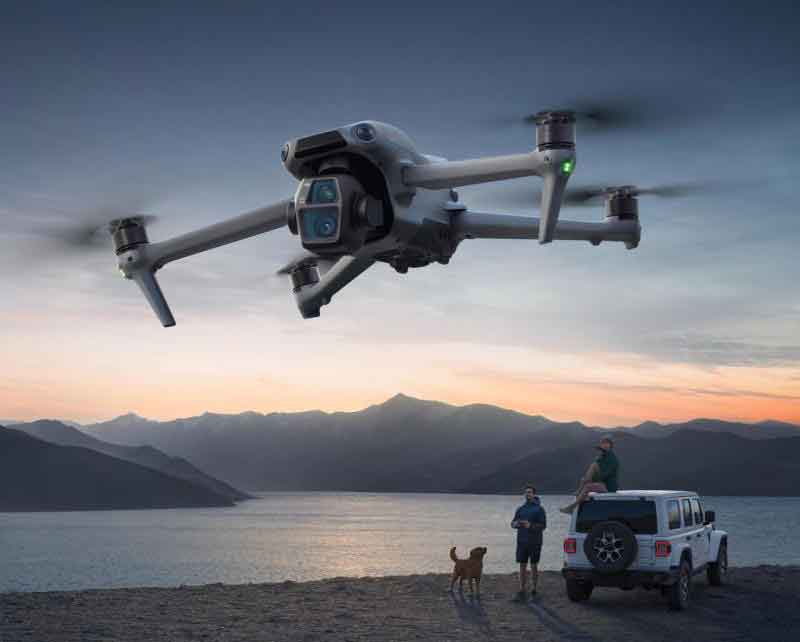
To understand how radio technology can manage civilian drones, one must first examine the radio signals they employ. During operation, civilian drones rely on various wireless links, which can be broadly classified into data transmission signals, image transmission signals, satellite navigation signals, and other application-specific data signals. Each type exhibits distinct spectral features that form the basis for technical interventions.
Data transmission signals, often used for command and control links between the drone and ground station, typically operate in license-free ISM bands. For instance, many civilian drones use frequency-hopping spread spectrum (FHSS) or WiFi protocols in the 2.4 GHz band. The spectral characteristics can be modeled mathematically. Consider a FHSS signal where the carrier frequency hops over time. The instantaneous frequency \( f(t) \) at time \( t \) can be expressed as:
$$ f(t) = f_0 + \Delta f \cdot S(t) $$
Here, \( f_0 \) is the base frequency, \( \Delta f \) is the frequency step, and \( S(t) \) represents the hopping sequence, often a pseudo-random pattern. In contrast, a fixed-frequency WiFi signal maintains a constant center frequency, such as 2.4115 GHz, with a bandwidth defined by its modulation scheme. The power spectral density \( P(f) \) for such signals can be approximated using:
$$ P(f) = \frac{P_t G_t G_r}{(4\pi d)^2 L} \cdot \text{sinc}^2\left(\frac{f – f_c}{B}\right) $$
where \( P_t \) is transmit power, \( G_t \) and \( G_r \) are antenna gains, \( d \) is distance, \( L \) is path loss, \( f_c \) is center frequency, and \( B \) is bandwidth. These formulas help in characterizing signals for detection purposes.
Image transmission signals, commonly used for real-time video feedback, often occupy the 5.8 GHz band, employing either digital WiFi or analog PAL/NTSC formats. An analog video signal, for example, might have a bandwidth of about 1 MHz centered at 5.945 GHz. The modulation index \( m \) for such analog signals influences the signal-to-noise ratio, given by:
$$ \text{SNR} = \frac{m^2 P_c}{N_0 B} $$
with \( P_c \) as carrier power and \( N_0 \) as noise density. Understanding these parameters is crucial for distinguishing drone signals from background noise.
Satellite navigation signals, from systems like GPS, GLONASS, or BeiDou, are vital for civilian drones’ positioning and autonomous flight. These signals use spread-spectrum techniques with precise timing. The received signal power \( P_r \) from a satellite can be modeled as:
$$ P_r = P_t + G_t + G_r – 20 \log_{10}\left(\frac{4\pi d}{\lambda}\right) – L_{\text{atm}} $$
where \( \lambda \) is wavelength and \( L_{\text{atm}} \) accounts for atmospheric losses. Jamming or spoofing these signals requires careful power calculations to avoid collateral interference.
Other data signals, used in specialized applications like surveying, may have unique modulations. For instance, synthetic aperture radar (SAR) on civilian drones might emit pulsed signals with specific repetition rates. Table 2 summarizes key signal types and their typical features.
| Signal Type | Frequency Bands | Common Modulation | Typical Bandwidth |
|---|---|---|---|
| Data Transmission | 2.4 GHz ISM band | FHSS, DSSS, WiFi | 1-20 MHz |
| Image Transmission | 5.8 GHz, 1.2 GHz, 328-334 MHz | WiFi, PAL/NTSC | 1-10 MHz |
| Satellite Navigation | L-band (e.g., 1.575 GHz for GPS) | CDMA, BPSK | 2-20 MHz |
| Other Data Signals | Varies by application | Custom modulations | Application-dependent |
Building on this signal analysis, I propose a radio-based management framework for civilian drones, comprising three stages: detection, localization, and countermeasures. This workflow, illustrated in Figure 3 of the original text but described here without reference, leverages the unique spectral fingerprints of civilian drones to enable non-destructive control.
In the detection phase, we utilize software-defined radio (SDR) platforms to monitor electromagnetic environments. By analyzing spectral features—such as frequency, bandwidth, and modulation—we can identify unauthorized civilian drones. A detection algorithm might compute the cross-correlation \( C(\tau) \) between received signal \( r(t) \) and a template \( s(t) \):
$$ C(\tau) = \int_{-\infty}^{\infty} r(t) s^*(t – \tau) dt $$
A high correlation peak indicates a match with known drone signals. Additionally, machine learning classifiers can be trained on features like cyclostationary properties to enhance accuracy. For instance, the cyclic autocorrelation function \( R_x^\alpha(\tau) \) for a signal \( x(t) \) at cyclic frequency \( \alpha \) is:
$$ R_x^\alpha(\tau) = \lim_{T \to \infty} \frac{1}{T} \int_{-T/2}^{T/2} x(t) x^*(t – \tau) e^{-j2\pi\alpha t} dt $$
This helps distinguish modulated signals from noise. Importantly, by accessing backend data from drone manufacturers, we can expand detection ranges, as many civilian drones transmit telemetry to cloud servers. This method significantly improves the practicality of monitoring civilian drones over large areas.
Once a civilian drone is detected, localization techniques pinpoint its position or that of its operator. For non-hopping signals, traditional direction-finding methods like time-difference of arrival (TDOA) are effective. With multiple sensors at positions \( \mathbf{p}_i \), the TDOA between sensors \( i \) and \( j \) for a source at \( \mathbf{q} \) is:
$$ \Delta t_{ij} = \frac{\|\mathbf{q} – \mathbf{p}_i\| – \|\mathbf{q} – \mathbf{p}_j\|}{c} $$
where \( c \) is the speed of light. Solving these equations yields the source location. For FHSS signals, we employ wideband receivers to capture hopping sequences, then apply matched filtering per hop. The localization error \( \sigma \) can be bounded by the Cramér-Rao lower bound (CRLB), which for a 2D scenario is:
$$ \sigma^2 \geq \frac{c^2}{2\pi^2 \text{SNR} \beta^2 N} $$
where \( \beta \) is effective bandwidth and \( N \) is the number of samples. This ensures precise tracking of civilian drones, essential for subsequent actions.
Countermeasures involve disrupting the communication or navigation links of civilian drones. Instead of brute-force jamming, which pollutes the spectrum, we advocate for targeted interference. For fixed-frequency signals, a narrowband jammer at the same frequency \( f_c \) with power \( P_j \) can suppress the signal if:
$$ P_j > P_r \cdot \text{MR} $$
where MR is the required margin ratio for successful blocking. For FHSS signals, we generate synchronized jamming signals that follow the hopping pattern. The jamming effectiveness \( J \) for a hop duration \( T_h \) is:
$$ J = \frac{1}{N_h} \sum_{k=1}^{N_h} \int_{0}^{T_h} |j_k(t) – s_k(t)|^2 dt $$
where \( j_k(t) \) and \( s_k(t) \) are jamming and source signals per hop, and \( N_h \) is the number of hops. Minimizing \( J \) ensures efficient disruption with minimal power, reducing interference to other ISM band users like WiFi and Bluetooth devices.
For civilian drones in autonomous mode relying solely on satellite navigation, we can employ spoofing techniques. By transmitting fake GPS signals with controlled time delays \( \delta t \), we induce position errors \( \Delta \mathbf{q} \):
$$ \Delta \mathbf{q} = c \cdot \delta t \cdot \mathbf{u} $$
where \( \mathbf{u} \) is the unit vector to the satellite. This can redirect civilian drones to safe zones. However, such measures must be deployed with directional antennas to limit environmental impact. During major events, real-time spectrum monitoring ensures that countermeasures do not harm legitimate communications, aligning with green radio principles.
In conclusion, radio technology provides a versatile toolkit for managing civilian drones. Through signal analysis, we can detect, locate, and neutralize rogue drones with precision. The integration of formulas and algorithms, as discussed, enhances the robustness of these methods. For instance, the overall detection probability \( P_d \) in a noisy environment can be modeled as:
$$ P_d = Q\left( \frac{\theta – \mu}{\sigma} \right) $$
where \( Q(\cdot) \) is the Q-function, \( \theta \) is the detection threshold, and \( \mu \) and \( \sigma \) are the mean and standard deviation of the signal feature. Future work should explore policy frameworks and advanced techniques like AI-driven signal classification to keep pace with evolving civilian drone technologies. By fostering collaboration between regulators and technologists, we can ensure that civilian drones contribute positively to society while mitigating risks. This proactive approach underscores the critical role of radio technology in shaping the future of unmanned aviation.