
In recent years, the evolution of global conflicts, particularly the situation in Ukraine, has profoundly reshaped my perspective on defense investments. The role of military drones on the battlefield has become increasingly pivotal, to the extent that these unmanned systems not only determine which side holds air superiority but also exert a deep influence on ground operations. The significance of military drones in contemporary warfare cannot be overstated, and their growing importance necessitates a thorough re-evaluation of investment opportunities in this sector. As I delve into this analysis, I will explore the expansive market potential, technological advancements, and core advantages that make military drones a cornerstone of future defense strategies.
The unmanned combat system represents a paradigm shift in military operations. It is built on an open architecture centered around network communications, offering advantages such as survivability, low cost, distributed functionality, and intelligent capabilities. A fundamental characteristic of this system is the high proportion of unmanned combat platforms, encapsulating the concept of “unmanned platforms, manned systems.” Unmanned combat systems integrate unmanned platforms, mission payloads, command and control systems, and air-space-ground information networks, with unmanned platforms serving as the core component. Based on their operational domains, these systems can be categorized into unmanned aerial systems, unmanned ground platforms, and unmanned maritime systems. The military drone, as a key element of unmanned aerial systems, has seen rapid adoption due to its versatility in roles ranging from targeted strikes to large-scale reconnaissance.
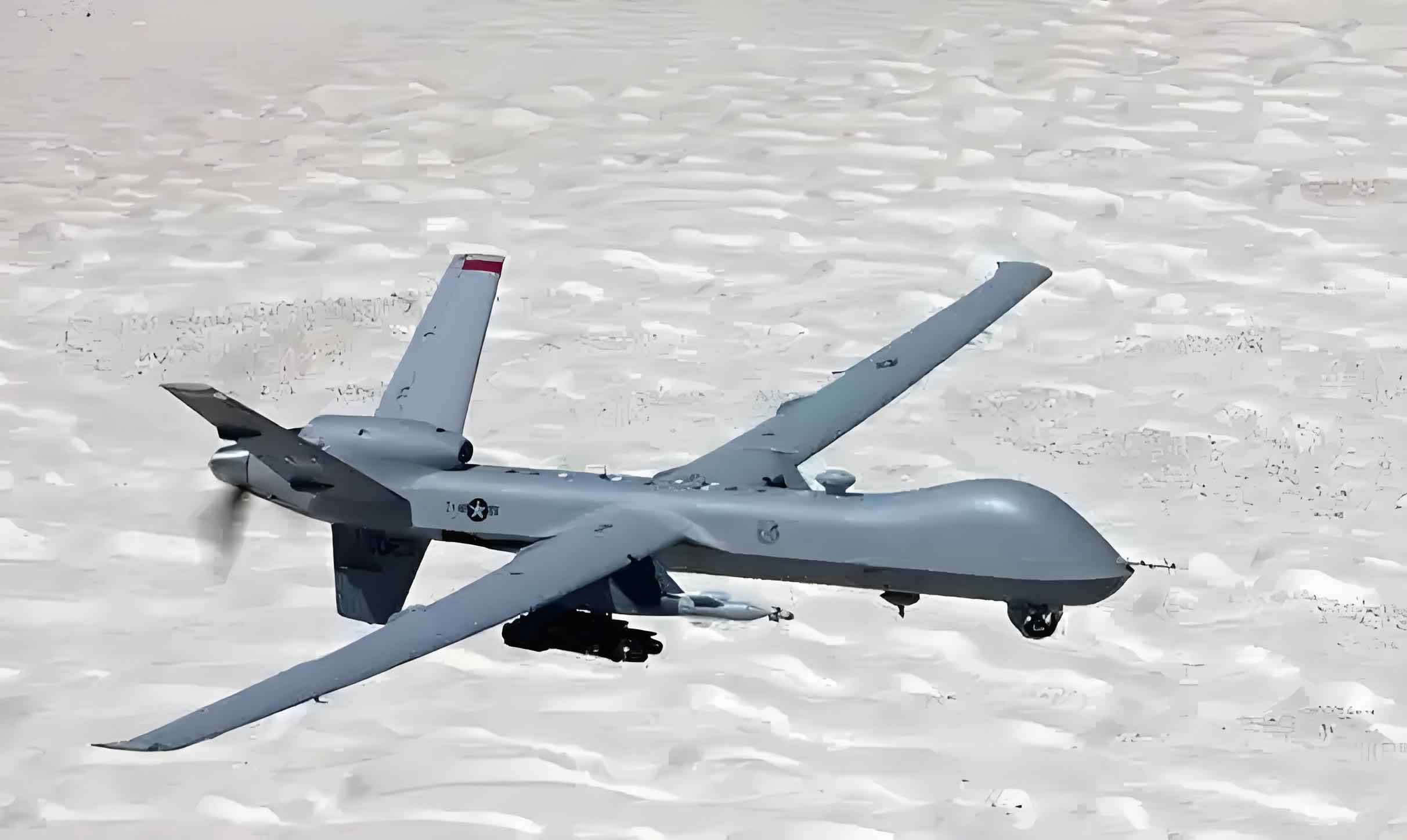
To quantify the market potential, let’s examine the projected growth. According to industry data, the global market for military drones was valued at approximately $12.1 billion in 2018. It is forecasted to reach $26.8 billion by 2025, reflecting a compound annual growth rate (CAGR) of 12.00%. This growth can be modeled using the CAGR formula:
$$ CAGR = \left( \frac{FV}{PV} \right)^{\frac{1}{n}} – 1 $$
Where \( FV \) is the future value ($26.8 billion), \( PV \) is the present value ($12.1 billion), and \( n \) is the number of years (7 from 2018 to 2025). Plugging in the numbers:
$$ CAGR = \left( \frac{26.8}{12.1} \right)^{\frac{1}{7}} – 1 \approx 0.12 \text{ or } 12.00\% $$
This robust growth is driven by increased defense budgets and technological innovations. For instance, a major military power has consistently allocated high budgets for military drone procurement, with annual spending averaging around $3 billion, accounting for over 6% of its total aviation equipment budget. The table below summarizes the historical and projected market size for military drones:
| Year | Market Size (USD billions) | CAGR Segment |
|---|---|---|
| 2018 | 12.1 | Base Year |
| 2019 | 13.6 | 12.00% |
| 2020 | 15.2 | 12.00% |
| 2021 | 17.0 | 12.00% |
| 2022 | 19.1 | 12.00% |
| 2023 | 21.4 | 12.00% |
| 2024 | 24.0 | 12.00% |
| 2025 | 26.8 | 12.00% |
In terms of deployment, current inventories reveal significant disparities. One nation operates over 1,000 large military drones, with army and air force branches being the primary users. These military drones include high-altitude long-endurance (HALE) and medium-altitude long-endurance (MALE) variants, which are crucial for intelligence, surveillance, reconnaissance (ISR), and strike missions. In contrast, other countries have far fewer operational military drones, indicating substantial room for catch-up through late-mover advantages. The demand for military drones is skewed towards large, reconnaissance, and combat-capable models, which offer extended loiter times and heavy payload capacities.
The technological edge in military drone systems lies in their integration with weaponry. The concept of “aircraft-missile integration” is a core advantage, where military drones are designed to seamlessly carry and deploy precision-guided munitions. This integration enhances strike accuracy and operational efficiency. For example, the effectiveness of a military drone in a strike mission can be expressed through a simplified kill chain formula:
$$ P_{\text{success}} = P_{\text{detect}} \times P_{\text{track}} \times P_{\text{engage}} \times P_{\text{hit}} $$
Where \( P_{\text{success}} \) is the probability of successful target neutralization, \( P_{\text{detect}} \) is the detection probability, \( P_{\text{track}} \) is the tracking probability, \( P_{\text{engage}} \) is the engagement probability, and \( P_{\text{hit}} \) is the hit probability. Military drones with integrated missile systems optimize these probabilities by reducing latency and improving sensor-shooter links. Reports from conflict zones have demonstrated that military drones equipped with such capabilities can execute hundreds of precise strikes, effectively neutralizing threats like vehicle-borne explosives before they reach their targets.
From a product portfolio perspective, leading manufacturers of military drones have developed comprehensive families covering high, medium, and low altitudes, as well as long, medium, and short ranges. These military drones are often modular, allowing for customization with various payloads, including electro-optical/infrared sensors, synthetic aperture radar, and electronic warfare suites. The table below compares key parameters for typical military drone categories:
| Category | Altitude Range | Endurance (hours) | Primary Roles | Typical Payload Capacity (kg) |
|---|---|---|---|---|
| HALE Military Drone | >15,000 m | >24 | Strategic ISR, Communications Relay | 500-1000 |
| MALE Military Drone | 5,000-15,000 m | 20-30 | Tactical ISR, Strike Missions | 200-500 |
| Tactical Military Drone | 1,000-5,000 m | 5-15 | Close Support, Battlefield Surveillance | 50-150 |
| Small Military Drone | <1,000 m | 1-5 | Company-level Reconnaissance, Targeting | 5-20 |
The competitive landscape for military drones features several key players, though specific names are omitted here as per guidelines. These entities range from state-owned aerospace conglomerates to specialized private firms. They compete on factors such as technological innovation, product reliability, and cost-effectiveness. Financial metrics indicate that top-tier manufacturers maintain healthy profitability, with gross margins often exceeding industry averages. This is attributed to economies of scale, proprietary technologies, and strong after-sales support. For instance, the gross margin for military drone sales can be modeled as:
$$ \text{Gross Margin} = \frac{\text{Revenue} – \text{Cost of Goods Sold}}{\text{Revenue}} \times 100\% $$
In the military drone sector, margins are bolstered by high-value contracts and recurring revenue from maintenance and upgrades. A comparative analysis of operational efficiency might use the return on assets (ROA) formula:
$$ ROA = \frac{\text{Net Income}}{\text{Total Assets}} \times 100\% $$
Companies focusing on military drones tend to exhibit improving ROA as production ramps up and R&D investments bear fruit.
Investment in military drone capabilities is accelerating through targeted funding. Recent capital raises have directed substantial resources towards next-generation military drone development and low-cost airborne weapon systems. Projects include enhanced variants of existing military drones, stealth unmanned aerial vehicles, and novel configurations like tiltrotor systems. These initiatives aim to solidify technological leadership and expand addressable markets. The payoff from such investments can be estimated using net present value (NPV) analysis:
$$ NPV = \sum_{t=0}^{T} \frac{C_t}{(1 + r)^t} $$
Where \( C_t \) is the net cash flow at time \( t \), \( r \) is the discount rate, and \( T \) is the project horizon. Positive NPV projects in military drone development signal value creation for stakeholders.
On the performance front, strategic divestitures have streamlined operations. Some manufacturers have offloaded non-core assets, such as capacitor film businesses, to concentrate on high-growth segments like military drones and related aerospace materials. This refocusing improves operational agility and resource allocation. The impact on earnings can be assessed through the DuPont analysis, decomposing return on equity (ROE):
$$ ROE = \text{Net Profit Margin} \times \text{Asset Turnover} \times \text{Equity Multiplier} $$
By shedding low-margin divisions, companies enhance net profit margins and asset turnover, thereby boosting ROE in the military drone domain.
Looking ahead, the trajectory for military drones is set for exponential growth. Innovations in artificial intelligence, autonomous swarming, and hypersonic technologies will further revolutionize this field. The integration of military drones with space-based assets and cyber networks will create interconnected kill webs, amplifying combat effectiveness. Moreover, the democratization of military drone technology may lower entry barriers, intensifying competition but also spurring innovation. I anticipate that military drones will become ubiquitous in defense arsenals, with applications expanding beyond traditional warfare to include border security, disaster response, and infrastructure monitoring.
To quantify future adoption, consider a logistic growth model for military drone proliferation:
$$ N(t) = \frac{K}{1 + \left( \frac{K – N_0}{N_0} \right) e^{-rt}} $$
Where \( N(t) \) is the number of military drones at time \( t \), \( K \) is the carrying capacity (market saturation point), \( N_0 \) is the initial number, \( r \) is the growth rate, and \( e \) is Euler’s number. Assuming \( K = 50,000 \) units globally, \( N_0 = 10,000 \), and \( r = 0.15 \), the projection over a decade shows rapid uptake.
In conclusion, the ascendancy of military drones as a decisive tool in modern conflict is undeniable. Their ability to project power with reduced risk to human operators, coupled with declining costs and advancing capabilities, makes them a focal point for defense investment. The market for military drones is not only vast but also evolving dynamically, with technological integration and strategic realignments shaping its future. As I reflect on the lessons from recent theaters of war, it becomes clear that military drones will continue to redefine aerial dominance and ground tactics. Investors and policymakers alike must prioritize this sector to harness its full potential. The journey of the military drone from a niche asset to a battlefield cornerstone is a testament to innovation and adaptation in the face of evolving threats.
To further illustrate the economic impact, below is a table summarizing potential cost savings from military drone adoption compared to manned aircraft:
| Cost Factor | Military Drone | Manned Aircraft | Savings with Military Drone |
|---|---|---|---|
| Acquisition Cost (USD millions) | 5-20 | 50-150 | Up to 80% |
| Operational Cost per Hour (USD thousands) | 3-10 | 15-40 | 60-75% |
| Training Cost per Pilot (USD millions) | 0.5-1.5 | 2-10 | 50-85% |
| Maintenance Annual Cost (USD millions) | 1-5 | 10-30 | 70-85% |
These savings underscore why military drones are attractive for budget-constrained defense forces. Additionally, the lifecycle cost of a military drone can be expressed as:
$$ LCC = C_{\text{acq}} + \sum_{t=1}^{T} (C_{\text{ops},t} + C_{\text{maint},t}) – S_{\text{residual}} $$
Where \( LCC \) is lifecycle cost, \( C_{\text{acq}} \) is acquisition cost, \( C_{\text{ops},t} \) is operational cost in year \( t \), \( C_{\text{maint},t} \) is maintenance cost in year \( t \), and \( S_{\text{residual}} \) is residual value. Military drones typically exhibit lower \( LCC \) due to reduced fuel consumption, simpler logistics, and longer service lives.
In summary, the military drone revolution is well underway, driven by strategic necessities and economic efficiencies. As technology progresses, we will witness even more sophisticated military drones capable of autonomous decision-making and collaborative operations. The investment case for military drones remains strong, with ample opportunities for growth and innovation. For those keen on the defense sector, military drones represent a critical area to watch, analyze, and ultimately, invest in for long-term returns.