
From my vantage point as a defense analyst, I have witnessed a profound transformation in the Asian security landscape, driven by the accelerating adoption and development of military drones. Following precedents set by Western powers, nations across Asia are now heavily investing in unmanned aerial systems, reshaping doctrines and capabilities. In this extensive examination, I will explore the technological trajectories, strategic motivations, and operational integrations of military drones across key Asian states. The term ‘military drone’ will recur throughout, underscoring its centrality to modern warfare. My analysis incorporates quantitative models and tabular data to elucidate trends and performance parameters.
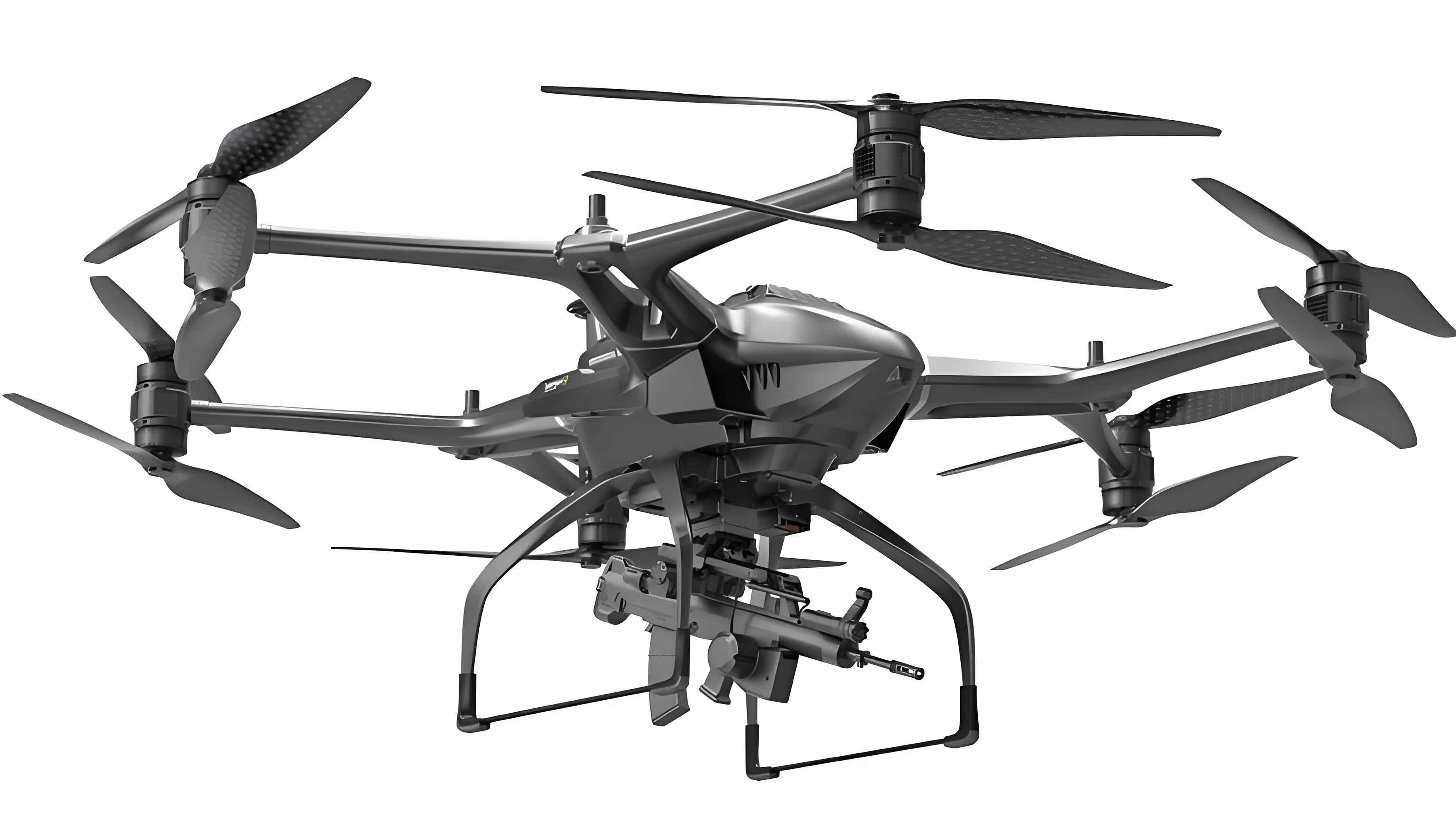
I observe that the proliferation of military drones is not merely about acquisition but involves deep indigenous research, international partnerships, and adaptation to diverse theaters. The core capabilities of a military drone—endurance, payload, stealth, and connectivity—are often expressed through engineering formulas. For instance, the fundamental range equation for a military drone can be approximated as: $$R = V \cdot \frac{C}{SFC} \cdot \ln\left(\frac{W_{initial}}{W_{final}}\right)$$ where \(R\) is range, \(V\) is velocity, \(C\) is fuel capacity, \(SFC\) is specific fuel consumption, and \(W\) represents weights. This formula highlights how technological advancements in propulsion and materials directly enhance a military drone’s operational reach.
My assessment begins with a pioneer in this domain. This nation has long been at the forefront of military drone technology, exporting systems worldwide and refining tactics through combat experience. The focus here is on developing versatile platforms for intelligence, surveillance, target acquisition, and reconnaissance (ISTAR). Key military drone families include tactical, medium-altitude long-endurance (MALE), and high-altitude long-endurance (HALE) types. The following table summarizes representative models based on my compilation of open-source data:
| Designation | Classification | Max Takeoff Weight (kg) | Endurance (hours) | Typical Payload (kg) | Primary Missions |
|---|---|---|---|---|---|
| Hermes 450 | Tactical | 450 | 20+ | 100 | Real-time ISR, laser designation |
| Heron | MALE | 1100 | 52 | 250 | Maritime patrol, ELINT, comms relay |
| Eitan (Heron TP) | HALE | 4000 | 70+ | 1000 | Signals intelligence, strategic reconnaissance |
From my analysis, the evolution of a military drone like the Hermes series illustrates incremental improvement: later variants see increased wingspan and payload capacity. The sensor suite effectiveness for a military drone can be modeled by the coverage area \(A_c\) over time: $$A_c = \frac{v \cdot t \cdot s_r}{2}$$ where \(v\) is ground speed, \(t\) is on-station time, and \(s_r\) is the sensor swath width. This shows why extending endurance is so critical for a military drone tasked with persistent surveillance.
Turning to South Asia, I note an ambitious, dual-track approach involving indigenous projects and foreign procurement. The drive for self-reliance in military drone technology is strong, with programs aimed at both tactical support and advanced unmanned combat systems. Simultaneously, immediate needs are met through imports. My research indicates a particular emphasis on military drones for high-altitude border monitoring and maritime domain awareness. The table below contrasts key indigenous and acquired military drone assets:
| Program/Acquisition | Origin | Category | Key Parameters (from public specs) | Status/Notes |
|---|---|---|---|---|
| Nishant | Indigenous | Tactical UAV | Weight: 380 kg, Endurance: 4.5 h | In service, catapult launched |
| Rustom | Indigenous | MALE UAV | Endurance: 12-15 h, Payload: 75 kg | Under development |
| Heron | Imported | MALE UAV | Endurance: 52 h, Altitude: 30,000 ft | Operational with Navy & Army |
| Stealth UCAV Project | Indigenous | Unmanned Combat Aerial Vehicle | Classified, focus on low observables | Feasibility study phase |
I have analyzed the requirements for a high-altitude military drone sought by this nation: it must operate above 50,000 feet for over 30 hours. The lift-to-drag ratio \(L/D\) becomes paramount here: $$E = \frac{C}{SFC} \cdot \frac{L}{D} \cdot \ln\left(\frac{W_{takeoff}}{W_{empty} + W_{payload}}\right)$$ where \(E\) is endurance. This formula explains the push for efficient aerodynamics and lightweight composites in next-generation military drones. Furthermore, the need for miniaturized sensors is driven by the payload constraint \(W_{payload}\), affecting the military drone’s design trade-offs.
In Northeast Asia, I discern a systematic buildup of military drone capabilities. One country has actively integrated foreign systems while fostering domestic development to create layered surveillance networks. The operational concept often involves using smaller military drones for tactical overwatch and larger ones for broader strategic coverage. A notable trend I see is the co-development of military drones with international partners to access advanced technologies. The performance of a typical tactical military drone can be summarized by its key metrics, often linked through simple relationships. For example, the power required for level flight in a military drone is given by: $$P_{req} = \frac{D \cdot V}{\eta_{prop}}$$ where \(D\) is drag, \(V\) is velocity, and \(\eta_{prop}\) is propeller efficiency. Reducing drag is thus a constant pursuit in military drone design.
The following table synthesizes the military drone landscape in this region, based on my observations of publicly announced programs:
| Country | Key Indigenous Military Drone | Key Imported Military Drone | Focus Areas | Notable Features |
|---|---|---|---|---|
| South Korea | Night Intruder (tactical), Remote Eye (mini) | Skylark (mini UAV from Israel) | Border surveillance, ISR | Emphasis on all-weather, day/night operation |
| Japan | Domestic HALE UAV under development | Planned import of Global Hawk or similar | Missile early warning, maritime monitoring | Integration with ballistic missile defense systems |
From my perspective, the Japanese case is intriguing for its focus on a military drone for early warning. The required radar performance for such a military drone involves the radar range equation: $$R_{max}^4 = \frac{P_t G^2 \lambda^2 \sigma}{(4\pi)^3 k T_s B F_n (SNR)_{min}}$$ where \(P_t\) is transmit power, \(G\) is antenna gain, \(\lambda\) is wavelength, \(\sigma\) is target cross-section, and other terms are system noise factors. Minimizing the size, weight, and power (SWaP) of such a radar for a military drone is a significant engineering challenge that my analysis suggests is a top priority.
In Southeast Asia, I note a concerted effort to institutionalize military drone operations. One nation has established a dedicated tri-service command for unmanned systems, signaling the strategic importance of military drones. This move aims to standardize training, procurement, and employment across the armed forces. The recent acquisition of a medium-altitude military drone system underscores the shift towards more capable, persistent platforms. The operational tempo for a military drone squadron can be modeled by availability \(A\): $$A = \frac{MTBF}{MTBF + MTTR}$$ where \(MTBF\) is mean time between failures and \(MTTR\) is mean time to repair. High availability is crucial for a military drone tasked with continuous surveillance missions.
My examination of this region’s military drone developments is summarized below:
| Aspect | Details from Analysis | Implications for Military Drone Capability |
|---|---|---|
| Organizational | Creation of a unified UAV Command | Centralized control, optimized resource allocation for military drones |
| Acquisition | Procurement of Hermes 450-class MALE drones | Enhanced battlefield surveillance range and endurance |
| Training | Establishment of a dedicated UAV training school | Improved human capital for operating complex military drone systems |
Moving to West Asia, I observe a dynamic mix of indigenous innovation, licensed production, and international collaboration in military drone technology. One nation is pursuing a family of domestically designed MALE and HALE military drones while also operating imported systems. The strategic goal appears to be achieving autonomy in critical military drone technologies, especially for surveillance over contested regions. The design trade-off for a military drone between endurance \(E\) and payload \(P\) can be expressed as a constraint: $$E \cdot P \leq K$$ where \(K\) is a constant dependent on fuel capacity and structural efficiency. This trade-off is central to the design of a military drone like the TAI Anka, where maximizing both is desired.
Another nation in this region has announced advances in stealth-oriented military drones, emphasizing low radar cross-section (RCS). The RCS reduction is critical for survivability and can be estimated for simple shapes. For a sphere, the optical region RCS is: $$\sigma = \pi r^2$$ but for a complex military drone shape, computational methods are used. The development of such military drones indicates a focus on penetrating defended airspace for reconnaissance or strike roles.
The following table captures key military drone projects from my analysis of West Asian nations:
| Country | Indigenous Military Drone Project | Collaboration/Acquisition | Reported Capabilities |
|---|---|---|---|
| Turkey | TAI Anka (MALE), TAI Aksungur (HALE) | Co-development talks with European consortia; Heron acquisition | Long-endurance ISR, potential weaponization |
| Iran | Shahed series, stealth UAV prototypes | Primarily indigenous, details scarce | Claimed stealth features, medium-range reconnaissance |
From my technical evaluation, the advancement in military drone autonomy is a common thread. The level of autonomy \(L_a\) for a military drone can be conceptualized on a scale, requiring sophisticated algorithms for navigation and decision-making. The path planning for a military drone in a contested environment involves solving optimization problems, such as minimizing exposure to threats: $$\min \int_{t_0}^{t_f} \sum_{i} \frac{w_i}{d_i(t)^2} dt$$ where \(d_i(t)\) is distance to known threat \(i\) and \(w_i\) is a weight. Implementing such algorithms is key for the next generation of intelligent military drones.
Across all these nations, I identify several overarching trends in military drone development. First, there is a clear move from mere surveillance platforms towards multi-role, networked systems capable of electronic warfare, communications relay, and even combat. Second, the push for longer endurance and higher altitudes is universal, driven by the desire for persistent stare. The required loiter time \(T_l\) for area monitoring of size \(A\) with a sensor footprint \(A_f\) is: $$T_l = \frac{A}{v \cdot A_f}$$ which explains why increasing \(A_f\) (via better sensors) and \(v\) (speed) is vital for a military drone. Third, miniaturization is enabling smaller, tactical military drones for squad-level operations, while larger, strategic military drones are becoming more common.
In conclusion, from my comprehensive analysis, the military drone landscape in Asia is characterized by rapid innovation, strategic diversification, and growing operational sophistication. The reliance on military drones for border security, maritime domain awareness, and force multiplication will only intensify. The technological race will likely focus on enhancing autonomy, survivability (through stealth and countermeasures), and seamless integration into joint all-domain command and control networks. The mathematical frameworks and performance parameters I have discussed underscore the engineering complexities behind these potent systems. As these capabilities mature, the military drone will remain a cornerstone of national defense strategies across the continent, reshaping the calculus of power and deterrence in the 21st century.