
As a researcher focused on defense technology, I have observed a transformative shift in the role of small and micro military drones, driven by the rapid evolution of compact electro-optical (EO) pods. These systems, once limited to basic reconnaissance, now integrate advanced sensors, enabling military drones to perform complex missions like target designation and battle damage assessment. In this article, I will explore the development, technical nuances, and operational applications of these compact EO pods, emphasizing how they enhance the capabilities of modern military drones. The integration of such pods has fundamentally altered tactical paradigms, allowing even small military drone platforms to deliver precision effects on the battlefield.
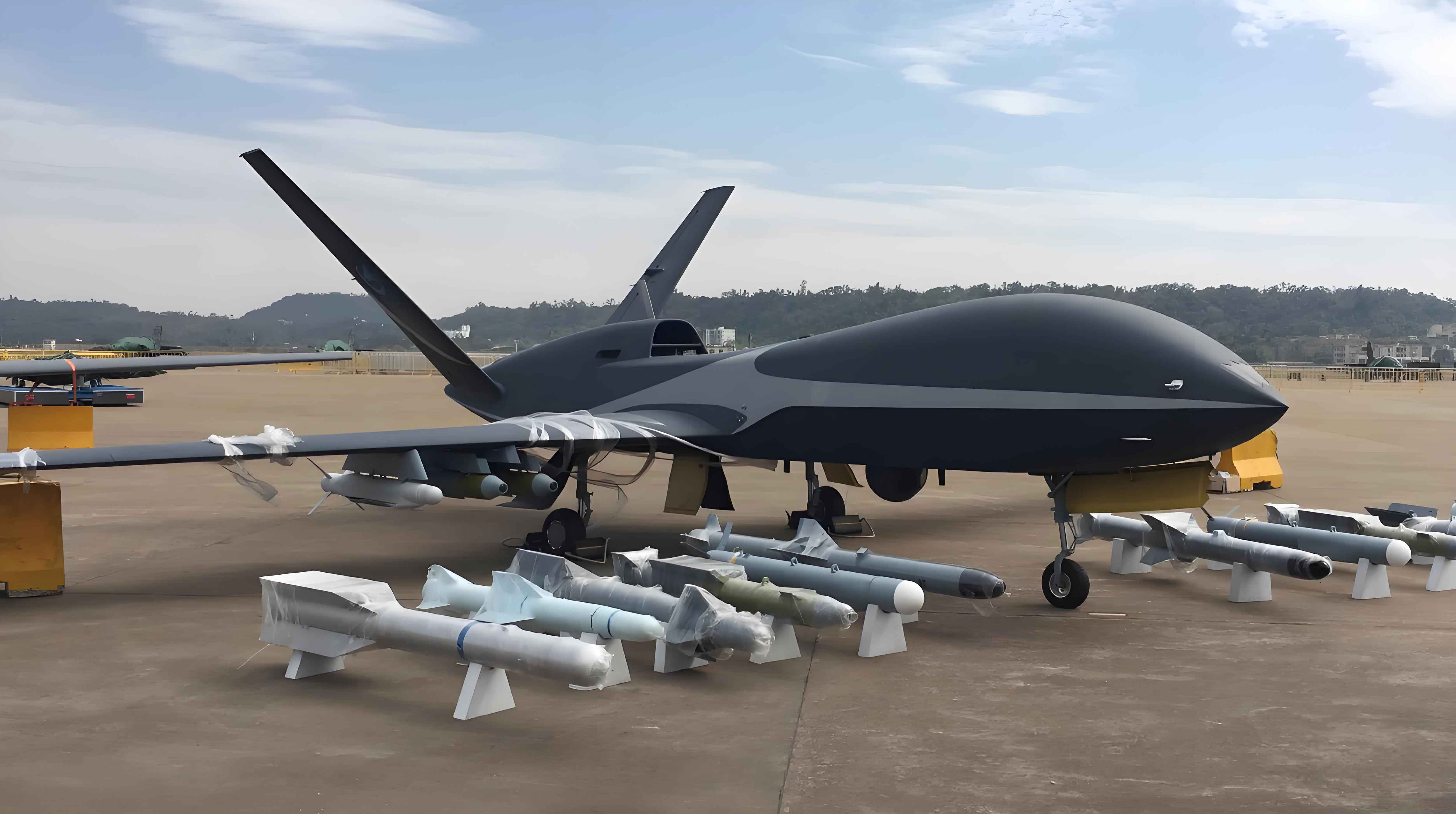
The proliferation of military drones across all domains has necessitated payloads that balance performance with size, weight, and power (SWaP) constraints. Compact EO pods, typically defined as systems under 8 kg, are designed for integration on Class I, II, and lightweight Class III military drones, such as the RQ-11B Raven or AeroVironment Puma. My analysis indicates that these pods are no longer mere surveillance tools; they are force multipliers that enable military drones to execute kill-chain functions autonomously or in concert with other assets. The core of this capability lies in multi-sensor fusion, combining visible-light cameras, infrared imagers, laser rangefinders, and, increasingly, laser designators into a single, stabilized package. This integration allows military drones to operate in diverse environments, from urban settings to maritime domains, providing real-time intelligence and targeting data.
To understand the technological leap, consider the sensor performance metrics. The detection range for a target by an EO pod on a military drone can be modeled using the Johnson criteria. For instance, the probability of detecting a standard NATO target (2.3 m × 2.3 m) with a mid-wave infrared (MWIR) sensor depends on the number of resolution lines across the target. A simplified expression for the maximum range \(R_{max}\) where detection is possible is given by:
$$R_{max} = \frac{h}{N \cdot \text{IFOV}}$$
where \(h\) is the target height, \(N\) is the number of cycles required for detection (typically 1.5 for detection, 6 for recognition), and \(\text{IFOV}\) is the instantaneous field of view of the sensor in radians. For a modern compact pod with a high-resolution 640 × 512 MWIR sensor and a narrow field of view, this range can exceed 10 km, enabling military drones to identify threats from standoff distances. Furthermore, the stabilization accuracy, often below 50 μrad, ensures that even when the military drone is maneuvering, the image remains steady for precise tracking. This is critical for missions where the military drone must maintain a lock on moving targets.
The development of compact EO pods has been led by several key international manufacturers. Below, I compare representative models from the United States, Israel, and China, highlighting the technological disparities. The table summarizes critical parameters that define the operational envelope of these pods on military drones.
| Parameter | StormCaster-DX (U.S.) | Alticam 11EOIR5 (U.S.) | T-STAMP-XD (Israel) | Zenmuse H20T (China) | Epsilon 180 (U.S.) |
|---|---|---|---|---|---|
| Weight (g) | 1250 | 6200 | 5750 | 828 | 3750 |
| Dimensions | 174 mm × 174 mm × 194 mm | 254 mm diameter | 193 mm diameter | 167 mm × 135 mm × 161 mm | 180 mm diameter |
| Stabilization | 3-axis gimbal | 4-axis stabilized | 3-axis stabilized | 3-axis gimbal | 2-axis mechanical, 3-axis electronic |
| Visible Camera | Not integrated | 640 × 480, 40× optical zoom | 1920 × 1080, 67× optical zoom | Zoom: 5184 × 3888; Wide: 4056 × 3040 | 1920 × 1080, 30× optical zoom |
| IR Camera | Dual-FOV LWIR, 640 × 512 | Cooled MWIR, 640 × 480 | Cooled MWIR, 640 × 512 | Uncooled LWIR, 640 × 512 | Cooled MWIR, 640 × 512 |
| Laser Rangefinder | Yes, up to 13 km | Yes, up to 4.5 km | Yes, up to 15 km | Yes, up to 1.2 km | Yes, up to 8 km |
| Laser Designator | Yes (1064 nm, STANAG 3733) | Yes (1064 nm, STANAG 3733) | Yes (1064 nm, STANAG 3733) | No | No (laser illuminator only) |
| IMU/GPS | Integrated | Not specified | Integrated | Integrated | Integrated |
From my perspective, the table reveals a clear technological gap. Western pods, like the StormCaster-DX and T-STAMP-XD, integrate full laser designation capabilities compliant with NATO standards, enabling military drones to guide semi-active laser-guided munitions. In contrast, Chinese models, while offering impressive visible and IR imaging, often lack laser designation or have limited rangefinder performance. This disparity affects the operational flexibility of military drones equipped with these pods. For instance, a military drone with a STANAG-compliant designator can support coordinated strikes with artillery or aircraft, whereas one without may be restricted to surveillance or non-precision roles. The integration density—packing multiple sensors into a sub-2 kg package—is a testament to advancements in miniaturization, but it also highlights dependencies on core sensor technologies where domestic production in some regions may lag.
The performance of these EO pods on military drones can be further analyzed through mathematical models of target acquisition. The signal-to-noise ratio (SNR) for an infrared sensor detecting a target against a background is crucial. It can be expressed as:
$$\text{SNR} = \frac{\Delta T \cdot \tau_{atm} \cdot A_d \cdot D^*}{\sqrt{A_d \cdot \Delta f}}$$
where \(\Delta T\) is the temperature difference between the target and background, \(\tau_{atm}\) is the atmospheric transmission, \(A_d\) is the detector area, \(D^*\) is the specific detectivity, and \(\Delta f\) is the electronic bandwidth. For military drones operating at low altitudes, atmospheric effects are less severe, but this equation underscores the importance of high-sensitivity detectors in compact pods. Modern cooled MWIR sensors, with \(D^*\) values exceeding \(10^{11}\) Jones, enable military drones to detect human targets at ranges over 5 km, even in cluttered environments. This capability is vital for intelligence, surveillance, and reconnaissance (ISR) missions where the military drone must identify threats without being detected.
Beyond technical specifications, the operational application of compact EO pods on military drones has revolutionized tactical engagements. I categorize these applications into three primary domains: intelligence gathering, target guidance, and damage assessment. Each domain leverages the multi-sensor fusion of the pod to enhance the effectiveness of military drones in combat scenarios.
First, intelligence gathering has become more pervasive and resilient. Military drones equipped with compact EO pods can penetrate contested airspace where larger platforms would be vulnerable. For example, in urban conflicts, a small military drone with a stabilized EO pod can hover near buildings, using its infrared camera to detect heat signatures through windows or walls. The real-time video feed allows operators to identify enemy positions, count personnel, or monitor movements. The pod’s GPS and IMU data geotag each frame, creating a precise spatial database. This is not just passive observation; it enables proactive decision-making. If the military drone detects a suspicious vehicle, it can track it automatically using onboard video analytics, providing a continuous stream of coordinates. The effectiveness of this was demonstrated in recent conflicts, where military drones like the PD-1 or Skylite provided overwatch for ground units, reducing their exposure to ambushes.
Second, target guidance represents the most significant advancement. Compact EO pods now allow military drones to directly participate in the kill chain by designating targets for precision-guided munitions. This involves two modalities: providing target coordinates or emitting laser designation signals. For coordinate-based guidance, the military drone uses its EO pod to identify a target, then calculates its exact location using laser rangefinding and angular measurements. The target’s coordinates \((x_t, y_t, z_t)\) are derived from the drone’s own position \((x_d, y_d, z_d)\), the range \(r\), and the azimuth \(\theta\) and elevation \(\phi\) angles:
$$x_t = x_d + r \cdot \cos(\phi) \cdot \sin(\theta)$$
$$y_t = y_d + r \cdot \cos(\phi) \cdot \cos(\theta)$$
$$z_t = z_d + r \cdot \sin(\phi)$$
These coordinates can be transmitted to artillery units or loitering munitions, enabling strikes with meter-level accuracy. However, for moving targets, laser designation is superior. A compact pod with a laser designator, like the StormCaster-DX, can illuminate a target with a coded laser pulse. Semi-active laser-guided weapons, such as the AGM-114 Hellfire or smaller munitions like the “Tomahawk” micro-missile, home in on the reflected energy. The military drone must maintain illumination until impact, which requires precise stabilization and often cooperative engagement with other assets. This capability was tested in Project Convergence 2022, where a Jump 20 military drone with an Alticam 11EOIR5 pod designated targets for laser-guided rounds, validating a seamless sensor-to-shooter link. The implication is profound: a single operator can deploy a military drone to find, fix, and finish a target, compressing the kill chain from minutes to seconds.
Third, battle damage assessment (BDA) is enhanced by the persistent surveillance of military drones. After a strike, the same military drone that designated the target can loiter safely, using its EO pod to assess the effects. The pod’s multispectral capability is key here; visible-light cameras show structural damage, while IR sensors can detect residual heat from fires or explosions. Quantitative BDA metrics, such as the percentage of target destroyed, can be estimated using image analysis algorithms. For instance, if a military drone observes a vehicle post-strike, it can compare the thermal signature to a baseline model to infer functionality. This real-time feedback allows commanders to decide on re-engagement, conserving resources and minimizing collateral damage. In asymmetric warfare, where targets may be dispersed, this role of the military drone is indispensable for validating mission success.
The evolution of compact EO pods also drives new tactical concepts for military drones. One emerging trend is the “drone swarm” approach, where multiple military drones equipped with different pods collaborate. For example, one military drone with a wide-FOV pod conducts area search, while another with a narrow-FOV pod performs identification, and a third with a laser designator guides munitions. The sensor data fusion across these military drones can be modeled as a network optimization problem, maximizing coverage while minimizing detection risk. Another concept is the integration of artificial intelligence (AI) directly into the pod. AI algorithms can automate target recognition, reducing the operator’s workload. The processing load on a military drone is non-trivial; it involves real-time video analysis, which can be expressed as a function of frame rate \(f\), resolution \(R\), and algorithm complexity \(C\):
$$P_{AI} = k \cdot f \cdot R \cdot C$$
where \(k\) is a constant factor. Advances in edge computing allow compact pods to run lightweight AI models, enabling military drones to identify threats like armored vehicles or personnel autonomously, then cue the operator for confirmation. This is particularly useful for military drones operating in communications-denied environments, where they must make decisions independently.
Looking forward, the development of compact EO pods for military drones faces several challenges and opportunities. From my analysis, three directions are critical: achieving sensor autonomy, enhancing integration density, and standardizing modular designs. First, sensor autonomy refers to the development of high-performance indigenous sensors. Many compact pods rely on imported components, which poses supply chain risks. For military drones to be truly resilient, domestic production of IR detectors, laser diodes, and optics must advance. The performance parameters, such as noise-equivalent temperature difference (NETD) for IR sensors, need improvement. NETD is given by:
$$\text{NETD} = \frac{\sqrt{A_d \cdot \Delta f}}{D^* \cdot \tau_{opt} \cdot \frac{\partial P}{\partial T}}$$
where \(\tau_{opt}\) is the optical transmission and \(\frac{\partial P}{\partial T}\) is the change in power with temperature. Lower NETD values, ideally below 50 mK, would allow military drones to detect subtle thermal contrasts, such as a person hidden in foliage. Second, integration density must increase without sacrificing SWaP. Future pods for military drones could incorporate additional sensors like hyperspectral imagers or electronic warfare modules, but this requires breakthroughs in packaging and heat dissipation. The use of metamaterials or micro-electromechanical systems (MEMS) could enable smaller, lighter stabilizers. Third, standardization is essential for interoperability. Military drones from different manufacturers should be able to swap pods easily, using common data interfaces and mechanical mounts. This would reduce lifecycle costs and accelerate deployment.
In conclusion, compact EO pods have elevated the military drone from a simple scout to a versatile combat node. Through multi-sensor integration and miniaturization, these pods enable military drones to perform ISR, target designation, and BDA with unprecedented efficiency. The technological gap between leading international products and domestic offerings highlights areas for investment, particularly in laser designation and high-end IR sensors. As military drones become more pervasive in multi-domain operations, the evolution of their EO pods will continue to shape tactical outcomes. Future advancements in AI, autonomy, and networking will further blur the lines between sensor and shooter, ensuring that the military drone remains a cornerstone of modern warfare. My research suggests that the next generation of compact pods will not only be smaller but smarter, capable of collaborative engagement across swarms of military drones, ultimately redefining the battlefield landscape.