
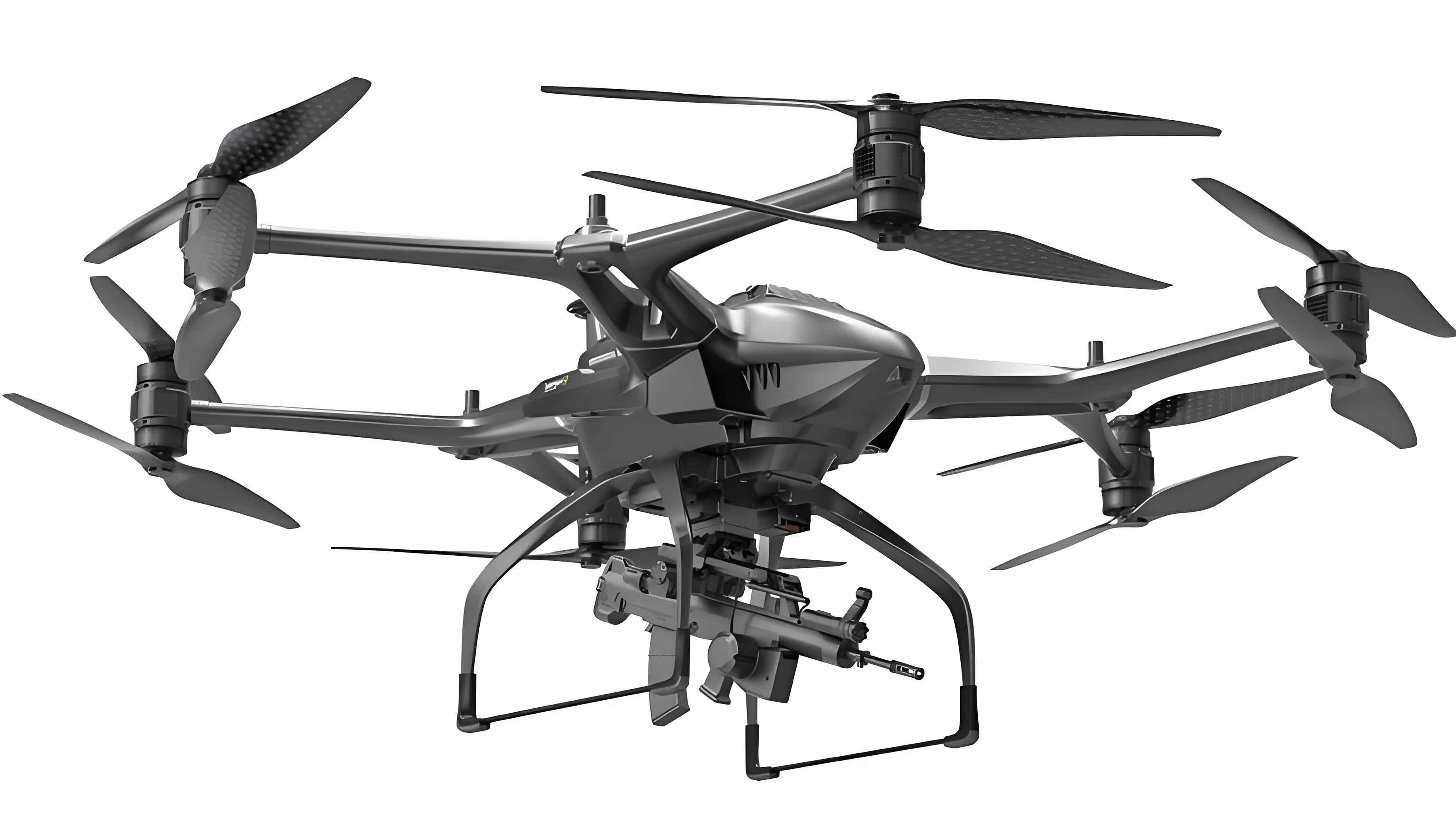
In the contemporary security landscape, the development and deployment of military drone systems have fundamentally altered the conduct of warfare and military operations. The intrinsic advantages of unmanned systems, primarily the reduction of human casualty risk and lower operational costs, have led to their indispensable role in modern conflicts. However, it is a critical misconception to assume that the safety risks associated with military drones are significantly diminished; these risks are largely transferred from the operational phase to the complex and multifaceted research, development, and testing phases. The safety of personnel, protection of assets, and security of sensitive technologies during the development lifecycle of a military drone present a formidable challenge. Currently, a systematic and standardized framework for safety production risk prevention throughout the development process of military drones is notably absent both domestically and internationally. Based on practical experience in constructing a Dual Prevention Mechanism—integrating risk分级管控 (graded control) with hidden danger investigation and governance—this article analyzes typical issues in safety risk identification and assessment during military drone development. It explores the rationality of existing processes and the feasibility of solutions, aiming to propose an optimized mode for safety production risk identification and assessment tailored to the unique ecosystem of military drone engineering in our context.
Table of Contents
- Current Status and Inherent Challenges in Safety Risk Management for Military Drone Development
- Foundational Principles and Optimization Framework
- The Optimized Implementation Mode: A Step-by-Step Guide
- Selection and Application of Risk Assessment Methodologies
- Case Application and Validated Outcomes
- Conclusion and Future Trajectory
1. Current Status and Inherent Challenges in Safety Risk Management for Military Drone Development
The safety risk management process within military drone development programs often exhibits several systemic shortcomings that undermine its effectiveness. These issues primarily manifest in the phases of hazard identification and risk evaluation.
1.1 Deficiencies in Hazard Identification
Hazard identification, the foundational step, is frequently plagued by incompleteness and inaccuracy. An analysis of typical risk registers from military drone project teams reveals a pattern of common problems, as summarized below:
| Issue Category | Manifestation & Example | Root Cause |
|---|---|---|
| Inaccurate Hazard Description | Vague statements like “Injury from lifting heavy objects” or “Vehicle operating on icy roads.” | Lack of a standardized template linking energy/hazardous substance, unsafe condition/act, and potential consequence. |
| Incomplete Hazard Recognition | Over-focus on physical equipment, neglecting human factors, management system flaws, and environmental conditions. | Failure to apply a systematic analysis covering “three temporal states” (past, present, future) and “three operational states” (normal, abnormal, emergency). |
| Misaligned Hazard-Risk Logic | Hazard: “Personnel activity in office.” Listed Risk: “Failure to hold required certification.” | Conceptual confusion between a hazard source and the specific risk event it precipitates. |
| Overly Broad Identification Units | Combining distinct processes like “lifting” and “transferring a load using a crane” into one step. | Coarse activity decomposition leads to inaccurate risk rating as control measures and risk magnitude differ per step. |
| Non-Standard Activity Description | Describing a task as “factory disinfecting personnel” instead of “using chemical XYZ to disinfect area ABC.” | Absence of a clear naming convention for job steps. |
| Dominance of General Office Risks | Risk registers overcrowded with generic administrative risks, overshadowing product-specific development hazards. | Lack of a product-lifecycle-centric approach that prioritizes design, manufacturing, and testing hazards. |
These problems stem fundamentally from insufficient training on core safety concepts—hazard, risk, danger point—leading to identification efforts that are neither comprehensive nor precise.
1.2 Shortcomings in Safety Risk Evaluation
Following flawed identification, the evaluation phase often compounds the problem. The prevalent use of the LEC (Graham) method, while simple, introduces significant subjectivity. The risk score $D$ is calculated as:
$$ D = L \times E \times C $$
where $L$ (Likelihood), $E$ (Exposure), and $C$ (Consequence) are assigned values based on evaluator judgment. The wide resulting score range (e.g., 6-63) and the evaluator’s bias can lead to inconsistent and unreliable risk rankings. Furthermore, existing control measures often fail to adhere to the hierarchy of risk controls. Risk registers also commonly lack critical metadata such as clear ownership (responsible department/team/person), risk category, and control hierarchy, hindering effective management and accountability.
2. Foundational Principles and Optimization Framework
The optimization is grounded in national guidelines and standards, including the “Opinions on Implementing the Guide to Curb Major Accidents and Building a Dual Prevention Mechanism” and standards like “Classification of Enterprise Staff Work-related Injuries” (GB/T 6441) and “Classification and Code for Dangerous and Harmful Factors in Production Process” (GB/T 13861). The core optimization logic addresses each identified problem systematically.
| Serial No. | Existing Problem | Optimization Content & Principle |
|---|---|---|
| 1 | Inaccurate hazard description. | Standardize description to: “[Energy/Hazardous Substance] may cause [Consequence] due to [Unsafe State/Unsafe Act/Management Defect/Environmental Factor].” |
| 2 | Incomplete hazard recognition. | Mandate systematic analysis across “Three Temporal States” and “Three Operational States,” focusing on energy/materials to identify human, equipment, environmental, and managerial factors. |
| 3 | Misaligned hazard-risk logic. | Clarify: Hazard is the source; Risk is the potential accident type & consequence arising from it. They are causally linked but distinct. |
| 4 | Overly broad identification units. | Classify all activities into three macro-categories: Product Design & Development, Office & General Management, Production & Operations. Subdivide meticulously based on process flow. |
| 5 | Non-standard activity description. | Format: “Perform [Action] using [Material/Tool/Equipment] in [Location/Area].” Use verbs: manage, operate, maintain, inspect, approve. |
| 6 | Dominance of generic risks. | Shift focus to product lifecycle. For design teams, analyze hazards from initial concept through design, manufacturing, test, maintenance, to disposal. |
| 7 | Subjective LEC evaluation. | Select assessment method (e.g., Risk Matrix) based on context. Use defined criteria for factor scoring. Apply ALARP principle for risk acceptance. |
| 8 | Poorly structured controls. | Apply the Hierarchy of Controls: prioritize Engineering, then Administrative, then PPE and Emergency measures. |
| 9 | Missing accountability data. | Include fields for: Control Level, Responsible Department/Team, Responsible Person, Risk Category in all risk registers. |
3. The Optimized Implementation Mode: A Step-by-Step Guide
The optimized mode presents a structured, eight-step workflow for continuous risk management in military drone programs, as illustrated in the following flowchart and detailed thereafter.
Military Drone Development Process: Hazard Identification & Risk Assessment Workflow
[Define Work Activity] → [Divide into Assessment Units & Job Steps] → [Identify Hazards → List] → [Define Risk Name] → [Analyze Risk (LS Matrix) → Determine Level] → [Propose Control Measures] → [Assign Control Ownership] → [Generate/Update Risk Register]
3.1 Preliminary Preparation
Effective risk management begins with comprehensive data collection. For a military drone project, the following documents are crucial:
- Facility Layouts & Drawings, List of Major Equipment, Dangerous Point Inventory.
- Chemical Safety Data Sheets (SDS) for all raw materials and consumables.
- Product lifecycle data: expected transport, use-case scenarios, maintenance procedures.
- Equipment SOPs, trial-run schemes, maintenance, and emergency procedures.
- System assembly/operation manuals highlighting safety-critical components and technical safeguards.
- Decommissioning and disposal requirements, especially for hazardous waste like lithium batteries.
3.2 The Core Identification & Assessment Process
This phase translates theory into actionable steps.
Step 1: Define Work Activity & Divide Units. All project activities are classified into three primary units for a military drone:
- Product Design & Development: Encompasses conceptual design, detailed design (aerodynamics, structures, propulsion, avionics, control systems, etc.), and test design.
- Office & General Management: Covers daily office work, lab equipment management, server administration, and management of hazardous non-production tasks.
- Production & Operations: Includes all manufacturing, assembly, integration, ground testing, and flight testing activities.
Precise location tagging (building, room, workshop area) is essential.
Step 2: Divide Job Steps using Job Hazard Analysis (JHA). Each activity unit is broken down into discrete, manageable steps. For example, “Flight Test” activity is divided into: Test Plan Development, Safety Briefing, Pre-entry Safety Check, Product Handling & Securing, Pyrotechnics Management, Fuel Handling, Battery Charging, Ground Testing (Engine, Taxi), and finally Flight Test Execution.
Step 3: Identify Hazards Systematically. For each job step, analysts ask: “What can go wrong?” guided by the standard description template and considering all temporal/operational states. Hazards are categorized as shown:
| Category | Description | Military Drone Example |
|---|---|---|
| Human Unsafe Act | Actions by personnel that violate safe procedures. | Technician bypassing an interlock during engine ground run; programmer inserting unverified code. |
| Equipment Unsafe State | Physical condition of hardware that is defective or dangerous. | Cracked composite wing spar; frayed lifting sling; faulty pressure sensor in fuel system. |
| Environmental Unsafe Factor | Conditions in the work environment that induce risk. | High winds during outdoor antenna setup; poor lighting in assembly bay; electromagnetic interference in test lab. |
| Management Defect | Deficiencies in the safety management system itself. | Lack of clear procedure for safe LiPo battery disposal; inadequate training for hazardous energy control (lockout/tagout). |
Step 4: Define Risk Name. Based on the identified hazard, the potential accident type is named according to standard classifications (e.g., Object Strike, Fire, Explosion, High-Fall, Electric Shock).
Step 5: Analyze Risk & Determine Level. A Risk Matrix (Likelihood-Severity) method is recommended for its balance of objectivity and simplicity. The risk level $R$ is determined by the coordinates of Likelihood ($L$) and Severity ($S$).
$$ R = f(L, S) $$
Where $L$ and $S$ are rated on predefined scales (e.g., 1-5). The resulting matrix cell defines the risk level: Low (Blue), Medium (Yellow), High (Orange), or Extreme (Red). This level is cross-referenced with predefined “Danger Point” levels for consistency.
Step 6: Propose Risk Control Measures. Controls are selected strictly following the hierarchy. The priority is to eliminate or reduce the risk at its source.
| Priority | Control Category | Meaning & Implementation | Military Drone Example |
|---|---|---|---|
| 1 (Highest) | Engineering Controls | Physical modifications, technical solutions, hardware interlocks. | Designing a fault-tolerant flight control system; installing pressure relief valves on test stands; using bonded storage for flammable solvents. |
| 2 | Administrative Controls | Policies, procedures, training, supervision, permits. | Implementing a strict pre-flight checklist (PFCL); mandating buddy system for high-voltage work; establishing a management of change (MOC) process for design modifications. |
| 3 | Personal Protective Equipment (PPE) | Equipment worn by personnel as a last line of defense. | Requiring safety glasses, hearing protection, and flame-resistant clothing in assembly areas; using anti-static straps when handling sensitive avionics. |
| 4 | Emergency Measures | Preparedness plans, first-aid, spill response, fire suppression. | Developing and drilling a specific emergency response plan for a fuel fire during ground operations; placing eyewash stations near chemical workbenches. |
Step 7: Assign Control Ownership. Every risk control measure must have an unambiguous owner—a specific department, project team, or even a named individual—responsible for its implementation, maintenance, and verification.
Step 8: Generate and Dynamically Update the Risk Register. All information is consolidated into a living risk register. This document is reviewed and updated regularly, especially after design changes, incidents, or introduction of new processes, ensuring the risk profile of the military drone project is always current.
4. Selection and Application of Risk Assessment Methodologies
Choosing an appropriate assessment method is critical. For the development of complex systems like military drones, a semi-quantitative approach like the Risk Matrix (LS) is often more suitable than the purely qualitative LEC method. It provides a more structured and consistent framework for judgment.
4.1 The Risk Matrix (LS) Method: This method uses two independently defined scales. For a military drone project, scales can be tailored:
- Likelihood (L): How likely is the event?
- Very Unlikely (e.g., < 0.001% chance per year)
- Unlikely
- Possible
- Likely
- Very Likely (e.g., > 10% chance per year)
- Severity (S): How severe are the consequences?
- Negligible (First-aid injury, minor equipment damage < $10k)
- Minor (Recordable injury, moderate damage)
- Moderate (Lost-time injury, significant system damage, mission delay)
- Major (Permanent disability, loss of a major subsystem, national media attention)
- Catastrophic (Fatality, total loss of prototype, severe environmental damage)
The risk level is the intersection point (L, S) on a 5×5 matrix. The risk value $R$ can be represented as an ordered pair or a derived score:
$$ R = (L, S) \quad \text{or} \quad R_{score} = L \times S $$
Acceptance criteria are then applied, often guided by the ALARP (As Low As Reasonably Practicable) principle. For a military drone program, a possible criteria is:
$$ \text{If } R_{score} \geq 12 \text{ (or } (L,S) \geq (4,3) \text{), risk is Unacceptable and must be reduced.} $$
$$ \text{If } 6 \leq R_{score} < 12 \text{, risk is Tolerable only if ALARP.} $$
$$ \text{If } R_{score} < 6 \text{, risk is Acceptable with routine monitoring.} $$
5. Case Application and Validated Outcomes
The optimized model was applied to a specific military drone development team. The team rigorously followed the eight-step process. The “Product Design & Development” unit was decomposed into 11 detailed design steps and over 20 specific test and manufacturing steps. This granular approach led to the identification of dozens of unique hazards, with a significantly altered distribution: Product-related hazards constituted 48% of the register, Office/Management 33%, and Production/Operations 19%. This represented a major shift from previous registers dominated by generic office risks.
The risk assessment using the LS matrix provided more defensible and consistent ratings. Control measures were explicitly linked to the hierarchy of controls. For instance, for the hazard “Lithium battery thermal runaway during charging due to defective management procedure,” the controls were:
- Engineering: Use certified smart chargers with automatic cut-off in a dedicated, ventilated charging station.
- Administrative: Implement a battery logbook and mandatory inspection before charging.
- PPE: Fire-resistant gloves and face shield for personnel during handling.
- Emergency: Class D fire extinguisher and thermal containment bag located at the charging station.
The final risk register included all required metadata, creating a clear, actionable, and accountable safety management tool for the military drone project.
6. Conclusion and Future Trajectory
The development of military drone systems is characterized by rapid technological evolution and inherent complexity, making robust safety risk management non-negotiable. The current ad-hoc approaches are insufficient. The optimized mode presented here, rooted in the Dual Prevention Mechanism philosophy, provides a systematic, standardized, and lifecycle-oriented framework for safety production risk identification and assessment. It clarifies fundamental concepts, introduces structured processes like JHA and the Risk Matrix, and mandates the application of the hierarchy of controls. This mode effectively addresses the typical shortcomings observed in practice, transforming risk management from a bureaucratic exercise into a core engineering and management discipline integral to the successful development of a military drone.
As military drone technologies continue to advance—with increasing autonomy, swarming capabilities, and new propulsion systems—the associated safety risks will also evolve. Therefore, the proposed risk management mode must not be static. It requires continuous iteration and refinement. Future work should focus on integrating this framework with digital tools for dynamic risk monitoring, developing domain-specific risk databases for common military drone development activities, and fostering a stronger safety culture where risk awareness is embedded in every phase of the military drone lifecycle, from the drawing board to the disposal yard.