
In recent years, the rapid evolution of unmanned aerial vehicles has fundamentally reshaped modern warfare, presenting new and complex challenges for naval defense. As a researcher focused on maritime security, I have observed that surface ships, traditionally designed to counter threats like anti-ship missiles, now face an escalating danger from military drones. These systems, ranging from small quadcopters to large unmanned aircraft, offer adversaries a cost-effective means of saturation attacks, precision strikes, and surveillance. The existing ship-based air defense arsenal, including close-in weapon systems and missiles, often proves inefficient against such threats due to high engagement costs and limited effectiveness against low-signature targets. Therefore, developing low-cost, high-efficiency counter-drone solutions for surface vessels has become a critical imperative. In this article, I will explore the classification and threats posed by military drones, analyze current anti-drone weapon systems, delve into key technologies for ship-based defense, and outline future trends. Through this study, I aim to provide insights that can guide the advancement of naval anti-drone capabilities, ensuring that surface ships remain resilient in an era dominated by unmanned warfare.
The proliferation of military drones has introduced a diverse array of threats, necessitating a clear understanding of their categories. Based on standardized classification frameworks, military drones can be grouped by size, mass, altitude, and speed, which directly influence their operational use and danger level. I have compiled a detailed table below to summarize these categories, highlighting how each class poses distinct challenges to surface ships. For instance, smaller drones may exploit terrain masking for close-range attacks, while larger ones can carry substantial payloads like guided munitions. This classification helps in tailoring defensive measures, as the response to a micro drone differs significantly from that to a high-altitude unmanned system.
| Category | Size | Take-off Mass (kg) | Operational Altitude (m) | Speed (m/s) | Typical Models | Primary Threat to Ships |
|---|---|---|---|---|---|---|
| I | Micro | 0–9 | < 360 | < 50 | RQ-11 Raven, quadcopters | Close-range attacks on personnel or exposed equipment; low cost enables swarming. |
| II | Small | 9–25 | < 1,100 | < 130 | Scan Eagle, Switchblade 600 | Precision strikes with guided weapons; moderate range and mobility. |
| III | Medium | < 600 | < 5,500 | < 130 | RQ-2 Pioneer, RQ-5 Hunter | Extended surveillance and attack capabilities; can carry heavier payloads. |
| IV | Large | > 600 | < 5,500 | Unrestricted | MQ-1 Predator, MQ-1C Gray Eagle | High-altitude endurance missions; potential to deploy anti-ship missiles. |
| V | Ultra-large | > 600 | > 5,500 | Unrestricted | RQ-4 Global Hawk | Strategic reconnaissance and long-range strikes; significant cost but limited numbers. |
To quantify the threat level of a military drone, I propose a simplified formula that considers key parameters: size (S), speed (V), payload capacity (P), and stealth characteristics (σ). The threat score T can be expressed as:
$$ T = \alpha \cdot S + \beta \cdot V + \gamma \cdot P – \delta \cdot \sigma $$
where α, β, γ, and δ are weighting coefficients based on naval defense priorities. For example, a small military drone with high speed and a precision payload may score higher in threat than a large, slow drone without weapons. This model aids in prioritizing targets during engagements, especially when facing mixed swarms of military drones.
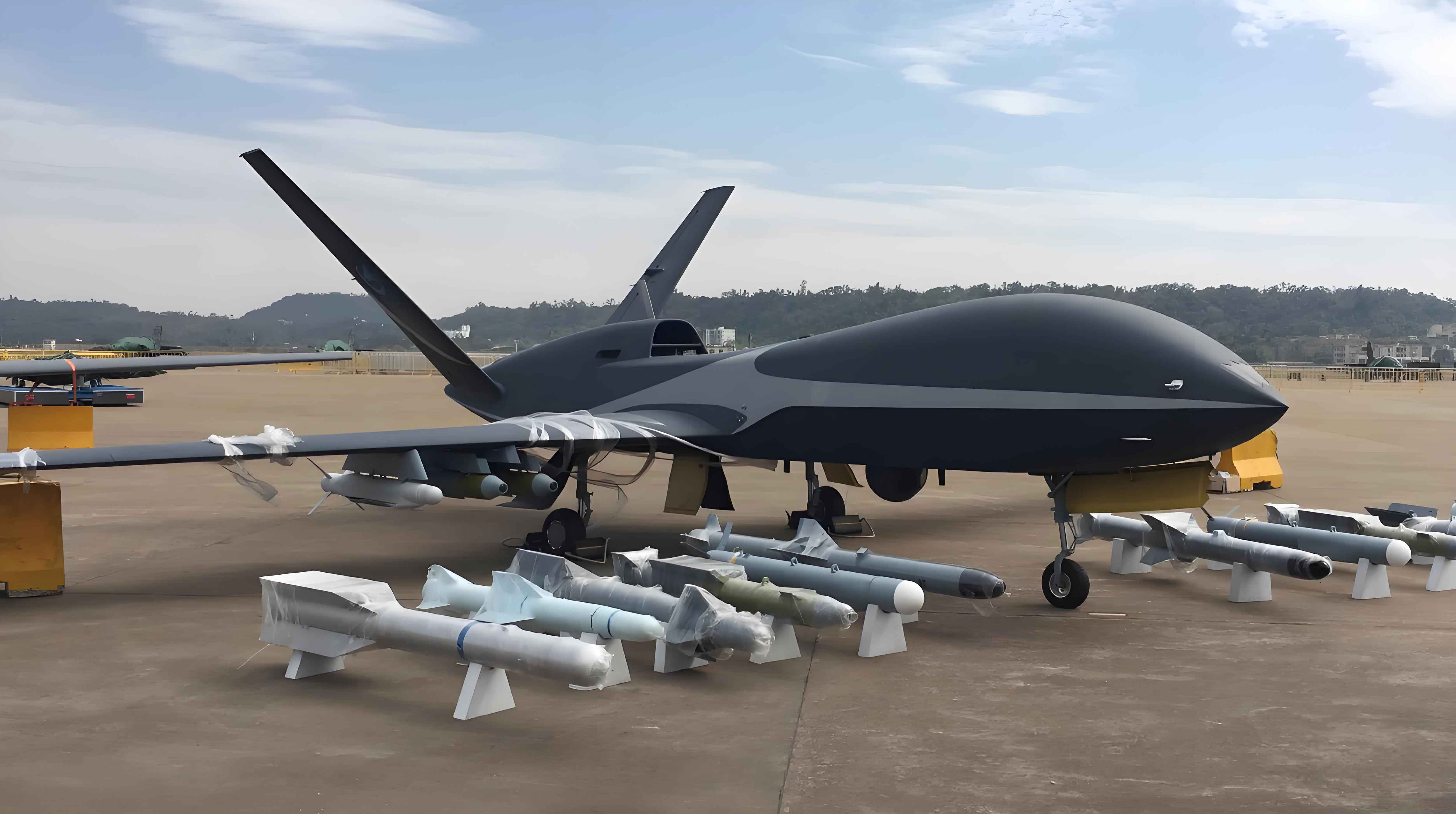
The visual representation above underscores the diversity of military drones, from handheld systems to advanced unmanned aircraft. In my analysis, I find that Category II and III military drones are particularly concerning for surface ships due to their balance of cost, capability, and availability. They can be deployed in large numbers for saturation attacks, overwhelming traditional defenses. For instance, in recent conflicts, we have seen such military drones used to target naval assets with explosives, highlighting the urgent need for adaptive countermeasures. The threat is compounded by the fact that these military drones often operate at low altitudes, exploiting radar clutter and gaps in coverage, which makes detection and tracking challenging for ship-based sensors.
Turning to anti-drone weapon systems, a variety of solutions exist, each with distinct effectiveness and cost profiles. As I evaluate these options, it is clear that no single system can address all military drone threats; instead, a layered approach is essential. Below, I present a comparative table of prominent anti-drone systems, focusing on their applicability to surface ships. This analysis draws from current deployments and experimental programs, emphasizing how each system performs against different classes of military drones.
| System Type | Examples | Effective Range (km) | Approximate Cost per Engagement | Key Strengths | Key Limitations | Suitability Against Military Drones |
|---|---|---|---|---|---|---|
| Rapid-Fire Guns (CIWS) | Phalanx MK-15, Goalkeeper | 1.5–2.0 | High (thousands of rounds) | High rate of fire; proven point defense. | Short range; high ammunition consumption; ineffective beyond 3 km. | Moderate for Category I–II; poor for swarms due to cost. |
| Electronic Warfare (Jamming) | Russian “Repellent”, U.S. “Titan” | 1.5–30 | Low (energy-based) | Low cost; can disable multiple drones; non-kinetic. | Susceptible to countermeasures; may affect friendly systems; limited vs. military-grade drones. | High for commercial drones; moderate for military drones with secure links. |
| Laser Weapons | Iron Beam, HEL TV | 1–5 | Very low (per shot) | Precision engagement; low cost per shot; rapid retargeting. | Atmospheric attenuation; limited range in poor weather; power requirements. | High for Category I–III; emerging technology for ships. |
| Microwave Weapons | Leonidas, Raytheon systems | 0.5–1 | Low (area effect) | Effective against swarms; non-kinetic; wide coverage. | Very short range; collateral risk to electronics; developmental stage. | High for dense groups; limited by proximity. |
| Surface-to-Air Missiles | APKWS, “Nail” missile | 5–20 | Moderate to high | Long range; high accuracy; versatile guidance. | High cost per missile; overkill for small drones. | High for Category III–V; low cost-effectiveness for small military drones. |
To model the effectiveness of an anti-drone system, I often use an engagement probability formula. For a given military drone at distance d, the probability of successful intercept \( P_i \) can be approximated as:
$$ P_i = \frac{1}{1 + e^{-k(d – d_0)}} \cdot \eta $$
where \( k \) is a system-specific constant, \( d_0 \) is the optimal engagement range, and \( \eta \) represents factors like weather or countermeasures. For example, laser weapons may have \( \eta \) drop significantly in fog, reducing \( P_i \). This formula helps in comparing systems: a low-cost jammer might have lower \( P_i \) but higher cost-efficiency against multiple military drones, while a missile offers high \( P_i \) but at greater expense.
In my research, I emphasize that the choice of anti-drone system depends heavily on the threat scenario. For instance, against a swarm of Category II military drones, a combination of jamming and lasers might be optimal, whereas a lone Category V military drone could be engaged with a missile. The cost per kill is a critical metric, especially for navies operating under budget constraints. I define cost-effectiveness \( CE \) as:
$$ CE = \frac{P_i}{C} $$
where \( C \) is the total cost of engagement, including ammunition and operational overhead. Systems like lasers score high on \( CE \) for small military drones, making them attractive for future integration. However, current deployments still rely on guns and missiles, which require upgrades to handle the unique challenges posed by military drones, such as their small radar cross-section and erratic flight paths.
Beyond individual systems, the integration of key technologies is vital for robust ship-based anti-drone defense. I have identified several core areas that demand focus. First, cooperative detection technology addresses the difficulty of tracking low-flying military drones. Ships typically use radar, electro-optical sensors, and electronic support measures, but each has limitations. By fusing data from multiple sensors, we can enhance detection probability and reduce false alarms. A fusion algorithm can be expressed as:
$$ F(t) = \sum_{i=1}^{n} w_i \cdot S_i(t) + \epsilon $$
where \( F(t) \) is the fused track at time \( t \), \( w_i \) are weights based on sensor reliability, \( S_i(t) \) are sensor inputs, and \( \epsilon \) accounts for noise. This approach allows ships to maintain situational awareness even when military drones exploit clutter or stealth features.
Second, heterogeneous weapon coordination technology enables efficient resource allocation. When facing a mixed swarm of military drones, ships must assign interceptors optimally to maximize kill probability while minimizing cost. This can be formulated as a weapon-target assignment (WTA) problem. Let \( x_{ij} \) be a binary variable indicating whether weapon \( i \) engages target \( j \). The objective is to maximize total expected damage:
$$ \text{Maximize} \sum_{i=1}^{m} \sum_{j=1}^{n} P_{ij} \cdot x_{ij} $$
subject to constraints like \( \sum_{j} x_{ij} \leq 1 \) for each weapon, and \( \sum_{i} x_{ij} \geq 1 \) for high-priority targets. Here, \( P_{ij} \) is the probability that weapon \( i \) destroys military drone \( j \). Solving this in real-time requires advanced algorithms, such as genetic algorithms or particle swarm optimization, which I have studied for naval applications. These methods allow ships to dynamically adjust to incoming threats, ensuring that cheap threats like small military drones are engaged with appropriate systems, preserving expensive missiles for larger threats.
Third, modular system design technology facilitates the adoption of anti-drone capabilities across diverse vessels. Surface ships vary in size, from small patrol boats to large destroyers, and a one-size-fits-all solution is impractical. By developing containerized modules—like Israel’s C-Dome—we can quickly equip ships with tailored defenses. The module’s effectiveness \( M \) can be modeled as:
$$ M = \frac{\sum \text{Capabilities}}{\text{Volume} \cdot \text{Power Requirement}} $$
where higher \( M \) indicates better integration. Such modules can include sensors, jammers, and interceptors, all in a standardized package that reduces installation time and cost. In my view, this modularity is crucial for rapid deployment, especially as military drone threats evolve unpredictably.
Looking ahead, I foresee several trends shaping the development of anti-drone technology for surface ships. These trends are driven by the need for efficiency, adaptability, and cost-effectiveness in countering military drone threats. First, detection systems will become increasingly cooperative. Instead of relying on a single radar, future ships will employ networks of radars, electro-optical/infrared sensors, and acoustic detectors, all linked by AI-driven fusion algorithms. This multi-domain approach can track even the smallest military drone through data correlation, providing a common operational picture. For example, a drone hiding in sea clutter might be detected by an infrared camera, with that cue passed to a radar for precise tracking. The fusion process can be enhanced with machine learning, where the system learns from past engagements to improve weight assignments in the formula above.
Second, interception means will diversify into a layered architecture. No single weapon can handle all military drone types, so ships will combine kinetic and non-kinetic effects. I envision a typical defense layer including: long-range jammers to disrupt drone communications, medium-range lasers for precise kills, and short-range guns or microwaves for last-ditch defense. The overall system effectiveness \( E \) can be expressed as:
$$ E = 1 – \prod_{k=1}^{L} (1 – P_k) $$
where \( P_k \) is the kill probability of layer \( k \), and \( L \) is the number of layers. This multiplicative model shows how layers complement each other; for instance, if a jammer fails to stop a military drone, a laser might still succeed. Such diversification ensures resilience, as adversaries may develop countermeasures against one system but not all.
Third, fire control systems will evolve toward full integration. Currently, many ships have separate systems for guns, missiles, and electronic warfare, leading to suboptimal coordination. Future integrated fire control will use centralized processors to manage all anti-drone assets, as seen in systems like the U.S. Ship Self-Defense System. This allows for automatic threat evaluation and weapon assignment, reducing human reaction time. In my analysis, an integrated system can improve engagement speed by up to 50% against fast-moving military drones, which is critical in swarm scenarios where seconds matter.
Fourth, weapon systems will embrace modularity for flexibility. As mentioned, containerized modules enable “plug-and-play” upgrades, letting ships swap out anti-drone components based on mission needs. For instance, a frigate on patrol might carry a module focused on jamming and lasers, while a carrier group’s escort might include missile-based modules. The cost savings from modularity are significant; rather than redesigning entire ships, navies can update modules as technology advances. I estimate that modular approaches could cut lifecycle costs by 30% compared to traditional retrofits, making it easier to keep pace with the rapid proliferation of military drones.
Fifth, there will be a relentless push toward cost minimization. Military drones are cheap to produce, so using expensive interceptors is unsustainable. Through my research, I identify several strategies: using commercial off-the-shelf components, adopting additive manufacturing (3D printing) for parts, and designing specialized low-cost missiles. For example, the APKWS rocket uses laser guidance to achieve precision at a fraction of the cost of standard missiles. The cost per kill \( C_{kill} \) should trend downward over time, ideally matching the low cost of military drones. A target formula for future systems might be:
$$ C_{kill} \leq \theta \cdot C_{drone} $$
where \( \theta \) is a multiplier (e.g., 10), ensuring economic viability. Advances in automation and mass production will further drive down costs, allowing ships to engage large swarms without depleting resources.
In conclusion, the threat posed by military drones to surface ships is real and growing, but through technological innovation and strategic integration, we can develop effective countermeasures. From my perspective, the future of naval anti-drone defense lies in cooperative detection, diversified interception, integrated fire control, modular designs, and cost minimization. By investing in these areas, we can ensure that surface ships remain protected against the evolving challenges of unmanned warfare. As military drones become more advanced and ubiquitous, continuous research and adaptation will be key—this study serves as a foundation for that ongoing effort, aiming to guide developers and operators toward a more secure maritime environment.