
The proliferation of smartphones and the mobile internet has irrevocably transformed modern society, weaving digital connectivity into the very fabric of daily life, commerce, and governance. This hyper-connectivity, however, has opened a vast and complex attack surface. Malicious actors continuously seek to exploit vulnerabilities in mobile ecosystems to steal personal data, financial information, and intellectual property. The loss or compromise of a single device can lead to significant personal harm, while a breach in corporate or governmental systems can have national security implications. The security of the mobile internet, therefore, is not merely a technical challenge but a foundational requirement for trust in the digital age. Core strategies to bolster this security involve stringent endpoint management, the development of specialized security services, and the segmentation of the digital landscape for tailored protection. As we fortify these digital frontiers, a parallel and deeply interconnected revolution is occurring in the physical domain: the rapid advancement of the military drone. These unmanned systems are evolving from simple remote-controlled aircraft into sophisticated, networked nodes of intelligence and action. Their potential, however, is intrinsically tied to the communication networks that enable them. The emergence of fifth-generation (5G) wireless technology presents a paradigm shift, offering the high-speed, low-latency, and reliable connectivity required to unlock the next generation of military drone capabilities, from real-time swarm coordination to secure battlefield data exfiltration. This article explores the security landscape of the mobile internet, delves into the transformative network capabilities of 5G, and provides a detailed analysis of how this symbiosis is driving the future of the military drone.
The Mobile Internet Security Imperative and Core Strategies
The security of the mobile internet hinges on protecting three critical pillars: the user’s identity, their financial assets, and sensitive data. In an era of ubiquitous “digital government” services and mandatory app authentication, a user’s digital identity is scattered across countless platforms. A breach in any one can cascade, exposing the individual to fraud and impersonation. Similarly, mobile payment systems are prime targets, directly threatening user finances. Furthermore, encrypted files on mobile devices often contain corporate or state secrets, where a single compromise can have devastating consequences. To counter these threats, a multi-faceted approach is essential.
First, robust endpoint management is non-negotiable. This involves not just device-level security (biometrics, encryption) but also strict application governance and user education. Second, the security-as-a-service market must mature. Many users and organizations lack the expertise to defend against advanced persistent threats (APTs) or ransomware attacks. Professional security services provide the necessary expertise to mitigate incidents and recover data. Third, a segmented management approach is crucial. The mobile internet serves diverse sectors—finance, healthcare, critical infrastructure—each with unique risk profiles and compliance requirements. Segmenting and applying specialized security policies and expertise to each domain enhances overall resilience. The formula for overall system risk can be conceptualized as a function of these elements:
$$ R_{system} = \sum_{i=1}^{n} (V_i \cdot T_i \cdot \frac{1}{C_i}) $$
Where:
- $R_{system}$ is the total system risk.
- $V_i$ is the vulnerability score of endpoint or segment $i$.
- $T_i$ is the threat level facing endpoint or segment $i$.
- $C_i$ is the strength of the security controls (management, service, segmentation) applied to $i$.
- $n$ is the total number of endpoints or segments.
The goal is to minimize $R_{system}$ by driving $C_i$ as high as possible through effective strategies.
| Security Strategy | Core Focus | Key Actions | Impact on Risk Factor (C_i) |
|---|---|---|---|
| Endpoint Management | Device, Identity & Data | Hardware encryption, strict app vetting, user authentication protocols | Directly reduces $V_i$ for individual devices |
| Security Service Development | Incident Response & Expertise | 24/7 monitoring, threat intelligence, digital forensics, ransomware mitigation | Increases overall $C_i$ by adding a layer of specialized defense |
| Segmented Network Management | Sector-Specific Protection | Network zoning, tailored firewalls, compliance-driven access controls | Reduces $T_i$ by isolating threats and limits blast radius of a breach |
The 5G Network Revolution: Capabilities Defining the Future
The transition from 4G/LTE to 5G is not a simple incremental upgrade; it is a foundational leap that redefines the possibilities of wireless communication. While 4G enabled the mobile broadband era, 5G is designed to support a vast Internet of Things (IoT), mission-critical communications, and enhanced mobile broadband simultaneously. Its core capabilities are summarized in the table below, highlighting the stark contrast with previous generations.
| Network Capability | 4G / LTE Advanced | 5G (Enhanced Mobile Broadband) | Implication for Military Systems |
|---|---|---|---|
| Peak Data Rate (Downlink) | ~1 Gbps | 20 Gbps | Enables real-time transmission of ultra-HD sensor feeds (SAR, video) from military drone platforms. |
| User Plane Latency | 10-30 ms | 1 ms (theoretical target) | Critical for closed-loop control of military drone swarms and real-time reaction in dynamic engagements. |
| Connection Density | ~100,000 devices/km² | ~1 million devices/km² | Supports massive-scale sensor networks and dense military drone cluster deployments. |
| Operational Spectrum | Sub-6 GHz (e.g., 700 MHz – 3.5 GHz) | Sub-6 GHz + mmWave (e.g., 24-40 GHz) | mmWave offers huge bandwidth for capacity; Sub-6 provides coverage. Dynamic spectrum sharing is key for military drone operations. |
| Mobility Support | Up to 350 km/h | Up to 500 km/h | Reliable connectivity for high-speed military drone and manned aircraft. |
| Network Slicing | Not native, limited via QoS | Native core functionality | Allows creation of a virtual, isolated, dedicated network slice for military drone C2, ensuring priority and security. |
These capabilities are enabled by key technological pillars. Massive MIMO (Multiple Input, Multiple Output) employs antenna arrays with dozens or hundreds of elements at the base station. This allows for spatial multiplexing, serving multiple military drone users on the same time-frequency resource, dramatically increasing spectral efficiency. The beamforming gain can be approximated by:
$$ G_{BF} \approx 10 \log_{10}(N) \quad \text{[dB]} $$
where $N$ is the number of antenna elements. A 256-element array thus provides roughly 24 dB of gain, extending range or improving signal robustness for a military drone link.
Network Slicing is a software-defined networking paradigm that allows a single physical 5G infrastructure to be partitioned into multiple virtual networks. Each slice can have its own unique characteristics optimized for a specific service. A slice for military drone command and control (C2) can be configured with ultra-reliable low-latency communication (URLLC) parameters, while a separate slice handles broader logistics data. The resource allocation per slice can be modeled as an optimization problem, ensuring the military drone slice meets its strict Service Level Agreement (SLA):
$$ \text{Maximize } U_{total} = \sum_{s \in S} U_s(R_s, L_s) $$
$$ \text{subject to: } \sum_{s \in S} R_s \leq R_{total}, \quad L_{drone-slice} \leq L_{max}, \quad \forall s \in S $$
Here, $U_{total}$ is total network utility, $U_s$ is the utility function of slice $s$, $R_s$ and $L_s$ are its allocated data rate and latency, $S$ is the set of all slices, and $R_{total}$ is the total available bandwidth. The constraint $L_{drone-slice} \leq L_{max}$ enforces the critical low-latency requirement for the military drone mission.
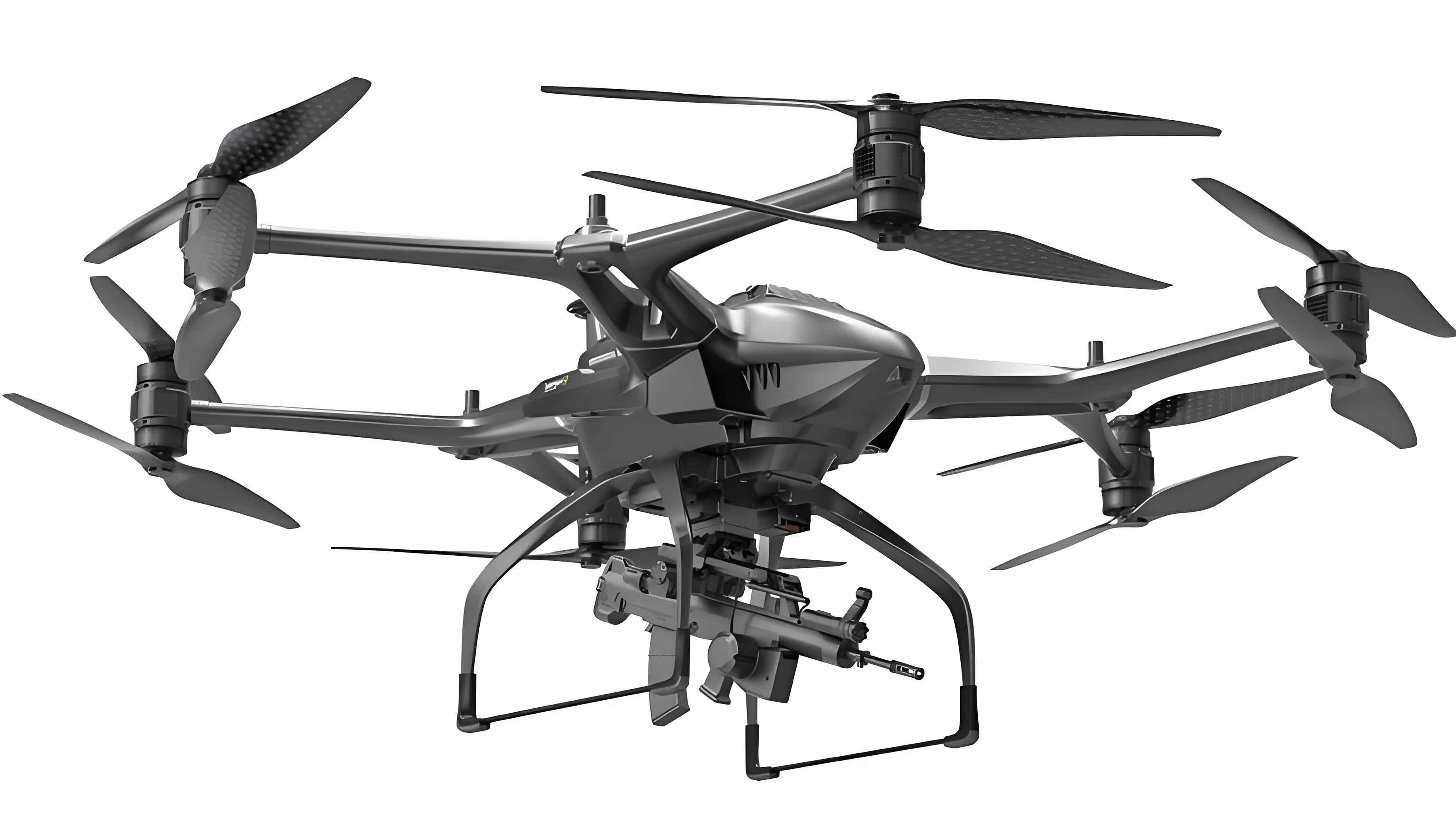
Symbiosis: How 5G Propels the Military Drone Ecosystem
The fusion of 5G and the military drone creates a powerful feedback loop of mutual enhancement. For the military drone, 5G acts as a transformative enabler.
1. Enhanced Situational Awareness and Real-Time Decision Making: Modern military drone sensors (LiDAR, multi-spectral imagers, synthetic aperture radar) generate terabytes of data. 5G’s multi-Gbps rates allow this raw data to be streamed to edge computing nodes or cloud-based AI analytics platforms in near real-time. Commanders can receive processed, actionable intelligence—such as identified targets, terrain analysis, or change detection—within seconds, collapsing the sensor-to-shooter timeline. The effective intelligence throughput $I_{eff}$ for a military drone can be expressed as:
$$ I_{eff} = \frac{D_{sensor} \cdot C_{compression}}{T_{process} + T_{transmit}} $$
where $D_{sensor}$ is raw sensor data volume, $C_{compression}$ is the compression ratio, $T_{process}$ is on-drone processing time, and $T_{transmit}$ is transmission time. 5G minimizes $T_{transmit}$, maximizing $I_{eff}$.
2. Cooperative Swarm Intelligence: This is perhaps the most significant advancement. 5G’s 1ms latency and high reliability are prerequisites for safe, coordinated flight of autonomous drone swarms. Drones in a swarm can share perception data (e.g., fused LiDAR and visual SLAM maps), dynamically re-task themselves based on a collective objective, and perform complex maneuvers like adaptive formation flying. The control stability of a swarm relies on timely state information exchange. The maximum allowable communication delay $T_{delay}^{max}$ for stable formation control can be derived from control theory principles and is a critical parameter that 5G aims to satisfy:
$$ T_{delay}^{max} < \frac{\pi}{2 \omega_{BW}} $$
where $\omega_{BW}$ is the desired closed-loop control bandwidth of the swarm. For agile military drone swarms requiring high $\omega_{BW}$, $T_{delay}^{max}$ becomes extremely small, pushing the limits of 5G URLLC.
3. Secure and Resilient Communications: 5G incorporates stronger native encryption algorithms and mutual authentication protocols compared to 4G. When combined with military drone-specific cryptographic modules and the isolation provided by a private network slice, it creates a highly secure communications channel resistant to interception and jamming. The signal-to-interference-plus-noise ratio (SINR) for a military drone connected via a 5G beamformed link is:
$$ \text{SINR} = \frac{P_{tx} \cdot G_{BF} \cdot G_{drone} \cdot |h|^2}{I + N} $$
where $P_{tx}$ is transmit power, $G_{BF}$ is the beamforming gain, $G_{drone}$ is the drone antenna gain, $|h|^2$ is the channel gain, $I$ is interference, and $N$ is noise. The high $G_{BF}$ directly improves SINR, enhancing link robustness against hostile $I$.
The Reciprocal Impact: Military Drones as 5G Network Agents
The relationship is not one-way. The military drone itself becomes a novel asset for 5G network deployment and resilience, particularly in contested or austere environments.
1. Aerial Base Stations (UxNB – UAV as Next-Generation NodeB): A military drone can be equipped with a compact 5G base station (gNodeB), becoming an airborne cell tower. This provides immediate, on-demand coverage for ground troops in areas with destroyed infrastructure or no pre-existing coverage. The coverage area $A_{cov}$ of such an aerial platform at altitude $h$ is approximately:
$$ A_{cov} \approx \pi \cdot (h \cdot \tan(\theta))^2 $$
where $\theta$ is the antenna’s elevation beamwidth. A military drone at 200m can provide coverage over a significant tactical area, acting as a communications relay for dismounted soldiers or other assets.
2. Dynamic Network Backhaul and Meshing: A fleet of military drone can form a mobile mesh network, creating a self-healing, flexible communication backbone. If one drone is lost, the network can automatically re-route traffic through others. This is invaluable for maintaining C2 connectivity in rapidly changing battlefield conditions. The end-to-end latency $L_{mesh}$ in a multi-hop drone network with $k$ hops is:
$$ L_{mesh} = \sum_{i=1}^{k} (L_{proc,i} + L_{prop,i} + L_{trans,i}) $$
where $L_{proc,i}$, $L_{prop,i}$, and $L_{trans,i}$ are the processing, propagation, and transmission delays at hop $i$. 5G’s low $L_{trans,i}$ and $L_{proc,i}$ (via edge computing on drones) are essential to keep $L_{mesh}$ within operational limits for real-time applications.
Confronting the Challenges and Future Trajectory
Despite the immense promise, the 5G-military drone integration faces significant hurdles that must be overcome for mature deployment.
| Challenge Category | Specific Issue | Potential Mitigation / Research Direction |
|---|---|---|
| Technical & Operational | Limited mmWave Range & Obstruction Sensitivity: High-frequency 5G signals attenuate quickly and are blocked by foliage, buildings, and even weather. | Hydual-band operation: Use sub-6 GHz for reliable C2 links and mmWave for high-data-rate backhaul in clear conditions. Intelligent predictive handover between frequencies and network nodes. |
| Technical & Operational | Drone Power Endurance: Operating a 5G modem and performing edge computing consumes significant power, reducing mission loiter time. | Advancements in drone energy systems (hydrogen fuel cells, hybrid propulsion). Optimized waveform design and duty cycling for communications. In-flight wireless charging research. |
| Security | Expanded Attack Surface: Connecting a military drone to a 5G network introduces new vectors for cyber-attack (slice hijacking, gNodeB impersonation). | Zero-trust architecture (ZTA) principles applied to the drone network. Quantum-resistant cryptography for future-proofing. Continuous security validation of network slices. |
| Spectral | Spectrum Congestion & Management: Military and civilian 5G networks may need to coexist or operate in shared spectrum, risking interference. | Development and deployment of Dynamic Spectrum Sharing (DSS) and Citizens Broadband Radio Service (CBRS)-like frameworks for prioritized military access. AI-driven spectrum sensing and allocation. |
The future trajectory points towards an increasingly intelligent and autonomous battlespace. 5G will serve as the nervous system connecting military drone swarms, manned platforms, autonomous ground vehicles, and dismounted soldiers into a single, cohesive “combat cloud.” Artificial Intelligence and Machine Learning (AI/ML) algorithms will run at the edge (on the drones themselves) and in the tactical cloud, enabled by 5G’s high-throughput, low-latency links. This will allow for:
- Predictive Battlefield Management: AI analyzing fused data from hundreds of military drone sensors to predict adversary movement and suggest optimal force deployment.
- Fully Autonomous Swarm Tactics: Swarms capable of independently executing complex missions like Suppression of Enemy Air Defenses (SEAD) or urban reconnaissance with minimal human oversight.
- Resilient Network-of-Networks: A hybrid architecture where 5G, satellite links (e.g., Starlink), and dedicated tactical data links are seamlessly managed to provide guaranteed connectivity for every military drone and asset.
In conclusion, the security of the mobile internet and the evolution of the military drone are two sides of the same coin: the secure and efficient flow of information in a connected world. 5G technology stands at the confluence of these domains. Its unparalleled speed, negligible latency, and architectural flexibility directly address the core demands of modern and future military drone operations. Simultaneously, the unique capabilities of the military drone offer novel solutions to extend and resiliently manage 5G networks in challenging environments. While technical and security challenges remain substantial, the synergistic relationship between 5G and the military drone is undeniable. It is a partnership that will fundamentally reshape the character of military operations, intelligence gathering, and network-centric warfare in the decades to come. The nation that most effectively masters this symbiosis will secure a decisive advantage in the informational and physical battlespaces of the future.