
As a transformative force in modern warfare, military drones have become a focal point of research for nations worldwide. Leading military powers are continuously exploring new concepts, methods, and domains for the combat application of unmanned systems. Among these, the United States stands as the country with the most advanced and numerous drone systems globally, boasting extensive operational experience. Since the turn of the 21st century, the U.S. has released five editions of its roadmap for drone development, consistently adapting to evolving combat needs and technological advancements to “correct” the direction of military drone development. In the 2009 roadmap, the U.S. introduced the new concept of Joint Capability Areas (JCA), aiming to align the development and deployment of military drones more closely with future operational requirements. In this article, I will delve into the historical use, mission evolution, emerging demands, and future performance trends of U.S. military drones, leveraging tables and formulas to summarize key insights.
The journey of military drones in U.S. operations began decades ago, with their role expanding from simple reconnaissance to complex, multi-mission platforms. From the Vietnam War to the Iraq War, these systems have proven indispensable, and their capabilities continue to grow. The integration of advanced technologies and shifting battlefield dynamics have driven the evolution of military drones, making them a cornerstone of contemporary military strategy. Here, I will explore how these developments have unfolded and what the future holds for unmanned systems in warfare.
Historical Use of U.S. Military Drones in Local Wars
The operational deployment of U.S. military drones dates back to the Vietnam War in the 1960s and 1970s, where modified BQM-34 Firebee target drones were employed for reconnaissance missions. Over 3,435 sorties were conducted, providing up to 80% of the battlefield intelligence gathered by U.S. forces. This early success highlighted the potential of unmanned systems for surveillance, setting the stage for broader adoption in subsequent conflicts.
During the Gulf War in 1991, the U.S.-led coalition extensively used unmanned reconnaissance drones such as the Pioneer, Pointer FQM-151A, and Mart. These military drones played critical roles in reconnaissance, surveillance, target acquisition, battlefield management, naval gunfire support, and battle damage assessment. For instance, a Pioneer drone detected an Iraqi attack in southwestern Saudi Arabia, enabling the U.S. Air Force to neutralize the threat effectively. Additionally, the Pioneer served as a naval gunfire spotter, demonstrating its versatility beyond mere observation.
In the Bosnian War in 1995, prior to airstrikes against Bosnian Serb forces, the U.S. deployed 80 sorties of Predator drones, accumulating over 700 flight hours. By the Kosovo War in 1999, U.S., British, and French forces utilized military drones for more than 1,400 flight hours, further cementing their value in modern combat. The Afghanistan War from 2001 to 2002 saw the widespread use of platforms like the Global Hawk and Predator, integrating reconnaissance, strike, and other missions into a cohesive operational framework. Notably, the Predator executed its first strike mission during this conflict, marking a milestone in drone warfare. The Global Hawk, with its high-altitude, long-endurance capabilities, complemented the Predator by filling gaps in satellite coverage and offering broader surveillance视野.
In the Iraq War of 2003, the U.S. deployed over 10 types of drone systems, totaling approximately 90 units, a threefold increase from Afghanistan. These included the Air Force’s Global Hawk and Predator A/B, the Marine Corps’ Dragon Eye and Pioneer, and the Army’s Hunter, Pointer, and Shadow 200. These military drones were used for tactical reconnaissance, battlefield patrols, and attacks on specific targets, showcasing their adaptability across diverse mission sets. The table below summarizes the use of key U.S. military drones in conflicts from 1990 to 2003, illustrating their growing prevalence and varied applications.
| Drone Name | Operation Code | Time of Use | Location |
|---|---|---|---|
| RQ-2 Pioneer | Desert Storm (Gulf War) | 1991 | Kuwait, Iraq |
| RQ-2 Pioneer | Allied Force (Kosovo War) | 1999 | Serbia |
| RQ-2 Pioneer | Iraqi Freedom (Iraq War) | 2003 | Iraq |
| FQM-151 Pointer | Desert Storm | 1991 | Kuwait |
| FQM-151 Pointer | Iraqi Freedom | 2003 | Iraq |
| RQ-5 Hunter | Allied Force | 1999 | Serbia |
| RQ-5 Hunter | Iraqi Freedom | 2003 | Iraq |
| RQ-1 Predator | Operation Provide Hope (Bosnian War) | 1995-1997 | Bosnia |
| RQ-1 Predator | Allied Force | 1999 | Serbia |
| RQ-1 Predator | Operation Enduring Freedom (Afghanistan War) | 2001 | Afghanistan |
| RQ-1 Predator | Iraqi Freedom | 2003 | Iraq |
| MQ-1 Predator | Enduring Freedom | 2001 | Afghanistan |
| MQ-1 Predator | Iraqi Freedom | 2003 | Iraq |
| RQ-4 Global Hawk | Enduring Freedom | 2001 | Afghanistan |
| RQ-4 Global Hawk | Iraqi Freedom | 2003 | Iraq |
| Dragon Eye | Iraqi Freedom | 2003 | Iraq |
| Desert Hawk | Iraqi Freedom | 2003 | Iraq |
| RQ-7 Shadow | Iraqi Freedom | 2003 | Iraq |
The cumulative flight hours of these military drones underscore their operational tempo. By October 2008, in just the Enduring Freedom and Iraqi Freedom operations, U.S. military drone systems (excluding hand-launched systems) had logged over 500,000 flight hours. This extensive usage has validated their roles in intelligence, surveillance, reconnaissance (ISR), strike missions, and communications relay, paving the way for further advancements.
Evolution of Combat Missions for U.S. Military Drones
The combat missions of U.S. military drones have evolved significantly, driven by battlefield experiences and technological innovations. Initially focused on reconnaissance, these systems have progressively incorporated target designation, strike capabilities, and multi-role functionalities, reflecting a shift from passive observation to active engagement.
In the early stages, military drones were primarily used for battlefield reconnaissance. During Desert Storm in 1991, the Pioneer drone demonstrated exceptional success in surveillance, aiding in threat detection and artillery spotting. However, by the mid-1990s, operational demands expanded beyond mere reconnaissance. In the Kosovo War’s Allied Force operation in 1999, the U.S. Air Force equipped some Predator drones with laser designators to provide target indication for manned aircraft, though this feature saw limited实战 use due to the war’s early conclusion. This highlighted a growing need for real-time targeting support.
The gap between target detection and destruction became a critical issue, as mobile targets like tanks often relocated before manned aircraft could engage. This time delay spurred the development of armed military drones. In 2001, the U.S. Air Force tested Hellfire air-to-ground missiles on the Predator, successfully destroying ground装甲 vehicles. This marked a pivotal moment, enabling “find-and-strike” capabilities. During Enduring Freedom, the Predator首次 served as an attack platform, launching approximately 40 Hellfire missiles by late 2002. In the Iraq War, on March 22, 2003, a Predator fired an AGM-114K Hellfire II missile to destroy an Iraqi radar-guided防空 missile site, showcasing the lethal potential of military drones.
As missions diversified, the U.S. military recognized that a single military drone could not meet all requirements. From 1993 to 1998, focused research led to the development of specialized drones tailored to specific tasks. For example, the X-47B was designed for carrier-based takeoff and landing, the Hummingbird for vertical takeoff and landing like a helicopter, and the Dragon Eye as a small, portable unit for Marine Corps personnel. This era saw the emergence of next-generation military drones with distinct roles. The MQ-9 Reaper, an enhanced version of the MQ-1 Predator, features a more powerful turboprop engine, higher altitude, reinforced wings, greater payload capacity, and an anti-icing system, capable of carrying up to eight Hellfire missiles. Meanwhile, the Global Hawk, intended as a successor to the U-2, offers superior altitude, speed, and endurance for strategic reconnaissance. The Desert Hawk, used in Enduring Freedom and Iraqi Freedom, provided localized surveillance around U.S. bases, contributing to force protection.
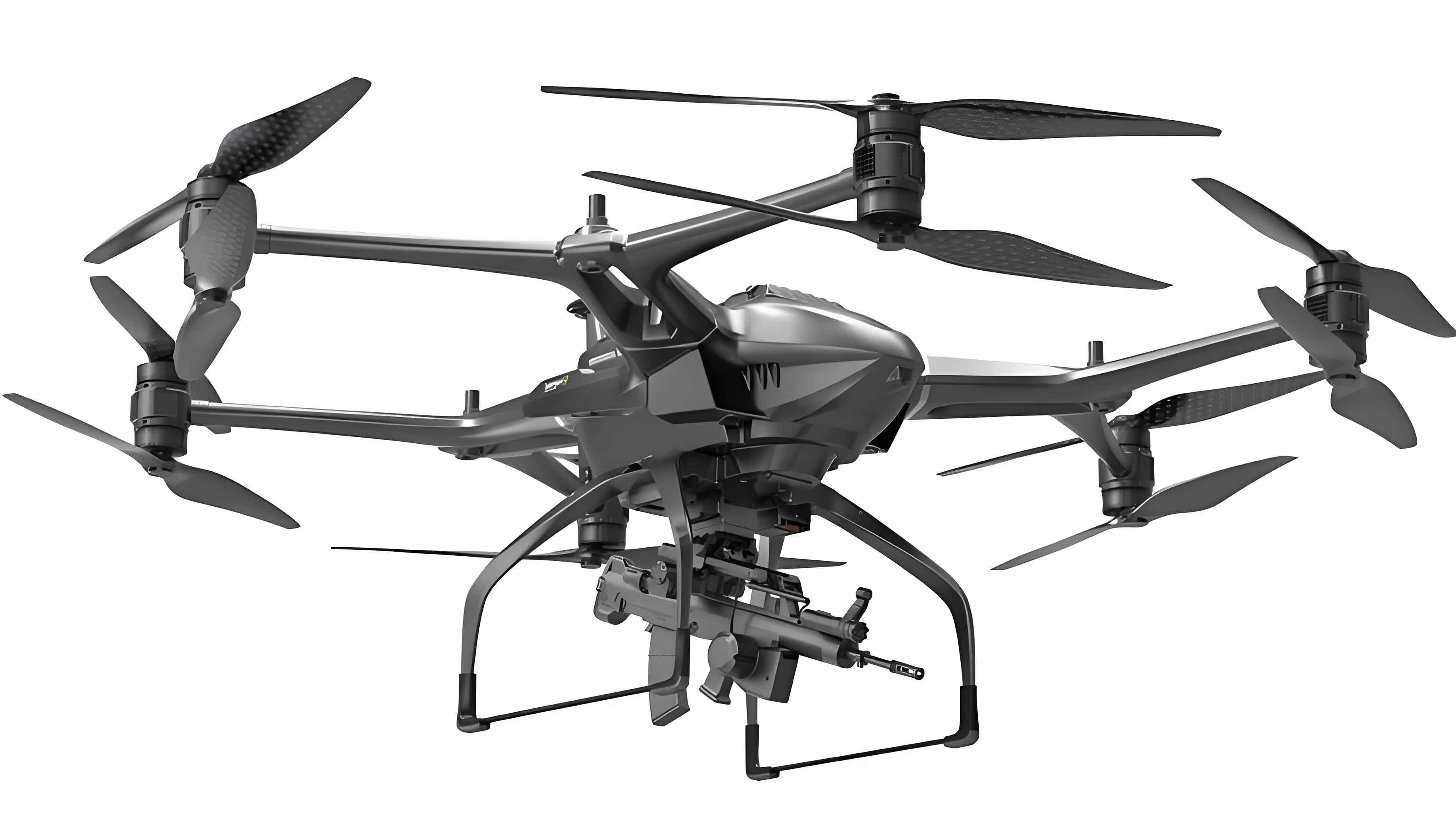
The evolution of military drone missions can be mathematically represented by a capability growth function. Let \( C(t) \) denote the combat capability of a military drone at time \( t \), which can be expressed as a sum of reconnaissance (\( R \)), target designation (\( D \)), and strike (\( S \)) components:
$$ C(t) = R(t) + D(t) + S(t) $$
where each component evolves over time based on technological投入 and operational feedback. For instance, the strike component \( S(t) \) saw a sharp increase post-2001, reflecting the integration of weapons. This functional approach helps quantify the progression from单一 to multi-mission platforms.
New Operational Requirements Based on Joint Capability Areas (JCA)
In the 21st century, the U.S. has updated its drone roadmap five times, reflecting持续 shifts in作战需求, technological progress, and lessons from实战. The 2005 roadmap replaced “Unmanned Aerial Vehicle (UAV)” with “Unmanned Aircraft System (UAS)” and included airships; the 2007 and 2009 roadmaps merged UAS, Unmanned Ground Systems (UGS), and Unmanned Maritime Systems (UMS) into an “Integrated Unmanned System” framework. This holistic view aims to enable cross-domain flexibility and integration with manned systems, enhancing joint force capabilities.
The 2009-2034 Integrated Unmanned Systems Roadmap introduced Joint Capability Areas (JCA), which categorize required capabilities into functional groups to support战略 planning and investment decisions. For military drones, the primary JCAs include Battlespace Awareness (BA), Force Application (FA), Protection (P), Logistics (L), and Building Partnerships (BP), with secondary contributions to Force Support (FC), Command and Control (C2), and Net-Centric (NC) areas. The table below maps existing and planned military drone systems to these JCAs, illustrating their aligned missions.
| Drone System | JCA Capabilities | Drone System | JCA Capabilities |
|---|---|---|---|
| Micro Air Vehicle (MAV) | BA, FA | Small Armed Drone | FA |
| MQ-5B Hunter | BA, P | SEAD/DEAD Drone | FA |
| RQ-7 Shadow | BA, P | Next-Gen Unmanned Bomber | FA |
| Warrior A/I-GNAT | BA, FA, P | Zephyr HALE Drone | BA |
| RQ-4 Global Hawk | BA, C2, NC, BP | Broad Area Maritime Surveillance (BAMS) Drone | BA, C2, NC, BP |
| SUAS Raven | BA, C2 | Air-to-Air Drone | FA |
| VTOL Tactical Drone Fire Scout | BA, FA, P, C2, NC | High-Speed Drone | BA, FA |
| MQ-9 Reaper | BA, FA, BP | Aerial Refueling Drone | L, BP |
| MQ-1 Predator | BA, P, FA | Global Observer | BA |
Battlespace Awareness (BA) involves understanding battlefield dispositions, intentions, and environmental conditions. Current military drones like the Predator, Reaper, and Global Hawk excel in this area, providing real-time imagery and data for decision-making. Force Application (FA) refers to the ability to conduct offensive operations, such as precision strikes and irregular warfare. Armed military drones like the Reaper and Extended Range/Multi-Purpose UAS already perform these tasks, with future systems expected to handle air-to-air engagements and suppression of enemy air defenses (SEAD). However, due to legal constraints, weapon release often remains under human control, even as autonomy increases.
Protection (P) encompasses dull, dirty, and dangerous missions, such as firefighting, decontamination, obstacle clearance, and explosive ordnance disposal. Military drones are ideal for these roles, with advancements in navigation and manipulation enhancing their autonomy. Logistics (L) covers tasks like resupply, maintenance, and medical evacuation, where military drones can improve efficiency and safety. Building Partnerships (BP) involves fostering alliances through shared surveillance or humanitarian aid, a byproduct of BA, P, and L capabilities. The integration of these JCAs underscores the expanding scope of military drone applications, driven by a公式 for operational effectiveness:
$$ O = \sum_{i=1}^{n} w_i \cdot JCA_i $$
where \( O \) represents overall operational value, \( JCA_i \) denotes the capability in each JCA, and \( w_i \) are weights assigned based on mission priorities. This model helps prioritize development efforts for military drones.
Future Performance Concepts for U.S. Military Drones
Looking ahead, the performance of military drones is poised for significant enhancements, with autonomy being a key enabler for achieving JCA objectives. The shift from high levels of human-in-the-loop control to autonomous tactical behavior will define future systems. Additionally, military drones in the aerial domain require specific advancements in speed, survivability, situational awareness, and maneuverability. Without onboard pilots, these systems can push physiological limits, potentially reaching accelerations of 40 g, but this demands robust obstacle detection and avoidance capabilities, especially for small, fast-moving objects.
Over the next 25 years, performance metrics for military drones will evolve along a发展包线, encompassing both cross-domain共性 indicators and aerial-specific parameters. The tables below outline these projected developments, derived from the 2009 roadmap. The first table covers全作战领域共性指标, while the second focuses on无人机系统其它指标.
| Common Indicator | 2009 | 2015 | 2034 |
|---|---|---|---|
| Command | Physical human-machine interaction | Voice/gesture control | Neuro-linguistic understanding |
| Collaboration | Single system | Formation within domains | Cross-domain formation协作 |
| Frequency | Limited to RF bands | Frequency hopping | Multi-band communication |
| Mission Complexity | Operator-controlled | Adaptive operations | Autonomous mission execution |
| Environmental Adaptability | Limited | Expanded | All-weather capability |
| Production Line | Mission-package based | Independent line | Scalable manufacturing |
| Operational Security (OPSEC) | High signature | Low signature | Minimal detectability |
| Operational Control | 1 operator/platform | 1 operator/domain | 1 operator/formation |
| Bandwidth | Limited | Advanced management | Automatic bandwidth allocation |
| Mission Duration | Hours | Days to months | Years |
| Maintainability | Operator-dependent | Semi-automated | Fully automated |
| Perception | Sensor data | Situational awareness | Controllable information |
| Aerial Indicator | 2009 | 2015 | 2034 |
|---|---|---|---|
| Dependency | Human-based SA/off-board SA | Sense and avoid | Full autonomy/onboard SA |
| Speed | Subsonic | Transonic | Supersonic/hypersonic |
| Stealth | High signature | Low signature | Very low signature |
| Maneuverability | 1 g | 9 g | 40 g |
| Self-Defense | Threat detection | Countermeasures deployment | Integrated defense systems |
| Sensor Field of View | Current | Expanded by 25% | Expanded by 50% |
| Anti-Icing | Light | Moderate | High |
| Anti-Turbulence | Light | Moderate | High |
| Anti-Precipitation | Light | Moderate | High |
These performance trends can be modeled mathematically. For example, mission duration \( T \) relates to fuel efficiency and autonomy. Let \( F \) be fuel capacity, \( C \) be consumption rate, and \( A \) be autonomy factor (ranging from 0 for full human control to 1 for full autonomy). Then:
$$ T = \frac{F}{C} \cdot (1 + kA) $$
where \( k \) is a constant reflecting efficiency gains from autonomy. As \( A \) approaches 1, \( T \) increases significantly, enabling year-long operations. Similarly, speed \( V \) and maneuverability \( M \) can be expressed as functions of propulsion power \( P \) and structural design \( S \):
$$ V = f(P, S), \quad M = g(P, S) $$
with future military drones targeting hypersonic speeds (\( V > 5 \) Mach) and high-g maneuvers (\( M \approx 40 \) g). These formulas highlight the engineering challenges and innovations required for next-generation military drones.
Furthermore, the evolution of military drone performance is influenced by technological convergence. Advances in artificial intelligence, materials science, and propulsion will drive improvements. For instance, stealth capabilities depend on radar cross-section (RCS) reduction, which can be quantified as:
$$ RCS = \sigma_0 e^{-\alpha t} $$
where \( \sigma_0 \) is the initial RCS, \( \alpha \) is the improvement rate, and \( t \) is time. By 2034, military drones are expected to have minimal RCS, enhancing survivability. Additionally, sensor advancements will expand field of view (FOV), crucial for situational awareness. If \( \theta \) denotes FOV angle, future systems aim for \( \theta_{2034} = 1.5 \times \theta_{2009} \), enabling broader coverage and better threat detection.
Conclusion
In summary, U.S. military drones have undergone a remarkable transformation from simple reconnaissance tools to sophisticated, multi-role systems integral to modern warfare. Their historical use in conflicts from Vietnam to Iraq demonstrates a steady expansion in capabilities, driven by实战 needs and technological breakthroughs. The evolution of combat missions—from battlefield awareness to target designation and strike—reflects a shift toward greater autonomy and lethality. The introduction of Joint Capability Areas (JCA) in recent roadmaps provides a structured framework for aligning military drone development with future operational demands, emphasizing Battlespace Awareness, Force Application, Protection, Logistics, and Building Partnerships.
Looking forward, the performance of military drones is set to advance dramatically, with autonomy, speed, stealth, and maneuverability at the forefront. As outlined in the development envelopes, these systems will progress from human-controlled platforms to autonomous formations capable of year-long missions and hypersonic operations. The integration of formulas and models, such as those for mission duration and radar cross-section, helps quantify these trends and guide innovation. While challenges remain, such as legal and ethical considerations for autonomous strikes, the trajectory is clear: military drones will increasingly dominate the battlespace.
From the规律 of warfare, the demand for advanced武器装备 is perpetual, and unmanned military drones, free from onboard personnel constraints, are poised to become central actors in future conflicts. As technology evolves and作战需求 shift, the concept of integrated unmanned systems will continue to develop, with JCAs adapting accordingly. What is certain is that military drones will remain at the heart of military strategy, offering unparalleled flexibility and capability. The journey from 500,000 flight hours to missions measured in years underscores their growing importance, and I am confident that their role will only expand in the decades to come.