
The rapid evolution of information technology, supported by advancements in networks, big data, and cloud computing, is fundamentally transforming modern warfare. In this new battlefield paradigm, the military drone has transitioned from a supporting asset to a central pillar of operations, executing critical tasks from precision strikes and intelligence, surveillance, and reconnaissance (ISR) to electronic warfare. This proliferation creates a pressing logistical challenge: ensuring high operational availability and mission readiness through rapid, effective maintenance and repair. Traditional, fixed-base maintenance infrastructure is often incompatible with the dynamic, dispersed, and austere nature of future conflicts. Consequently, the development of mobile, robust, and self-sufficient repair platforms is paramount. This article explores the design philosophy and methodology for a military drone Emergency Repair Shelter, engineered specifically to operate within complex natural environments and sustain military drone fleets in contested theaters.
The efficacy of any military system is inextricably linked to the environment in which it operates. For a mobile repair shelter, the “complex environment” refers specifically to the harsh and variable natural conditions of potential battlefields. These environments impose severe physical stresses that directly influence shelter design, mobility, and functionality. We can categorize and analyze these influential factors systematically.
| Environmental Type | Key Characteristics | Primary Impact on Shelter Design |
|---|---|---|
| High-Altitude & Alpine | Low pressure, low oxygen, extreme cold (sub-zero °C), high winds, strong UV radiation. | Structural strength for wind/snow load; thermal insulation and heating systems; material performance at low temperature; power system derating. |
| Tropical & Jungle | High temperature, high humidity, heavy precipitation, dense vegetation, fungal/microbial growth. | Cooling and dehumidification systems; corrosion-resistant materials; anti-fungal treatments; camouflage and mobility in dense terrain. |
| Desert & Arid | Extreme diurnal temperature swings, low humidity, high solar irradiance, sand/dust infiltration, strong winds. | Thermal management (insulation & cooling); dust-proof sealing; UV-resistant materials and paint; sand filtration for ventilation. |
| Borderland & Continental | Prolonged低温 conditions, high winds, blowing snow, limited infrastructure. | Similar to alpine challenges, with emphasis on cold-weather starting for generators, and mobility on poor roads. |
These factors translate into specific, quantifiable design drivers. The shelter must maintain an internal environment conducive to both human technicians and sensitive repair equipment. This requires active climate control to counteract external extremes. The relationship between the external ambient condition (Text, RHext) and the required internal condition (Tint, RHint) defines the shelter’s environmental control system’s capacity (Pclimate). A simplified model for the thermal load highlights the challenge:
$$ P_{thermal} = U \cdot A \cdot (T_{ext} – T_{int}) + \rho \cdot c_p \cdot V \cdot \frac{dT_{int}}{dt} + Q_{internal} $$
Where \(U\) is the overall heat transfer coefficient of the shelter wall (a measure of insulation), \(A\) is the surface area, \(\rho\) and \(c_p\) are air density and specific heat, \(V\) is the interior volume, and \(Q_{internal}\) is heat generated by personnel, equipment, and lighting. In a desert environment, \((T_{ext} – T_{int})\) could exceed 50°C, demanding excellent insulation (low \(U\)) and powerful cooling. Conversely, in alpine settings, the gradient reverses, requiring significant heating capacity.
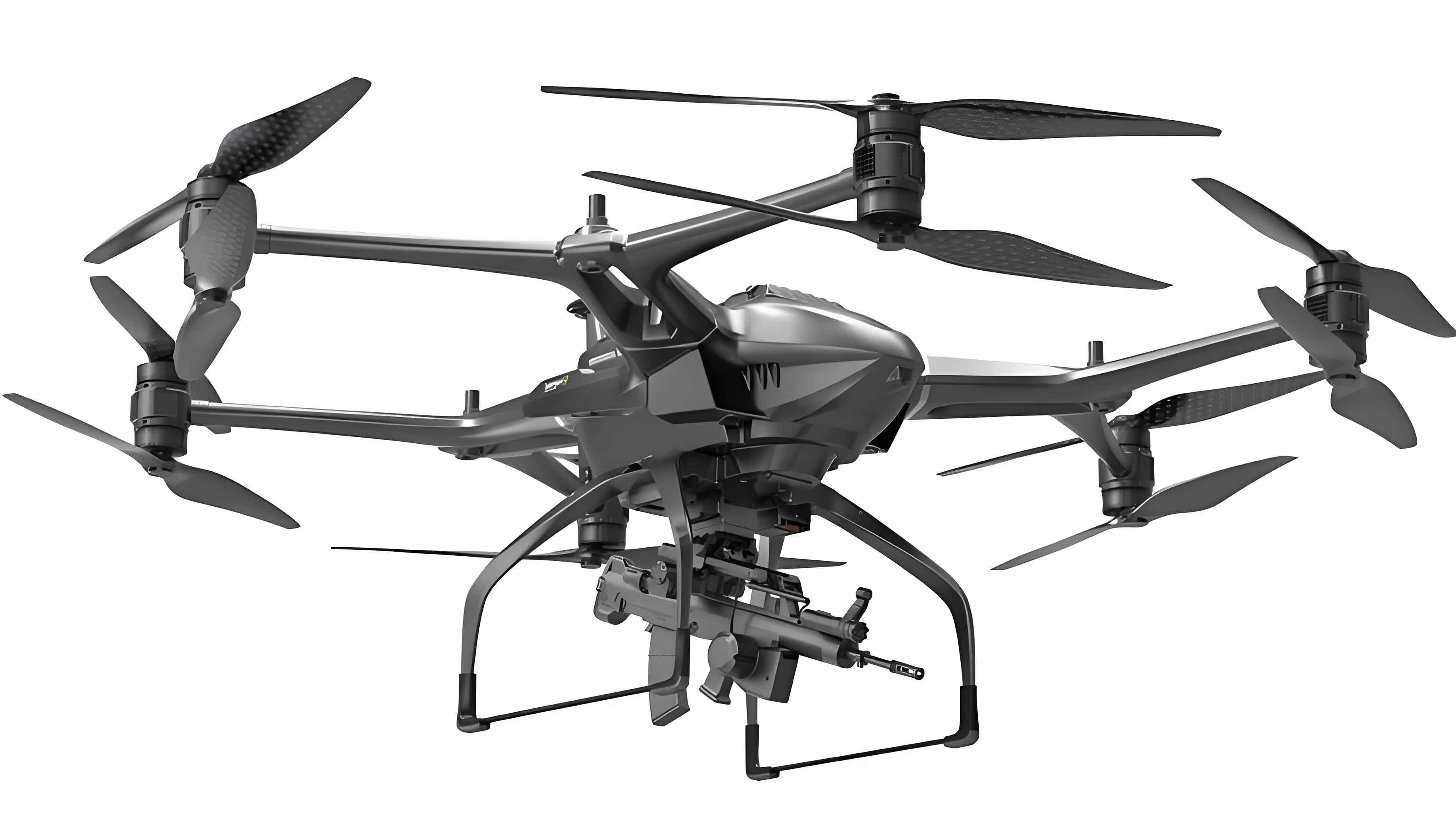
The core mission of the shelter is to restore damaged military drones to operational status as quickly as possible. The repair process must be streamlined for the battlefield context. A two-tiered, integrated repair flow is essential, moving away from separate, dispersed repair echelons towards a consolidated, mobile capability. The ideal shelter combines the functions of a forward repair post and a logistics cache.
Tier 1: Shelter-Centric Repair. For drones with minor to moderate damage (e.g., damaged sensors, propeller replacement, minor structural composites), a recovery team transports the asset to the stationary shelter location. The shelter provides a controlled workspace, all necessary tools, and on-the-spot parts.
Tier 2: Expeditionary Field Repair. For严重 damaged drones that cannot be moved easily, or to support forward operations, the entire shelter system is mobilized to the drone’s location. This requires the shelter to be highly mobile and rapidly deployable from its transport vehicle.
The efficiency of this process can be conceptualized by a metric for Mean Time To Repair (MTTR) in the field, which the shelter aims to minimize:
$$ MTTR_{field} = T_{setup} + T_{diagnosis} + T_{part\_retrieval} + T_{fix} + T_{test} $$
Here, \(T_{setup}\) is the time to make the shelter operational on-site, \(T_{part\_retrieval}\) is the time to locate the needed spare part. An optimally designed shelter minimizes \(T_{setup}\) through rapid deployment systems, minimizes \(T_{diagnosis}\) with integrated test equipment, and nearly eliminates \(T_{part\_retrieval}\) by having a comprehensive, well-organized parts inventory on-board. Therefore, the internal layout and workflow are as critical as the external shell.
The design of the military drone repair shelter is a systems engineering problem, balancing physical constraints, environmental hardening, human factors, and operational procedures. The requirements can be distilled into a set of concrete specifications that directly inform the造型 (modeling/form factor) and architecture.
| Design Aspect | Key Requirements & Technical Indicators | Influence on Shelter Form/造型 |
|---|---|---|
| Environmental Performance | Operational Temp: -10°C to +70°C. Operational Humidity: 25% to 85% RH at 25°C. Weatherproofing: Resist 8 mm/min rain at 45° for 2.5h; operational in 6级风 (13.8 m/s), survive 8级风 (20.7 m/s). Sealing: IP54 or higher against dust and water ingress. |
Angled roofs for rain/snow runoff; reinforced corners and structural members; absence of sharp edges that catch wind; high-grade door and seam seals; choice of thermally insulating and stable wall composites. |
| Structural & Material | High strength-to-weight ratio; durable for 15-year service life. Materials: Non-flammable, corrosion-resistant, UV-stable. Safety: No sharp edges or protrusions; secure internal equipment mounting. |
Use of welded steel or aluminum frame with sandwich panels (e.g., aluminum skin, polyurethane foam core). Smooth, rounded external transitions. Internal structure with integrated tie-down points and racks. |
| Mobility & Transport | Compatible with standard military trucks (road) and container ships (sea). Rapid deployment and stowage. |
Standardized ISO container dimensions or derivatives (e.g., 20ft equivalent). Integrated lifting points, forklift pockets. Potential for integrated self-loading/unloading mechanisms (e.g., retractable wheels, roller systems). |
| Camouflage & Signature | Visual and infrared signature reduction. Avoid detection by enemy ISR. |
Exterior paint in appropriate theater camouflage (e.g., woodland, desert, urban digital). Use of radar-absorbent or infrared-suppressive materials where feasible. Low-profile design. |
| Internal Layout & Workflow | Support simultaneous repair of multiple military drone components or one medium-sized drone. Logical zoning: Power Gen, Parts Storage, Diagnostic/Repair Workspace. Ergonomic workspace for technicians. |
Defines internal compartmentalization. Large, accessible doors for drone entry. Strategic placement of workbenches, tool walls, parts bins, and overhead hoists to create an efficient repair cell. |
An effective shelter layout zones activities logically. The shelter is conceptually divided into a Power Generation Bay and a Main Repair Bay. The Power Bay, thermally and acoustically isolated, houses the diesel generator, HVAC condensers, and electrical distribution panels. The Main Repair Bay is the primary workspace. Its layout is dictated by the repair workflow:
- Intake/Staging Area: Located just inside the large main door, where the military drone is initially placed for damage assessment.
- Diagnostic & Repair Stations: Central area with sturdy, grounded workbenches equipped with test monitors, soldering stations, and specialized tools for avionics, propulsion, and airframe repair.
- Parts & Tool Storage: High-density shelving and locking cabinets along the walls, organized via a clear inventory system. Overhead storage utilizes the vertical space for lighter items.
- Assembly/Reassembly Area: Clear floor space, often with an overhead electric hoist on a rail system, for handling larger assemblies like wings or landing gear.
The spatial efficiency can be represented by a utilization ratio, seeking to maximize the effective repair volume:
$$ V_{effective} = V_{total} – (V_{structure} + V_{powerbay} + V_{permanent\_equipment}) $$
$$ Utilization Ratio = \frac{V_{effective}}{V_{total}} $$
The goal is to design a shelter where \(V_{effective}\) is maximized for a given external footprint, directly influencing the internal ceiling height, bay depth, and clever use of collapsible or multi-function furniture.
Based on the aforementioned principles, a conceptual design for a military drone Emergency Repair Shelter is outlined. The shelter follows a standard ISO 20ft container footprint for global logistics compatibility, with external dimensions approximately 6058mm (L) x 2438mm (W) x 2591mm (H). The external造型 is clean, utilitarian, and robust, with slightly radiused edges to reduce stress concentrations and improve aerodynamics during transport.
The exterior skin is made of marine-grade aluminum alloy sheets, riveted to a reinforced steel frame. The cavity is filled with rigid polyurethane foam, providing excellent thermal insulation (low \(U\)-value). The primary access is a full-height, double-width door on one long side for equipment and personnel. A smaller, weather-sealed personnel door is located on the opposite side. The roof is slightly domed for water runoff. Key external features include:
– Camouflage paint scheme applied over a corrosion-resistant primer.
– Protected, watertight connectors for external power input, data, and environmental sensor masts.
– Integrated, retractable stabilizer jacks at the four corners for leveling the shelter on uneven ground.
– A low-profile HVAC unit and generator exhaust, shielded and baffled to reduce thermal and acoustic signatures.
The interior is a model of organized efficiency. The front section (approximately one-quarter length) is a dedicated power and climate control bay, separated by a solid, insulated bulkhead. It houses a silenced diesel generator, the external units for two split-system air conditioners (providing both heating and cooling), and the main power distribution panel with surge protection, voltage regulation, and ground-fault safety systems.
The main repair bay is a brightly lit, climate-controlled workspace. The layout is designed around a central repair corridor:
– Left Wall: Floor-to-ceiling modular shelving (Aluminum alloy) with adjustable bins and drawers, holding spare parts categorized by military drone system (avionics, flight control, payload, structural).
– Right Wall: A continuous workbench surface with integrated tool shadow boards, electrical outlets, data ports, and task lighting. Below-bench cabinets hold bulky tools and consumables.
– Rear Wall: Features a large, digitally connected diagnostic station with monitors for accessing military drone logs and running system tests. Above it are locking cabinets for sensitive items like cryptographic modules or classified technical manuals.
– Ceiling: Fitted with an I-beam track for a movable electric hoist (500kg capacity), allowing a single technician to safely remove and install heavy components like engines or battery packs.
– Floor: Covered with anti-fatigue, anti-static matting. Multiple heavy-duty tie-down points are flush-mounted for securing drones during transport or repair.
To achieve the rapid deployment required for Tier 2 (expeditionary) repairs, the shelter incorporates a self-loading/unloading system. Instead of relying solely on cranes or forklifts, the shelter is equipped with four recessed, heavy-duty linear actuators at its base. Upon arrival, these “self-lifting legs” extend downwards, lifting the shelter off the truck bed. Once clear, four secondary motorized wheels deploy from their compartments. The shelter can then be driven off the truck platform under its own battery power, controlled via a wireless remote. For loading, the process is reversed. This system, while adding complexity, dramatically reduces setup and retrieval time (\(T_{setup}\)), a critical factor under hostile conditions. The shelter’s transport state is defined as fully stowed on its transport truck, while its operational state is deployed and leveled on the ground with its systems active.
The increasing centrality of unmanned systems in modern combat necessitates a parallel evolution in sustainment capabilities. A military drone is only as effective as its operational availability. The design of a mobile Emergency Repair Shelter for complex environments is a multifaceted challenge that sits at the intersection of mechanical engineering, environmental science, human factors, and operational art. By rigorously analyzing the stressors of the complex battlefield environment—from thermal extremes to abrasive dust—and mapping them to specific material, structural, and system requirements, a robust platform can be developed. Furthermore, by integrating the repair workflow directly into the shelter’s internal layout and pairing it with innovative mobility solutions like self-unloading mechanisms, the critical metric of Mean Time To Repair in the field can be significantly reduced. This holistic approach to shelter design, treating it as a integrated system rather than merely a portable box, is essential for maintaining the combat power of military drone fleets in the demanding and dispersed battlescapes of the future.