
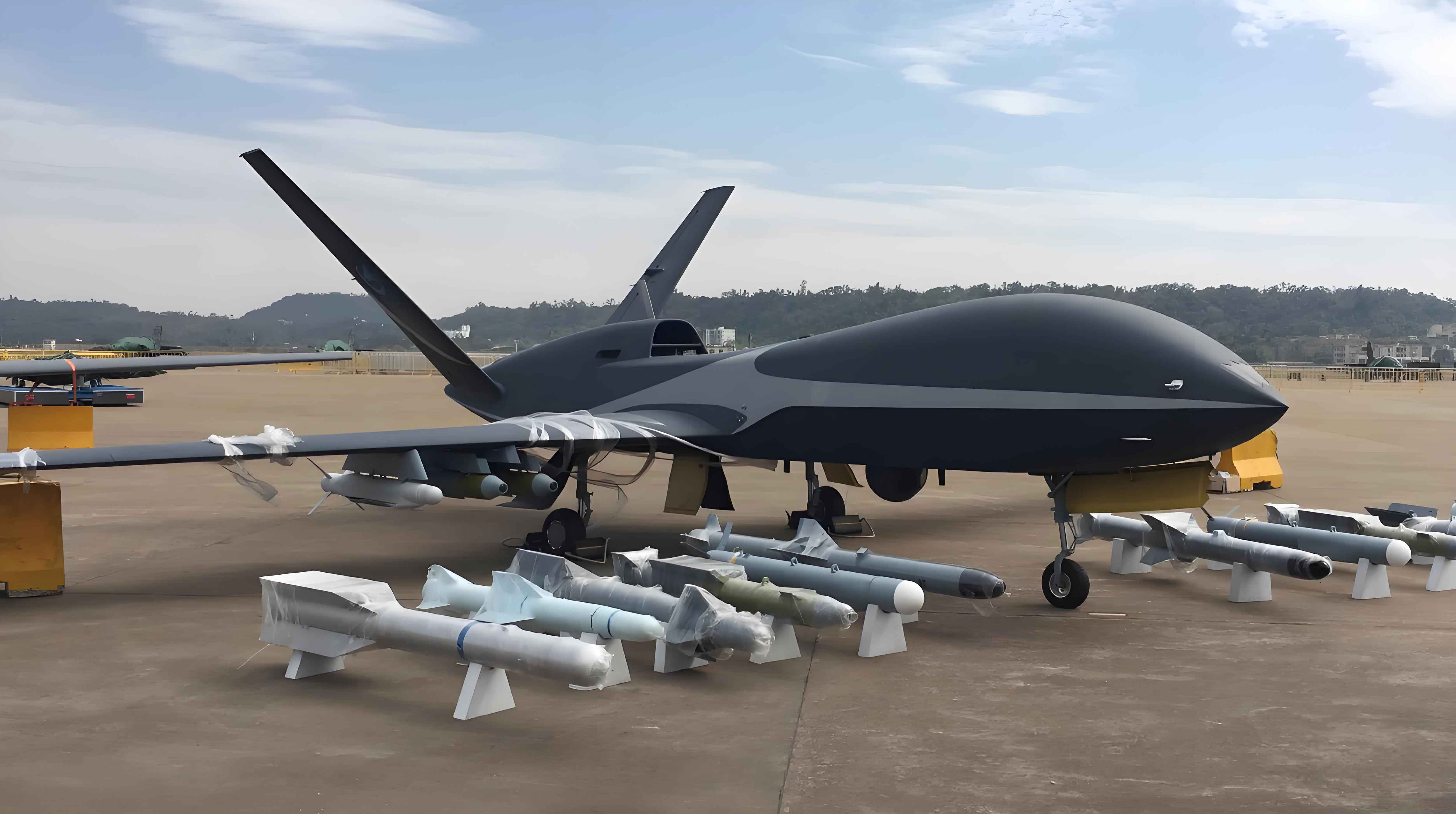
In modern naval warfare, the integration of submarines and unmanned aerial vehicles (UAVs) represents a transformative leap in operational capabilities. As a researcher focused on advanced military technologies, I explore the vertical launch technology for submarine-launched large military drones. These drones are innovative platforms that combine the stealth of submarines with the versatility of UAVs, enabling missions such as intelligence surveillance, target designation, communication relay, strike operations, and damage assessment. The term “military drone” encapsulates these sophisticated systems, which are pivotal for enhancing submarine-based warfare. This article delves into the technical challenges and solutions for launching large military drones from submarines, emphasizing vertical launch methods, with extensive use of tables and formulas to summarize key concepts. The development of such military drones is crucial for maintaining strategic advantage in contested maritime environments.
The core challenge lies in the size and weight of large military drones. Typically, these drones have cross-sectional dimensions exceeding 2 meters and masses over 4 tons, necessitating integration into large-diameter launch systems on submarines. Vertical launch is the only feasible approach, as it leverages existing missile launch tubes or future universal vertical launch systems. This article analyzes launch requirements, classifies launch technologies, reviews U.S. advancements, and proposes recommendations for China’s development. Throughout, we emphasize the importance of military drones as force multipliers, and the keyword “military drone” will be reiterated to underscore their role in modern combat. The discussion is framed from a first-person perspective, reflecting my analytical insights into this cutting-edge field.
Launch Requirements for Submarine-Launched Large Military Drones
To maximize the effectiveness of underwater platforms, the launch of large military drones must meet stringent criteria. These requirements ensure that the drones enhance submarine capabilities without compromising stealth or operational efficiency. Based on my analysis, the key requirements are as follows:
- Space Utilization: The launch system must optimize the use of available space on submarines, allowing for the carriage of multiple military drones. This is critical for sustained operations and mission diversity. We can model the space constraint using a volume efficiency formula: $$ \eta = \frac{V_{\text{drone}}}{V_{\text{launch tube}}} \times 100\% $$ where \( \eta \) is the packing efficiency, \( V_{\text{drone}} \) is the volume of the folded military drone, and \( V_{\text{launch tube}} \) is the internal volume of the launch tube. Higher efficiency enables more military drones per submarine.
- Stealth and Silent Launch: Submarines rely on stealth for survival; thus, launch operations must be “quiet and concealed.” Any acoustic or hydrodynamic signature could reveal the submarine’s position. We assess stealth using a detection probability model: $$ P_d = 1 – e^{-\lambda \cdot S} $$ where \( P_d \) is the probability of detection, \( \lambda \) is a constant related to sensor sensitivity, and \( S \) is the launch signature magnitude. Minimizing \( S \) is essential for military drone launches.
- Commonality with Existing Systems: The launch system should be compatible with current vertical launch installations on submarines, such as ballistic missile tubes, to avoid dedicated infrastructure. This reduces costs and simplifies integration. The compatibility can be expressed as: $$ C = \frac{N_{\text{compatible tubes}}}{N_{\text{total tubes}}} $$ where \( C \) is the commonality index, and higher values indicate better adaptability for military drone deployment.
These requirements guide the design of launch technologies for military drones, ensuring they align with submarine operational paradigms. In the following sections, we break down launch technologies in detail, using tables and formulas to encapsulate the complexities.
Classification of Vertical Launch Technologies for Military Drones
Vertical launch technologies for submarine-launched military drones can be categorized based on launch position, contact with water, and launch power. Each category has distinct advantages and disadvantages, influencing the selection for large military drones. We explore these categories systematically, with mathematical models to quantify performance.
Launch Position
The launch position refers to the location on the submarine from which the military drone is deployed. Primary options include missile vertical launch tubes, modular masts, and future large-diameter universal vertical launch systems. Modular masts, while suitable for small military drones, limit size and preclude underwater recovery. For large military drones, launch tubes are preferred. Table 1 summarizes the characteristics of different launch positions.
| Launch Position | Advantages | Disadvantages | Suitability for Large Military Drones |
|---|---|---|---|
| Missile Launch Tubes | Large diameter; existing infrastructure; high payload capacity | Limited number; may require modifications | High |
| Modular Masts | Rapid deployment; no underwater launch challenges | Size constraints; no recovery; exposes submarine | Low |
| Universal Vertical Launch Systems | Flexible; future-proof; scalable | Under development; integration challenges | Medium to High |
The choice of launch position impacts the design of the military drone, particularly its folded dimensions. For instance, if a military drone is launched from a tube of diameter \( D \), the maximum drone width \( w \) must satisfy: $$ w \leq D – 2\delta $$ where \( \delta \) is the clearance margin for safe ejection. This constraint is critical for large military drones.
Dry vs. Wet Launch
This classification depends on whether the military drone contacts water during launch. In dry launch, the drone is housed in a sealed carrier, remaining dry until surface emergence. In wet launch, the drone is exposed to water, requiring waterproofing and pressure resistance. Table 2 compares these methods.
| Launch Type | Description | Advantages | Disadvantages |
|---|---|---|---|
| Dry Launch | Drone encapsulated in a carrier; launched via ejection or buoyancy | Protects drone from water; simpler drone design; compatible with existing tubes | Carrier adds weight and volume; recovery challenges |
| Wet Launch | Drone directly exposed to water; launched underwater | No carrier needed; larger drone possible; direct ignition | Requires waterproofing; pressure issues; complex ignition systems |
For large military drones, dry launch is often favored due to reduced technical risks. The buoyancy force \( F_b \) in dry launch can be calculated using Archimedes’ principle: $$ F_b = \rho g V $$ where \( \rho \) is water density, \( g \) is gravitational acceleration, and \( V \) is the volume of the carrier. If \( F_b > mg \) (where \( m \) is the total mass), the carrier floats silently, aiding stealth. This principle is key for military drone launches.
Launch Power
Launch power refers to the method of imparting initial momentum to the military drone. Options include self-powered launch, catapult launch, and buoyancy-assisted launch. Each has implications for stealth and efficiency. We model the dynamics using Newton’s second law: $$ F_{\text{net}} = m a $$ where \( F_{\text{net}} \) is the net force, \( m \) is the drone mass, and \( a \) is acceleration. Table 3 outlines the launch power methods.
| Launch Power | Mechanism | Stealth Level | Complexity |
|---|---|---|---|
| Self-Powered | Rocket booster provides thrust; drone ignites underwater or at surface | Low (acoustic signature) | High (requires ignition system) |
| Catapult | External force (e.g., gas pressure) ejects drone; used in dry launch | Medium (mechanical noise) | Medium (requires catapult mechanism) |
| Buoyancy-Assisted | Buoyant carrier floats to surface; minimal active power | High (silent) | Low (simple design) |
For military drones, buoyancy-assisted launch aligns with stealth requirements. The ascent velocity \( v \) of a buoyant carrier can be derived from the drag equation: $$ m \frac{dv}{dt} = F_b – mg – \frac{1}{2} C_d \rho A v^2 $$ where \( C_d \) is the drag coefficient, \( A \) is the cross-sectional area, and \( v \) is velocity. Solving this differential equation helps optimize launch profiles for military drones.
Integrating these classifications, we see that vertical launch technology for military drones involves trade-offs between size, stealth, and complexity. In the next section, we examine U.S. advancements to draw lessons for future development.
U.S. Advances in Vertical Launch for Military Drones: Case Studies and Insights
The United States has pioneered research on submarine-launched military drones, with projects like “Sea Sentry” and “Cormorant” offering valuable insights. These case studies highlight practical applications of vertical launch technologies for military drones. As an analyst, I review these to inform best practices.
Sea Sentry Military Drone
The Sea Sentry is a small military drone launched from a Universal Modular Mast (UMM) on a submarine sail. The UMM can hold up to four folded military drones. During launch, the submarine operates at periscope depth, with the mast extending above water to eject the drone via cold launch. This approach avoids underwater challenges but is limited to small military drones due to mast size constraints. The launch dynamics can be modeled as a spring-mass system: $$ m \ddot{x} + c \dot{x} + kx = F_{\text{catapult}} $$ where \( x \) is displacement, \( c \) is damping, \( k \) is spring constant, and \( F_{\text{catapult}} \) is the catapult force. For military drones like Sea Sentry, this ensures rapid deployment without water contact.
Cormorant Military Drone
The Cormorant is a large military drone weighing 4,100 kg, with a length of 5.8 m and wingspan of 4.9 m. It is stored folded in the missile tubes of Ohio-class submarines, using a saddle fixture. Launch involves releasing the drone into the water, where it floats to the surface, ignites solid rocket boosters, and transitions to turbojet flight. This exemplifies a hybrid wet-dry launch: the drone is dry in the tube but wet during ascent. The buoyancy force is critical here. The net upward force during floating is: $$ F_{\text{net}} = \rho g V_{\text{displaced}} – m_{\text{drone}} g $$ For the Cormorant, positive \( F_{\text{net}} \) ensures silent surfacing, a key stealth feature for military drones.
From these cases, we derive key insights for military drone launch technology:
- Leverage Existing Infrastructure: Both systems use current submarine launch tubes or masts, avoiding custom solutions. This maximizes commonality and reduces costs for military drone integration.
- Prioritize Stealth: The Cormorant’s buoyancy-assisted launch minimizes acoustic signatures, underscoring the importance of silent operations for military drones.
- Adapt to Drone Size: Large military drones like Cormorant require spacious tubes, indicating that future submarines should incorporate large-diameter launch systems.
These insights guide recommendations for other nations, including China, as discussed later. The success of U.S. military drone projects demonstrates the feasibility of vertical launch, albeit with technical hurdles.
Mathematical Modeling for Military Drone Launch Dynamics
To deepen the analysis, we present mathematical models for vertical launch of military drones. These models aid in optimizing launch parameters and assessing performance. We focus on buoyancy-assisted launch, given its stealth advantages for military drones.
The motion of a military drone inside a launch tube can be described using equations of motion. Consider a drone of mass \( m \) launched vertically in a water column. The forces include thrust \( T \), buoyancy \( F_b \), gravity \( mg \), and drag \( F_d \). The equation is: $$ m \frac{d^2 y}{dt^2} = T + F_b – mg – F_d $$ where \( y \) is the vertical position, and \( F_d = \frac{1}{2} C_d \rho A \left( \frac{dy}{dt} \right)^2 \). For buoyancy-assisted launch, \( T = 0 \) initially, so the drone relies on \( F_b \).
The buoyancy force depends on the carrier volume. If the carrier is cylindrical with diameter \( D \) and length \( L \), then: $$ V = \frac{\pi D^2 L}{4} $$ and $$ F_b = \rho g V $$. To ensure floating, we require \( F_b > mg \). This inequality defines the minimum carrier size for a given military drone mass.
During ascent, the velocity reaches a terminal velocity \( v_t \) when forces balance: $$ F_b – mg = \frac{1}{2} C_d \rho A v_t^2 $$ Solving for \( v_t \): $$ v_t = \sqrt{\frac{2(F_b – mg)}{C_d \rho A}} $$ Lower \( v_t \) reduces noise, benefiting stealth for military drones.
For rocket-boosted launches, as in the Cormorant military drone, we add thrust phase. The thrust \( T \) from solid boosters can be modeled as: $$ T = \dot{m} v_e + A_e (p_e – p_a) $$ where \( \dot{m} \) is propellant mass flow rate, \( v_e \) is exhaust velocity, \( A_e \) is nozzle area, \( p_e \) is exit pressure, and \( p_a \) is ambient pressure. This thrust must overcome drag and gravity to achieve lift-off for the military drone.
These models enable simulation of launch trajectories for military drones. For instance, we can compute the time to surface \( t_s \) by integrating: $$ \int_0^{t_s} v(t) dt = h $$ where \( h \) is launch depth. Optimizing \( t_s \) minimizes exposure and enhances submarine stealth.
In practice, military drone launches involve multi-stage dynamics, from tube ejection to aerial flight. Computational fluid dynamics (CFD) simulations further refine these models, but the above formulas provide a foundational understanding.
Recommendations for China’s Vertical Launch Technology for Military Drones
Based on U.S. experiences and technical analysis, I propose recommendations for China’s development of vertical launch systems for large military drones. These suggestions aim to address unique challenges while leveraging advancements in military drone technology.
First, China should adopt dry launch methods for large military drones. While wet launch allows larger drones, it requires solving waterproofing and pressure resistance, which are complex for irregular shapes. Dry launch, using sealed carriers, simplifies drone design and aligns with existing capabilities. The carrier can be designed for buoyancy-assisted launch, ensuring stealth. For example, the carrier volume \( V_c \) can be sized using: $$ V_c = \frac{m_{\text{total}} g}{\rho g} + \Delta V $$ where \( \Delta V \) is an extra volume margin for positive buoyancy. This ensures silent ascent for military drones.
Second, China should utilize large-diameter launch tubes on submarines, such as those on ballistic missile submarines, for military drone deployment. These tubes offer ample space, minimizing design constraints. The compatibility index \( C \) should be maximized by retrofitting existing tubes. A strategic approach could involve modifying future submarine classes to include universal vertical launch systems accommodating military drones. The economic benefit can be expressed as: $$ B = \frac{N_{\text{drones}} \cdot U_{\text{utility}}}{C_{\text{cost}}} $$ where \( B \) is the benefit-cost ratio, \( N_{\text{drones}} \) is the number of carryable military drones, \( U_{\text{utility}} \) is mission utility per drone, and \( C_{\text{cost}} \) is integration cost. Higher \( B \) justifies investments in military drone launch systems.
Third, China should prioritize buoyancy-assisted launch power for military drones to maintain submarine stealth. Compared to self-powered or catapult launches, buoyancy-assisted launch minimizes acoustic and hydrodynamic signatures. The detection probability \( P_d \) from earlier can be reduced by lowering \( S \) through buoyancy control. Implementing passive ascent mechanisms, such as variable buoyancy carriers, could further enhance stealth for military drones.
Additionally, China should invest in research on recovery technologies for military drones, though this is beyond launch scope. For now, dry launch facilitates recovery via surface ships, but future advancements may enable submarine recovery. The development of military drones should be integrated with broader naval modernization efforts.
These recommendations are summarized in Table 4, which outlines the proposed approach for China’s military drone launch technology.
| Aspect | Recommendation | Rationale | Expected Impact on Military Drones |
|---|---|---|---|
| Launch Type | Dry launch with sealed carrier | Reduces technical risk; protects drone; compatible with tubes | Simpler drone design; easier integration |
| Launch Position | Large-diameter missile tubes on submarines | Ample space; existing infrastructure; high payload capacity | Enables larger military drones; more drones per submarine |
| Launch Power | Buoyancy-assisted launch | Minimizes acoustic signature; silent operation; enhances stealth | Stealthy deployment; reduced detection risk |
| Future Development | Integrate with universal vertical launch systems | Future-proof; scalable; supports diverse payloads | Flexible military drone deployment; cost-effective |
By following these recommendations, China can advance its capabilities in submarine-launched military drones, contributing to maritime dominance. The focus on military drones as key assets will drive innovation in launch technologies.
Conclusion
In conclusion, vertical launch technology for submarine-launched large military drones is a complex yet vital domain in modern naval warfare. Through this analysis, we have explored launch requirements, classified technologies, reviewed U.S. case studies, and proposed recommendations for China. The military drone emerges as a transformative platform, enhancing submarine missions through vertical launch methods. Key takeaways include the importance of stealth via buoyancy-assisted launch, the need for space optimization in launch tubes, and the value of leveraging existing infrastructure. Mathematical models, such as those for buoyancy and dynamics, provide quantitative insights for designing launch systems. As military drones evolve, continued research into dry launch, large-diameter tubes, and silent propulsion will be essential. Ultimately, the integration of submarines and military drones via vertical launch technology will redefine underwater operations, offering unprecedented flexibility and power in contested seas. This article underscores the critical role of military drones in future warfare, with vertical launch as a cornerstone for their deployment.