
In my perspective as an observer of modern defense technologies, the rise of military drones has fundamentally transformed the landscape of warfare and security operations. These unmanned aerial vehicles, or military drones, represent a convergence of advanced engineering, artificial intelligence, and strategic innovation. From their humble beginnings in the early 20th century to the sophisticated systems of today, military drones have evolved into indispensable assets for nations worldwide. The primary allure of military drones lies in their ability to perform high-risk missions without endangering human pilots, thereby reducing casualties and operational costs. As I delve into this topic, I will explore the various facets of military drones, including their classification, global development status, and future trajectories, all while emphasizing the critical role these systems play in contemporary and future conflicts.
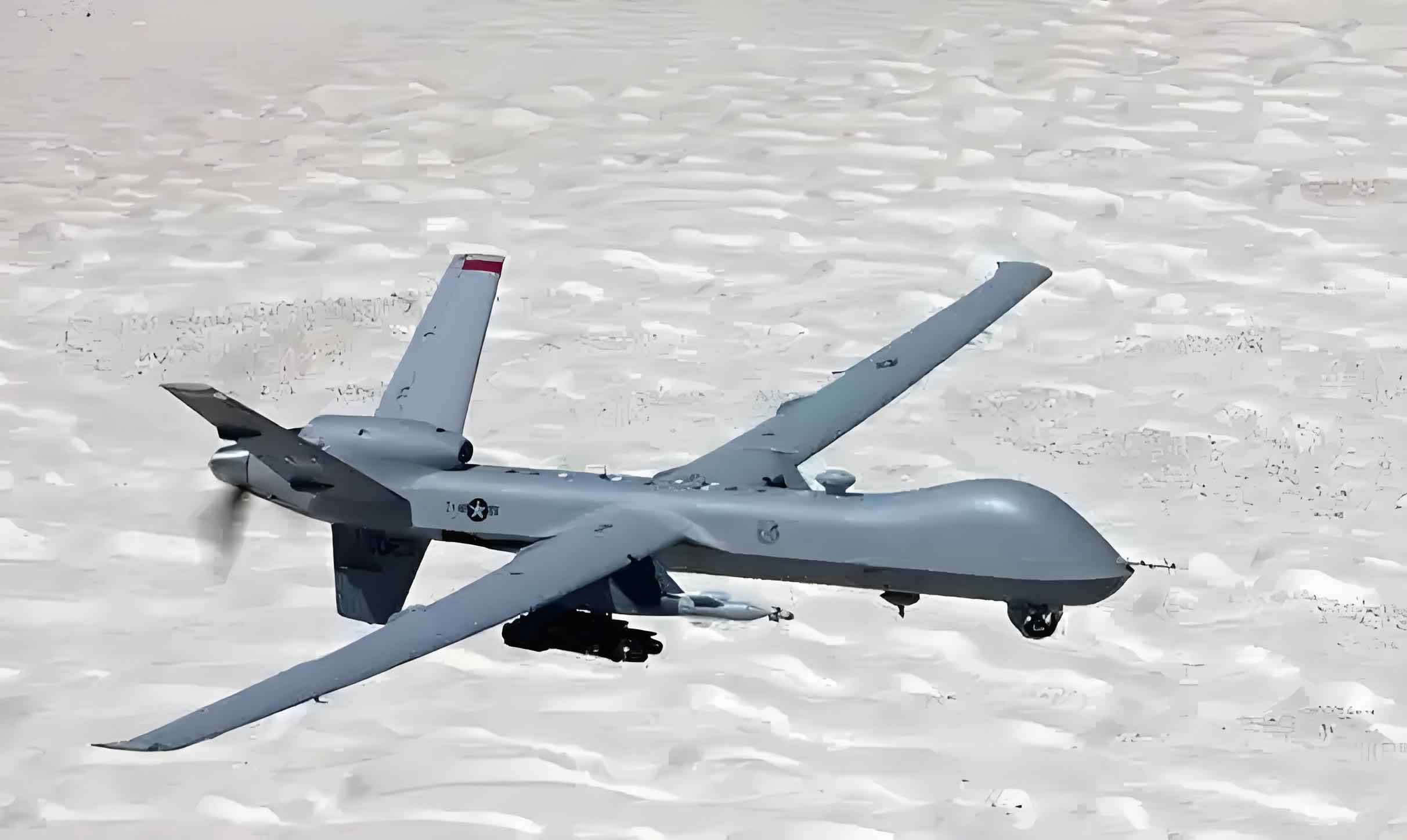
The concept of military drones dates back to World War I, but it is in recent decades that they have surged in prominence. A military drone is essentially an aircraft that operates without a human pilot onboard, controlled either remotely via wireless links or autonomously through pre-programmed software. This autonomy allows military drones to execute complex missions with precision and endurance. The proliferation of military drones across global armed forces underscores their strategic value. In my analysis, I will break down the key aspects of military drones, leveraging tables and formulas to summarize data and trends. The keyword ‘military drone’ will recur frequently, as it is central to understanding this domain. For instance, the operational efficiency of a military drone can be modeled using performance metrics such as endurance and payload capacity, which I will illustrate through mathematical expressions.
Classification of Military Drones
Military drones can be categorized based on their primary functions, with two main types dominating the field: reconnaissance drones and combat drones. In my view, this classification is crucial for grasping the diverse applications of military drones in modern theaters.
Reconnaissance Drones: These military drones are designed for surveillance, intelligence gathering, and target acquisition. They are equipped with high-resolution sensors, including electro-optical, infrared, and synthetic aperture radar (SAR) systems, enabling them to operate in all weather conditions and during both day and night. A prime example is the U.S. MQ-9 Reaper, a military drone that has been extensively used in conflicts for persistent surveillance. The effectiveness of a reconnaissance military drone can be quantified by its sensor resolution and loiter time. For instance, the probability of detecting a target can be expressed as:
$$ P_d = 1 – e^{-\lambda \cdot A \cdot t} $$
where \( P_d \) is the detection probability, \( \lambda \) is the sensor sweep rate, \( A \) is the area coverage, and \( t \) is the time on station. This formula highlights how military drones enhance situational awareness.
Combat Drones: Also known as unmanned combat aerial vehicles (UCAVs), these military drones are armed with missiles, bombs, or directed-energy weapons to engage ground and aerial targets. They offer significant advantages over manned aircraft, including lower procurement costs, reduced logistical footprints, and the ability to perform high-risk strikes without pilot fatigue. The Israeli Heron TP is a notable military drone in this category. The lethality of a combat military drone can be assessed using engagement models, such as the probability of kill \( P_k \) given by:
$$ P_k = \frac{1}{1 + \left(\frac{R}{r_0}\right)^n} $$
where \( R \) is the range to target, \( r_0 \) is a scale factor, and \( n \) is an exponent dependent on weapon accuracy. This underscores the precision strike capabilities of military drones.
To further elucidate, I present a table comparing key attributes of these two types of military drones:
| Type | Primary Role | Example Models | Endurance (Hours) | Typical Payload (kg) | Key Technologies |
|---|---|---|---|---|---|
| Reconnaissance Drone | Surveillance, Intelligence | Global Hawk, Heron | 24-40 | 200-500 | SAR, EO/IR Sensors |
| Combat Drone | Strike, Interdiction | MQ-9 Reaper, Bayraktar TB2 | 15-30 | 500-1500 | Precision-guided Munitions |
This table illustrates the operational diversity of military drones. In addition, military drones can be subclassified by altitude and endurance, such as high-altitude long-endurance (HALE) or medium-altitude long-endurance (MALE) drones. Each variant of military drone serves specific tactical needs, from border patrol to deep-strike missions.
Global Development Status of Military Drones
The development of military drones is a global endeavor, with nations investing heavily in research and deployment. In my assessment, the United States and Israel lead the pack, but other countries are rapidly closing the gap. The proliferation of military drones has become a marker of technological prowess in defense sectors worldwide.
United States: The U.S. maintains a dominant position in military drone technology, with programs spanning HALE drones, stealth UCAVs, and micro-drones. The MQ-4C Triton and RQ-170 Sentinel are examples of advanced military drones that emphasize stealth and persistence. The U.S. Department of Defense allocates substantial budgets to military drone initiatives, driving innovation in autonomy and sensor fusion. For instance, the annual investment in military drone research can be modeled as a growth function:
$$ I(t) = I_0 \cdot e^{kt} $$
where \( I(t) \) is the investment at time \( t \), \( I_0 \) is the initial investment, and \( k \) is the growth rate. This reflects the strategic priority given to military drones.
Israel: As a major exporter of military drones, Israel excels in tactical drone systems like the Hermes and Skylark. Israeli military drones are renowned for their reliability and combat-proven designs, often integrating cutting-edge electronics and communication systems. The export market for Israeli military drones contributes significantly to its defense economy, with sales metrics showing exponential trends.
Europe: European nations, including the UK, France, and Germany, collaborate on projects such as the nEUROn UCAV, a stealth military drone aimed at matching U.S. capabilities. However, fragmentation in defense policies sometimes hampers progress. Russia, meanwhile, focuses on military drones like the Orion and Okhotnik for reconnaissance and strike roles, though its technology lags behind Western counterparts.
Asia: Countries like China, Japan, and India are advancing their military drone portfolios. China’s Wing Loong and CH series have gained international attention, while India’s Rustom drone program aims for self-sufficiency. The technological diffusion of military drones in Asia is accelerating, driven by regional security dynamics.
To summarize the global landscape, here is a table of select military drones from key nations:
| Country | Notable Military Drone | Type | Max Altitude (m) | Endurance (h) | Status |
|---|---|---|---|---|---|
| USA | RQ-4 Global Hawk | HALE Reconnaissance | 18,000 | 34 | Operational |
| Israel | Heron TP | MALE Combat/Recon | 13,700 | 36 | Operational |
| China | Wing Loong II | MALE Combat | 9,000 | 32 | Operational |
| Russia | Orion | MALE Combat | 7,500 | 24 | Testing |
| Turkey | Bayraktar Akıncı | HALE Combat | 12,000 | 24 | Operational |
This table highlights the competitive development of military drones. In my opinion, the rapid iteration of military drone technologies across these nations underscores their critical role in modern defense strategies. The keyword ‘military drone’ encapsulates a dynamic field where innovation is constant.
Technological Trends in Military Drones
Looking ahead, several key trends will shape the evolution of military drones. Based on current research, I foresee advancements in stealth, endurance, payload miniaturization, and artificial intelligence. These trends will enhance the capabilities of military drones, making them more formidable and versatile.
Stealth and Low Observability: Future military drones will increasingly incorporate stealth features to evade detection by radar and infrared sensors. This involves using radar-absorbent materials, reducing thermal signatures, and optimizing aerodynamic shapes. The radar cross-section (RCS) of a military drone can be minimized through design, as described by the formula:
$$ \text{RCS} = \frac{\sigma}{4\pi} \cdot \left(\frac{\lambda}{d}\right)^2 $$
where \( \sigma \) is the scattering coefficient, \( \lambda \) is the radar wavelength, and \( d \) is the characteristic dimension. Stealth military drones, like the U.S. X-47B, exemplify this trend, enabling covert operations in contested airspace.
High-Altitude Long-Endurance (HALE) Capabilities: To extend operational reach and persistence, military drones are being designed for higher altitudes and longer flights. Solar-powered drones, such as the Airbus Zephyr, aim for months of continuous flight. The endurance \( E \) of a military drone can be modeled based on energy balance:
$$ E = \frac{E_{\text{battery}} + P_{\text{solar}} \cdot t_{\text{day}}}{P_{\text{consumption}}} $$
where \( E_{\text{battery}} \) is battery energy, \( P_{\text{solar}} \) is solar power input, \( t_{\text{day}} \) is daylight duration, and \( P_{\text{consumption}} \) is power consumption rate. HALE military drones will provide persistent surveillance, complementing satellite networks.
Payload Miniaturization: As military drones take on more missions, their payloads—sensors, weapons, and communication gear—must become smaller and lighter. Advances in micro-electronics and nanomaterials are driving this trend. For example, the weight \( W \) of a synthetic aperture radar (SAR) payload can scale with size \( s \) as:
$$ W \propto s^3 $$
Thus, reducing size dramatically cuts weight, allowing military drones to carry more diverse payloads. Miniaturized payloads enhance the functionality of military drones without compromising agility.
Enhanced Autonomy and AI: The next generation of military drones will leverage artificial intelligence for autonomous decision-making, reducing reliance on human operators. Machine learning algorithms can enable a military drone to navigate complex environments, identify targets, and even coordinate with other drones in swarms. The autonomy level \( A \) can be quantified using a metric like:
$$ A = \frac{N_{\text{auto decisions}}}{N_{\text{total decisions}}} $$
where higher \( A \) indicates greater autonomy. AI-driven military drones will be able to adapt to dynamic battlefield conditions, improving mission success rates.
To illustrate these trends, consider the following table comparing current and future military drone characteristics:
| Trend | Current Military Drone Example | Future Military Drone Projection | Key Improvement |
|---|---|---|---|
| Stealth | RQ-170 Sentinel | Next-Gen Stealth UCAV | RCS reduction by 90% |
| HALE | MQ-4C Triton | Solar-Powered Stratospheric Drone | Endurance > 1000 hours |
| Payload Miniaturization | MQ-9 Reaper with SAR pod | Micro-SAR on small drone | Payload weight < 10 kg |
| Autonomy | Predator B with manual control | AI-driven swarm drone | Fully autonomous missions |
These trends underscore the rapid evolution of military drones. In my view, the integration of these technologies will make military drones even more central to defense architectures, with the keyword ‘military drone’ symbolizing innovation in unmanned systems.
Applications and Case Studies of Military Drones
Military drones have been deployed in numerous conflicts and operations, demonstrating their versatility. From my analysis of recent engagements, military drones excel in roles such as reconnaissance, precision strikes, electronic warfare, and logistics support. Here, I delve into specific applications to highlight the impact of military drones.
Reconnaissance and Surveillance: In conflicts like those in Afghanistan and Syria, military drones like the MQ-1 Predator provided real-time video feeds, enabling commanders to monitor insurgent movements. The effectiveness of such military drones can be measured by the area coverage rate \( C \):
$$ C = v \cdot w \cdot \eta $$
where \( v \) is velocity, \( w \) is sensor swath width, and \( \eta \) is efficiency factor. This allows military drones to cover vast territories efficiently.
Combat Operations: Armed military drones have been used for targeted killings and suppression of enemy air defenses. For instance, the U.S. strike on Qasem Soleimani involved a military drone, showcasing precision capabilities. The cost-effectiveness of a military drone strike compared to manned aircraft can be evaluated using a ratio:
$$ \text{Cost Ratio} = \frac{C_{\text{manned}}}{C_{\text{drone}}} $$
where \( C_{\text{manned}} \) and \( C_{\text{drone}} \) are the costs per mission. Typically, military drones offer lower costs, making them attractive for sustained campaigns.
Electronic Warfare: Some military drones are equipped with jammers or signal intelligence systems to disrupt enemy communications. The jamming power \( P_j \) required to neutralize a target at range \( R \) is given by:
$$ P_j = \frac{P_r \cdot R^2}{G_t \cdot G_r} $$
where \( P_r \) is received power, and \( G_t \) and \( G_r \) are antenna gains. Electronic warfare military drones enhance battlefield dominance.
Logistics and Resupply: Military drones are being tested for cargo delivery in hostile environments, reducing risk to ground convoys. The payload capacity of logistics military drones is a key parameter, often optimized using structural design equations.
To summarize applications, here is a table of military drone roles in recent conflicts:
| Conflict | Military Drone Used | Primary Application | Outcome |
|---|---|---|---|
| Afghanistan War | MQ-9 Reaper | Reconnaissance and Strike | Enhanced targeting accuracy |
| Nagorno-Karabakh | Bayraktar TB2 | Destroying armor units | Decisive advantage for Azerbaijan |
| Syrian Civil War | Orion drone | Surveillance for Russian forces | Improved situational awareness |
| Yemen Conflict | Wing Loong II | Counter-insurgency strikes | Reduced militant capabilities |
These cases illustrate how military drones have become integral to modern warfare. In my opinion, the adaptability of military drones ensures their continued relevance across various operational scenarios.
Challenges and Future Directions for Military Drones
Despite their advantages, military drones face several challenges that must be addressed to unlock their full potential. From my standpoint, issues such as cybersecurity vulnerabilities, regulatory hurdles, and ethical concerns are critical. Furthermore, the future of military drones will involve greater integration with other systems and domains.
Cybersecurity: Military drones rely on data links and software that can be hacked or jammed. Securing these systems is paramount. The vulnerability \( V \) of a military drone communication channel can be expressed as:
$$ V = \frac{1}{1 + \text{SNR} \cdot \text{Encryption Strength}} $$
where SNR is the signal-to-noise ratio. Enhancing encryption and using frequency hopping are essential for protecting military drones.
Regulatory and Ethical Issues: The use of military drones in autonomous lethal operations raises ethical questions about accountability and proportionality. International laws are evolving to govern military drone deployments, but consensus remains elusive. In my view, frameworks for responsible use of military drones must be developed.
Technological Integration: Future military drones will operate as part of networked systems, including satellites, ground stations, and other drones. This requires advanced communication protocols and interoperability standards. The connectivity \( K \) of a military drone network can be modeled using graph theory:
$$ K = \frac{2E}{N(N-1)} $$
where \( E \) is the number of links and \( N \) is the number of nodes. High connectivity enables seamless coordination among military drones.
Swarm Technology: Drone swarms, where multiple military drones act in unison, represent a cutting-edge direction. Swarm intelligence algorithms allow military drones to perform complex tasks like distributed sensing or coordinated attacks. The effectiveness of a swarm of military drones can be assessed through emergent behavior models.
To outline future directions, consider this table of emerging technologies for military drones:
| Technology | Description | Impact on Military Drones | Expected Timeline |
|---|---|---|---|
| AI-Powered Autonomy | Deep learning for real-time decision-making | Reduced human intervention, faster responses | 2025-2030 |
| Quantum Communication | Secure data links using quantum encryption | Enhanced cybersecurity for military drones | 2030+ |
| Biomimetic Design | Drones mimicking birds or insects for stealth | Improved agility and low observability | 2025-2035 |
| Energy Harvesting | Solar, wind, or RF energy scavenging | Extended endurance for military drones | 2030+ |
These advancements will propel military drones into new realms of capability. In my analysis, the keyword ‘military drone’ will continue to embody innovation as these challenges are overcome and new technologies mature.
Conclusion
In conclusion, military drones have irrevocably altered the dynamics of defense and security. From their classification as reconnaissance or combat platforms to their global proliferation and future trends, military drones represent a pinnacle of technological achievement. As I have discussed, the evolution of military drones is characterized by stealthier designs, longer endurance, smaller payloads, and smarter autonomy. The integration of formulas and tables in this analysis underscores the quantitative aspects of military drone performance. Looking ahead, military drones will not only dominate aerial warfare but also expand into civilian domains like disaster response and infrastructure monitoring. However, addressing cybersecurity and ethical concerns will be crucial for sustainable development. Ultimately, the keyword ‘military drone’ signifies a transformative force in modern technology, one that will continue to shape strategic landscapes for decades to come. The journey of military drones is far from over, and their potential remains vast, driven by relentless innovation and strategic necessity.