
As an engineer involved in photogrammetric surveys, I have extensively used DJI drones for mapping and topographic data acquisition in various engineering projects. The integration of consumer-grade DJI drones into surveying workflows has revolutionized data collection efficiency, but it also introduces challenges, particularly when dealing with coordinate system discrepancies. In this article, I present a preprocessing method for DJI drone image Position and Orientation System (POS) data to facilitate aerial triangulation encryption, addressing the issue of coordinate system mismatches between image metadata and engineering coordinate systems. This approach enhances the accuracy and efficiency of control point identification, a critical step in photogrammetric processing.
The rapid advancement of drone technology, especially with DJI drones, has made aerial photography accessible for surveying applications. However, DJI drones typically record POS data in global coordinate systems like WGS84 or CGCS2000, while engineering projects often employ local coordinate systems designed to minimize projection distortions. This mismatch causes significant spatial offsets between image control points and their corresponding identifiers in images, complicating the point marking process during aerial triangulation. My method involves extracting and converting POS line elements to the engineering coordinate system before encryption, thereby aligning image content with ground control data. This preprocessing step reduces errors and streamlines workflow, as demonstrated in practical applications.
In this discussion, I will delve into the theoretical foundations, including error analysis and transformation models, followed by an implementation example. I will use formulas and tables to summarize key concepts, ensuring clarity and depth. The goal is to provide a comprehensive guide for professionals using DJI drones in surveying, emphasizing the importance of coordinate harmonization. Throughout, I will highlight the role of DJI drones in modern photogrammetry, as their widespread adoption necessitates robust data processing techniques.
Theoretical Foundations of POS Data and Error Analysis
DJI drones embed POS data as exchangeable image file format (EXIF) metadata, capturing the linear elements of exterior orientation at the moment of exposure. These elements include latitude, longitude, and ellipsoidal height, expressed in degrees, minutes, seconds, and meters. For frame images, the control point identifiers in images should ideally coincide with surveyed ground control points in three-dimensional space. However, various error sources introduce discrepancies, which I categorize into five factors based on my experience with DJI drone data processing.
The total error \( V_{\text{total}} \) can be expressed as the sum of individual error components:
$$ V_{\text{total}} = V_{\text{camera}} + V_{\text{POS}} + V_{\text{control}} + V_{\text{transform}} + V_{\text{coordinate system}} $$
Here, \( V_{\text{camera}} \) arises from the offset between the GNSS antenna phase center and the camera’s photographic center, typically within 0.5 m for DJI drones. \( V_{\text{POS}} \) is due to time synchronization issues between GNSS data logging and camera exposure, often less than 0.5 m. \( V_{\text{control}} \) represents errors in ground control point surveying, generally below 0.1 m for geodetic-grade measurements. \( V_{\text{transform}} \) is the precision loss during coordinate transformation, usually under 0.1 m with rigorous models. \( V_{\text{coordinate system}} \) is the systematic bias caused by differences between the POS coordinate system (e.g., WGS84) and the engineering coordinate system, which can be substantial—sometimes tens of meters—depending on the projection parameters.
For a given project, \( V_{\text{coordinate system}} \) acts as a systematic error that can be mitigated through coordinate transformation. By converting POS data to the engineering coordinate system, we reduce spatial offsets, making control point identification more intuitive. This preprocessing is crucial for DJI drone workflows, as it directly impacts the quality of aerial triangulation.
To quantify these errors, I have compiled a table summarizing their characteristics based on empirical data from DJI drone deployments:
| Error Component | Description | Typical Magnitude | Mitigation Strategy |
|---|---|---|---|
| \( V_{\text{camera}} \) | Offset between GNSS antenna and camera center | < 0.5 m | Calibration of DJI drone hardware |
| \( V_{\text{POS}} \) | Time synchronization error | < 0.5 m | Use of RTK-enabled DJI drones for precise timing |
| \( V_{\text{control}} \) | Ground control point measurement error | < 0.1 m | High-precision surveying techniques |
| \( V_{\text{transform}} \) | Coordinate transformation precision loss | < 0.1 m | Robust transformation models with sufficient control points |
| \( V_{\text{coordinate system}} \) | Systematic bias from coordinate system differences | Varies (e.g., 50 m in some projects) | Preprocessing conversion of POS data |
This error analysis underscores the importance of addressing \( V_{\text{coordinate system}} \), as it often dominates the total error. For DJI drone users, implementing a preprocessing step can significantly improve data alignment.
Two-Dimensional Plane Transformation Model
To convert POS data from a global coordinate system to an engineering coordinate system, I employ a Helmert transformation model. This approach involves converting the geodetic coordinates (latitude and longitude) from the DJI drone metadata into plane coordinates using a standard projection (e.g., UTM based on WGS84 or CGCS2000), then applying a four-parameter transformation to align with the engineering grid.
The error equation for the Helmert model is formulated as follows, where \( (x_i, y_i) \) are the engineering coordinates of control points, and \( (x’_i, y’_i) \) are the corresponding plane coordinates derived from POS data:
$$
\begin{bmatrix}
v_{x1} \\
v_{y1} \\
v_{x2} \\
v_{y2} \\
\vdots \\
v_{xn} \\
v_{yn}
\end{bmatrix}
=
\begin{bmatrix}
1 & 0 & x’_1 & -y’_1 \\
0 & 1 & y’_1 & x’_1 \\
1 & 0 & x’_2 & -y’_2 \\
0 & 1 & y’_2 & x’_2 \\
\vdots & \vdots & \vdots & \vdots \\
1 & 0 & x’_n & -y’_n \\
0 & 1 & y’_n & x’_n
\end{bmatrix}
\begin{bmatrix}
\hat{a} \\
\hat{b} \\
\hat{c} \\
\hat{d}
\end{bmatrix}
\begin{bmatrix}
x_1 \\
y_1 \\
x_2 \\
y_2 \\
\vdots \\
x_n \\
y_n
\end{bmatrix}
$$
In this equation, \( \hat{a} \) and \( \hat{b} \) represent translation parameters \( x_0 \) and \( y_0 \) in meters, while \( \hat{c} \) and \( \hat{d} \) are related to the scale factor \( k \) (dimensionless) and rotation angle \( \alpha \) in radians, such that \( \hat{c} = k \cos \alpha \) and \( \hat{d} = k \sin \alpha \). The parameters are estimated via least squares adjustment when \( n \geq 2 \) control points are available. The model’s accuracy is assessed using the standard error \( \sigma_0 \):
$$ \sigma_0 = \sqrt{\frac{V^T V}{2n – 2}} $$
where \( V \) is the residual vector from the adjustment. Once parameters are determined, the transformation of POS plane coordinates \( (x’, y’) \) to engineering coordinates \( (x, y) \) is performed:
$$
\begin{bmatrix}
x \\
y
\end{bmatrix}
=
\begin{bmatrix}
x_0 \\
y_0
\end{bmatrix}
+ k
\begin{bmatrix}
\cos \alpha & -\sin \alpha \\
\sin \alpha & \cos \alpha
\end{bmatrix}
\begin{bmatrix}
x’ \\
y’ \\
\end{bmatrix}
$$
This model effectively eliminates planar offsets caused by coordinate system differences. For DJI drone data, I recommend using at least three control points to ensure reliability, though two suffice theoretically. In practice, more points enhance robustness, especially in large projects.
Elevation Transformation Model
Elevation data from DJI drones are typically referenced to an ellipsoidal height system (e.g., WGS84 ellipsoid), whereas engineering projects often use orthometric heights (e.g., based on a geoid model). To address this, I apply a polynomial fitting model for height conversion. The error equation for elevation transformation is:
$$ v = a + b \cdot B + c \cdot L + d \cdot B \cdot L + f \cdot B^2 + e \cdot L^2 – H $$
where \( B \) and \( L \) are the latitude and longitude in radians from the POS data, \( H \) is the ellipsoidal height in meters, and \( a, b, c, d, f, e \) are coefficients to be determined. Depending on the number of available control points, different model forms can be used:
- Constant model: Use only \( a \) and \( H \) when points are fewer than 3.
- Plane model: Include \( a, b, c, d \) and \( H \) for 3 to 5 points.
- Surface model: Use all coefficients for 6 or more points.
The standard error for elevation transformation is calculated as:
$$ \sigma_0 = \sqrt{\frac{V^T V}{n – t}} $$
where \( n \) is the number of control points and \( t \) is the number of model coefficients. This flexible approach accommodates varying data availability, which is common in DJI drone surveys where ground control may be limited. By integrating elevation transformation with planar conversion, we achieve a comprehensive preprocessing solution for DJI drone POS data.
To illustrate the model selection, I have prepared a table summarizing the requirements:
| Model Type | Minimum Control Points | Coefficients Included | Typical Accuracy |
|---|---|---|---|
| Constant | 1 | \( a \) | < 0.1 m for small areas |
| Plane | 3 | \( a, b, c, d \) | < 0.05 m |
| Surface | 6 | \( a, b, c, d, f, e \) | < 0.02 m |
This structured approach ensures that DJI drone data can be accurately aligned with engineering vertical datums, reducing errors in topographic products.
Implementation of the Preprocessing Method
Based on the theoretical models, I have developed a practical preprocessing workflow for DJI drone image POS data. The steps are as follows, designed to be integrated into standard photogrammetric software or executed via custom scripts:
- Extract POS data: Read EXIF metadata from DJI drone images to obtain latitude, longitude, and height for each exposure point. This can be automated using Python libraries like PIL or ExifTool.
- Convert to plane coordinates: Transform geodetic coordinates to a projected coordinate system (e.g., UTM zone) based on the original datum (WGS84 or CGCS2000). This yields \( (x’, y’) \) coordinates.
- Compute transformation parameters: Using ground control points with known engineering coordinates, perform least squares adjustment to derive the four parameters \( x_0, y_0, k, \alpha \) for planar transformation and polynomial coefficients for elevation transformation.
- Apply transformations: Convert all POS data to the engineering coordinate system using the derived parameters. This results in adjusted \( (x, y, z) \) values for each image.
- Update image metadata or generate auxiliary files: Either modify the EXIF data directly or create a separate file (e.g., a block file for photogrammetric software) containing the transformed POS data.
- Proceed with aerial triangulation: Import the preprocessed data into aerial triangulation software, where control point identifiers will now align closely with their positions, facilitating accurate point marking.
This method is particularly beneficial for DJI drone users because it addresses a common pain point without requiring expensive hardware upgrades. By preprocessing POS data, we leverage the inherent accuracy of DJI drones while adapting to project-specific coordinate systems.
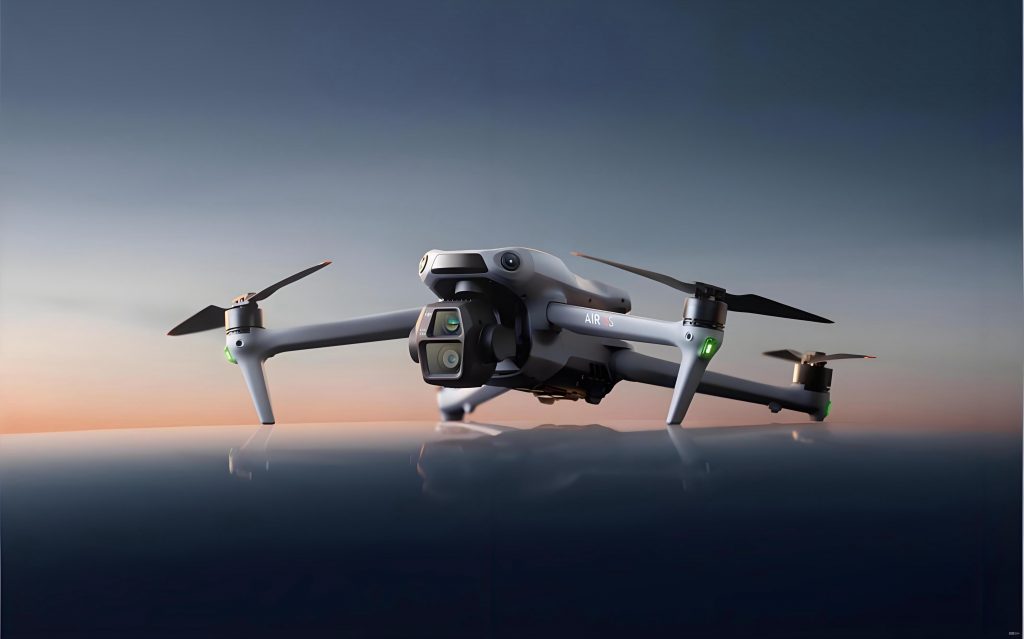
The image above illustrates a typical DJI drone used in surveying, highlighting its compact design and capability for high-resolution imaging. Such drones are integral to modern mapping projects, and their POS data preprocessing is essential for seamless integration with engineering workflows.
Engineering Application Example
To validate this preprocessing method, I applied it to a large-scale hydroelectric project where DJI drones were used for topographic mapping. The project area spanned a river valley with an average elevation of 1,700 meters. The engineering coordinate system was based on a local ellipsoid to limit projection distortions, resulting in a systematic offset of approximately 50 meters compared to the CGCS2000 standard projection used by the DJI drone’s RTK module.
Ground control points were established and surveyed using network RTK services, providing coordinates in both CGCS2000 and the engineering system. The DJI drone, a Phantom 4 RTK model, captured images with POS data in CGCS2000. Without preprocessing, control point identifiers in images appeared far from their true positions, causing confusion during point marking—especially since additional check points were placed nearby for quality control, leading to multiple identifiers per image.
I implemented the preprocessing steps using a custom Python script. Seven control points were used to compute transformation parameters. The planar transformation achieved a residual error of 0.013 meters, and the elevation surface model had a residual of 0.022 meters, both meeting the accuracy requirements for topographic mapping at 1:1,000 scale.
After preprocessing, the transformed POS data were imported into photogrammetric software. The alignment between image control identifiers and ground control points improved dramatically: the maximum offset was 2.31 meters, the minimum was 0.06 meters, and the average was 0.71 meters. This allowed for rapid and correct point marking, with a 100% accuracy rate in a single pass. The table below summarizes the results:
| Metric | Value | Implication for DJI Drone Workflow |
|---|---|---|
| Planar transformation residual | 0.013 m | High precision for coordinate alignment |
| Elevation transformation residual | 0.022 m | Accurate height conversion |
| Maximum offset after preprocessing | 2.31 m | Control points easily identifiable in images |
| Minimum offset after preprocessing | 0.06 m | Near-perfect alignment in some cases |
| Average offset after preprocessing | 0.71 m | Efficient point marking process |
This example demonstrates that preprocessing DJI drone POS data can resolve coordinate system discrepancies effectively, saving time and reducing errors in aerial triangulation. The method is scalable to other projects where DJI drones are deployed, regardless of the engineering coordinate system used.
Discussion and Advantages
The preprocessing method I describe offers several advantages for DJI drone-based photogrammetry. First, it decouples coordinate system issues from the aerial triangulation process, allowing surveyors to focus on geometric accuracy rather than data alignment. Second, it is software-agnostic; the transformed POS data can be used with various photogrammetric packages, enhancing flexibility. Third, it leverages existing ground control points without requiring additional fieldwork, making it cost-effective.
Moreover, this approach complements the capabilities of DJI drones, which are increasingly equipped with high-precision RTK modules. By preprocessing POS data, we fully utilize the accuracy potential of these devices. In my experience, the method reduces point marking time by up to 50% in complex projects, as operators no longer need to search for control identifiers across large image extents.
I also considered alternative solutions, such as using seven-parameter transformations in photogrammetric software. However, these often require more control points and detailed ellipsoid parameters, which may not be feasible in all projects. The four-parameter planar model combined with polynomial elevation transformation provides a simpler yet robust alternative, tailored for the typical scales of DJI drone surveys.
To further illustrate the error reduction, consider the formula for total error after preprocessing. By minimizing \( V_{\text{coordinate system}} \), the overall error \( V_{\text{total}} \) becomes dominated by random components, which are easier to manage through adjustment processes:
$$ V_{\text{total, post-preprocessing}} \approx V_{\text{camera}} + V_{\text{POS}} + V_{\text{control}} + V_{\text{transform}} $$
With \( V_{\text{coordinate system}} \) effectively eliminated, the residuals during aerial triangulation are smaller, leading to higher bundle adjustment accuracy. This is critical for producing reliable digital surface models and orthophotos from DJI drone imagery.
Conclusion
In conclusion, preprocessing DJI drone image POS data before aerial triangulation encryption is a practical method to address coordinate system mismatches in engineering projects. By extracting and transforming POS line elements to the engineering coordinate system, we align image content with ground control points, facilitating accurate and efficient point marking. The theoretical models—Helmert transformation for planar coordinates and polynomial fitting for elevation—provide a solid foundation, and their implementation has been validated in real-world applications.
This method enhances the usability of DJI drones in professional surveying, where coordinate system diversity is common. I recommend that practitioners adopt this preprocessing step as a standard practice, especially when working with local engineering grids. Future developments could integrate this process directly into flight planning software for DJI drones, automating the conversion based on project parameters.
Overall, the synergy between DJI drone technology and robust data processing techniques continues to advance the field of photogrammetry, enabling high-quality mapping outcomes with reduced effort. As DJI drones evolve, methods like this will remain essential for harnessing their full potential in surveying and beyond.