
As a seasoned professional in the field of aerial imaging and cinematography, I have witnessed firsthand the rapid evolution of technology that empowers creators to capture stunning visuals from the skies. Today, I am thrilled to delve into the latest breakthroughs that are set to redefine the standards of drone-based photography and video monitoring. In this comprehensive exploration, I will focus on two pivotal innovations: a next-generation digital transmission system designed for FPV (First-Person View) drones, and a high-precision electronic viewfinder that enhances on-ground monitoring. Throughout this discussion, I will emphasize how these advancements integrate seamlessly with modern DJI drone systems, elevating the entire creative workflow. My goal is to provide an in-depth analysis, supported by technical tables and mathematical models, to illustrate the profound impact of these tools. The synergy between cutting-edge transmission and precise monitoring is crucial for professionals like myself, who rely on DJI drone platforms to push the boundaries of visual storytelling.
Let me begin by examining the groundbreaking digital transmission system that has recently captured the attention of the drone community. This system represents a significant leap forward in FPV technology, offering unparalleled clarity, reduced latency, and extended range. For any enthusiast or professional operating a DJI drone, transmission quality is paramount, as it directly influences the real-time feedback and control during flight. The new system comes in two variants: a standard unit and a pro version, each tailored to different needs but both engineered to excel in demanding environments. As someone who frequently pilots a DJI drone for cinematic shots, I appreciate how these enhancements address common pain points like signal dropout and lag, which can compromise safety and creativity. The core of this system lies in its advanced video encoding and sensor technology, which I will break down using comparative tables and formulas to highlight the technical superiority.
To better understand the specifications, I have compiled a detailed table comparing the key features of the two transmission units. This comparison underscores the versatility and performance gains offered by each model, particularly when integrated with a high-performance DJI drone.
| Feature | Standard Transmission Unit | Pro Transmission Unit |
|---|---|---|
| Weight | 8.2 grams | Slightly higher due to enhanced components (exact weight not specified, but optimized for balance) |
| Image Sensor Size | 1/2-inch sensor | 1/1.3-inch sensor |
| Video Recording Capability | 4K resolution at 60 frames per second (fps) | 4K resolution at 120 fps |
| Color Mode | Standard color profiles | 10-bit D-Log M color mode for greater dynamic range |
| Field of View | Standard wide angle | 155° ultra-wide angle |
| Transmission System | Advanced digital transmission with H.265 video encoding | Enhanced digital transmission with dual-antenna design |
| Maximum Transmission Distance | Up to 10 kilometers (estimated based on previous models) | Up to 15 kilometers under optimal conditions |
| Latency in Racing Mode | As low as 15 milliseconds | Comparable low latency, with optimized responsiveness |
| Multi-Drone Support | Supports up to 8 drones simultaneously in racing mode | Similar multi-drone capability, ideal for competitive events |
From this table, it is evident that both units offer exceptional performance, but the pro version caters to more demanding scenarios, such as high-speed aerial cinematography or professional racing. When attached to a DJI drone, these units transform the flying experience by providing crystal-clear real-time video feeds. The transmission system utilizes H.265 video encoding, which efficiently compresses video data without sacrificing quality. This can be expressed mathematically through the rate-distortion trade-off in video coding. The efficiency of H.265 compared to older codecs like H.264 can be modeled using the following formula for bitrate reduction:
$$ R_{H.265} = R_{H.264} \times \left(1 – \frac{\Delta D}{D_{\text{max}}}\right) $$
where \( R_{H.265} \) is the bitrate required for H.265 encoding, \( R_{H.264} \) is the bitrate for H.264 encoding at similar quality, \( \Delta D \) is the reduction in distortion, and \( D_{\text{max}} \) is the maximum allowable distortion. This equation illustrates how H.265 enables higher quality transmission at lower bitrates, crucial for maintaining stable links over long distances when flying a DJI drone. In practice, this means that even when capturing 4K footage at high frame rates, the transmission remains smooth and reliable, minimizing interruptions that could affect piloting decisions.
Another critical aspect is the latency, especially in FPV racing or dynamic shooting. The new system introduces a “Racing Mode” that reduces latency to as low as 15 milliseconds. This is a game-changer for pilots who need instantaneous feedback to navigate complex environments. Latency (\( L \)) in digital transmission can be broken down into several components: encoding delay (\( L_e \)), transmission delay (\( L_t \)), and decoding delay (\( L_d \)). The total latency can be approximated as:
$$ L_{\text{total}} = L_e + L_t + L_d $$
For a typical DJI drone setup, \( L_e \) and \( L_d \) are minimized through hardware acceleration, while \( L_t \) depends on the transmission distance and signal integrity. With the advanced dual-antenna design in the pro unit, signal stability is enhanced, reducing \( L_t \) significantly. This is particularly beneficial for long-range flights where a DJI drone might be used for landscape or wildlife filming, as the pilot can maintain precise control without noticeable lag. Moreover, the ability to support up to eight drones simultaneously in racing mode opens up new possibilities for synchronized aerial shows or competitive events, where multiple DJI drone units can interact seamlessly.
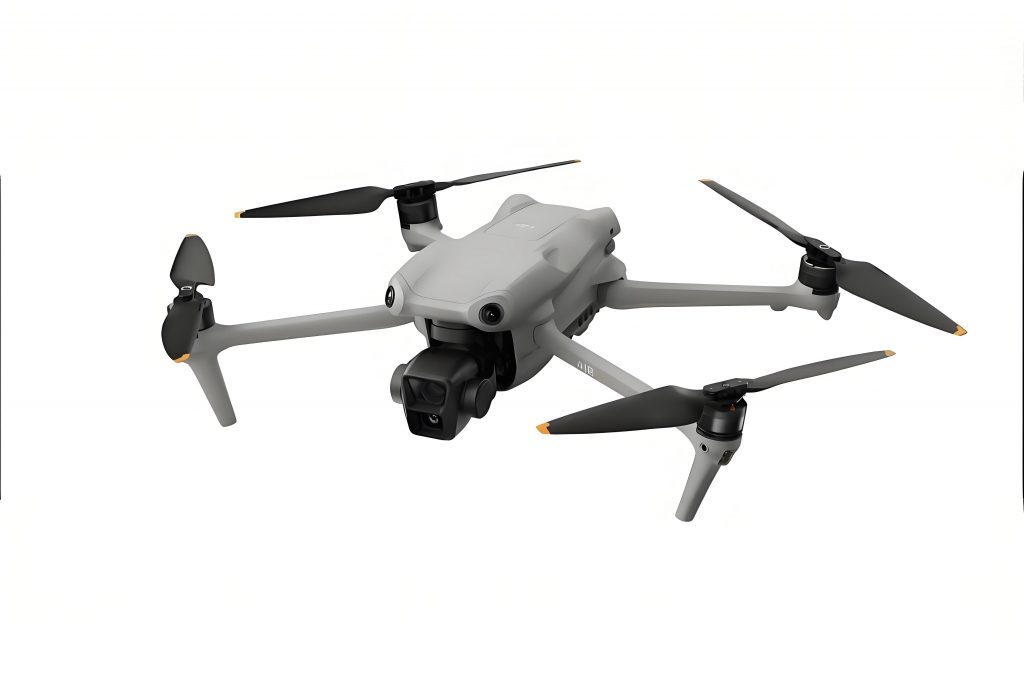
Beyond transmission, the imaging capabilities of these units are equally impressive. The standard unit features a 1/2-inch sensor, while the pro version boasts a larger 1/1.3-inch sensor. The larger sensor size in the pro unit allows for better light capture and improved dynamic range, which is essential for professional cinematography. The relationship between sensor size and image quality can be explored through the concept of signal-to-noise ratio (SNR). For a given pixel size, the SNR is proportional to the square root of the sensor area. Mathematically, for a sensor with area \( A \), the SNR improvement over a smaller sensor can be expressed as:
$$ \text{SNR}_{\text{pro}} = \text{SNR}_{\text{std}} \times \sqrt{\frac{A_{\text{pro}}}{A_{\text{std}}}} $$
where \( \text{SNR}_{\text{pro}} \) and \( \text{SNR}_{\text{std}} \) are the signal-to-noise ratios for the pro and standard units, respectively, and \( A_{\text{pro}} \) and \( A_{\text{std}} \) are their sensor areas. Assuming a 1/1.3-inch sensor has an area approximately 1.5 times that of a 1/2-inch sensor, the pro unit offers about a 22% improvement in SNR, leading to cleaner images in low-light conditions. This is a significant advantage when using a DJI drone for sunset or night shots, where every bit of detail counts. Additionally, the pro unit’s 10-bit D-Log M color mode provides greater color depth, allowing for more flexibility in post-production grading. This is crucial for filmmakers who rely on DJI drone footage to match with other high-end camera systems.
Now, let me shift focus to the second major innovation: a high-definition electronic viewfinder designed for professional monitoring. This device is a versatile tool that complements the aerial transmission system by offering precise on-ground visualization. As someone who often works with multiple camera setups, including DJI drone feeds, I find that a reliable viewfinder is indispensable for ensuring focus, exposure, and composition accuracy. This new viewfinder supports HDMI connectivity, making it compatible with a wide range of cameras, from cinema cameras to DSLRs and mirrorless models. Its integration with a DJI drone system is straightforward, as many drones output HDMI signals for real-time monitoring, allowing for a seamless workflow from sky to screen.
To encapsulate the features of this electronic viewfinder, I have created another table that highlights its key specifications and functionalities. This table demonstrates how it caters to the needs of professional cinematographers, especially when paired with a DJI drone for aerial shots.
| Aspect | Details |
|---|---|
| Display Technology | Full HD 0.7-inch Micro-OLED micro-display with advanced optical design |
| Color Processing | 10-bit color processing channel for accurate and sharp color reproduction |
| Diopter Adjustment | Range from -6D to +2D, accommodating users from 600 degrees myopia to 200 degrees hyperopia |
| Connectivity | One full-size HDMI input and one HDMI loop-out interface for multi-monitor setups |
| Software Features | Includes waveform, focus peaking, histogram, false color, and HDMI metadata display |
| Compatibility | Works with most professional cameras with HDMI ports, including feeds from DJI drone systems |
This viewfinder addresses common challenges in field monitoring, such as eye strain and inaccurate color representation. The diopter adjustment range ensures that a wide variety of users can achieve comfortable viewing, which is vital during long shooting sessions. When connected to a DJI drone’s HDMI output, the viewfinder provides a crisp, real-time feed that aids in framing and focusing. The 10-bit color processing is particularly beneficial for matching aerial footage with ground-based shots, maintaining consistency across a project. The loop-out interface allows for additional monitors or recorders to be connected, facilitating collaborative work on set—a common requirement when directing complex scenes involving a DJI drone.
The software features embedded in the viewfinder are powerful tools for technical analysis. For instance, waveform and histogram displays help in exposure assessment, which can be modeled using luminance distribution functions. The luminance \( Y \) of a pixel in a video signal is often derived from the RGB values using the formula:
$$ Y = 0.299R + 0.587G + 0.114B $$
where \( R \), \( G \), and \( B \) are the red, green, and blue components, respectively. By visualizing this through a waveform, cinematographers can ensure that the DJI drone footage is properly exposed, avoiding overblown highlights or crushed shadows. Similarly, focus peaking uses edge detection algorithms to highlight in-focus areas, which can be described using gradient-based methods. For an image \( I(x,y) \), the gradient magnitude \( G \) is computed as:
$$ G = \sqrt{\left(\frac{\partial I}{\partial x}\right)^2 + \left(\frac{\partial I}{\partial y}\right)^2} $$
Areas with high \( G \) values are accentuated, providing visual cues for sharp focus—critical when monitoring fast-moving subjects from a DJI drone. These tools collectively enhance the precision of on-ground monitoring, ensuring that every frame captured by the DJI drone meets professional standards.
Integrating these two innovations—the advanced transmission system and the electronic viewfinder—creates a holistic ecosystem for aerial cinematography. When I use a DJI drone equipped with the new transmission unit, the real-time video feed is not only high-quality but also low-latency, allowing for immediate adjustments during flight. This feed can be routed to the electronic viewfinder via HDMI, giving me a detailed, color-accurate preview on the ground. For example, when shooting a dynamic chase scene with a DJI drone, I can rely on the viewfinder’s focus peaking to ensure the subject remains sharp, while the transmission system’s racing mode keeps latency minimal for responsive piloting. This synergy is further enhanced by the multi-drone support, enabling complex multi-angle shoots where multiple DJI drone units are synchronized—a technique increasingly popular in modern filmmaking.
To delve deeper into the technical interplay, consider the end-to-end latency from capture to display. This involves the transmission latency discussed earlier, plus the processing delay in the viewfinder. If \( L_{\text{transmission}} \) is the latency from the DJI drone to the receiver, and \( L_{\text{viewfinder}} \) is the processing delay in the viewfinder, the total monitoring latency \( L_{\text{monitor}} \) is:
$$ L_{\text{monitor}} = L_{\text{transmission}} + L_{\text{viewfinder}} $$
With the new transmission system achieving as low as 15 ms and the viewfinder designed for minimal processing lag (typically under 5 ms for high-end models), the overall latency can be kept below 20 ms. This is imperceptible in most scenarios, providing a near-instantaneous view that is crucial for FPV flying or real-time directing. For a DJI drone operator, this means greater confidence and creativity, as they can see exactly what the drone sees without disruptive delays.
Moreover, the transmission distance capabilities open up new creative possibilities. The pro unit’s range of up to 15 kilometers allows for expansive shots in remote locations, such as mountain ranges or coastal areas. When combined with the viewfinder’s accurate monitoring, filmmakers can plan and execute shots that were previously risky due to signal loss. For instance, flying a DJI drone over a vast landscape to capture a sunrise requires reliable long-range transmission and precise exposure monitoring—both addressed by these innovations. The dual-antenna system in the pro unit automatically selects optimal frequency points, reducing interference and maintaining a stable link even in crowded RF environments. This is particularly useful in urban settings where a DJI drone might be used for architectural or event coverage.
Another aspect worth exploring is the impact of these technologies on post-production workflows. The high-quality video recorded by the transmission units, especially the pro version’s 4K/120fps and 10-bit color, provides rich material for editing. When footage from a DJI drone is combined with ground shots monitored through the viewfinder, color grading becomes more consistent thanks to the accurate color representation. The D-Log M color mode offers a flat profile that preserves dynamic range, which can be expressed through the concept of logarithmic encoding. In logarithmic space, the relationship between light intensity \( I \) and encoded value \( V \) is given by:
$$ V = c \cdot \log_{10}(I) + b $$
where \( c \) and \( b \) are constants specific to the color mode. This encoding allows for greater flexibility in adjusting highlights and shadows during grading, ensuring that aerial footage from a DJI drone blends seamlessly with other sources. The viewfinder’s support for HDMI metadata further aids in this process by embedding technical information like frame rate and resolution, streamlining the editing pipeline.
From a broader perspective, these advancements reflect the ongoing evolution of drone technology and professional video tools. As a user who frequently operates a DJI drone for both personal and commercial projects, I see these innovations as essential steps toward democratizing high-end cinematography. They lower the barriers to achieving cinematic quality, making it accessible to independent filmmakers and content creators. The integration of such systems encourages experimentation, such as using a DJI drone for virtual production or immersive VR content, where real-time transmission and precise monitoring are critical. Furthermore, the emphasis on low latency and multi-drone support aligns with emerging trends like drone swarms for light shows or coordinated aerial surveys, expanding the utility of DJI drone platforms beyond traditional filming.
In terms of practical applications, let me outline a few scenarios where these technologies excel. First, in documentary filmmaking, a DJI drone equipped with the pro transmission unit can capture wildlife from a distance without disturbing subjects, while the viewfinder allows for careful framing and focus adjustments on the ground. Second, in sports coverage, the racing mode enables high-speed tracking of athletes, with multiple DJI drone units providing different angles simultaneously. Third, in real estate videography, the combination of long-range transmission and accurate monitoring helps in showcasing properties from unique aerial perspectives. Each of these scenarios benefits from the reliability and quality offered by these tools, reinforcing the value of investing in advanced systems for any serious DJI drone operator.
To further illustrate the technical specifications, I have prepared a comparative analysis of the transmission units in relation to environmental factors. The performance of a DJI drone’s transmission system can be influenced by obstacles, weather, and interference. The dual-antenna design in the pro unit mitigates these issues through diversity reception, which can be modeled using signal combining techniques. If \( S_1 \) and \( S_2 \) are the signals received by the two antennas, the combined signal \( S_{\text{combined}} \) can be expressed as:
$$ S_{\text{combined}} = \sqrt{|S_1|^2 + |S_2|^2} $$
assuming maximal ratio combining for optimal SNR. This results in a more robust link, ensuring that the DJI drone maintains a stable connection even in challenging conditions. Additionally, the automatic frequency selection algorithm continuously scans for clear channels, reducing the impact of interference from other electronic devices—a common concern when flying a DJI drone in populated areas.
Looking ahead, I anticipate that these technologies will continue to evolve, with future iterations offering even higher resolutions, lower latencies, and smarter integration. For instance, we might see AI-assisted transmission that predicts signal blockages and adjusts flight paths autonomously, or viewfinders with augmented reality overlays for enhanced monitoring. As a proponent of DJI drone ecosystems, I believe that such advancements will further solidify drones as indispensable tools in the creative industry. The ongoing synergy between aerial transmission and ground monitoring will drive new storytelling techniques, from immersive 360-degree videos to interactive live streams.
In conclusion, the innovations discussed here represent significant milestones in the realms of aerial transmission and professional monitoring. By enhancing the capabilities of DJI drone systems, they empower creators to achieve new levels of precision and creativity. The detailed tables and mathematical models I have provided underscore the technical excellence of these products, while the first-person perspective highlights their practical benefits. Whether you are a seasoned cinematographer or an aspiring drone pilot, integrating these tools into your workflow can transform your approach to visual storytelling. As I continue to explore the possibilities with my own DJI drone setups, I am excited by the potential that these advancements unlock, paving the way for a future where the sky is no longer the limit for cinematic expression.
To summarize key points, let me present a final table that encapsulates the overall advantages of combining the transmission system and electronic viewfinder with a DJI drone. This table serves as a quick reference for professionals considering these upgrades.
| Component | Advantage for DJI Drone Operations | Impact on Workflow |
|---|---|---|
| Advanced Transmission Unit (Standard/Pro) | High-quality real-time video feed with low latency and long range | Enables precise piloting and confident shooting in diverse environments |
| Electronic Viewfinder with HDMI | Accurate color monitoring and focus assistance for ground-based preview | Improves on-set decision-making and ensures technical quality |
| Combined System | Seamless integration for end-to-end monitoring from drone to display | Streamlines production and enhances creative control over aerial footage |
As I reflect on these developments, it is clear that the fusion of cutting-edge transmission and monitoring technologies is reshaping how we capture and experience the world from above. For anyone invested in the capabilities of a DJI drone, these innovations offer tangible improvements that translate to better results in the field. I encourage fellow enthusiasts to explore these tools and experience the difference firsthand, as they continue to push the boundaries of what is possible with aerial imaging.