
My journey with DJI drones began in 2016, a journey that has paralleled the breathtakingly rapid evolution of aerial technology itself. Each new model brought incremental improvements, but my recent experience with the DJI Mavic 4 Pro has been nothing short of a paradigm shift. As a seasoned pilot, this machine didn’t just feel like an upgrade; it felt like stepping into the next generation of aerial imaging and flight performance. This report is my comprehensive, firsthand account of what this flagship DJI drone truly offers.
Unboxing the Mavic 4 Pro, I was struck by a sense of sophisticated familiarity. It retains the iconic foldable design of the Mavic lineage, a non-negotiable feature for professionals and enthusiasts who are constantly on the move. Its compact, folded footprint belies the power within. Once unfolded, the airframe exudes a robust, precision-engineered feel. The most immediate visual cue to its advanced capabilities is the proliferation of sensory orbs—omnidirectional obstacle sensing modules, including a prominent LiDAR unit, hinting at a level of environmental awareness previously reserved for far larger, commercial-grade drones. The thoughtful inclusion of a full protective cover for transport safeguards these critical sensors and the gimbal, a detail that, while requiring a moment to master, proves invaluable for preserving the drone’s integrity.
Flight Performance: Power, Precision, and Endurance
If I had to summarize the flight character of this DJI drone, I would call it a “muscular intellectual.” The raw power is immediately apparent. Takeoff is decisive, and the aircraft responds to control inputs with an eager, yet utterly precise, authority.
| Flight Performance Parameter | Value (Sport Mode) | Value (Normal Mode) |
|---|---|---|
| Max Ascent Speed | 10 m/s | 6 m/s |
| Max Descent Speed | 10 m/s | 6 m/s |
| Max Horizontal Speed (No Wind) | 25 m/s (90 km/h) | 15 m/s |
| Max Horizontal Speed (2 m/s Tailwind) | 27 m/s | 15 m/s |
The 90 km/h top speed isn’t just a spec sheet number. In dynamic shooting scenarios—following a vehicle along a coastal road or capturing the peak action of a sporting event—this DJI drone maintains pace effortlessly, ensuring you never miss the crucial moment because your aircraft was too slow.
However, raw speed is only half the story. The true game-changer for serious aerial work is endurance. Equipped with the new 95Wh high-capacity battery, the Mavic 4 Pro achieves a published maximum flight time of 51 minutes. In practical field tests, under mixed shooting conditions (hovering, maneuvering, dealing with light wind), I consistently achieved flights well over 40 minutes. This is a monumental leap. Previously, a complex shoot would be fragmented by multiple battery swaps, constantly breaking creative flow. With this DJI drone, I can plan and execute extensive sequences—comprehensive site surveys, long tracking shots, or multi-angle coverage of a location—in a single, uninterrupted flight. The efficiency gain is profound.
We can model the effective operational time gain. If a previous-generation DJI drone offered an average of 30 minutes of usable flight time per battery, and a shoot required 120 minutes of total airborne coverage, the operation would necessitate at least 4 flights (plus time for landing, swapping, and restarting).
$$ \text{Number of Flights}_{\text{old}} = \frac{\text{Total Coverage Time}}{\text{Flight Time}_{\text{old}}} = \frac{120}{30} = 4 \text{ flights} $$
With the Mavic 4 Pro providing a conservative 45 minutes of usable time:
$$ \text{Number of Flights}_{\text{new}} = \frac{120}{45} \approx 2.67 \rightarrow 3 \text{ flights} $$
This represents a 25% reduction in the number of required battery cycles for the same mission, translating directly to less downtime and more focused creativity.
The Omnidirectional Guardian: Advanced Obstacle Avoidance
DJI has labeled its latest system “Omni-Directional Active Sensing,” and after pushing its limits, I find the term perfectly apt. The fusion of six wide-angle vision sensors and a forward LiDAR creates a perception bubble around the aircraft. The difference in pilot confidence is night and day.
Flying through a dense grove of trees, with branches crisscrossing at various levels, would traditionally be a high-stress, white-knuckle affair requiring constant vigilance. With this DJI drone, the experience was transformed. The aircraft proactively navigated the labyrinth, adjusting its path smoothly to avoid contact. It felt less like piloting and more like guiding an intelligent entity through a complex environment. This allows the pilot to concentrate fully on composition, camera movement, and capturing the story, rather than merely avoiding disaster. For single-operator shoots in challenging environments, this feature is not a luxury; it’s a fundamental tool that expands the boundaries of what is safely possible.
The Heart of the Beast: A Truly Professional Tri-Camera System
This is where the DJI Mavic 4 Pro firmly separates itself from the consumer pack and enters the professional imaging realm. The triple-camera array isn’t a marketing gimmick; it’s a meticulously engineered suite of tools, each with a distinct and powerful purpose.
| Camera System | Sensor & Resolution | Lens (35mm Equivalent) | Aperture | Primary Use Case |
|---|---|---|---|---|
| Hasselblad Main Camera | 4/3″ CMOS, 100 MP | 28mm, FOV: 84° | f/2.0 – f/11 | Ultra-high-res landscapes, architecture, primary video |
| Medium Telephoto Camera | 1/1.3″ CMOS, 48 MP | 70mm, FOV: 35° | f/2.8 | Portraits, compressed landscapes, detail isolation |
| Telephoto Camera | 1/1.5″ CMOS, 50 MP | 168mm, FOV: 15° | f/2.8 | Extreme distance shots, candid observation, unique perspectives |
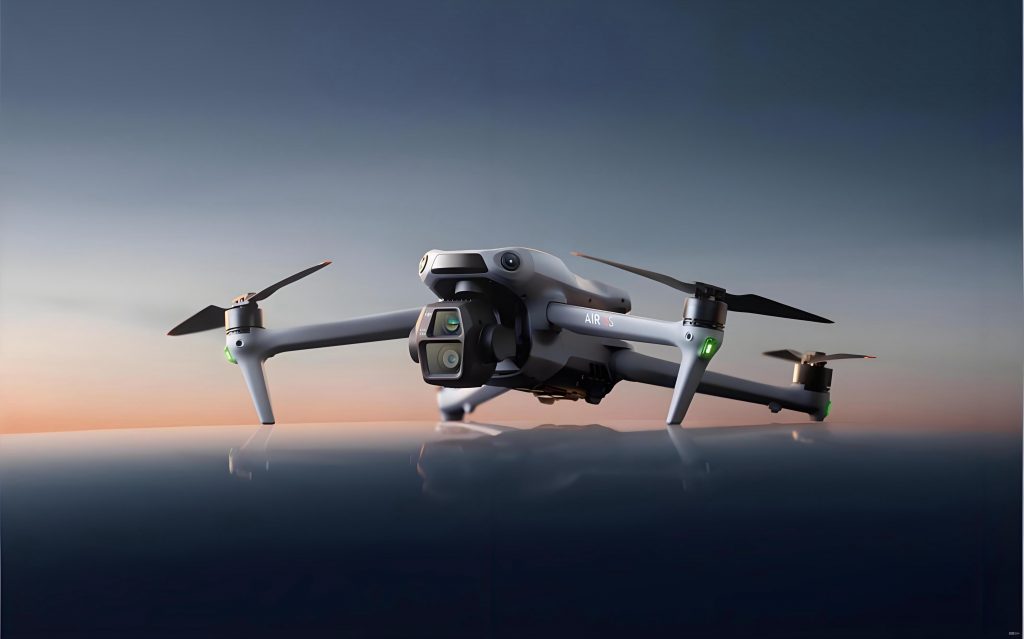
The 100-megapixel Hasselblad camera is a revelation. The sheer level of detail captured from the air is staggering. Photographing an urban skyline, I can zoom into the image at 100% and clearly distinguish individual window panes, text on distant signage, and the texture of building materials. The dynamic range and color science, a hallmark of the Hasselblad partnership, produce files that are richly detailed and color-accurate straight out of the camera, minimizing post-processing work for many applications. The flexibility of an adjustable aperture (f/2.0 to f/11) allows for precise control over depth of field and exposure, enabling techniques like sunstars in aerial shots.
The telephoto cameras are far from secondary. They are powerful creative instruments. The 70mm lens offers a natural, flattering perspective for isolating subjects within a landscape—a single building amidst a city, a boat on a vast lake, or a person in an environment. The 168mm lens is a game-changer for discretion, safety, and unique composition. It allows you to capture detailed shots of subjects from a significant and often legally or safely required distance—wildlife on a cliff face, intricate architectural details on a tall tower, or candid scenes without disturbing the environment. The image quality from these smaller sensors, thanks to high pixel counts and advanced processing, remains exceptionally high for their class.
The concept of equivalent focal length is key to understanding this system’s flexibility. The actual focal lengths of the lenses are much shorter, but they project an image circle onto a smaller sensor, creating a narrower field of view equivalent to a longer lens on a full-frame camera. This is calculated by multiplying the actual focal length by the sensor’s crop factor. For the main 4/3″ sensor, the crop factor is approximately 2.
$$ \text{Equivalent Focal Length} = \text{Actual Focal Length} \times \text{Crop Factor} $$
This multi-focal-length capability fundamentally changes aerial cinematography and photography. A single flight with this DJI drone can yield wide establishing shots, intimate medium frames, and tight telephoto details, all with consistent color grading and from the same flight path, providing unparalleled editorial flexibility in post-production.
The Gimbal: Unlocking Creative Camera Movement
Complementing the tri-camera system is a gimbal of remarkable dexterity. Its 360° unlimited rotation on the yaw axis, combined with a generous tilt range, opens up cinematic possibilities that were cumbersome or impossible with earlier DJI drones. Classic drone moves like the “orbit” or “point of interest” are executed with buttery smoothness. More advanced techniques, such as revealing a subject by rotating the camera while the aircraft flies laterally, or creating disorienting, dynamic reveals, become intuitively achievable. This gimbal isn’t just a stabilization device; it’s a direct extension of the director’s vision, allowing for complex, multi-axis moves that add tremendous production value to any video project.
Control & Interface: The RC Pro 2 Remote
The aircraft is only half of the story. The bundled DJI RC Pro 2 remote controller is the command center this professional DJI drone deserves. The high-brightness, rotatable screen is a massive quality-of-life improvement, especially for portrait-orientation shooting. The physical controls—including customizable dials and buttons—are a professional’s dream. I have set one dial to control aperture and another for ISO or EV compensation. This means critical exposure adjustments can be made instantly, by feel, without taking my eyes off the screen to fumble with touch controls. This tactile control loop dramatically improves shooting efficiency and allows for real-time creative adjustments that can make or break a shot.
Technical Deep Dive: Understanding the Specifications
Let’s quantify some of the key performance aspects with formulas and data.
1. Pixel Density and Detail: The 100MP sensor in a 4/3″ format results in an extremely high pixel density. While this enables incredible detail, it also places demands on optics and stabilization. The lens must be able to resolve detail to match the sensor’s potential, which the Hasselblad lens clearly does.
2. Signal-to-Noise Ratio (SNR) Consideration: All else being equal, a larger sensor pixel gathers more light, leading to a better signal-to-noise ratio. The 4/3″ sensor of the main camera has a significant advantage here over the smaller auxiliary sensors, especially in low-light conditions. The performance can be approximated by considering pixel area. For two sensors with the same resolution but different sizes, the pixel area ratio is the square of the ratio of their sensor diagonals.
3. Flight Time Calculation (Theoretical): Maximum flight time is a function of battery energy, aircraft power draw at hover, and environmental conditions. The official 51-minute rating is achieved under ideal, lab-controlled conditions. A more realistic estimate for planning considers average power draw. If the battery capacity is \( E \) (in Watt-hours) and the average power consumption during a typical mixed flight is \( P_{avg} \) (in Watts), the expected flight time \( T \) is:
$$ T_{(hours)} = \frac{E}{P_{avg}} $$
For the 95Wh battery and an observed \( P_{avg} \) of around 130W during active filming, we get:
$$ T = \frac{95\text{Wh}}{130\text{W}} \approx 0.73 \text{ hours} \approx 44 \text{ minutes} $$
This aligns closely with my real-world experience.
| Condition | Approximate Flight Time | Notes |
|---|---|---|
| Hovering in Calm Air | 45-48 minutes | Close to max rating |
| Active Filming (Mixed Maneuvers) | 40-44 minutes | Real-world typical use |
| High-Speed Sport Mode / Strong Winds | 25-35 minutes | High power draw significantly reduces time |
Considerations and Workflow Impact
This DJI drone is a top-tier professional tool, and its capabilities come with corresponding demands on the entire production workflow. It is not without considerations that potential buyers must weigh.
1. The Computational Backend: A 100-megapixel RAW photo file is enormous. A burst of such images or footage in 5.1K, 4K/120fps, or Apple ProRes will quickly consume hundreds of gigabytes of storage. This necessitates investment in high-capacity, high-speed storage media (UHS-II V90 cards are recommended for maximum performance). More critically, it demands a powerful computer for post-processing. Editing and grading ProRes footage or stitching multi-gigabyte panoramic images require significant CPU/GPU power, fast SSDs, and ample RAM. This DJI drone effectively mandates a professional-grade post-production setup to fully leverage its imaging power.
2. Portability vs. Capability: While foldable, the Mavic 4 Pro is denser and slightly larger than its predecessors. At approximately 1063 grams, it is perceptibly heavier. For the ultra-light traveler or the pilot who prioritizes absolute minimum pack weight, this is a tangible trade-off for the larger sensors, additional cameras, and bigger battery.
3. Cost of Entry: The advanced technology comes at a premium price point. It represents a significant investment, positioning it clearly for professionals and dedicated enthusiasts who can leverage its full suite of features to generate value or artistic fulfillment.
Conclusion: For Whom is This DJI Drone?
After extensive use, the profile of the ideal user for the DJI Mavic 4 Pro becomes very clear. This drone is engineered for:
- Professional Photographers & Cinematographers: Those working in advertising, real estate, documentary filmmaking, and broadcast who require the highest aerial image quality, multi-focal-length flexibility, and reliable, long-duration flights.
- Serious Aerial Imaging Enthusiasts: Individuals for whom image quality is the paramount concern, who are willing to invest in the tool that currently sits at the absolute peak of consumer/prosumer aerial imaging.
- Industrial & Mapping Users: The 100MP camera and precision flight make it suitable for high-detail aerial surveys, inspections, and photogrammetry projects where ground sample distance (GSD) is critical.
Conversely, this may not be the optimal choice for:
- First-time Drone Buyers or Casual Users: The complexity, cost, and file management overhead are likely excessive for simple recreational flying or social media clips.
- Travelers with Severe Weight/Size Restrictions: Where every gram and cubic centimeter counts, a smaller, lighter DJI drone might be more practical.
- Users with Limited Post-Processing Capability: If your workflow cannot handle massive image and video files, much of this drone’s potential will be bottlenecked at the editing stage.
In final assessment, the DJI Mavic 4 Pro is a landmark achievement. It consolidates top-tier performance in flight dynamics, safety, endurance, and—most importantly—imaging versatility into a remarkably portable form factor. It has fundamentally altered my approach to aerial projects, granting creative freedom and operational efficiency I previously thought impossible from a platform of this size. For the professional or the devoted enthusiast ready to meet its demands, this isn’t just another DJI drone; it is, without hyperbole, a transformative tool for visual storytelling. The investment it requires is significant, but for the right user, the return in capability, reliability, and breathtaking image quality is unequivocally worth it.