
The safe and reliable operation of urban gas pipeline networks is a critical component of modern infrastructure. To ensure this safety, regular and comprehensive inspection is paramount. Traditional manual inspection methods are often characterized by low efficiency, high costs, and significant safety risks for personnel, especially in remote or hazardous terrains. The emergence and adoption of China UAV drone technology have introduced a paradigm shift, offering a highly efficient, flexible, and safer alternative for pipeline monitoring. These China UAV drones can be equipped with various sensors, including high-definition visible-light cameras and thermal imaging systems, to capture detailed imagery and data along the pipeline right-of-way.
However, the widespread deployment of China UAV drones for long-distance linear asset inspection is fundamentally constrained by the limited communication range of conventional drone control and data links. Standard radio control (RC) systems, Wi-Fi, or other proprietary drone communication protocols typically offer reliable control within a line-of-sight range of a few kilometers at best. This limitation poses a severe challenge for inspecting pipelines that may stretch over tens or even hundreds of kilometers, often traversing complex geographical features like mountains, forests, and rivers where direct communication with the ground control station (GCS) is impossible. This paper aims to theoretically investigate the feasibility of utilizing Long Range (LoRa) relay technology to overcome this range limitation, thereby significantly extending the operational distance for pipeline inspection conducted by China UAV drones.
The core of this investigation lies in analyzing whether a network of strategically placed LoRa relay nodes can create a reliable, multi-hop communication backbone that maintains a data link between a distant China UAV drone and its operator. We will dissect the problem by first examining the inherent limitations of current drone communication systems in the pipeline context. Following this, we will delve into the technical principles of LoRa that make it a suitable candidate, followed by a detailed theoretical analysis covering signal propagation, link budget, and network topology. Finally, a conceptual system design incorporating LoRa relays will be proposed, followed by a discussion of the practical advantages and challenges of such a system.
Current Limitations of UAV Drone Communications for Pipeline Inspection
The effectiveness of a China UAV drone inspection mission is heavily dependent on a stable, bidirectional communication link. This link is responsible for transmitting flight control commands uplink to the drone and sending telemetry (position, status) and payload sensor data (imagery, video) downlink to the GCS. Several critical limitations impede this link in long-range pipeline scenarios.
1. Signal Transmission Range Constraint: The primary limitation is the physical range of the communication system.
- Geographical Impact: Pipelines are linear assets that inevitably cross diverse and challenging terrains. In mountainous regions, signals are blocked, reflected, and attenuated by the terrain itself. In densely forested areas, foliage causes significant signal absorption and scattering. For instance, while a China UAV drone’s control system might advertise a several-kilometer range in open fields, this can degrade to mere hundreds of meters in a valley or behind a hill, creating coverage gaps along the pipeline route.
- Technology-Specific Limits: Common drone communication technologies have inherent physical limits. Standard RC operates on specific power-limited bands. Wi-Fi, while offering higher data rates, suffers from rapid signal decay over distance and is highly susceptible to obstruction. Even specialized drone datalinks are optimized for a balance of rate and range, rarely exceeding robust communication beyond 10-15 km in ideal conditions, which is insufficient for lengthy pipelines.
2. Signal Interference Vulnerability: The operational electromagnetic environment along pipelines is rarely clean.
- External Interference Sources: Pipelines often run in corridors shared with other infrastructure, such as high-voltage power lines, which generate intense electromagnetic fields that can swamp receiver circuits. Cellular network base stations, industrial equipment, and other radio transmitters also contribute to a noisy RF environment, potentially causing packet loss, increased bit error rates, or complete link dropout for the China UAV drone.
- Internal Drone Noise: The drone itself is a source of interference. High-speed brushless motors, electronic speed controllers (ESCs), and onboard computing systems can generate broadband electrical noise that degrades the sensitivity of its own communication receivers.
3. Inadequate Data Throughput (Bandwidth): While long-range is the primary challenge, bandwidth is a secondary but important constraint.
- High-Definition Payload Data: Effective pipeline inspection requires high-resolution imagery and video to identify cracks, corrosion, or third-party intrusions. Streaming this data in real-time or near-real-time demands substantial bandwidth, which is at odds with the goal of achieving ultra-long-range communication, as most technologies trade bandwidth for range.
- Multi-Sensor Data Fusion: Modern inspection China UAV drones may carry gas detectors, LiDAR, or hyperspectral cameras alongside visual sensors. The aggregate data from all these sources compounds the bandwidth requirement, risking congestion and delay over a limited-bandwidth long-range link.
4. Insufficient Link Stability and Reliability: For critical infrastructure inspection, communication must be robust.
- Frequent Signal Drops: The dynamic nature of the flight path and environment can lead to intermittent signal loss. When a China UAV drone flies into a radio shadow (e.g., behind a large hill), the link is severed, which can trigger a failsafe return-to-home maneuver, interrupting the inspection.
- Low Fault Tolerance: Most drone communication systems rely on a single, direct link. If this link fails due to equipment malfunction or extreme interference, there is no inherent network redundancy to maintain control, posing a safety and mission risk.
The following table summarizes these key limitations:
| Limitation Category | Specific Issue | Impact on China UAV Drone Pipeline Inspection |
|---|---|---|
| Range | Geographical obstacles, technology limits | Restricts inspection to short segments, requires multiple GCS relocations. |
| Interference | External (power lines, RF noise) and internal (drone electronics) | Causes unstable control, data corruption, or complete loss of link. |
| Bandwidth | High data volume from HD video and multiple sensors | Limits real-time data transmission quality; forces lower resolution or stored data. |
| Reliability | Single-point link failure, signal fading | Increases risk of mission abortion, drone loss, and data gaps. |
Communication Requirements Analysis for Pipeline UAV Drone Inspection
To evaluate the suitability of LoRa relay, we must first define the communication requirements for a long-distance pipeline inspection mission using a China UAV drone. Unlike applications requiring millisecond-level latency (e.g., drone racing), pipeline inspection has a different priority profile.
- Data Type and Volume: The primary data types include command/control signals (small packets, low bandwidth but critical latency), telemetry (small, periodic), and payload data (large, bursty). While HD video is data-intensive, the real-time requirement is often relaxed; the system can tolerate latencies on the order of seconds, as the operator typically monitors a live but slightly delayed feed. The crucial need is for reliable and complete data delivery over the entire route.
- Communication Range: This is the paramount requirement. The system must maintain a bidirectional link over the entire planned inspection distance, which could be 50 km, 100 km, or more, irrespective of terrain obstacles. The China UAV drone should be controllable and able to send status updates from any point along the pipeline.
- Reliability and Robustness: Given the safety-critical nature of infrastructure inspection and the value of the asset (the drone), the communication link must have high availability. It should resist fading, recover from short interruptions, and provide a measure of redundancy. Data integrity for inspection imagery is also vital for accurate post-analysis.
- Power Efficiency: Both the China UAV drone and potential unattended relay nodes have limited power budgets. The communication system must be power-efficient to maximize drone flight time and relay node operational duration, especially in remote areas where grid power is unavailable.
Theoretical Feasibility of LoRa Relay for Range Extension
LoRa (Long Range) is a spread spectrum modulation technique derived from Chirp Spread Spectrum (CSS). Its key characteristics—long-range, low power consumption, and strong interference immunity—make it a compelling candidate for building a relay network. The core question is whether its theoretical capabilities align with the requirements outlined above.
1. LoRa Technology Principles:
LoRa achieves its performance by trading data rate for receiver sensitivity and robust signal processing. A key parameter is the Spreading Factor (SF), which can be adjusted from SF7 (faster, shorter range) to SF12 (slower, longest range). Higher SF provides a higher processing gain, allowing the receiver to decode signals far below the noise floor. LoRa operates in sub-GHz license-free bands (e.g., 433 MHz, 868 MHz, 915 MHz), which experience less path loss and better propagation through obstacles compared to the 2.4 GHz or 5.8 GHz bands commonly used for drone video links.
| LoRa Parameter | Impact on Performance | Relevance to China UAV Drone Relay |
|---|---|---|
| Spreading Factor (SF) | Higher SF increases range and receiver sensitivity but reduces data rate and increases airtime. | Enables reliable communication at extreme distances between drone and relay node, suitable for telemetry and commands. |
| Bandwidth (BW) | Lower BW increases sensitivity but reduces data rate. | Can be optimized for the required control/data throughput over the desired range. |
| Coding Rate (CR) | Adds forward error correction, increasing robustness at the cost of reduced effective data rate. | Enhances data integrity for critical telemetry and small payload data packets in noisy environments. |
2. Signal Propagation and Relay Strategy:
The feasibility hinges on overcoming path loss. The signal strength received ($P_r$) at a distance $d$ from the transmitter is given by the link budget equation. Path loss ($L_p$) is the most critical variable. In free space, it is modeled as:
$$L_{fs}(d) = 32.44 + 20 \log_{10}(f) + 20 \log_{10}(d)$$
where $L_{fs}(d)$ is the free-space path loss in dB, $f$ is the frequency in MHz, and $d$ is the distance in km.
For example, at 915 MHz, the path loss over 10 km is approximately:
$$L_{fs}(10) = 32.44 + 20 \log_{10}(915) + 20 \log_{10}(10) \approx 32.44 + 59.23 + 20 = 111.67 \text{ dB}$$
However, for practical pipeline environments with terrain, the Okumura-Hata or similar models provide a more realistic estimate, adding an environment-specific clutter factor. In non-line-of-sight (NLOS) conditions, loss can be 20-40 dB higher. This is where a relay strategy becomes essential. By placing a LoRa relay node within the reliable communication radius of the China UAV drone (e.g., 5-15 km depending on terrain), the signal only needs to traverse a series of shorter “hops.” Each hop experiences significantly lower path loss, making the link feasible even with low transmission power. The relay receives, potentially amplifies or decodes/re-encodes, and retransmits the signal towards the next node or the final gateway connected to the GCS.
3. Link Budget Analysis with Relay:
A link budget calculates the margin between the received signal power and the receiver’s sensitivity. The simplified budget is:
$$P_r = P_t + G_t + G_r – L_p – L_{sys}$$
where:
– $P_r$: Received power (dBm)
– $P_t$: Transmitter output power (dBm)
– $G_t$, $G_r$: Transmit and receive antenna gains (dBi)
– $L_p$: Path loss (dB)
– $L_{sys}$: System losses (cable loss, etc.) (dB)
The link is feasible if $P_r > \text{Receiver Sensitivity}$.
Example Calculation for a Single Hop:
Assume a China UAV drone transmitter with $P_t = 20 \text{ dBm}$ (100 mW), $G_t = 2 \text{ dBi}$, a relay node with $G_r = 3 \text{ dBi}$, $L_{sys} = 2 \text{ dB}$, and a receiver sensitivity of $-137 \text{ dBm}$ (for LoRa with SF12, BW 125 kHz). For a 10 km hop in a moderately cluttered environment, estimate $L_p \approx 130 \text{ dB}$.
$$P_r = 20 + 2 + 3 – 130 – 2 = -107 \text{ dBm}$$
The link margin is: $-107 \text{ dBm} – (-137 \text{ dBm}) = 30 \text{ dB}$. This substantial positive margin indicates a very robust link with significant fade margin for the single hop. By designing the relay network such that each hop is within this calculated maximum range, the overall inspection distance can be extended indefinitely, in theory. The total system range becomes $N \times d_{hop}$, where $N$ is the number of hops and $d_{hop}$ is the reliable per-hop distance.
4. Network Topology for Linear Asset Inspection:
The linear nature of a pipeline lends itself perfectly to a string or multi-hop star topology. A simple and reliable topology is a linear daisy-chain of relays.
- The China UAV drone communicates with the nearest LoRa relay node (Node A).
- Node A forwards the data packet to the next node closer to the GCS (Node B).
- This process continues until the packet reaches a gateway node with a backhaul connection (e.g., cellular, satellite, or a long-distance point-to-point radio link) to the central GCS.
For bidirectional control, the process reverses. This topology is simple to manage. More robust (but complex) topologies like a mesh could allow for alternate routing paths if one relay node fails, increasing system resilience. The optimal placement of relay nodes is determined by the per-hop link budget analysis for the specific terrain, ensuring contiguous coverage along the entire pipeline corridor.
Conceptual System Design for LoRa-Relay Enhanced Pipeline Inspection
Based on the theoretical feasibility, we propose a conceptual system architecture integrating a China UAV drone with a ground-based LoRa relay network.
1. System Architecture Overview:
The system comprises three main subsystems:
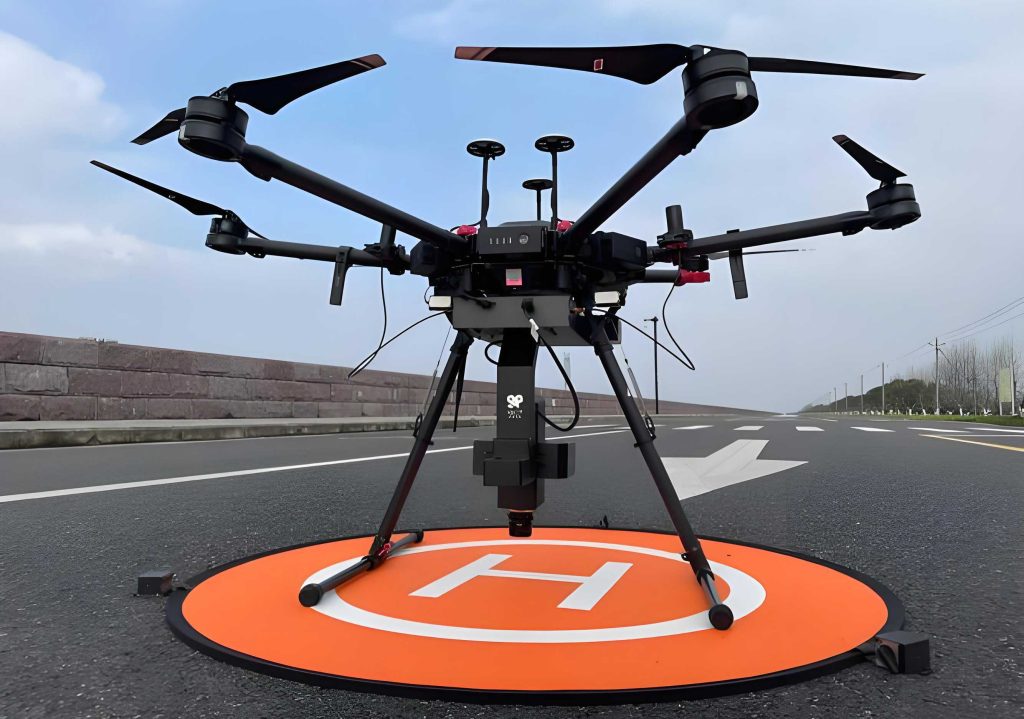
- The Inspection China UAV Drone: Equipped with flight controller, payload sensors, and a LoRa communication module (in addition to its standard short-range control/video link for launch/recovery phases).
- The LoRa Relay Network: A series of solar-powered, ruggedized outdoor nodes deployed at calculated intervals along the pipeline. Each node contains a LoRa transceiver, microcontroller, power system, and antenna.
- The Ground Control Station (GCS): Comprises a computer with mission planning software, a LoRa gateway connected to the relay network’s terminal node, and potentially a standard RC system for local drone handling.
2. China UAV Drone Subsystem Design:
- Hardware: A long-endurance fixed-wing or hybrid VTOL China UAV drone is preferred for covering long distances. Its avionics are augmented with a low-power, lightweight LoRa module (e.g., based on Semtech SX1276/78). This module operates on a separate sub-GHz frequency from the drone’s primary flight control link to avoid interference.
- Software & Protocol: The drone’s flight computer runs a protocol stack that packages telemetry (GPS, altitude, battery status) and small payload data (e.g., compressed metadata from sensors, thumbnail images) into LoRa packets. A key design choice is the data management strategy: high-volume data like full-resolution video can be stored onboard for retrieval post-flight, while critical status alerts and low-bandwidth sensor data are transmitted in real-time via the LoRa link.
3. LoRa Relay Node Design:
- Hardware: A typical node consists of a microcontroller unit (MCU) managing two LoRa transceivers: one for the “uplink” towards the drone/previous node and one for the “downlink” towards the next node/gateway. This allows for simultaneous listening and forwarding, reducing latency. They are powered by solar panels and batteries, designed for unattended operation. Antennas are omnidirectional or slightly directional along the pipeline axis.
- Software & Network Logic: The node firmware implements a store-and-forward or decode-and-forward routing protocol. It listens for packets on its assigned uplink frequency, validates them, and then retransmits them on the downlink frequency. It may also collect diagnostic data about link quality to aid in network health monitoring.
4. Ground Control Station (GCS) Design:
The GCS is the endpoint of the LoRa network. Its gateway receives all the relayed packets from the China UAV drone. Specialized software reconstructs the drone’s telemetry stream, displays its position on a digital map in near-real-time (with the latency of the multi-hop network), and presents any incoming payload data. The operator can send command packets (e.g., change waypoint, trigger a sensor) back through the same relay chain to the drone.
Advantages and Challenges of the LoRa Relay Approach
| Aspect | Advantages | Challenges & Considerations |
|---|---|---|
| Range | Dramatically extends operational control and data range far beyond visual line of sight (BVLS). Enables inspection of 50+ km pipeline sections from a single GCS location. | Requires careful site survey and planning for relay node placement to ensure line-of-sight or reliable propagation between nodes. Physical deployment and maintenance of nodes in remote areas can be logistically challenging. |
| Power Consumption | LoRa’s ultra-low-power characteristics are ideal. The China UAV drone’s LoRa module consumes minimal power compared to its video transmitter. Relay nodes can run on solar power for years. | Optimizing the trade-off between data rate (airtime) and power consumption is necessary. Higher SF for longer range increases packet airtime and thus energy use per packet. |
| Robustness & Interference | LoRa’s spread spectrum modulation offers excellent resistance to co-channel interference and multipath fading. The relay network provides path redundancy compared to a single point-to-point link. | The sub-GHz ISM bands can become congested. Careful frequency selection, channel planning, and listen-before-talk (LBT) mechanisms are needed to avoid self-interference within the relay network and from other users. |
| Data Throughput | Sufficient for telemetry, commands, and small sensor data packets, enabling effective mission monitoring and basic alerting. | Extremely low data rate (often < 1 kbps for long-range settings) is the major drawback. Real-time HD video transmission is impossible. This necessitates an “inspect now, retrieve data later” model or a separate high-bandwidth link for video. |
| Cost & Complexity | LoRa modules and infrastructure are relatively low-cost. The system leverages simple, standardized technology. | Initial network deployment has a fixed cost. System complexity increases with network size, requiring management software for monitoring node health and network status. |
Conclusion and Future Outlook
This theoretical analysis demonstrates a strong feasibility argument for using LoRa relay technology to overcome the fundamental range limitation in long-distance pipeline inspection conducted by China UAV drones. The core strength of LoRa—its ability to provide reliable, low-power communication over distances of 10 km or more per hop—directly addresses the critical range requirement. Through systematic link budget analysis and appropriate network topology design (e.g., a linear daisy-chain of relays), the effective operational range of the inspection China UAV drone can be extended to cover entire pipeline segments spanning dozens to hundreds of kilometers from a single control point. This capability would revolutionize the efficiency of pipeline monitoring campaigns.
The proposed conceptual system separates the functions: a low-bandwidth, ultra-long-range LoRa network handles vital telemetry, command & control, and transmission of small critical data packets or alerts. High-volume inspection data, such as HD video and detailed sensor logs, is stored onboard the China UAV drone for retrieval after the mission, when the drone returns within range of a high-speed download link. This hybrid approach pragmatically balances the constraints of physics with operational needs.
Future developments in this area are promising. The integration of autonomous flight planning with dynamic link quality assessment could allow the China UAV drone to optimize its flight path to maintain the best connection with the relay network. Advances in edge computing could enable the drone or relay nodes to perform preliminary image analysis, sending only alert metadata over the LoRa link instead of raw images. Furthermore, combining a LoRa backbone for control with emerging satellite IoT modules for fallback communication could create an even more resilient system for inspecting the most remote pipelines. In conclusion, while practical deployment challenges exist, the theoretical foundation for using LoRa relay networks to enable long-range China UAV drone pipeline inspection is solid and points toward a significant enhancement in the capabilities of infrastructure monitoring systems.