
Flight trajectory control is an indispensable aspect of small unmanned aerial vehicle (UAV) technology development. It not only enhances the intelligence level of small drones but also brings significant economic and social benefits across various industries. In agriculture, by precisely controlling flight paths, small UAVs can achieve accurate fertilization and pesticide spraying for crops, improving production efficiency, reducing the use of chemicals, and lowering environmental pollution. In logistics, small drones can optimize delivery routes for fast and accurate cargo distribution, shortening delivery times and reducing costs. In medical rescue, drones can quickly reach disaster areas, providing real-time imagery and data support to rescue personnel, thereby improving efficiency. However, trajectory control faces numerous challenges. Firstly, small UAVs must process vast amounts of environmental data in real-time during flight, including wind speed, wind direction, and obstacle positions, imposing high demands for real-time trajectory adjustment. Secondly, accurately identifying and avoiding obstacles in complex environments remains a major difficulty. Furthermore, trajectory control must also consider energy consumption optimization—how to minimize flight energy consumption while ensuring mission completion is a critical research direction.
Existing trajectory control methods often struggle to achieve satisfactory performance due to inherent limitations in their applied models, techniques, or algorithms. For instance, methods focusing on wind disturbance compensation may lack mechanisms for handling randomly appearing and moving obstacles. Other approaches optimizing for a single objective like user service rate might compromise flight safety or energy efficiency. Some methods utilizing deep learning for planning may generate insufficiently diverse candidate trajectories, prone to local optima, or inadequately capture the UAV’s dynamic characteristics. Techniques designed for specific scenarios like formation flying may not emphasize real-time updating mechanisms for the UAV’s state, environmental model, and control strategy. While some control methods offer flexibility, they may struggle with highly complex, multi-factor dynamic changes. These limitations highlight the need for a more comprehensive and adaptive approach to control the flight trajectory of small China UAV drones in complex low-altitude environments.
To address the limitations of existing methods in handling complex environments and their tendency for suboptimal optimization due to a focus on single performance metrics, this study proposes a flight trajectory control method for small unmanned aerial vehicles based on the Monte Carlo method. This approach aims to effectively control the flight path of small China UAV drones by comprehensively considering multiple factors like obstacle distribution, wind disturbance, and energy consumption, while adapting to dynamic environmental changes.
Methodology
1. Environmental Modeling and Probabilistic Initialization
When a small China UAV drone operates in complex low-altitude environments, it faces two major challenges: the stochastic distribution of obstacles and the uncertainty of wind speed disturbances. Obstacle positions are variable, and wind disturbances are difficult to predict. Traditional deterministic models cannot fully account for these dynamic factors, making it challenging to accurately quantify the dynamic risk field, which reduces the accuracy and effectiveness of flight trajectory control. Therefore, a comprehensive and precise control method is required. This is initiated by constructing an environmental risk field model and initializing the probability density function of the small UAV’s state vector, providing a computable stochastic sampling space for subsequent trajectory control.
Environmental modeling is the foundational step for controlling the flight trajectory of a small China UAV drone. Its objective is to construct an accurate environmental map from sensor data to support path planning and obstacle avoidance. Achieving high-precision, high-robustness environmental modeling requires the协同 work of a series of hardware devices, as summarized in Table 1.
| Device Type | Device Name | Device Parameters | Parameter Configuration |
|---|---|---|---|
| Environmental Data Acquisition Devices | Lidar | Range Accuracy Scan Frequency Angular Resolution | 50~500 m ±2 cm 10~100 Hz 0.1°~0.5° |
| Vision Sensor | Resolution Frame Rate Horizontal FOV Vertical FOV | 12~48 MP 30~120 FPS 90°~120° 60°~90° | |
| Ultrasonic Sensor | Measurement Range Accuracy Update Frequency | 0.1~10 m ±1 cm 10~50 Hz | |
| Environmental Data Processing Devices | On-board Computer | Processor Clock Speed Memory Storage Power | ≥4 cores ≥2.0 GHz ≥8 GB ≥128 GB ≤20 W |
| Image Processing Unit | CUDA Cores VRAM Capacity Compute Performance | ≥512 ≥4 GB ≥1 TFLOPS | |
| Environmental Data Transmission & Storage | Wireless Comms Module | Protocol Transmission Bandwidth Range | WiFi/5G 10~100 Mbps 1~15 km |
| Data Storage Device | Capacity Read/Write Speed Interface | ≥512 GB ≥500 MB/s USB 3.0 / NVMe |
The vision sensor is a key device for environmental data acquisition. However, its internal circuitry may have certain defects leading to overall lower quality of environmental images, affecting modeling accuracy. Specifically, the internal circuitry may have deficiencies in signal amplification and noise suppression. An improved three-stage amplifier circuit design can be employed, incorporating low-noise amplification, variable gain adjustment based on ambient light, and power amplification, along with band-pass/notch filters and differential structures to enhance signal quality and reduce noise.
Based on the environmental data acquired from the hardware in Table 1 for the small China UAV drone’s operating area, an environmental risk field is constructed. This field primarily consists of two components: obstacle position modeling and wind disturbance modeling. Typically, the spatial distribution of obstacles exhibits multi-modal characteristics. A Gaussian Mixture Model (GMM), through the linear superposition of multiple Gaussian distributions, can effectively fit such complex distributions. Therefore, the proposed method uses a GMM to model obstacle positions:
$$ p_{\text{obs}}(\mathbf{x}) = \sum_{k=1}^{K} \omega_k \cdot \mathcal{N}(\mathbf{x}; \boldsymbol{\mu}_k, \mathbf{Q}_k) $$
where \( p_{\text{obs}}(\mathbf{x}) \) is the obstacle position probability density, \( K \) is the total number of obstacle clusters, \( \omega_k \) is the weight of the k-th Gaussian component satisfying \( \sum_{k=1}^{K} \omega_k = 1 \), \( \mathcal{N}(\mathbf{x}; \boldsymbol{\mu}_k, \mathbf{Q}_k) \) is the multivariate Gaussian distribution, \( \mathbf{x} \) is the state vector of the small UAV, \( \boldsymbol{\mu}_k \) is the 3D center coordinate of the k-th obstacle cluster obtained via clustering algorithms like DBSCAN on sensor data, and \( \mathbf{Q}_k \) is the covariance matrix describing the cluster’s geometric shape.
Wind speed disturbances, typically following turbulence statistics, can be modeled as a zero-mean random process. Their spatial correlation can be described by an exponential covariance function:
$$ F_w(r) = \sigma_w^2 \cdot \exp\left(-\frac{r}{L}\right) $$
where \( F_w(r) \) is the spatial covariance function of wind speed, \( \sigma_w^2 \) is the wind speed variance reflecting disturbance intensity, \( r \) is the vector norm representing distance, and \( L \) is the turbulence integral scale characterizing spatial correlation.
The comprehensive environmental risk field model, combining obstacle and wind disturbance risks, is given by:
$$ \rho_{\text{risk}}(\mathbf{x}) = \alpha \cdot p_{\text{obs}}(\mathbf{x}) + \beta \cdot F_w(||\nabla \mathbf{x}||) $$
where \( \rho_{\text{risk}}(\mathbf{x}) \) is the comprehensive environmental risk density, and \( \alpha \) and \( \beta \) are weight coefficients reflecting the trade-off between collision risk and instability risk due to wind.
The initial probability density function for the small China UAV drone’s state vector is initialized as:
$$ p_0(\mathbf{x}) = \mathcal{N}(\mathbf{x}; \hat{\mathbf{x}}_0, \mathbf{P}_0) $$
where \( \hat{\mathbf{x}}_0 \) is the initial state estimate and \( \mathbf{P}_0 \) is a block-diagonal covariance matrix with blocks corresponding to measurement noise for position, attitude, linear velocity, and angular velocity.
This process completes the construction of the environmental risk field model and the initialization of the UAV state probability density, laying the mathematical foundation for subsequent Monte Carlo sampling. This enables randomly generated trajectories to cover high-probability safe regions while effectively exploring potential optimal paths.
2. Candidate Trajectory Generation via Markov Chain Monte Carlo (MCMC)
Environmental modeling and probabilistic initialization only achieve the transformation from physical uncertainty to a mathematical probability model and the construction of a random sampling space. However, controlling the flight trajectory of a small China UAV drone requires numerous candidate trajectories that satisfy physical and environmental constraints for evaluation and optimization. Therefore, this study employs a Markov Chain Monte Carlo (MCMC) method. Building upon the environmental risk field model \( \rho_{\text{risk}}(\mathbf{x}) \) and the initialized state probability density \( p_0(\mathbf{x}) \) from the previous section, it effectively integrates Markov chains and Monte Carlo sampling to generate candidate flight trajectories for the small UAV, establishing a solid foundation for subsequent trajectory evaluation and Bayesian optimization.
MCMC is a stochastic sampling technique for generating samples from high-dimensional probability distributions, particularly suitable for UAV trajectory generation. Its core idea is to construct a Markov chain whose stationary distribution matches the target distribution (the UAV state space distribution), thereby generating a large number of candidate trajectories that comply with physical and environmental constraints.
The process for generating candidate flight trajectories for a small China UAV drone using MCMC is as follows:
Step 1: Define State Space and Target Distribution
The target distribution \( \pi(\mathbf{x}) \) for the small UAV is primarily composed of three parts: the environmental risk field, dynamic constraints, and goal point attraction.
$$ \pi(\mathbf{x}) \propto \rho_{\text{risk}}(\mathbf{x}) \cdot \rho_{\text{dyn}}(\mathbf{x}) \cdot \rho_{\text{goal}}(\mathbf{x}) $$
where \( \rho_{\text{dyn}}(\mathbf{x}) \) enforces kinematic/dynamic feasibility, and \( \rho_{\text{goal}}(\mathbf{x}) \) attracts the trajectory towards the target.
Step 2: Design Proposal Distribution
The proposal distribution \( q(\mathbf{x}^* | \mathbf{x}_t) \) generates candidate states \( \mathbf{x}^* \). Its design must balance exploration capability and computational efficiency. For small China UAV drone trajectory generation, it typically includes control input perturbation and state propagation.
$$ \mathbf{x}^* = \xi \cdot f(\mathbf{x}_t, \mathbf{u}^*) + \delta \cdot \boldsymbol{\epsilon} $$
where \( \xi, \delta \) are weights, \( f(\cdot) \) is the state transition model, \( \mathbf{u}^* \) is a perturbed control input, and \( \boldsymbol{\epsilon} \) is random noise.
Step 3: Calculate Acceptance Probability
The acceptance probability \( \gamma \) determines whether to accept the candidate state \( \mathbf{x}^* \). For a symmetric proposal distribution \( q(\mathbf{x}^*|\mathbf{x}_t) = q(\mathbf{x}_t|\mathbf{x}^*) \), it simplifies to:
$$ \gamma = \min \left( 1, \frac{\pi(\mathbf{x}^*)}{\pi(\mathbf{x}_t)} \right) $$
Step 4: Importance Sampling and Weight Assignment
To improve sampling efficiency, importance sampling is introduced. For each candidate trajectory \( \ell^{(i)} = \{ \mathbf{x}_0^{(i)}, \mathbf{x}_1^{(i)}, …, \mathbf{x}_{\hat{T}}^{(i)} \} \) (where \( \hat{T} \) is the total sampled time horizon), its importance weight is calculated. For high-risk regions (e.g., near obstacles), sampling density is increased by adjusting weights:
$$ w^{(i)} = \frac{1}{\pi(\ell^{(i)}) \cdot (1 – p_{\text{obs}}(\mathbf{x})) + \epsilon} $$
where \( \epsilon \) is a smoothing parameter.
Step 5: Dynamic Sampling Density Adjustment
The method dynamically adjusts the sampling region range based on the environmental risk field \( \rho_{\text{risk}}(\mathbf{x}) \):
High-risk regions: Increase sampling density, reduce proposal distribution variance \( W_u \).
Low-risk regions: Decrease sampling density, increase \( W_u \).
The adjustment formula is:
$$ W_u = W_u^0 \cdot \exp(-\lambda \cdot \rho_{\text{risk}}(\mathbf{x})) $$
where \( W_u^0 \) is the initial variance and \( \lambda \) is a tuning coefficient.
Step 6: Generate Candidate Trajectories
The specific trajectory generation process iterates through initialization, iterative sampling (generate candidate, calculate acceptance, update weights), finally producing a set of \( N \) candidate trajectories \( \{ \ell^{(i)} \}_{i=1}^{N} \).
This process completes the generation of candidate flight trajectories for the small China UAV drone, providing a rich set of candidate solutions for subsequent evaluation and optimization. Dynamic adjustment of sampling density significantly improves the search efficiency of the method in high-dimensional state spaces.
3. Candidate Trajectory Evaluation and Bayesian Optimization
The candidate trajectories generated by MCMC vary in quality. Relying solely on the generation process makes it difficult to directly determine the optimal trajectory and effectively balance multiple performance indicators. Therefore, candidate trajectory evaluation and Bayesian optimization are necessary to efficiently screen the optimal solution from a large number of candidates, providing strong support for controlling the flight trajectory of the small China UAV drone.
Based on the candidate trajectories \( \{ \ell^{(i)} \}_{i=1}^{N} \) generated in the previous section, Bayesian optimization combined with Monte Carlo integration is used to efficiently screen the optimal trajectory while balancing multiple objectives.
The steps for optimal trajectory screening are as follows:
Step 1: Randomly select \( N_0 \) trajectories from the candidate set. For each, approximate its expected cost \( \mathbb{E}[J(\ell^{(i)})] \) using Monte Carlo integration due to uncertainties in dynamics and environment:
$$ \mathbb{E}[J(\ell^{(i)})] \approx \frac{1}{M} \sum_{m=1}^{M} J(\ell^{(i)}, \boldsymbol{\omega}_m) $$
where \( M \) is the number of disturbance samples (e.g., wind realizations) and \( J(\cdot, \boldsymbol{\omega}_m) \) is the cost under the m-th sample (considering safety, energy, time).
Step 2: Bayesian optimization is employed as a sequential model-based optimization method. A Gaussian Process (GP) surrogate model is chosen to model the expensive-to-evaluate cost function \( \mathbb{E}[J(\ell)] \):
$$ \mathbb{E}[J(\ell)] \sim \mathcal{GP}(m(\ell), k(\ell, \ell’)) $$
where \( m(\ell) \) is the mean function and \( k(\ell, \ell’) \) is the kernel function (e.g., Radial Basis Function) describing similarity between trajectories.
Step 3: In each iteration, select the next trajectory \( \ell^{(i_t)} \) to evaluate using an acquisition function (e.g., Expected Improvement – EI) that balances exploration and exploitation based on the current GP model. Compute its expected cost via Monte Carlo integration, update the GP model with the new data point \( (\ell^{(i_t)}, \mathbb{E}[J(\ell^{(i_t)})]) \).
Step 4: Repeat Step 3 until a stopping criterion is met (e.g., evaluation budget exhausted). From the final set of evaluated trajectories, the one with the minimum expected cost is selected as the optimal trajectory \( \ell^* \).
To handle multi-objective optimization (safety, energy, time), a composite cost function can be constructed: \( J(\ell) = w_1 \cdot J_{\text{safety}}(\ell) + w_2 \cdot J_{\text{energy}}(\ell) + w_3 \cdot J_{\text{time}}(\ell) \), converting the multi-objective problem into a single-objective one for the above Bayesian optimization process.
This process completes the screening of the optimal trajectory. The final output \( \ell^* \) not only satisfies physical constraints and environmental safety but also achieves the best balance between energy consumption, risk, and time efficiency for the small China UAV drone.
4. Real-time Update and Adaptive Control
While Bayesian optimization can screen the optimal trajectory from many candidates and balance multiple metrics, the flight environment for a small China UAV drone is dynamic. A pre-determined optimal trajectory may become invalid due to environmental changes, and it is difficult to handle real-time uncertainties like sensor noise and external disturbances. Therefore, real-time update and adaptive control, combining Monte Carlo methods and sliding window optimization techniques, are implemented to perform online updates of the UAV state, environmental model, and control strategy. This ensures efficient and safe flight in complex dynamic environments. The closed-loop control system architecture and workflow are as follows:
Step 1: Initialization – Establish initial state and environment model using methods from Section 1.1.
Step 2: Candidate Generation – Generate candidate trajectories using MCMC from Section 1.2.
Step 3: Evaluation & Optimization – Evaluate and select the optimal trajectory using Bayesian optimization from Section 1.3.
Step 4: Real-time Update Loop:
a) Sliding Window Replanning: This local optimization technique decomposes the global problem into a series of local problems over a window of length \( H \), reducing computational complexity. The window length can be adjusted based on environmental dynamics (e.g., obstacle speed \( V_{\text{obs}} \)):
$$ H = \begin{cases}
H_{\text{max}} & \text{static environment} \\
H_{\text{max}} – \Delta H \cdot V_{\text{obs}} & \text{dynamic environment}
\end{cases} $$
Within the current window \( \mathcal{X}_t = \{ \mathbf{x}_t, \mathbf{x}_{t+1}, …, \mathbf{x}_{t+H} \} \), MCMC and Bayesian optimization are applied to find the optimal local trajectory \( \ell_t^* \). The window then slides forward one time step.
b) Online Distribution Update: New sensor data is fused to correct state estimates and update the environmental risk field model in real-time. For instance, the risk field is updated as:
$$ \rho_{\text{risk}}(\mathbf{x}, t+1) = \alpha \cdot p_{\text{obs}}(\mathbf{x}, t+1) + \beta \cdot F_w(||\nabla \mathbf{x}(t+1)||) $$
c) Adaptive Control Tuning: Control parameters are dynamically adjusted based on historical performance. For example, the control perturbation variance \( W_u \) can be adapted:
$$ W_u = W_u^0 \cdot \exp\left( -\lambda \cdot \frac{1}{N_h} \sum_{h=1}^{N_h} J(\ell^{(h)}) \right) $$
where \( N_h \) is the number of historical trajectories. Increase \( W_u \) in high-cost regions for more exploration; decrease it in low-cost regions for finer control.
Step 5: Control Command Execution – The best trajectory and control commands from the closed-loop system are executed by the UAV’s control actuators.
In summary, through real-time update and adaptive control, the small China UAV drone achieves efficient and safe flight in dynamic environments. Sliding window replanning reduces computational load, while online updates and adaptive tuning effectively handle uncertainties. The combined use of Monte Carlo methods and Bayesian optimization allows adaptation to various mission scenarios.
Experimental Analysis
Experimental Setup
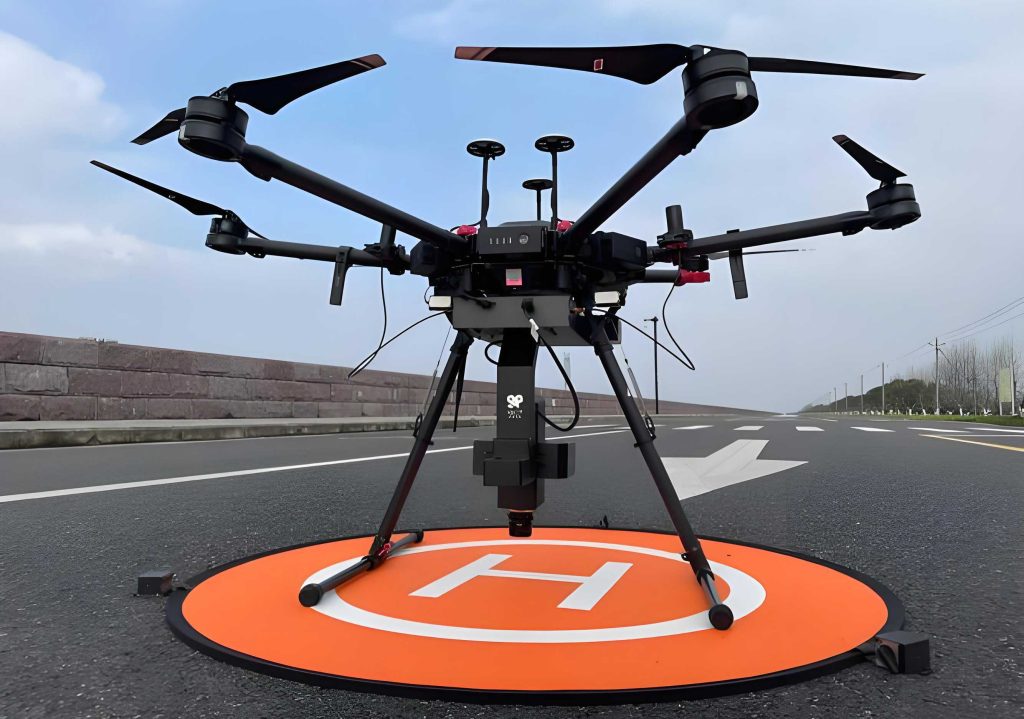
A quadrotor was selected as the experimental small China UAV drone platform. Its core parameters were configured as shown in Table 2 to ensure data accuracy.
| Parameter Type | Parameter Name | Configuration |
|---|---|---|
| Flight Platform | Wheelbase | 450 mm |
| Mass | 1.5 kg | |
| Max Thrust | 20 N | |
| Max Speed | 15 m/s | |
| Power System | Battery Capacity | 10000 mAh |
| Motor Power | 1000 W | |
| Hover Time | ≈40 min | |
| Navigation & Control | Positioning Accuracy | 0.01 m |
| Control Latency | ≤50 ms | |
| Control Range | 15 km |
The experimental environment included static obstacles (simulating buildings/trees) randomly distributed in 3D space and wind disturbances modeled with average wind and Gaussian process turbulence. Sensor noise (position, velocity) was modeled as Gaussian. A simplified experimental scenario involved navigation from a start point to a goal point through an obstacle field.
Candidate Trajectory Generation Performance
The proposed method was compared against two others from literature: a Content-Aware trajectory planning method (Method 1) and a Computer Deep Learning-based method (Method 2). The candidate trajectories generated by the proposed method for the quadrotor small China UAV drone closely matched the actual feasible candidate trajectories in the environment, showing diversity while avoiding obstacles. In contrast, the trajectories generated by the comparison methods showed greater deviation from actual feasible paths, with some exhibiting potential collisions. This validates the superior candidate generation performance of the proposed method, primarily due to the effective integration of Markov chains and Monte Carlo sampling, which ensures both prediction accuracy and exploratory robustness.
Optimal Trajectory Determination Performance
The optimal trajectory determined by the proposed method for the quadrotor was identical to the actual global optimal trajectory (considering the defined cost metrics). The trajectories selected by the comparison methods showed significant deviation from this actual optimum. The advantage of the proposed method stems from the joint use of Bayesian optimization and Monte Carlo integration. Bayesian optimization efficiently explores the parameter space guided by a probabilistic model, while Monte Carlo integration handles the high-dimensional expectations under uncertainty, leading to more precise and globally optimal trajectory selection for the China UAV drone.
Flight Trajectory Control Performance
The control performance was evaluated using metrics like control perturbation variance (reflecting stability) and expected cost. Over a simulated flight mission, the proposed method maintained significantly lower control perturbation variance and lower expected cost compared to the two baseline methods. The minimum achieved values were 0.2 and 10, respectively. This demonstrates the effectiveness of the Monte Carlo-based approach in handling uncertainties, optimizing the trade-off between exploration and exploitation, and achieving robust, low-cost flight control for the small UAV.
Robustness Under Emergent Conditions
Further tests were conducted to verify the control system’s stability and robustness when facing emergencies like communication interruption or sensor failure. Experiments simulated communication blackouts of 5s, 10s, and 15s, as well as faults in positioning and speed sensors. Performance was evaluated using metrics like average position deviation, average adjustment time, average attitude deviation angle, and fault recovery time. The results, summarized in Table 3, show the proposed method consistently outperformed the comparison methods across all fault conditions, with lower deviations, faster adjustment, and quicker recovery. This confirms the enhanced robustness of the proposed Monte Carlo-based control framework for small China UAV drones in challenging operational scenarios.
| Condition | Method | Avg. Pos. Dev. (m) | Avg. Adj. Time (s) | Avg. Att. Dev. (°) | Fault Rec. Time (s) |
|---|---|---|---|---|---|
| Comm. Interrupt 5s | Proposed | 0.2 | 1.3 | 1.6 | 3.1 |
| Method 1 | 0.5 | 2.6 | 3.1 | 6.5 | |
| Method 2 | 0.4 | 2.1 | 2.6 | 5.3 | |
| Comm. Interrupt 10s | Proposed | 0.3 | 2.1 | 2.6 | 4.8 |
| Method 1 | 0.7 | 3.6 | 4.1 | 8.1 | |
| Method 2 | 0.6 | 3.1 | 3.6 | 7.5 | |
| Pos. Sensor Fault | Proposed | 0.3 | 1.6 | 2.1 | 4.6 |
| Method 1 | 0.6 | 3.1 | 4.6 | 7.5 | |
| Method 2 | 0.5 | 2.6 | 3.6 | 6.9 |
The system incorporates specific contingency measures. For communication loss, it switches to autonomous mode using pre-stored plans and attempts to re-establish link via backups. For sensor faults, it utilizes redundant sensors or employs fault-diagnosis and estimation algorithms to maintain state awareness, simultaneously alerting the ground station.
Conclusion and Future Work
Precise flight trajectory control is crucial for the safety, mission efficiency, and energy management of small China UAV drones. With their expanding applications in agriculture, logistics, surveillance, and more, effective trajectory control becomes a key enabler. This study proposed a flight trajectory control method based on the Monte Carlo method. Experimental results demonstrated that the method effectively improved candidate trajectory generation and optimal trajectory determination performance, while reducing control perturbation variance and expected cost. It provides a more effective methodological support for controlling the flight trajectory of small UAVs and serves as a reference for related research.
However, this research has certain limitations. First, regarding computational complexity, the Monte Carlo-based method requires significant stochastic sampling and computation, which can impact real-time performance on resource-constrained small UAV platforms. Second, concerning adaptability boundaries in highly dynamic environments, while the method performs well in static or slowly changing settings, its adaptability and robustness in rapidly changing environments with strong gusts or sudden obstacles require further enhancement.
Future work can proceed in several directions. Firstly, exploring multi-UAV cooperative trajectory optimization methods could improve overall fleet efficiency and safety through information sharing and collaborative decision-making, while also distributing computational load. Secondly, investigating fusion strategies of Reinforcement Learning (RL) with Monte Carlo methods could leverage RL’s adaptive learning capability, allowing the China UAV drone to continuously optimize its trajectory based on real-time feedback in dynamic environments, thereby improving adaptability and robustness. Additionally, further optimization of the Monte Carlo sampling strategy and computational efficiency is needed to better balance complexity and real-time requirements. Through continuous research and improvement, the Monte Carlo-based flight trajectory control method for small UAVs is poised to play a more significant role across various domains, providing stronger technical support for the widespread application of small China UAV drones.