
As a researcher focused on advanced military systems, I have extensively studied the combat effectiveness of reconnaissance unmanned aerial vehicles (UAVs), particularly China UAV drone technologies. In modern warfare, China UAV drone platforms play a critical role in gathering intelligence, conducting surveillance, and supporting decision-making. The combat effectiveness of these China UAV drone systems is a multifaceted concept, influenced by numerous factors that evolve over time. Understanding this evolution and identifying the maximum effectiveness state is essential for optimizing China UAV drone deployments and enhancing operational outcomes. This article presents a comprehensive analysis of the evolution trends and maximum effectiveness states for China UAV drone combat efficiency, leveraging probabilistic models, network abstractions, and spatial distributions. I will delve into the influencing factors, describe the evolution process, derive mathematical formulations, and provide practical insights through examples, all while emphasizing the relevance of China UAV drone advancements.
The combat effectiveness of a China UAV drone refers to its ability to successfully execute reconnaissance missions, encompassing aspects like detection range, accuracy, real-time data transmission, and survivability. It is a dynamic measure that fluctuates based on environmental conditions, system parameters, and adversarial actions. To analyze this, I propose a methodology that treats combat effectiveness as a system failure evolution process, where mission failure is the end state. By modeling this process, I can derive probability distributions that characterize effectiveness changes and pinpoint optimal operating conditions. The approach integrates static and dynamic factors, abstracting the evolution into a network structure within a multidimensional space. This allows for trend analysis and maximization of effectiveness, specifically tailored for China UAV drone operations. Throughout this article, I will use formulas, tables, and spatial concepts to elucidate the methodology, ensuring it aligns with the complexities of China UAV drone deployments.
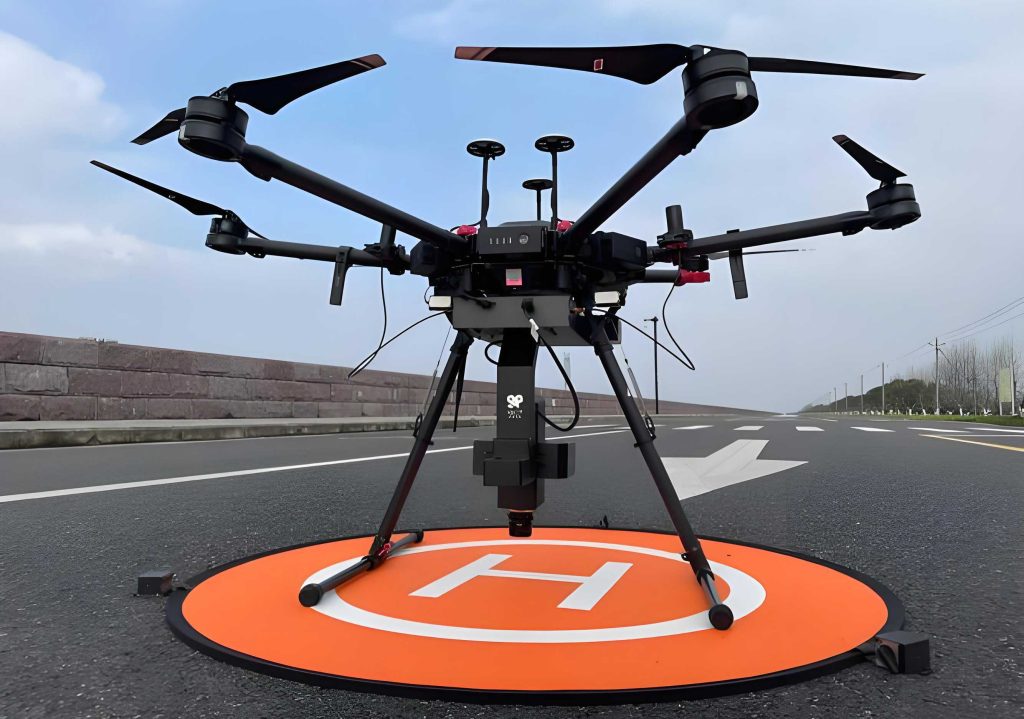
Influencing factors are the cornerstone of understanding China UAV drone combat effectiveness. Based on prior research, I categorize these factors into static and dynamic types. Static factors remain relatively constant during a mission, inherent to the China UAV drone design or external systems, while dynamic factors can be adjusted in real-time to adapt to battlefield conditions. This distinction is crucial for modeling and optimization. For China UAV drone systems, key factors include enemy radar detection probability, maximum detection range, flight duration, speed, cross-sectional area, weapon accuracy, antenna coverage, sensor frequency ranges, and information processing parameters. I summarize these in Table 1, highlighting their roles and categorization. Emphasizing China UAV drone applications, these factors collectively determine the likelihood of mission failure, which inversely reflects combat effectiveness. By analyzing them, I can identify which parameters most impact China UAV drone performance and how they interact.
| Factor | Symbol | Description | Type | Typical Range/Value |
|---|---|---|---|---|
| Enemy Radar Detection Probability | $$p_{D0}$$ | Probability of radar detecting the China UAV drone | Static | 0.05 (5%) |
| Maximum Detection Distance | $$R_0$$ | Radar’s maximum range in km | Static | 400 km |
| Reconnaissance Time | $$T$$ | Mission duration in minutes | Dynamic | [1, 10] min |
| Flight Speed | $$v$$ | China UAV drone speed in m/s | Dynamic | [856800, 1836000] m/s |
| Cross-sectional Area | $$A_P$$ | Target area in m² | Static | 2 m² |
| Weapon Circular Error Probability | $$\sigma_r$$ | Accuracy in meters | Static | 2 m |
| Azimuth Coverage | $$\theta_1$$ | Antenna azimuth in degrees | Dynamic | [250°, 320°] |
| Elevation Coverage | $$\theta_2$$ | Antenna elevation in degrees | Dynamic | [50°, 80°] |
| Detection Range | $$R_1$$ | China UAV drone sensor range in km | Dynamic | [200, 400] km |
| Frequency Coverage | $$f$$ | Sensor frequency in MHz | Static | 18 GHz |
| Instantaneous Bandwidth | $$\Delta f$$ | Bandwidth in MHz | Static | 18 GHz |
| Radar Carrier Frequency | $$f_r$$ | Enemy radar frequency in MHz | Static | 300 MHz |
| Radar Signal Bandwidth | $$\Delta f_r$$ | Radar bandwidth in MHz | Static | 5 MHz |
| Information Loss Probability | $$P_m$$ | Probability due to signal overlap | Static | 0.05 |
| Coincidence Probability | $$P_0$$ | Instantaneous coincidence probability | Static | 0.01 |
| Coincidence Period | $$T_0$$ | Period in minutes | Static | 5 min |
| Information Processing Failure Probability | $$q_I$$ | Probability of data processing failure | Static | 0.01 |
To model the evolution of China UAV drone combat effectiveness, I adopt a system fault evolution framework. This conceptual model comprises four elements: influencing factors, basic events, logical relationships, and evolution conditions. For a China UAV drone mission, factors lead to basic failure events, such as detection, destruction, coverage loss, or information interception failures. These events then propagate through logical connections—like AND or OR gates—to higher-level process events, ultimately resulting in mission failure. I abstract this process into a space fault network, a topological model where factors are circular nodes, events are rectangular nodes, and directed edges represent causal links. This network captures the dynamic interplay in China UAV drone operations, enabling a structured analysis. The network for a typical China UAV drone is depicted conceptually, with static and dynamic factors influencing basic events that cascade to mission failure. This abstraction is pivotal for deriving quantitative measures.
Within this network, I define the probability distributions for basic events. For a China UAV drone, these are derived from physical and operational principles. The probability of being detected, $$q_F$$, depends on radar parameters and flight dynamics:
$$ q_F = p_{D0} \left( \frac{R_0 – T \times v}{R_0} \right)^4 $$
Here, $$T$$ and $$v$$ are dynamic factors representing China UAV drone mission time and speed. The probability of being destroyed, $$q_J$$, relates to cross-sectional area and weapon accuracy:
$$ q_J = \frac{A_P}{2\pi\sigma_r^2 + A_P} $$
Spatial coverage failure probability, $$q_P$$, for the China UAV drone sensors is given by:
$$ q_P = 1 – \left( \frac{\theta_1}{360} \cdot \frac{4\pi R_1^3}{3} \right) \times \left( 1 – \frac{(1 – \sin\theta_2)^2 (2 + \sin\theta_2)}{2 \cdot \frac{4\pi R_0^3}{3}} \right) $$
Frequency coverage failure probability, $$q_D$$, depends on sensor and radar frequencies:
$$ q_D = 1 – \left( \frac{f – f_r}{f} \right) \left( \frac{\Delta f – \Delta f_r}{\Delta f} \right) $$
Information interception failure probability, $$q_H$$, involves timing and overlap factors:
$$ q_H = 1 – (1 – P_m) \left( 1 – (1 – P_0) e^{-\frac{T}{T_0}} \right) $$
Information processing failure probability, $$q_I$$, is assumed as a static value for simplicity. These formulas form the foundation for calculating overall mission failure probability for the China UAV drone.
The logical relationships combine these basic events. Let $$q_S$$ be the probability of survival failure (detection and destruction), and $$q_Z$$ be the probability of reconnaissance failure (any coverage or information failure). For the China UAV drone, these are:
$$ q_S = q_F \times q_J $$
$$ q_Z = 1 – (1 – q_P)(1 – q_D)(1 – q_H)(1 – q_I) $$
The overall mission failure probability, $$q_T$$, which inversely indicates China UAV drone combat effectiveness, is:
$$ q_T = 1 – (1 – q_S)(1 – q_Z) $$
Substituting the basic probabilities, I derive a comprehensive expression for $$q_T$$ as a function of dynamic factors: $$q_T(T, v, \theta_1, \theta_2, R_1)$$. This represents the combat failure probability distribution in a multidimensional space, specifically a Hilbert space $$H_6$$ with dimensions for $$T$$, $$v$$, $$\theta_1$$, $$\theta_2$$, $$R_1$$, and $$q_T$$. In this space, $$q_T$$ forms a continuous surface, capturing the evolution of China UAV drone effectiveness. I summarize the event probabilities and their dependencies in Table 2, emphasizing the China UAV drone context.
| Event | Symbol | Probability Formula | Description |
|---|---|---|---|
| Detection Failure | $$q_F$$ | $$q_F = p_{D0} \left( \frac{R_0 – T v}{R_0} \right)^4$$ | Probability of China UAV drone being detected by enemy radar |
| Destruction Failure | $$q_J$$ | $$q_J = \frac{A_P}{2\pi\sigma_r^2 + A_P}$$ | Probability of China UAV drone being destroyed upon detection |
| Spatial Coverage Failure | $$q_P$$ | $$q_P = 1 – \left( \frac{\theta_1}{360} \cdot \frac{4\pi R_1^3}{3} \right) \left( 1 – \frac{(1 – \sin\theta_2)^2 (2 + \sin\theta_2)}{2 \cdot \frac{4\pi R_0^3}{3}} \right)$$ | Probability of China UAV drone failing to cover required airspace |
| Frequency Coverage Failure | $$q_D$$ | $$q_D = 1 – \left( \frac{f – f_r}{f} \right) \left( \frac{\Delta f – \Delta f_r}{\Delta f} \right)$$ | Probability of China UAV drone sensor frequency mismatch |
| Information Interception Failure | $$q_H$$ | $$q_H = 1 – (1 – P_m) \left( 1 – (1 – P_0) e^{-T/T_0} \right)$$ | Probability of China UAV drone failing to intercept signals |
| Information Processing Failure | $$q_I$$ | Assumed constant (e.g., 0.01) | Probability of China UAV drone data processing error |
| Survival Failure | $$q_S$$ | $$q_S = q_F q_J$$ | Probability of China UAV drone being detected and destroyed |
| Reconnaissance Failure | $$q_Z$$ | $$q_Z = 1 – (1 – q_P)(1 – q_D)(1 – q_H)(1 – q_I)$$ | Probability of China UAV drone failing in reconnaissance tasks |
| Mission Failure | $$q_T$$ | $$q_T = 1 – (1 – q_S)(1 – q_Z)$$ | Overall probability of China UAV drone mission failure |
To analyze trends in China UAV drone combat effectiveness, I examine how changes in dynamic factors affect $$q_T$$. Since $$q_T(T, v, \theta_1, \theta_2, R_1)$$ is continuous in $$H_6$$, I compute partial derivatives to determine sensitivity. For instance, the trend with respect to reconnaissance time $$T$$ is:
$$ \frac{\partial q_T}{\partial T} = \frac{\partial}{\partial T} \left[ 1 – (1 – q_S)(1 – q_Z) \right] $$
Expanding this using the chain rule provides insights into how extending mission time influences China UAV drone failure risk. Similarly, derivatives for $$v$$, $$\theta_1$$, $$\theta_2$$, and $$R_1$$ reveal the impact of speed, antenna coverage, and sensor range. I present these trend functions in Table 3, which aids in optimizing China UAV drone parameters. For example, increasing $$v$$ might reduce detection probability but could affect coverage; the derivatives quantify these trade-offs. This trend analysis is crucial for real-time adjustments in China UAV drone operations, ensuring adaptability in dynamic combat environments.
| Dynamic Factor | Partial Derivative of $$q_T$$ | Interpretation for China UAV Drone |
|---|---|---|
| Reconnaissance Time ($$T$$) | $$\frac{\partial q_T}{\partial T} = (1 – q_Z) \frac{\partial q_S}{\partial T} + (1 – q_S) \frac{\partial q_Z}{\partial T}$$ | Increasing $$T$$ raises detection risk but may improve information interception for China UAV drone. |
| Flight Speed ($$v$$) | $$\frac{\partial q_T}{\partial v} = (1 – q_Z) \frac{\partial q_S}{\partial v}$$ | Higher $$v$$ reduces detection probability for China UAV drone, enhancing survivability. |
| Azimuth Coverage ($$\theta_1$$) | $$\frac{\partial q_T}{\partial \theta_1} = (1 – q_S) \frac{\partial q_Z}{\partial \theta_1}$$ | Expanding $$\theta_1$$ lowers spatial coverage failure, boosting China UAV drone reconnaissance. |
| Elevation Coverage ($$\theta_2$$) | $$\frac{\partial q_T}{\partial \theta_2} = (1 – q_S) \frac{\partial q_Z}{\partial \theta_2}$$ | Increasing $$\theta_2$$ improves vertical coverage, reducing failure for China UAV drone. |
| Sensor Range ($$R_1$$) | $$\frac{\partial q_T}{\partial R_1} = (1 – q_S) \frac{\partial q_Z}{\partial R_1}$$ | Larger $$R_1$$ extends detection capability, decreasing failure for China UAV drone. |
Determining the maximum combat effectiveness for a China UAV drone involves minimizing $$q_T$$ over the dynamic factor ranges. Since $$q_T$$ is a continuous function in $$H_6$$, I can use optimization techniques like enumeration or gradient-based methods. For practical purposes, I employ enumeration by discretizing the factor spaces. Define the value ranges and increments for China UAV drone parameters as in Table 4. The total enumeration count is the product of the number of steps for each factor, allowing a comprehensive search for the minimum $$q_T$$, which corresponds to maximum China UAV drone effectiveness.
| Dynamic Factor | Range | Increment ($$\Delta$$) | Number of Steps ($$\Lambda$$) |
|---|---|---|---|
| $$T$$ (min) | [1, 10] | 1 min | 10 |
| $$v$$ (m/s) | [856800, 1836000] | 0.06 km/s | 273 |
| $$\theta_1$$ (degrees) | [250°, 320°] | 5° | 15 |
| $$\theta_2$$ (degrees) | [50°, 80°] | 2° | 16 |
| $$R_1$$ (km) | [200, 400] | 10 km | 21 |
The enumeration process computes $$q_T$$ for each combination of $$x_T, x_v, x_{\theta_1}, x_{\theta_2}, x_{R_1}$$ within the discretized sets. The minimum $$q_T$$, denoted $$q_T^{\text{min}}$$, and the corresponding factor values $$[x_T^{\text{min}}, x_v^{\text{min}}, x_{\theta_1}^{\text{min}}, x_{\theta_2}^{\text{min}}, x_{R_1}^{\text{min}}]$$ define the optimal state for China UAV drone effectiveness. Formally, this is:
$$ q_T^{\text{min}} = \min_{x_T, x_v, x_{\theta_1}, x_{\theta_2}, x_{R_1}} q_T(x_T, x_v, x_{\theta_1}, x_{\theta_2}, x_{R_1}) $$
The optimal ranges around these values, such as $$T^{\text{min}} = [x_T^{\text{min}} – \Delta T, x_T^{\text{min}} + \Delta T]$$ intersected with the original range, indicate robust zones where China UAV drone performance remains near maximum. This approach ensures that the China UAV drone can operate effectively even with minor parameter variations.
To illustrate, I apply this methodology to a specific China UAV drone model with parameters as in Table 1. Substituting static values into $$q_T$$, I get the explicit function:
$$ q_T(T, v, \theta_1, \theta_2, R_1) = 1 – \left(1 – 0.05 \left( \frac{400 – T v}{400} \right)^4 \cdot \frac{2}{2\pi \cdot 2^2 + 2} \right) \times \left( \frac{\theta_1}{360} \cdot \frac{4\pi R_1^3}{3} \cdot \left( 1 – \frac{(1 – \sin\theta_2)^2 (2 + \sin\theta_2)}{2 \cdot \frac{4\pi \cdot 400^3}{3}} \right) \cdot \left( \frac{18000 – 300}{18000} \right) \left( \frac{18000 – 5}{18000} \right) \cdot (1 – 0.05) \left( 1 – (1 – 0.01) e^{-T/5} \right) (1 – 0.01) \right) $$
Simplifying, this reduces to:
$$ q_T(T, v, \theta_1, \theta_2, R_1) = 1 – \left(1 – 1.4452 \times 10^{-8} \left( \frac{1}{360} – \frac{1}{180} \cdot 0.5 \cdot (3.9063 \times 10^{-11}(400 – T v)^4) / (8\pi + 2) \right) \cdot \theta_1 R_1^3 \left( 1 – \frac{1}{2}(1 – \sin(\frac{\theta_2 \pi}{180}))^2 (2 + \sin(\frac{\theta_2 \pi}{180})) \right) (1 – 0.99 e^{-T/5}) \right) $$
Using enumeration over the steps in Table 4 (approximately 1.37592 × 10^7 combinations), I find the minimum $$q_T$$ for this China UAV drone. The result is $$q_T^{\text{min}} = 29.22\%$$, corresponding to maximum combat effectiveness of 70.78%. The optimal dynamic factor values are $$T^{\text{min}} = 10$$ min, $$v^{\text{min}} = 856800$$ m/s, $$\theta_1^{\text{min}} = 320°$$, $$\theta_2^{\text{min}} = 80°$$, and $$R_1^{\text{min}} = 400$$ km. The robust ranges are $$T^{\text{min}} = [9, 10]$$ min, $$v^{\text{min}} = [856800, 860400]$$ m/s, $$\theta_1^{\text{min}} = [315°, 320°]$$, $$\theta_2^{\text{min}} = [78°, 80°]$$, and $$R_1^{\text{min}} = [390, 400]$$ km. Operating the China UAV drone within these ranges ensures near-optimal performance, highlighting the practical utility of this analysis.
I further explore the implications for China UAV drone design and deployment. The trends indicate that increasing sensor range and antenna coverage significantly reduces failure probability, while flight speed must balance detection avoidance and mission duration. For China UAV drone swarms or coordinated operations, this methodology can be extended to multiple units, incorporating interdependencies. Additionally, the space fault network allows for adding new factors or events, such as electronic warfare effects or weather conditions, making it adaptable to evolving China UAV drone technologies. The continuous probability surface in $$H_6$$ enables advanced analytics, including Monte Carlo simulations or machine learning integrations, to predict China UAV drone effectiveness under uncertainty.
In conclusion, analyzing the evolution trends and maximum effectiveness states of China UAV drone combat efficiency is vital for modern military strategy. By modeling factors, events, and their interactions through system fault evolution and space fault networks, I derive a probabilistic framework that quantifies effectiveness and identifies optimal conditions. The methodology, demonstrated with a specific China UAV drone instance, shows how dynamic factors like time, speed, and coverage can be tuned to minimize failure probability, thereby maximizing effectiveness. This approach not only enhances China UAV drone mission planning but also informs design improvements and tactical adaptations. As China UAV drone capabilities advance, incorporating more sophisticated factors and network structures will further refine this analysis, ensuring that China UAV drone systems remain at the forefront of reconnaissance and combat operations. The integration of formulas, tables, and spatial concepts provides a robust foundation for ongoing research and application in China UAV drone development.
To summarize key formulas and values, I present Table 5, which encapsulates the core mathematical expressions for China UAV drone combat failure probability and optimization. This serves as a quick reference for practitioners and researchers working with China UAV drone technologies.
| Item | Formula | Description |
|---|---|---|
| Mission Failure Probability | $$q_T = 1 – (1 – q_S)(1 – q_Z)$$ | Overall probability of China UAV drone mission failure |
| Survival Failure Probability | $$q_S = q_F q_J$$ | Probability of China UAV drone being detected and destroyed |
| Reconnaissance Failure Probability | $$q_Z = 1 – (1 – q_P)(1 – q_D)(1 – q_H)(1 – q_I)$$ | Probability of China UAV drone failing in reconnaissance tasks |
| Optimal Minimum Failure Probability | $$q_T^{\text{min}} = 29.22\%$$ | Minimum failure probability for the example China UAV drone |
| Maximum Combat Effectiveness | $$1 – q_T^{\text{min}} = 70.78\%$$ | Maximum effectiveness for the example China UAV drone |
| Optimal Dynamic Factor Values | $$[T^{\text{min}}, v^{\text{min}}, \theta_1^{\text{min}}, \theta_2^{\text{min}}, R_1^{\text{min}}] = [10, 856800, 320, 80, 400]$$ | Values yielding maximum effectiveness for China UAV drone |
This comprehensive analysis underscores the importance of a systematic approach to China UAV drone combat effectiveness. By leveraging mathematical models and computational techniques, I can unlock insights that drive innovation and efficiency in China UAV drone operations. Future work may involve real-time monitoring and adaptive control systems for China UAV drone fleets, integrating the trends and optimal states identified here. As the landscape of warfare evolves, so too will the methodologies for ensuring China UAV drone supremacy, with this framework providing a solid foundation for ongoing advancements.