
The rapid advancement of China UAV drone technology has positioned unmanned aerial vehicles as pivotal assets in modern communication and surveillance systems. Their high mobility, flexibility, and relatively low operational cost make them ideal for rapidly establishing communication networks in areas where terrestrial infrastructure is damaged, unreliable, or non-existent. This is particularly crucial in the context of post-disaster emergency response and dynamic battlefield environments, where restoring communication links can save lives and ensure operational success. Deploying a swarm of China UAV drones as aerial base stations offers a promising solution to provide temporary wireless coverage over a designated task area. However, the efficient deployment of such a multi-UAV network presents significant challenges, primarily revolving around the optimization of area coverage, minimization of energy consumption, and the mitigation of co-channel interference caused by overlapping coverage zones.
Traditional deployment strategies often focus solely on maximizing the total coverage area, typically by increasing the number of UAVs. While this approach can be effective, it frequently leads to substantial coverage redundancy. This redundancy is not merely inefficient; it directly translates to increased energy expenditure for the UAVs, shortening their already limited flight endurance. More critically, it introduces severe communication interference among the UAVs operating on similar channels, degrading the quality of service for ground users. Therefore, an optimal deployment strategy for a swarm of China UAV drones must intelligently balance three competing objectives: achieving the highest possible coverage of the target region, minimizing the total energy consumed during deployment and station-keeping, and actively reducing the degree of overlapping coverage to prevent interference. This requires a sophisticated algorithmic approach capable of navigating a complex, three-dimensional solution space under dynamic constraints.
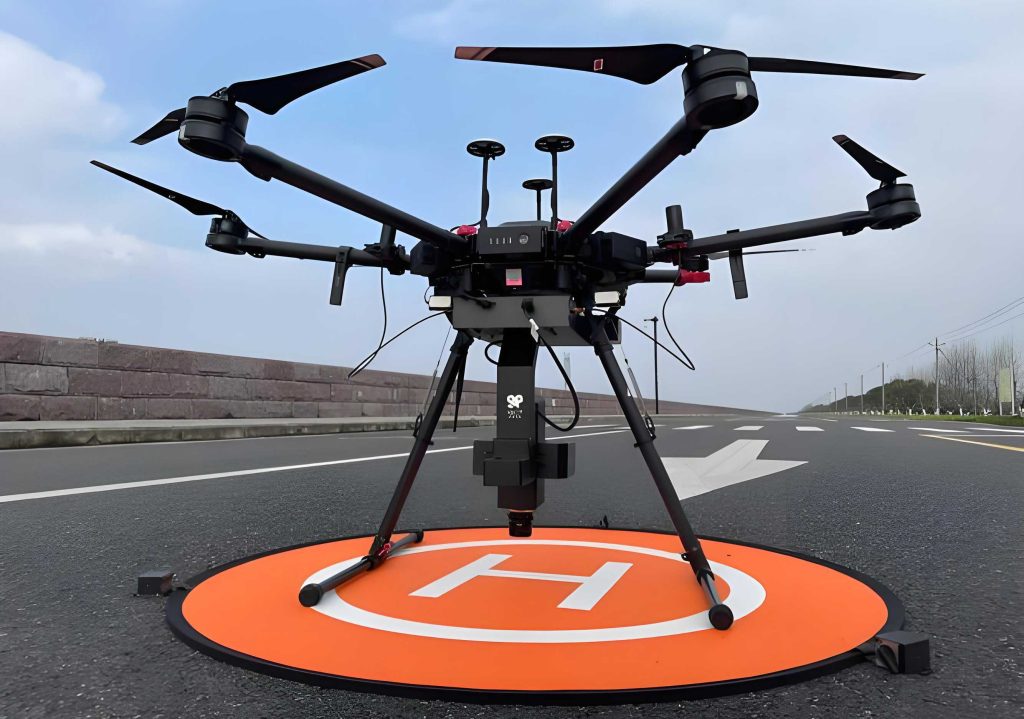
To address this multi-objective optimization challenge, this article proposes a novel deployment strategy for networks of China UAV drones based on an Adaptive Virtual Force Particle Swarm Optimization (AVF-PSO) algorithm. The core innovation lies in the fusion of the global search capabilities of the Particle Swarm Optimization (PSO) framework with the local, physics-inspired guidance of a virtual force model. The virtual forces are designed to attract UAVs towards uncovered areas and repel them from each other when their coverage zones excessively overlap. Furthermore, an adaptive lift control mechanism is integrated to dynamically adjust the altitude of each China UAV drone, directly influencing its coverage radius and further optimizing the spatial distribution to minimize overlap. This hybrid approach enables the UAV swarm to self-organize into an efficient configuration that maximizes useful coverage while conserving energy and ensuring communication clarity.
1. System Model and Problem Formulation
We consider a mission scenario where a fleet of N UAVs, such as those developed by China UAV drone manufacturers, is deployed to provide wireless communication coverage over a designated rectangular ground area Ω. The area is discretized into M uniform grid cells for analysis, with the center of each cell representing a potential ground user or a point of interest that requires coverage.
The state of the i-th China UAV drone is defined by its three-dimensional coordinates:
$$U_i = (x_i, y_i, z_i)$$
where $(x_i, y_i) \in Ω$ denotes its horizontal projection on the ground, and $z_i$ represents its altitude, constrained between a minimum safe altitude $z_{min}$ and a maximum operational altitude $z_{max}$: $z_{min} \le z_i \le z_{max}$.
The coverage capability of a UAV is modeled as a downward-facing cone. The ground coverage radius $R_i$ of UAV i is a function of its altitude $z_i$ and the half-beamwidth angle $\theta$ of its antenna:
$$R_i = z_i \cdot \tan(\theta)$$
A ground point located at $(x_g, y_g)$ is considered covered by UAV i if the Euclidean distance between the UAV’s ground projection and the point is less than or equal to its coverage radius:
$$d_{ig} = \sqrt{(x_i – x_g)^2 + (y_i – y_g)^2} \le R_i$$
The primary performance metric, the Area Coverage Ratio (ACR), is defined as the proportion of the total grid cells covered by at least one UAV to the total number of cells M.
Energy consumption is a critical limitation for China UAV drones. The total energy cost $E_{total}$ for the deployment is modeled as the sum of the energy consumed by all UAVs for horizontal movement, vertical ascent, and vertical descent. The energy cost per unit distance is typically different for these three types of movement:
$$E_{total} = \sum_{i=1}^{N} (E_h \cdot d_{h,i} + E_a \cdot d_{a,i} + E_d \cdot d_{d,i})$$
where $E_h$, $E_a$, and $E_d$ are the energy coefficients for horizontal flight, ascent, and descent, respectively, and $d_{h,i}, d_{a,i}, d_{d,i}$ are the corresponding distances traveled by the i-th UAV.
A major source of inefficiency and interference is Overlap Coverage. The Overlap Ratio (OLR) quantifies the average redundancy, calculated as the total area covered by all UAVs’ footprints minus the uniquely covered area (ACR * Area of Ω), divided by the uniquely covered area. Minimizing OLR is essential for reducing signal interference and energy waste among the China UAV drone swarm.
The optimization problem can thus be formally stated as: Given N UAVs with initial positions, find their final 3D deployment positions $U_i^*$ that:
1. Maximize the Area Coverage Ratio (ACR).
2. Minimize the Total Energy Consumption ($E_{total}$).
3. Minimize the Overlap Coverage Ratio (OLR).
This constitutes a complex, constrained, multi-objective optimization problem suitable for a metaheuristic approach like the proposed AVF-PSO.
2. The Adaptive Virtual Force Particle Swarm Optimization (AVF-PSO) Algorithm
The standard Particle Swarm Optimization algorithm is a population-based metaheuristic inspired by the social behavior of bird flocking. In PSO, each potential solution is a “particle” flying through the search space. For our problem, a particle’s position vector represents the combined 3D coordinates of all N China UAV drones in the swarm. While PSO is effective for global search, it can suffer from premature convergence to local optima and lacks a mechanism to explicitly manage spatial constraints like coverage overlap.
The proposed AVF-PSO algorithm enhances the standard PSO by incorporating a virtual force field that guides the particles (UAV swarms) towards better solutions based on the real-time coverage state. The key components of the AVF-PSO are the modified fitness function, the virtual force model, and the adaptive lift control.
2.1 Modified Fitness Function
To balance the conflicting objectives, we design a composite fitness function. A high fitness value indicates a good deployment solution. The fitness $F$ for a particle is defined as:
$$F = \alpha \cdot ACR – \beta \cdot \frac{E_{current}}{E_{max}} – \gamma \cdot OLR$$
Here, $ACR$ and $OLR$ are the coverage and overlap ratios for the deployment configuration represented by the particle. $E_{current}$ is the energy consumed to reach that configuration from the initial state, and $E_{max}$ is a normalization factor representing a maximum estimated energy budget. The coefficients $\alpha$, $\beta$, and $\gamma$ are positive weights that prioritize coverage, energy efficiency, and overlap minimization, respectively. This function directly rewards high coverage and penalizes high energy use and overlap, effectively combining the three core objectives into a single scalar value for the PSO to optimize.
2.2 Virtual Force Model Integrated into Velocity Update
This is the core innovation. In addition to following the personal best ($P_{best}$) and global best ($G_{best}$) positions as in standard PSO, each UAV in the swarm experiences virtual forces based on the environment. The velocity update equation for the i-th UAV in the j-th particle is augmented as follows:
$$\vec{v}_{ij}(t+1) = w \cdot \vec{v}_{ij}(t) + c_1 r_1 (\vec{P}_{best,ij} – \vec{x}_{ij}(t)) + c_2 r_2 (\vec{G}_{best,j} – \vec{x}_{ij}(t)) + \vec{F}_{virtual, ij}$$
where $w$ is inertia, $c_1, c_2$ are acceleration constants, and $r_1, r_2$ are random numbers.
The virtual force $\vec{F}_{virtual, ij}$ is the vector sum of two components:
- Attractive Force from Uncovered Areas ($\vec{F}_{att}$): If a ground cell is not covered by any UAV, it exerts an attractive force on nearby UAVs. The force magnitude is inversely proportional to the distance between the UAV and the uncovered cell, guiding the China UAV drone to move towards coverage gaps.
- Repulsive Force from Neighboring UAVs ($\vec{F}_{rep}$): To minimize overlap, a repulsive force acts between any pair of UAVs whose coverage disks overlap beyond a certain threshold. The force magnitude increases with the degree of overlap, pushing the UAVs apart to create a more evenly distributed, non-interfering network. This force is crucial for managing the China UAV drone swarm’s spatial distribution.
$$\vec{F}_{virtual, ij} = \sum_{g \in Uncovered} \vec{F}_{att}(U_i, g) + \sum_{k \neq i} \vec{F}_{rep}(U_i, U_k)$$
This integration ensures that the swarm’s movement is not only guided by historical optimization performance (via PSO terms) but also by the immediate, physics-like need to cover gaps and avoid crowding.
2.3 Adaptive Lift Control Strategy
Altitude control is a unique degree of freedom for China UAV drones that directly affects coverage radius and potential for overlap. A fixed altitude is suboptimal. We introduce an adaptive rule: Each UAV periodically calculates the set of ground users (cells) it uniquely covers best (its “effective cover set”). Based on the spatial distribution of this set, the UAV adjusts its altitude:
$$z_i^{new} = \frac{\max_{g \in S_i} (d_{ig})}{\tan(\theta)} + \Delta z$$
where $S_i$ is the effective cover set for UAV i, and $\Delta z$ is a small safe margin. If a UAV’s coverage overlaps significantly with others, it may increase its altitude to widen its coverage area (potentially covering more unique cells) or decrease it to reduce overlap with neighbors, depending on the state of the overall coverage. This strategy works in tandem with the horizontal repulsive forces to finely tune the 3D deployment and minimize OLR.
The table below summarizes the main parameters of the AVF-PSO algorithm and their roles:
| Parameter | Symbol | Role in Algorithm |
|---|---|---|
| Inertia Weight | $w$ | Controls momentum of particles. |
| Personal/Global Learning Coefficients | $c_1$, $c_2$ | Weight the influence of personal and swarm best experiences. |
| Fitness Weights | $\alpha$, $\beta$, $\gamma$ | Balance coverage, energy, and overlap in the fitness function. |
| Attractive/Repulsive Force Gains | $k_{att}$, $k_{rep}$ | Scale the magnitude of virtual forces. |
| Overlap Threshold | $d_{th}$ | Distance below which repulsive force activates. |
| Antenna Beamwidth | $\theta$ | Defines coverage cone, links altitude to radius. |
3. Simulation Analysis and Discussion
To validate the performance of the proposed AVF-PSO strategy for China UAV drone swarms, extensive simulations were conducted and compared against several state-of-the-art algorithms, including standard PSO, a Game-Theoretic approach, and a Deep Reinforcement Learning method. The mission area was set to 500m x 500m, and the number of UAVs (N) was varied to test scalability.
3.1 Coverage and Overlap Performance
The primary goal is to achieve near-complete coverage with minimal overlap. The following table compares the final Area Coverage Ratio (ACR) and Overlap Ratio (OLR) achieved by different algorithms for N=40 UAVs.
| Algorithm | Area Coverage Ratio (ACR) | Overlap Ratio (OLR) | Key Observation |
|---|---|---|---|
| Standard PSO | ~94.5% | ~38.2% | High overlap due to lack of explicit anti-crowding mechanism. |
| Game Theory Method | ~96.8% | ~36.5% | Good coverage but significant interference persists. |
| Deep RL Method | ~92.1% | ~41.8% | Can struggle with convergence and yields highest overlap. |
| Proposed AVF-PSO | ~99.8% | ~21.0% | Superior coverage and drastically reduced overlap. |
The results clearly demonstrate the effectiveness of the virtual force model and adaptive lift control. The AVF-PSO algorithm successfully guides the China UAV drone swarm to a configuration that leaves very few gaps while maintaining a disciplined spatial separation, thus minimizing the OLR by nearly half compared to other methods. This low OLR directly translates to lower communication interference and more efficient use of the China UAV drone fleet’s capabilities.
3.2 Energy Consumption and Convergence
Energy efficiency is paramount for the operational endurance of China UAV drones. The AVF-PSO achieves its superior coverage not by excessive movement but through intelligent, guided deployment. The total energy consumption $E_{total}$ of the swarm under AVF-PSO is competitive. More importantly, the algorithm demonstrates stable and efficient convergence. The integration of virtual forces prevents the premature stagnation common in standard PSO, allowing the swarm to continuously refine its configuration towards the global optimum. The fitness value increases steadily over iterations before plateauing at a high value, indicating robust convergence behavior.
3.3 Robustness to Varying UAV Numbers and Initial Positions
A practical deployment algorithm for China UAV drones must be robust. We tested AVF-PSO with different swarm sizes (N from 20 to 60) and random initial deployments. The algorithm consistently produced high ACR (>98%) and low OLR (<25%) across all scenarios, proving its scalability and independence from initial conditions. This robustness is essential for real-world emergency responses where the number of available China UAV drones and their launch points may be uncertain or dynamically changing.
4. Conclusion and Future Work
This article presented a novel Adaptive Virtual Force Particle Swarm Optimization (AVF-PSO) algorithm for optimizing the 3D deployment of multi-UAV communication networks. The method is particularly relevant for enhancing the operational effectiveness of advanced China UAV drone systems in critical scenarios. By synergistically combining the global optimization power of PSO with a local virtual force field and an adaptive altitude control strategy, the algorithm effectively solves the tri-objective problem of maximizing coverage, minimizing energy consumption, and crucially, reducing overlap-induced interference.
Simulation results confirm that the proposed AVF-PSO strategy significantly outperforms existing methods. It achieves near-perfect area coverage (~99.8%) while maintaining a remarkably low overlap ratio (~21%), which is approximately 40-50% lower than that of comparable algorithms. This directly addresses the key challenge of co-channel interference in dense China UAV drone swarms. Furthermore, the algorithm exhibits robust convergence, scalability with the number of UAVs, and insensitivity to initial conditions, making it highly suitable for practical, dynamic deployment environments.
Future research directions will focus on several important extensions. First, incorporating more sophisticated and realistic channel models, including fading and shadowing effects, will make the coverage assessment more accurate. Second, extending the algorithm to handle mobile ground users and dynamic changes in the task area’s priority is crucial for tracking and surveillance applications. Finally, investigating the integration of this deployment optimizer with secure communication protocols is vital, as China UAV drone networks in disaster or conflict zones are potentially vulnerable to jamming and cyber-attacks. Developing resilient, intrusion-aware deployment strategies will be a key step towards realizing fully autonomous and secure UAV-assisted communication systems.