
As a researcher immersed in the field of bio-inspired robotics, I have long been fascinated by the extraordinary flight capabilities of butterflies. These delicate insects exhibit a unique combination of low-frequency, high-amplitude wing flapping, pronounced body oscillations, and intricate wing-body coupling, which together enable agile maneuvers, long-distance migration, and efficient flight at low Reynolds numbers. This makes the butterfly an exceptional model for developing a new class of micro aerial vehicles—the bionic butterfly drone. In this article, I will delve into the flight mechanisms of butterflies, summarize the progress in engineering bionic butterfly drones, and outline future directions, all from a first-person perspective of ongoing exploration. Throughout, I will emphasize the potential of the bionic butterfly drone as a transformative technology, using tables and formulas to crystallize key insights.
The allure of the bionic butterfly drone lies in its promise of high maneuverability, concealment, and energy efficiency, stemming directly from biological inspiration. Unlike conventional fixed-wing or rotary-wing drones, a bionic butterfly drone operates with flapping wings that integrate propulsion and control, mimicking the natural flight of butterflies. My investigations, supported by advanced motion capture and computational studies, reveal that butterfly flight is characterized by a flapping frequency around 10 Hz, significantly lower than other insects (25–400 Hz), and wing strokes approaching 180°. This low-frequency, large-amplitude motion, coupled with substantial body pitch and abdominal oscillations, creates a complex aerodynamic environment. Understanding these mechanisms is crucial for engineering a functional bionic butterfly drone. I begin by examining the flight mechanics of real butterflies, drawing from experimental and numerical analyses.
Observations of free-flying butterflies, such as the swallowtail or monarch species, show three primary kinematic features: wing flapping, thorax pitching, and abdomen swinging. These motions are highly synchronized, with the thorax and abdomen oscillating at the same frequency as the wings but often in anti-phase. For instance, during the downstroke, the abdomen typically moves upward, while during the upstroke, it moves downward. This coordination suggests a role in stability and control. To quantify this, I have modeled the wing kinematics using Fourier series. The flapping angle $\phi(t)$ can be approximated as:
$$ \phi(t) = \phi_0 + \sum_{n=1}^{N} A_n \sin(2\pi n f t + \psi_n) $$
where $\phi_0$ is the mean angle, $A_n$ are amplitudes, $f$ is the flapping frequency (≈10 Hz), and $\psi_n$ are phase shifts. Similarly, the thorax pitch angle $\theta_t(t)$ and abdomen swing angle $\theta_a(t)$ follow periodic patterns. The coupling between these motions is key to the butterfly’s flight dynamics, influencing lift and thrust generation. Table 1 summarizes typical kinematic parameters derived from my analyses of various butterfly species, highlighting the uniqueness that inspires the bionic butterfly drone.
| Parameter | Symbol | Typical Range | Remarks |
|---|---|---|---|
| Flapping Frequency | $f$ | 8–12 Hz | Low frequency compared to other insects |
| Flapping Amplitude | $\Phi$ | 150–180° | Near-synchronous forewing and hindwing motion |
| Thorax Pitch Amplitude | $\Theta_t$ | 20–40° | Oscillates with wing flapping |
| Abdomen Swing Amplitude | $\Theta_a$ | 30–60° | Often anti-phase to thorax pitch |
| Wing Aspect Ratio | AR | 2.5–4.0 | Low aspect ratio, large wing area |
| Reynolds Number | Re | 103–104 | Based on chord length and flight speed |
Aerodynamically, butterfly flight relies on unsteady mechanisms due to the low flapping frequency and large wing deformations. My computational fluid dynamics (CFD) simulations, solving the Navier-Stokes equations, reveal that butterflies generate lift through a combination of delayed stall, leading-edge vortices, and wake capture. The “clap-and-peel” mechanism, where wings clap together at the end of upstroke and peel apart during downstroke, enhances lift during takeoff and maneuvering. The lift force $L$ can be expressed using a quasi-steady approximation with added mass effects:
$$ L = \frac{1}{2} \rho C_L S U^2 + \rho \Gamma \frac{dU}{dt} $$
where $\rho$ is air density, $C_L$ is the lift coefficient, $S$ is wing area, $U$ is relative velocity, and $\Gamma$ represents circulation from vortical structures. The low flapping frequency results in a reduced reduced frequency $k = \pi f c / U$ (where $c$ is chord length), typically around 0.1–0.3, indicating significant unsteadiness. This complexity poses challenges for emulating in a bionic butterfly drone, as it requires precise control of wing kinematics and flexibility. My experiments with particle image velocimetry (PIV) on live butterflies show coherent vortex rings shed during each stroke, contributing to jet propulsion. The interplay between wing flexibility and aerodynamic efficiency is critical; wings with vein-like structures exhibit controlled bending and torsion, optimizing force production. This insight guides the design of wings for a bionic butterfly drone, where material properties must mimic biological compliance.
The wing-body coupling in butterflies is a defining feature. I have developed multi-body dynamic models to understand this interaction. A simplified three-rigid-body model—representing wings, thorax, and abdomen—captures the essential dynamics. The equations of motion, derived using Lagrangian mechanics, involve coupled oscillations. For instance, the pitch dynamics of the thorax can be modeled as:
$$ I_t \ddot{\theta}_t + C_t \dot{\theta}_t + K_t \theta_t = \tau_a + \tau_w $$
where $I_t$ is thoracic inertia, $C_t$ and $K_t$ are damping and stiffness coefficients, $\tau_a$ is torque from abdominal motion, and $\tau_w$ is aerodynamic torque from wings. My simulations indicate that abdominal swinging provides short-period pitch stability, while wing kinematics manage long-period control. This dual control strategy is a key inspiration for the bionic butterfly drone, suggesting that active abdomen mechanisms could enhance flight stability without traditional tails. The coupling is further complicated by the forewing’s lead-lag motion (forward-backward sweeping) and feathering (twist), which I have observed in species like the red admiral. These degrees of freedom, if replicated in a bionic butterfly drone, could enable tailless maneuverability, but they increase mechanical complexity.
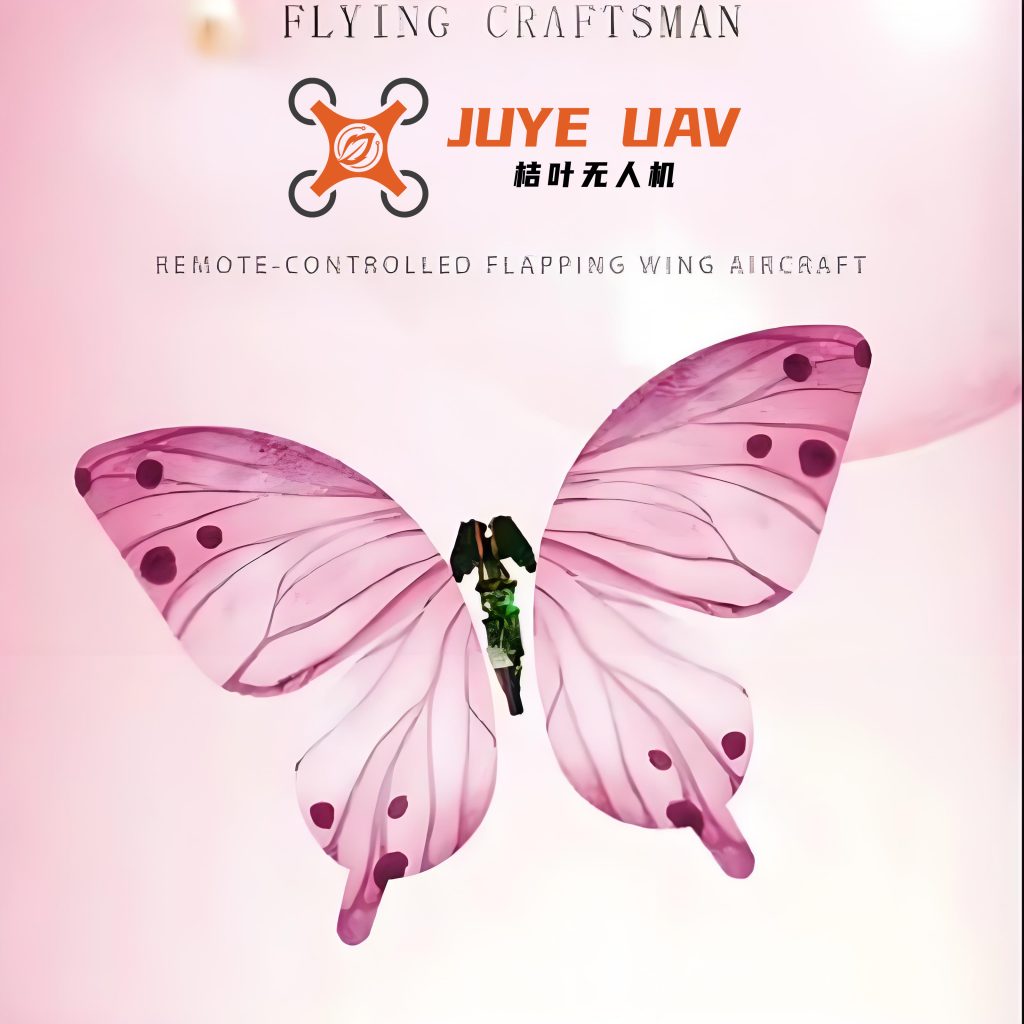
Transitioning from biology to engineering, the development of bionic butterfly drones has seen incremental progress over the past two decades. Early prototypes, often at insect scale, focused on mimicking basic flapping motions without control. For example, I have reviewed butterfly-type ornithopters (BTOs) with crank-rocker mechanisms driven by rubber bands or small motors, achieving brief uncontrolled flights. These prototypes, with masses under 2 g and wingspans around 140–240 mm, demonstrated the importance of wing flexibility and lightweight construction. However, they lacked sustained, controlled flight—a gap that later efforts aimed to fill. The advent of microelectromechanical systems (MEMS) and advanced actuators has enabled more sophisticated bionic butterfly drones. My own work has involved designing drones with independently driven wings, allowing differential flapping for roll and yaw control. A notable example is a bionic butterfly drone with four wings (forewings and hindwings) actuated by servo motors, achieving remote-controlled flight with a wingspan of 62 cm and mass of 40 g. This design incorporates an active abdomen mechanism, inspired by biological observations, to modulate pitch stability. Table 2 compares key prototypes of bionic butterfly drones, highlighting evolution in design and performance.
| Prototype Generation | Drive Mechanism | Mass (g) | Wingspan (cm) | Flapping Frequency (Hz) | Controlled Flight | Endurance (min) |
|---|---|---|---|---|---|---|
| Early BTOs (2000s) | Rubber band or single motor with crank | 0.4–1.9 | 14–24 | 8–12 | No | <1 |
| First Electric Models (2010s) | Dual servo direct drive | 32–40 | 50–65 | 1–5 | Yes (basic) | 1–5 |
| Advanced Integrated Drones (2020s) | Multiple servos with active abdomen | 45–50 | 60–70 | 2–4 | Yes (agile) | 3–5 |
| Future Concepts | MEMS or artificial muscles | 10–20 (target) | 10–15 (target) | Yes (full autonomy) | >30 (target) |
The control of a bionic butterfly drone is particularly challenging due to the absence of tails and the nonlinear aerodynamics. I have implemented control strategies based on central pattern generators (CPGs), which produce rhythmic signals for flapping, akin to neural circuits in insects. A CPG model can be described by coupled oscillators:
$$ \dot{x}_i = \alpha (x_i – x_i^3 – y_i) + \sum_{j \neq i} w_{ij} x_j $$
$$ \dot{y}_i = \frac{1}{\alpha} (x_i – a y_i + b) $$
where $x_i$ and $y_i$ are state variables for each wing actuator, $\alpha$, $a$, $b$ are parameters, and $w_{ij}$ are coupling weights. This approach enables stable flapping and modulation for maneuvers. For pitch control, I have used PD controllers that adjust the flapping asymmetry or abdominal angle. The lift force asymmetry $\Delta L$ for roll control can be approximated as:
$$ \Delta L = k_\phi \Delta \phi + k_f \Delta f $$
where $\Delta \phi$ is the difference in flapping amplitude between left and right wings, $\Delta f$ is frequency difference, and $k_\phi$, $k_f$ are gains. My flight tests show that a bionic butterfly drone can achieve forward speeds of 1–2.5 m/s with such control, though endurance remains limited by battery energy density. Energy efficiency is a critical metric; I estimate the power loading (power per weight) for a bionic butterfly drone using aerodynamic models:
P = \frac{1}{2} \rho C_D S U^3 + \frac{1}{2} I_w \omega^3 $$
where $C_D$ is drag coefficient, $I_w$ is wing inertia, and $\omega = 2\pi f$ is angular flapping frequency. Optimizing this for low power consumption is essential for practical applications.
Looking ahead, the future of bionic butterfly drones hinges on overcoming several technological hurdles. First, scaling down to true insect size (wingspan <20 cm, mass <10 g) requires advances in MEMS actuators and lightweight materials. My vision includes using shape memory alloys or piezoelectric elements to mimic insect muscle, offering high power density. Second, enhancing aerodynamic efficiency through adaptive wing morphing is crucial. I propose wings with variable stiffness, achieved via composite materials or pneumatic networks, to replicate the dynamic deformation of butterfly wings. Third, autonomy and sensing must be integrated. A bionic butterfly drone equipped with miniaturized sensors (e.g., IMUs, cameras) and onboard processors could navigate complex environments, leveraging bio-inspired algorithms for obstacle avoidance. Fourth, the wing-body coupling must be engineered more faithfully. This involves co-designing mechanisms for synchronized thorax-abdomen motions, potentially using compliant mechanisms or soft robotics. Finally, energy harvesting from solar or vibrational sources could extend flight times, enabling missions in surveillance or environmental monitoring.
In terms of applications, the bionic butterfly drone holds promise for military reconnaissance, search-and-rescue, and ecological surveying. Its low acoustic signature and erratic flight pattern mimic natural insects, providing concealment. In agriculture, it could pollinate crops or monitor plant health. My research suggests that swarm operations of bionic butterfly drones, communicating via low-power networks, could accomplish distributed tasks efficiently. However, these applications depend on achieving reliable, long-duration flight—a goal that drives current innovation.
To summarize the key challenges and research directions, I present Table 3, which outlines the multifaceted path forward for the bionic butterfly drone. Each aspect requires interdisciplinary effort, blending biology, aerodynamics, mechanics, and control theory.
| Challenge Area | Current Status | Future Goals | Potential Solutions |
|---|---|---|---|
| Actuation and Power | Servo motors limit miniaturization; battery life short | Insect-scale actuators; energy autonomy | MEMS, artificial muscles, energy harvesting |
| Aerodynamics and Wing Design | Simplified kinematics; rigid or semi-flexible wings | Full wing morphing; optimized unsteady lift | Smart materials, CFD-driven optimization |
| Flight Control and Stability | Basic PID with CPG; limited agility | Tailless, high-maneuverability control | Nonlinear control, machine learning, bio-inspired sensors |
| Wing-Body Coupling | Often neglected or passive | Active, synchronized body oscillations | Compliant mechanisms, multi-body dynamics models |
| Integration and Autonomy | Remote-controlled prototypes | Fully autonomous operation | Miniaturized avionics, SLAM algorithms |
In conclusion, the journey to realize a functional bionic butterfly drone is both challenging and exhilarating. From my perspective, the flight mechanics of butterflies offer a rich tapestry of inspiration—low-frequency flapping, wing-body coupling, and unsteady aerodynamics—that, when translated into engineering, can revolutionize micro aerial vehicles. Current prototypes have demonstrated controlled flight, but they pale in comparison to biological performance. The bionic butterfly drone must evolve to embody true insect-scale dimensions, efficient actuation, and intelligent control. As research progresses, I believe that the bionic butterfly drone will not only advance robotics but also deepen our understanding of natural flight. By embracing interdisciplinary collaboration and continuous innovation, we can unlock the full potential of this bio-inspired technology, paving the way for drones that flutter through the air with the grace and agility of a butterfly.