
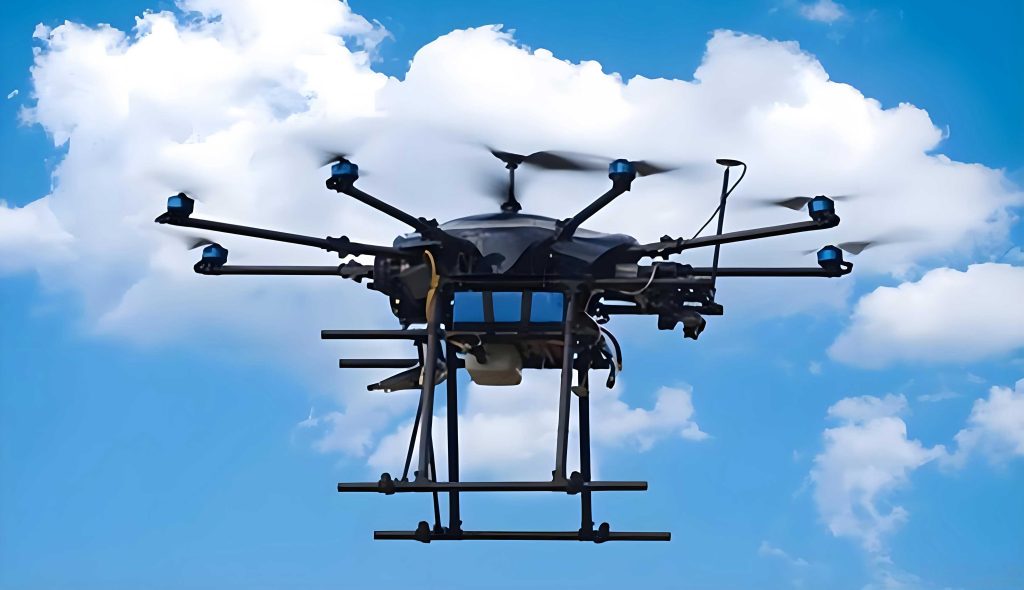
In the era of the Internet of Things (IoT) and proliferating mobile devices, the demand for real-time processing of computation-intensive tasks has escalated dramatically. Traditional cloud computing paradigms, which rely on remote data centers, often introduce significant latency and energy consumption due to long-distance data transmission. To address these challenges, Mobile Edge Computing (MEC) has emerged as a pivotal technology, bringing computation, storage, and network resources closer to data sources. This approach reduces transmission delays, alleviates core network load, and supports high-real-time applications. Among the various platforms for MEC, unmanned aerial vehicles (UAV drones) have gained considerable attention due to their mobility, flexibility, and ability to establish Line-of-Sight (LoS) communication links. UAV drones can serve as aerial edge servers, providing on-demand computing services to ground users in dynamic environments.
However, in multi-UAV-assisted MEC scenarios, several critical challenges arise. The complex three-dimensional (3D) environments, often cluttered with obstacles such as buildings or terrain features, can obstruct communication links and impede UAV drone navigation. Moreover, the joint optimization of user task offloading decisions and UAV drone 3D trajectories involves a mixed discrete-continuous action space with strong decision coupling. The discrete nature of offloading choices (e.g., local execution or offloading to a specific UAV drone) and the continuous control of UAV drone movements must be co-optimized to minimize system-wide latency and energy consumption. Existing approaches often tackle these aspects separately or assume simplified environments, neglecting the intricate interplay between obstacle avoidance, communication quality, and computational efficiency. Therefore, there is a pressing need for an integrated framework that can adaptively coordinate heterogeneous agents—ground users and UAV drones—in dynamic settings.
In this paper, we propose a novel co-optimization framework leveraging heterogeneous multi-agent reinforcement learning (MARL) to address these challenges. Our primary objective is to minimize the weighted sum of the system’s maximum task completion latency and total energy consumption by jointly optimizing user offloading decisions and UAV drone 3D trajectories. To handle the mixed action space and credit assignment issues in multi-agent systems, we design a dedicated algorithm named UOUM (User Offloading and UAV Mobility Co-optimization). This algorithm incorporates a differential reward mechanism to quantify individual agents’ marginal contributions and integrates an artificial potential field (APF) as a differentiable constraint for safe obstacle avoidance. Through extensive simulations, we demonstrate that our approach outperforms baseline methods in terms of convergence, latency reduction, energy efficiency, and adaptability to varying environmental conditions.
The remainder of this paper is structured as follows. We first present the system model, detailing the task offloading framework, UAV drone mobility model, obstacle avoidance constraints, communication and computation models, and the formulation of the optimization problem. Next, we describe our heterogeneous MARL solution, including the design of the multi-agent Markov decision process (MDP), state and action spaces, reward functions, and the UOUM algorithm architecture. We then provide a comprehensive simulation analysis to validate the performance of our approach under different scenarios. Finally, we conclude with a summary of contributions and directions for future research.
System Model
We consider a multi-UAV-assisted MEC system operating in a 3D space with static and dynamic obstacles. The system comprises a set of ground users, denoted as $\mathcal{N} = \{1, 2, \ldots, N\}$, and a fleet of UAV drones, denoted as $\mathcal{M} = \{1, 2, \ldots, M\}$. The system operates over discrete time slots indexed by $t \in \mathcal{T} = \{1, 2, \ldots, T\}$, each with duration $\tau$. Each user generates computational tasks that can be executed locally or offloaded to one of the UAV drones. The UAV drones provide edge computing services while navigating through the environment to maintain communication links and avoid obstacles.
Task Offloading Model
At time slot $t$, user $n \in \mathcal{N}$ generates a computational task characterized by a tuple $(D_n^t, C_n^t)$, where $D_n^t$ is the data size (in bits) and $C_n^t$ is the number of CPU cycles required per bit. The offloading decision for user $n$ is represented by a binary vector $\boldsymbol{\alpha}_n(t) = [\alpha_n^0(t), \alpha_n^1(t), \ldots, \alpha_n^M(t)]$, where $\alpha_n^m(t) \in \{0, 1\}$. Here, $\alpha_n^0(t) = 1$ indicates local execution, and $\alpha_n^m(t) = 1$ for $m \in \mathcal{M}$ indicates offloading to UAV drone $m$. To ensure each task is processed uniquely, the following constraint must hold:
$$\sum_{m=0}^{M} \alpha_n^m(t) = 1, \quad \forall n \in \mathcal{N}, \forall t.$$
The total task processing time for user $n$ at time $t$ is given by:
$$T_n(t) = \alpha_n^0(t) T_n^{\text{l,cpt}}(t) + \sum_{m=1}^{M} \alpha_n^m(t) T_n^m(t),$$
where $T_n^{\text{l,cpt}}(t)$ is the local computation latency and $T_n^m(t)$ is the latency for offloading to and computing on UAV drone $m$.
UAV Drone Mobility Model
Each UAV drone $m \in \mathcal{M}$ moves in 3D Cartesian coordinates. Its position at time $t$ is denoted as $\mathbf{P}_m(t) = [x_m(t), y_m(t), z_m(t)]^\top$, velocity as $\mathbf{v}_m(t) = [v_{x,m}(t), v_{y,m}(t), v_{z,m}(t)]^\top$, and acceleration as $\mathbf{a}_m(t) = [a_{x,m}(t), a_{y,m}(t), a_{z,m}(t)]^\top$. The displacement over a time slot $\tau$ is:
$$\Delta \mathbf{P}_m(t) = \mathbf{v}_m(t-1) \tau + \frac{1}{2} \mathbf{a}_m(t) \tau^2,$$
leading to the trajectory update:
$$\mathbf{P}_m(t) = \mathbf{P}_m(t-1) + \Delta \mathbf{P}_m(t).$$
The horizontal heading angle $\psi_m(t)$ and vertical pitch angle $\sigma_m(t)$ are defined as:
$$\psi_m(t) = \arctan\left(\frac{v_{y,m}(t)}{v_{x,m}(t)}\right), \quad \sigma_m(t) = \arctan\left(\frac{v_{z,m}(t)}{\sqrt{v_{x,m}(t)^2 + v_{y,m}(t)^2}}\right).$$
The speed is bounded by a maximum $V_{\text{max}}$: $0 \leq \|\mathbf{v}_m(t)\| \leq V_{\text{max}}$. The propulsion power consumption $P_m^{\text{fly}}(t)$ for a rotary-wing UAV drone is modeled as:
$$P_m^{\text{fly}}(t) = P_1 \left(1 + \frac{3\|\mathbf{v}_m(t)\|^2}{V_{\text{tip}}^2}\right) + P_2 \left( \sqrt{1 + \frac{\|\mathbf{v}_m(t)\|^4}{4v_0^4}} – \frac{\|\mathbf{v}_m(t)\|^2}{2v_0^2} \right)^{1/2} + \frac{1}{2} d_0 \rho A \|\mathbf{v}_m(t)\|^3,$$
where $P_1$, $P_2$, $V_{\text{tip}}$, $v_0$, $d_0$, $\rho$, and $A$ are parameters related to UAV drone aerodynamics. The flight energy consumption is $E_m^{\text{fly}}(t) = P_m^{\text{fly}}(t) \tau$.
Artificial Potential Field for Obstacle Avoidance
To ensure safe navigation in obstacle-rich environments, we incorporate an artificial potential field (APF) method. This approach converts geometric collision constraints into continuous, differentiable potential functions, providing dense risk signals for reinforcement learning. The APF generates repulsive potentials for static non-surmountable obstacles (e.g., towers), static surmountable obstacles (e.g., low buildings), and dynamic obstacles (other UAV drones).
For a static non-surmountable obstacle $i$ at position $\mathbf{P}_{\text{NS}_i}$, the repulsive potential for UAV drone $m$ at position $\mathbf{P}_m(t)$ is:
$$U_{m,\text{NS}_i}(\mathbf{P}_m(t)) = \frac{1}{2} K_{\text{rep,NS}_i} \left( \frac{1}{\rho(\mathbf{P}_m(t), \mathbf{P}_{\text{NS}_i})} – \frac{1}{\rho_{\text{NS}_0}} \right)^2,$$
where $\rho(\cdot)$ is the Euclidean distance and $\rho_{\text{NS}_0}$ is a safety threshold. The total potential from all such obstacles is:
$$U_{m,\text{NS}}(\mathbf{P}_m(t)) = \begin{cases} \sum_{i} U_{m,\text{NS}_i}(\mathbf{P}_m(t)), & \text{if } \rho(\mathbf{P}_m(t), \mathbf{P}_{\text{obs}}) \leq \rho_{\text{NS}_0}, \\ 0, & \text{otherwise}. \end{cases}$$
For a static surmountable obstacle $j$ with height $H_j$ and horizontal center $(x_j, y_j)$, the repulsive potential includes a height-dependent term:
$$U_{m,\text{S}_j}(\mathbf{P}_m(t)) = \frac{1}{2} K_{\text{rep,S}} \left( \frac{1}{d(\mathbf{P}_m(t), \mathbf{P}_{\text{S}_j})} – \frac{1}{d_{\text{S}_0}} \right)^2 \cdot e^{(H_j – z_m(t))},$$
where $d(\cdot)$ is the horizontal distance and $d_{\text{S}_0}$ is a safety threshold. The total potential from surmountable obstacles is computed similarly.
For dynamic obstacles (other UAV drones), the repulsive potential between UAV drone $m$ and $k$ ($k \neq m$) is:
$$U_{m,k}(t) = \frac{1}{2} K_{\text{rep}} \left( \frac{1}{d_{m,k}(t)} – \frac{1}{\rho_0} \right)^2,$$
where $d_{m,k}(t)$ is the distance between UAV drones and $\rho_0$ is a safety threshold. The total potential from other UAV drones is:
$$U_{m,\text{K}}(t) = \begin{cases} \sum_{k \neq m} U_{m,k}(t), & \text{if } d_{m,k}(t) \leq \rho_0, \\ 0, & \text{otherwise}. \end{cases}$$
Obstacle Model
We model static obstacles as cuboids using a ground elevation function $h(x, y)$. For $O$ obstacles, the function is defined as:
$$h(x, y) = \sum_{i=0}^{O} H_i \cdot S(x – (x_i – \varpi_i)) \cdot S((x_i + \varpi_i) – x) \cdot S(y – (y_i – \zeta_i)) \cdot S((y_i + \zeta_i) – y),$$
where $(x_i, y_i)$ is the base center, $H_i$ is the height, $\varpi_i$ and $\zeta_i$ are half-lengths along the x and y axes, and $S(u)$ is the unit step function (1 if $u \geq 0$, else 0). This formulation creates rectangular regions representing obstacles.
Communication Model
The communication between ground users and UAV drones can be either LoS or NLoS, depending on obstacle blockage. The distance between user $n$ and UAV drone $m$ at time $t$ is:
$$d_n^m(t) = \sqrt{(x_m(t) – x_n(t))^2 + (y_m(t) – y_n(t))^2 + z_m(t)^2}.$$
The LoS condition is determined by checking if the line segment between user $n$ and UAV drone $m$ intersects any obstacle. We define an indicator $I_n^m(t) = 1$ for LoS and $0$ for NLoS. The path loss is modeled as:
$$L(\theta_n^m(t), d_n^m(t)) = I_n^m(t) L_{\text{LoS}}(d_n^m(t)) + (1 – I_n^m(t)) L_{\text{NLoS}}(d_n^m(t)),$$
where $L_{\text{LoS}}(d) = 20 \log\left(\frac{4\pi f d}{c}\right) + \eta_{\text{LoS}}$ and $L_{\text{NLoS}}(d) = 20 \log\left(\frac{4\pi f d}{c}\right) + \eta_{\text{NLoS}}$, with $f$ as carrier frequency, $c$ as light speed, and $\eta_{\text{LoS}}, \eta_{\text{NLoS}}$ as additional losses. The channel gain is:
$$h_n^m(t) = 10^{-\frac{L(\theta_n^m(t), d_n^m(t))}{10}}.$$
Using orthogonal frequency-division multiple access (OFDMA), the signal-to-noise ratio (SNR) is:
$$\gamma_n^m(t) = \frac{P_n^m h_n^m(t)}{N_0 B},$$
where $P_n^m$ is the transmission power, $N_0$ is noise power spectral density, and $B$ is bandwidth. The data rate is given by Shannon capacity:
$$R_n^m(t) = B \log_2(1 + \gamma_n^m(t)).$$
The transmission latency for offloading is:
$$T_n^{m,\text{trs}}(t) = \min\left( \frac{D_n^t}{R_n^m(t)}, \tau \right),$$
and the transmission energy consumption is $E_n^{m,\text{trs}}(t) = P_n^m T_n^{m,\text{trs}}(t)$.
Computation Model
Local Computation: If user $n$ executes locally ($\alpha_n^0(t) = 1$), the computation latency is:
$$T_n^{\text{l,cpt}}(t) = \min\left( \frac{D_n^t C_n^t}{f_n(t)}, \tau \right),$$
where $f_n(t)$ is the local CPU frequency. The energy consumption is $E_n^{\text{l,cpt}}(t) = \kappa_n (f_n(t))^3 T_n^{\text{l,cpt}}(t)$, with $\kappa_n$ as the effective capacitance coefficient.
UAV Drone Computation: If offloaded to UAV drone $m$ ($\alpha_n^m(t) = 1$), the computation latency on UAV drone $m$ is:
$$T_n^{m,\text{cpt}}(t) = \min\left( \frac{D_n^t C_n^t}{f_m(t)} – T_n^{m,\text{trs}}(t), \tau – T_n^{m,\text{trs}}(t) \right),$$
where $f_m(t)$ is the UAV drone’s CPU frequency. The computation energy is $E_n^{m,\text{cpt}}(t) = \kappa_m (f_m(t))^3 T_n^{m,\text{cpt}}(t)$.
Optimization Problem Formulation
The overall system latency $T_{\text{sys}}(t)$ and energy consumption $E_{\text{sys}}(t)$ at time $t$ are:
$$T_{\text{sys}}(t) = \sum_{n=1}^{N} T_n(t), \quad E_{\text{sys}}(t) = \sum_{n=1}^{N} E_n(t) + \varpi \sum_{m=1}^{M} E_m^{\text{fly}}(t),$$
where $E_n(t) = \alpha_n^0(t) E_n^{\text{l,cpt}}(t) + \sum_{m=1}^{M} \alpha_n^m(t) (E_n^{m,\text{trs}}(t) + E_n^{m,\text{cpt}}(t))$, and $\varpi$ is a weight for UAV drone flight energy. We aim to minimize the long-term weighted cost:
$$\mathcal{P}: \min_{\{\alpha_n^m\}, \{\mathbf{a}_m\}} \sum_{t=1}^{T} \mathcal{L}_{\text{sys}}(t) = \sum_{t=1}^{T} \left( \omega_1 T_{\text{sys}}(t) + \omega_2 E_{\text{sys}}(t) \right)$$
subject to constraints:
- C1, C2: Computational resource limits for users and UAV drones: $0 \leq f_n(t) \leq f_n^{\text{max}}$, $0 \leq f_m(t) \leq f_m^{\text{max}}$.
- C3, C4: UAV drone mobility limits: $v_m^{\text{min}} \leq \|\mathbf{v}_m(t)\| \leq v_m^{\text{max}}$, $\mathbf{a}_m^{\text{min}} \leq \mathbf{a}_m(t) \leq \mathbf{a}_m^{\text{max}}$.
- C5-C7: Safety constraints based on APF potentials, ensuring potentials remain below thresholds $U_{\text{rep,S}}^{\text{th}}, U_{\text{rep,NS}}^{\text{th}}, U_{\text{rep,uav}}^{\text{th}}$.
- C8: Spatial boundaries: $X_{\text{min}} \leq x_m(t) \leq X_{\text{max}}$, $Y_{\text{min}} \leq y_m(t) \leq Y_{\text{max}}$, $H_{\text{min}} \leq z_m(t) \leq H_{\text{max}}$.
- C9: Offloading decision uniqueness: $\sum_{m=0}^{M} \alpha_n^m(t) = 1, \forall n, t$.
This problem is a mixed-integer nonlinear programming (MINLP) problem with high complexity due to non-convexities and coupling between discrete offloading decisions and continuous UAV drone trajectories. Traditional optimization methods struggle to solve it efficiently, motivating our reinforcement learning approach.
Heterogeneous Multi-Agent Reinforcement Learning Solution
To address the challenges of problem $\mathcal{P}$, we formulate it as a multi-agent Markov decision process (MA-MDP) and propose the UOUM algorithm based on heterogeneous multi-agent deep reinforcement learning. Our framework adopts a centralized training with decentralized execution paradigm, allowing agents to learn cooperative policies while acting based on local observations.
Multi-Agent MDP Formulation
We model ground users and UAV drones as heterogeneous agents with distinct state and action spaces. The MDP is defined by states, actions, and rewards.
State Design:
- User State: For user $n$, the local observation at time $t$ is $S_n(t) = \{ D_n^t, f_n(t), \mathbf{R}_n^M(t), \mathbf{F}_M(t) \}$, where $\mathbf{R}_n^M(t) = [R_n^1(t), \ldots, R_n^M(t)]$ is the vector of transmission rates to each UAV drone, and $\mathbf{F}_M(t) = [f_1(t), \ldots, f_M(t)]$ is the vector of UAV drone computational frequencies.
- UAV Drone State: For UAV drone $m$, the local observation is $S_m(t) = \{ \mathbf{P}_m(t), \mathbf{v}_m(t), U_m^{\text{rep}}(t), N_{\text{LoS}}(t), \{ \mathbf{p}_{m,k}(t) \}_{k \in \mathcal{K}_m(t)} \}$, where $U_m^{\text{rep}}(t)$ is the repulsive potential value, $N_{\text{LoS}}(t)$ is the number of users in LoS, and $\{ \mathbf{p}_{m,k}(t) \}$ are relative positions to the nearest $K$ users.
Action Design:
- User Action: The action for user $n$ is a discrete offloading decision $a_n(t) \in \mathcal{A}_N = \{0, 1, \ldots, M\}$, where $0$ denotes local execution and $m \geq 1$ denotes offloading to UAV drone $m$.
- UAV Drone Action: The action for UAV drone $m$ is a continuous 3D acceleration vector $\mathbf{A}_m(t) = [a_x(t), a_y(t), a_z(t)]^\top$, used to update its trajectory.
Reward Design: To guide cooperative learning and address credit assignment, we design a multi-tiered reward system.
- Global Reward: $R_{\text{sys}}(t) = -(\omega_1 T_{\text{sys}}(t) + \omega_2 E_{\text{sys}}(t))$, penalizing high latency and energy.
- Differential Rewards: For each agent $i$, the differential reward $R_i^{\text{dif}}(t) = R_{\text{sys}}(t) – R_{(-i)}(t)$ quantifies its marginal contribution by comparing the global reward with the reward when agent $i$ is excluded.
- User Reward: For user $n$, we include a penalty for uncompleted tasks. Let $D_n^{\text{rem}}(t)$ be the remaining task data. The penalty is $\text{Pen}_n(t) = -\lambda_{\text{rem}} D_n^{\text{rem}}(t)$. The total user reward is $R_n(t) = R_n^{\text{dif}}(t) + \text{Pen}_n(t)$.
- UAV Drone Reward: For UAV drone $m$, the reward combines differential reward, safety penalties, and an intrinsic service efficiency gain. The service gain $G_m^{\text{LoS}}(t)$ encourages maintaining LoS links and optimal positioning:
$$G_m^{\text{LoS}}(t) = N_m^{\text{LoS}}(t) \times \left[ \lambda_{xy} \left(1 – \frac{|\psi_m(t) – \phi_m(t)|}{\pi/2}\right) + \lambda_z \left(1 – \frac{|\sigma_m(t) – \theta_m(t)|}{\pi/2}\right) \right],$$
where $\phi_m(t)$ and $\theta_m(t)$ are ideal heading and pitch angles toward the centroid of served users. Safety penalties $\text{Pen}_m(t)$ include APF-based penalties for proximity to obstacles and boundary violations. The total UAV drone reward is:
$$R_m(t) = R_m^{\text{dif}}(t) + \eta G_m^{\text{LoS}}(t) + \text{Pen}_m(t),$$
with $\eta$ as a weight.
UOUM Algorithm Framework
The UOUM algorithm employs an actor-critic architecture with heterogeneous networks for users and UAV drones. Each agent has an actor network that outputs actions based on local states and a critic network that estimates Q-values using global information during training. We use twin delayed deep deterministic policy gradient (TD3) techniques to mitigate overestimation bias.
Actor-Critic Networks:
- For user agents, the actor network is a multi-layer perceptron (MLP) that outputs a probability distribution over discrete actions via a softmax layer. During training, actions are sampled; during execution, the action with highest probability is selected.
- For UAV drone agents, the actor network is an MLP that outputs continuous acceleration vectors, with added Gaussian noise for exploration during training.
- Each agent has two critic networks (twin critics) to compute Q-values. The critics take the joint state-action pair of all agents as input, enabling centralized training. The target Q-value for agent $i$ is:
$$y_i(t) = r_i(t) + \gamma \min_{o=1,2} Q^o_i \left( \mathbf{S}_i(t+1), \mathbf{A}_i(t+1), \mathbf{S}_{-i}(t+1), \mathbf{A}_{-i}(t+1); \boldsymbol{\theta}^o_{i,c} \right),$$
where $\gamma$ is a discount factor, and $\mathbf{S}_{-i}, \mathbf{A}_{-i}$ are states and actions of other agents.
Training Mechanism: The critic networks are updated by minimizing the mean squared Bellman error:
$$\mathcal{L}(\boldsymbol{\theta}_{i,c}) = \frac{1}{J} \sum_{j=1}^{J} \sum_{o=1}^{2} \left[ y_i^o(t) – Q^o_i \left( \mathbf{S}_i(t), \mathbf{A}_i(t), \mathbf{S}_{-i}(t), \mathbf{A}_{-i}(t); \boldsymbol{\theta}^o_{i,c} \right) \right]^2,$$
where $J$ is the batch size from a replay buffer. The actor network is updated using the deterministic policy gradient:
$$\nabla_{\boldsymbol{\theta}_{i,a}} \mathcal{L}(\boldsymbol{\theta}_{i,a}) = \frac{1}{J} \sum_{j=1}^{J} \nabla_{\boldsymbol{\theta}_{i,a}} \mu_i(\mathbf{s}_i(t); \boldsymbol{\theta}_{i,a}) \cdot \nabla_{\mathbf{a}} Q_i \left( \mathbf{S}_i(t), \mathbf{A}_i(t), \mathbf{S}_{-i}(t), \mathbf{A}_{-i}(t); \boldsymbol{\theta}_{i,c} \right) \big|_{\mathbf{a} = \mu_i(\mathbf{s}_i(t); \boldsymbol{\theta}_{i,a})},$$
where $\mu_i$ is the actor policy. Target networks are softly updated to stabilize training.
Algorithm Summary: UOUM proceeds as follows: initialize networks and replay buffer; for each episode, agents interact with the environment, store experiences, and periodically update networks via sampled batches. The centralized critic guides decentralized actors to learn cooperative policies minimizing long-term cost.
Simulation Analysis
We conduct simulations to evaluate the performance of UOUM in various scenarios. The environment is a $500 \times 500 \, \text{m}^2$ area with randomly distributed users and obstacles. UAV drones operate at heights between 8 m and 36 m. Key parameters are summarized in Table 1.
| Parameter | Value |
|---|---|
| Service area boundaries | [-500, -500] m to [500, 500] m |
| Number of UAV drones ($M$) | 2, 3, 4 (varied) |
| Number of users ($N$) | 8 to 16 (varied) |
| Path loss parameters ($\eta_{\text{LoS}}, \eta_{\text{NLoS}}$) | 1.5 dB, 10 dB |
| Noise power spectral density ($N_0$) | -174 dBm/Hz |
| Transmission power ($P_n^m$) | 400 mW |
| Bandwidth per user ($B$) | 30 MHz |
| Compute density ($C_n^t$) | 100–200 CPU cycles/bit |
| Compute power coefficient ($\kappa_n, \kappa_m$) | $1 \times 10^{-28} \, \text{J/Hz}^3$ |
| Task data size ($D_n^t$) | 2–4 MB |
| UAV drone rotor disk area ($A$) | 0.503 m² |
| Air density ($\rho$) | 1.225 kg/m³ |
| Rotor tip speed ($V_{\text{tip}}$) | 62 m/s |
| Safety thresholds ($\rho_{\text{NS}_0}, d_{\text{S}_0}, \rho_0$) | 40 m, 10 m, 30 m |
| Weighting factors ($\omega_1, \omega_2, \varpi$) | 0.5, 0.5, 1.0 |
We compare UOUM against three baseline methods:
- OUO (Only User Offloading optimization): UAV drones follow fixed trajectories; only users optimize offloading decisions using multi-agent reinforcement learning.
- OUT (Only UAV Trajectory optimization): Users randomly offload tasks; only UAV drones optimize trajectories using reinforcement learning.
- H-MARL (standard Heterogeneous Multi-Agent Reinforcement Learning): A baseline with heterogeneous actors but using a global reward only and single critic networks, without differential rewards or twin critics.
Convergence and Reward Performance: Figure 1 shows the training curves of UOUM. The global reward and individual agent rewards converge to stable values, indicating effective learning. Compared to baselines, UOUM achieves higher final rewards with less fluctuation. Specifically, UOUM improves the average final reward by approximately 28.6% over H-MARL and by over 35% over OUO and OUT. This demonstrates the benefits of differential rewards and twin critics in enhancing cooperation and reducing variance.
Obstacle Avoidance and Safety: We test UOUM in environments with low, medium, and high obstacle densities. The number of UAV drone collisions decreases rapidly during training, approaching zero in all cases. In high-density settings, convergence takes longer but remains effective, showing UOUM’s adaptability to complex environments. The integration of APF provides dense risk signals, enabling safe navigation without explicit collision penalties.
Communication Rate Improvement: By optimizing UAV drone trajectories, UOUM significantly improves average communication rates. In low-density obstacle environments, the rate increases by about 13.01%; in medium and high densities, improvements exceed 13.9%. This is because UAV drones learn to position themselves to maximize LoS links with users, enhancing transmission quality.
Scalability with User Count: As the number of users increases from 8 to 16, system latency and energy consumption rise for all methods due to increased resource competition. However, UOUM maintains the lowest costs, with the slowest growth rate, highlighting its efficiency in joint resource management. For instance, at 16 users, UOUM reduces latency by about 25% compared to H-MARL.
Impact of UAV Drone Count: Varying the number of UAV drones from 1 to 4, we observe that system latency decreases with more UAV drones due to parallel processing, while total energy consumption increases due to added flight energy. UOUM consistently achieves the best trade-off, minimizing the weighted cost. With 4 UAV drones, UOUM reduces latency by 30% compared to OUO, while keeping energy consumption 20% lower than OUT.
Trajectory Analysis: Visualizations of UAV drone trajectories show that in low-obstacle settings, paths are smooth and direct, focused on user service. In high-obstacle settings, trajectories exhibit complex 3D maneuvers to avoid obstacles while maintaining service coverage. This demonstrates UOUM’s ability to balance multiple objectives: obstacle avoidance, communication quality, and energy efficiency.
Conclusion
In this paper, we have presented a comprehensive framework for co-optimizing task offloading and 3D trajectory planning in multi-UAV-assisted mobile edge computing systems. The proposed UOUM algorithm leverages heterogeneous multi-agent reinforcement learning to address the mixed discrete-continuous action space and strong decision coupling between users and UAV drones. Key innovations include a differential reward mechanism for credit assignment, integration of artificial potential fields for safe obstacle avoidance, and twin critic networks for stable learning. Our simulations demonstrate that UOUM outperforms baseline methods in terms of convergence speed, latency reduction, energy efficiency, and adaptability to dynamic environments with obstacles.
However, there are limitations to this work. The communication model simplifies channel states to LoS/NLoS conditions, ignoring more stochastic factors like interference and fading. Additionally, the centralized training paradigm may face scalability issues in very large-scale systems with numerous UAV drones and users. Future research could explore the integration of reconfigurable intelligent surfaces (RIS) to enhance communication reliability, or develop distributed learning architectures such as federated reinforcement learning to reduce overhead. Extending the framework to include more dynamic elements, such as moving users or time-varying tasks, would also be valuable. Overall, this work lays a foundation for intelligent coordination in UAV drone-assisted edge computing, with potential applications in smart cities, disaster response, and industrial IoT.