
The maintenance and operation of urban lighting infrastructure have long been challenging endeavors, traditionally reliant on manual, labor-intensive, and inefficient inspection methods. Conventional approaches typically require at least two personnel and a vehicle to conduct night-time patrols, a process that is not only costly and strenuous but also fraught with safety risks, particularly for inspections involving elevated structures. Furthermore, the supervisory bodies face significant difficulties in monitoring the real-time progress and verifying the results of these manual inspections. The sheer scale and complexity of urban road networks, coupled with frequent organizational silos between management and maintenance units, lead to delayed fault detection, inefficient resource allocation, and an overall lack of actionable intelligence. To address these multifaceted challenges, this article presents a comprehensive intelligent inspection system that integrates Unmanned Aerial Vehicle (UAV) drones, artificial intelligence (AI), and edge computing. This system enables a fundamental shift from reactive, manual oversight to proactive, data-driven management.
The convergence of the low-altitude economy and artificial intelligence provides the foundational impetus for this transformation. Nationally, the low-altitude economy has been elevated to a strategic emerging industry, fostering the development of advanced airspace management systems and digital flight service platforms in pilot cities. In parallel, AI technology, particularly in computer vision and large language models, has seen explosive growth, becoming a core driver for new industrialization. The synergy of these two fields is reconstructing traditional industry value chains. For instance, in power grid inspections, AI-powered “Eagle Eye” systems have demonstrated fault identification accuracy exceeding 99.7% while reducing maintenance costs significantly. This powerful combination is now being tailored to revolutionize urban lighting maintenance, facilitating a digital and intelligent transition from paper-based, passive processes to data-centric, active management systems.
The core of our solution is an AI-powered intelligent inspection system built upon UAV drone platforms, sophisticated image processing, and data analytics. The system architecture is designed as a collaborative “End-Edge-Cloud” framework, ensuring efficient data flow and processing from acquisition to actionable insights.
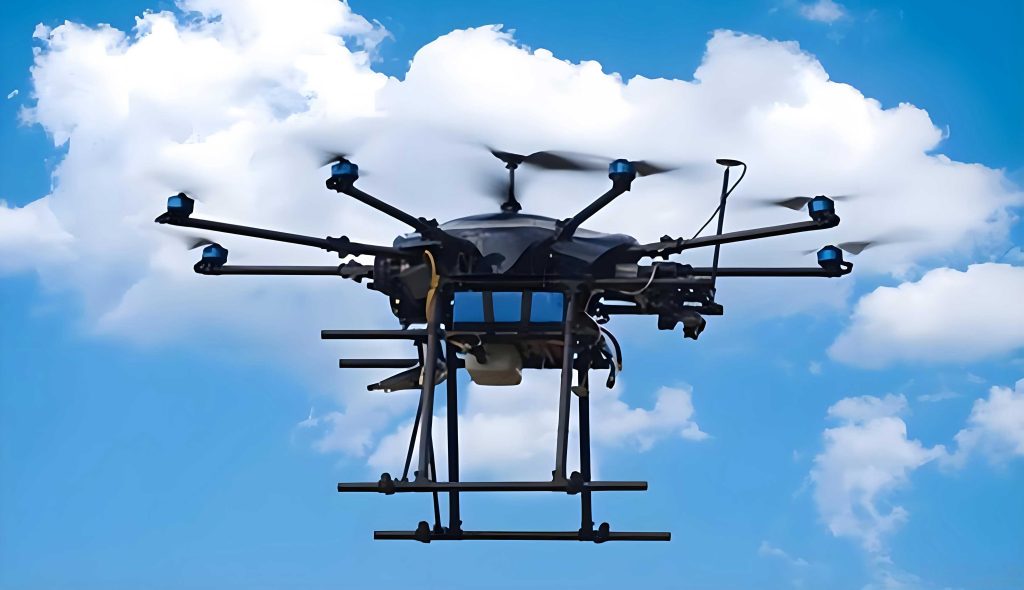
The operational workflow begins at the End (Device) Layer. This layer comprises UAV drones, equipped with high-resolution cameras and other sensors, and AI Inspection Terminals. The drones communicate via 2.4/5.8 GHz, 4G/5G, and BeiDou/GPS systems. A key innovation is the deployment of automated drone docking stations or “airports” mounted directly onto smart street light poles, enabling fully autonomous launch, mission execution, and recharge cycles without human intervention. The AI terminals, featuring powerful heterogeneous computing architectures (e.g., 4×Cortex-A76 + 4×Cortex-A55), provide onboard processing capabilities with up to 6 TOPS of computing power.
The Edge Layer involves initial data processing either on the drone itself or at the proximate AI terminal. This layer handles immediate computation, such as preliminary image analysis and filtering, which reduces the bandwidth required for data transmission to the cloud and allows for faster initial response times.
The Cloud Layer is the system’s brain, housing the central management platform and powerful AI model servers. This layer performs deep analysis on the collected data, manages inspection tasks, stores all historical data, and facilitates the entire closed-loop workflow from fault identification to repair verification. The platform integrates various subsystems, visualized under a unified “One Center, One Map, One Platform, Two Databases, N Applications” framework.
| Layer | Components | Key Technologies & Functions |
|---|---|---|
| End (Device) | AI-equipped UAV Drones, Smart Poles with Docking Stations, Mobile AI Terminals | Autonomous navigation, HD/IR imaging, 5G/BeiDou communication, On-board preprocessing. |
| Edge | On-device AI chips, Local Gateways | Real-time preliminary analysis (e.g., object detection), Data compression, Latency reduction. |
| Cloud | AI Model Servers, Central Management Platform, GIS & 3D Digital Twin | Deep learning model training/inference, Task scheduling & planning, Big data analytics, Closed-loop workflow management. |
The intelligent inspection process is managed by a comprehensive suite of software modules within the Cloud Platform:
- Mission Planning & Dispatch: The system allows for the creation of detailed, optimized flight paths for UAV drones based on the geographic distribution of assets, historical fault data, and priority levels.
- Autonomous Execution & Data Acquisition: UAV drones autonomously execute the planned routes, capturing high-resolution imagery and video of every streetlight and related infrastructure.
- AI-Powered Analysis & Fault Identification: This is the core analytical phase. The visual data is processed by computer vision algorithms trained to recognize specific defects. The AI models can identify issues such as:
- Complete lamp failure (dark spots)
- Partial failure or dimming
- Physical damage to the luminaire or pole
- Obstructions like overgrown vegetation
- Irregular lighting patterns indicating power issues
The analysis can be quantified. For example, the system can calculate the average illumination uniformity (U0) across a road section and flag areas below a threshold. A simple formulation for identifying an under-performing zone could be:
$$ \frac{E_{min}}{E_{avg}} < U_{threshold} $$
where \(E_{min}\) and \(E_{avg}\) are the minimum and average illuminance values measured by the drone’s sensors along a defined path, and \(U_{threshold}\) is the required uniformity ratio (e.g., 0.4 as per many lighting standards). - Alert Generation & Work Order Management: Detected anomalies are automatically classified, geotagged, and converted into work orders within the platform. Alerts are sent to relevant maintenance teams via mobile applications.
- Closed-Loop Verification & Analytics: Once maintenance is completed, technicians update the status. The system can then dispatch UAV drones for a verification flight. The platform also provides rich analytics, including inspection heatmaps, performance trends, and cost-benefit analyses.
The integration of UAV drones with urban streetlight poles represents a pinnacle of infrastructure synergy, effectively turning the lighting grid into a backbone for the low-altitude economy. In our implementation, specialized composite poles (e.g., 12-meter height) are deployed. These poles not only provide high-quality LED illumination but also feature an integrated, fully automated drone docking station at their apex. A separate, powerful AI computing terminal is housed within the pole’s base cabinet. This setup creates a distributed network of autonomous “inspection cells.”
The operational advantage is profound. A single drone, launched from its pole-based “airport,” can inspect a predetermined cluster of streetlights. Upon completion, it returns to its home dock or a neighboring dock for battery swapping, data upload, and shelter. This enables persistent, 24/7 inspection capability without any human presence on-site. The model creates a “one drone, one pole, one terminal” inspection matrix that operates with high autonomy.
The performance gains from deploying this integrated UAV drone and AI system are substantial and measurable. Empirical data from the pilot implementation demonstrates a transformative impact on operational efficiency and cost.
| Performance Metric | Traditional Manual Inspection | UAV+AI Intelligent Inspection | Improvement |
|---|---|---|---|
| Inspection Efficiency | Low. Requires 2 persons/vehicle/night. Limited coverage per shift. | High. One drone can cover 10x the area per hour autonomously, day or night. | > 50% increase in area coverage rate. |
| Operational Cost | High. Labor, vehicle, and insurance costs dominate. | Low. Primarily involves drone electricity, maintenance, and cloud services. | ~60% reduction in comprehensive inspection cost. |
| Fault Detection Accuracy & Speed | Subjective, slow, and prone to human error. Faults may go unreported for days. | Objective, consistent, and real-time. AI algorithms provide immediate identification with high confidence $$ P_{detection} > 0.95 $$. | Near-instantaneous reporting vs. multi-day delays. |
| Worker Safety | High risk from night-time road work and potential need for elevated platform access. | Minimal risk. Personnel manage system remotely from an office. | Elimination of high-altitude and roadside hazards. |
| Data Comprehensiveness | Limited to manual notes and occasional photos. Difficult to audit or analyze trends. | Rich, geotagged visual database. Enables predictive analytics and lifecycle asset management. | Transition from qualitative notes to quantitative, actionable big data. |
The AI models are central to this success. Their performance can be characterized by metrics such as precision and recall for each fault type. The system continuously improves through a dedicated training subsystem that uses newly collected and labeled data from the UAV drones to refine the algorithms. The confidence score \(C\) for a detected fault is a key output, often determined by the neural network’s softmax output for the target class. A fault is typically reported only if:
$$ C \geq C_{threshold} $$
where \(C_{threshold}\) might be set at 0.9 to minimize false positives.
Based on the successful pilot, a strategic roadmap for broader adoption is recommended. The promotion should follow a phased approach:
- Phase 1 – Regional Benchmarking: Focus on replicating the model in economically advanced and digitally mature city clusters (e.g., Yangtze River Delta, Pearl River Delta) to establish strong reference cases.
- Phase 2 – Standardization & Scaling: Develop and promulgate industry standards for communication protocols between UAV drones, poles, and platforms, data formats, and operational procedures to ensure interoperability and reduce deployment costs.
- Phase 3 – Ecological Development: Foster an industrial ecosystem involving drone manufacturers, lighting pole producers, telecom operators, AI software firms, and maintenance service providers. Explore innovative business models like Data-as-a-Service (DaaS) for urban infrastructure health analytics.
- Phase 4 – Full Integration & Advanced Services: Integrate the lighting inspection data stream with broader city management platforms for traffic monitoring, environmental sensing, and public safety, fully realizing the pole’s role as a multi-functional urban node.
Critical to this rollout is a robust risk mitigation framework addressing:
- Airspace Security: Integration with Unified Traffic Management (UTM) systems for real-time flight tracking and dynamic geofencing.
- Data Security: Implementation of end-to-end encryption for data transmission and strict access controls for the cloud platform.
- Operational Resilience: Development of drone models and protocols resilient to adverse weather conditions (e.g., rain, strong winds) to ensure service reliability.
In conclusion, the integration of UAV drones with artificial intelligence and edge computing presents a paradigm-shifting solution for urban lighting maintenance. The described system architecture, centered on a collaborative “End-Edge-Cloud” framework and the innovative fusion of drones with smart streetlight infrastructure, successfully transitions the industry from a costly, reactive, and hazard-prone manual operation to a efficient, proactive, and data-intelligent management model. The empirical results confirm drastic improvements in inspection efficiency (>50%) and operational cost reduction (~60%), while simultaneously enhancing worker safety and data quality. This technology pathway not only solves the immediate challenges of lighting养护 but also lays a critical foundation for smart city development, positioning ubiquitous streetlight poles as active nodes in the expanding low-altitude economy. The future of urban infrastructure management is autonomous, intelligent, and data-driven, with UAV drones serving as its essential eyes in the sky.