
The air was thick with the scent of epoxy and anticipation. With less than 72 hours before our first official flight at the 2025 national collegiate UAV design competition, our team stood frozen on the tarmac, watching in stunned silence as our months of work spiraled downward. During a final pre-competition test flight, the entire wing of our dual-propeller UAV drone had catastrophically detached from the fuselage. The sleek composite airframe, which we had designed, laid up, and assembled with our own hands, was now a shattered collection of carbon fiber and dreams on the runway. In that moment of crushing defeat, a fierce resolve ignited within us. This is our story—not just of building UAV drones, but of the spirit, science, and solidarity that allows a broken machine, and a team, to not just recover, but to soar higher than ever before.
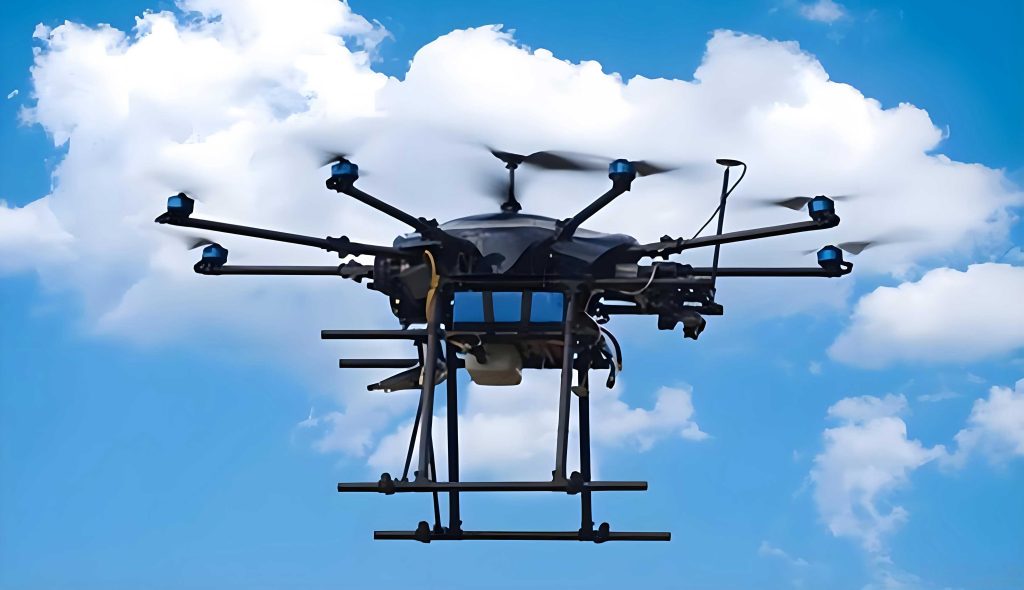
The journey of our competition UAV drone began three months prior. Our mission for the timed payload challenge was audacious: build a UAV drone capable of carrying the maximum mass in the shortest number of flights. Our core design philosophy was “increase single-sortie capacity, reduce landing cycles.” This led to a large-format, twin-engine aircraft where every gram of structural weight was a gram of payload sacrificed. We lived by a fundamental trade-off equation, constantly balancing the key parameters of our UAV drone:
$$ \text{Max Payload} = M_{\text{TOW}} – (M_{\text{airframe}} + M_{\text{avionics}} + M_{\text{power}}) $$
where \( M_{\text{TOW}} \) is the maximum take-off weight, constrained by lift and motor power. The lift required is given by:
$$ L = \frac{1}{2} \rho V^2 S C_L = W = M_{\text{TOW}} \cdot g $$
Here, \( \rho \) is air density, \( V \) is velocity, \( S \) is wing area, and \( C_L \) is the coefficient of lift. To maximize \( M_{\text{TOW}} \) while minimizing \( M_{\text{airframe}} \), we turned to advanced composite materials. The primary structure was a monolithic carbon-fiber reinforced polymer (CFRP) sandwich. The bending stiffness \( D \) of such a sandwich panel, crucial for wing spar design, is approximated by:
$$ D \approx \frac{E_f t_f h^2}{2(1-\nu^2)} $$
where \( E_f \) is the Young’s modulus of the face-sheet, \( t_f \) its thickness, \( h \) the core height, and \( \nu \) Poisson’s ratio. This allowed us to create a wing that was both incredibly light and stiff. The final numbers spoke for themselves:
| Parameter | Value | Significance |
|---|---|---|
| Empty Weight | 7.2 kg | Ultra-light airframe via CFRP |
| Max Take-Off Weight (MTOW) | 26 kg | Payload-to-empty ratio > 2.6 |
| Wing Span | 3.2 m | Large area for low wing loading |
| Powerplant | 2 x Brushless Motors | Redundant thrust for safety |
| Endurance | ~25 minutes | Sufficient for multiple sorties |
The crash was a brutal lesson in systems integration. A post-mortem revealed the failure was not in the composite’s strength, but in a metal fitting that connected the wing’s main spar to the fuselage—a classic stress concentration point. The shear stress \( \tau \) at the bolt interface under bending moment \( M \) exceeded the fitting’s yield strength:
$$ \tau = \frac{V Q}{I t} $$
where \( V \) is the shear force, \( Q \) the first moment of area, \( I \) the second moment of area, and \( t \) the thickness. Our design had underestimated the dynamic loads during a specific maneuver. Faced with this disaster, our team made a unanimous, adrenaline-fueled decision: we would fly back to our university workshop and rebuild the entire central fuselage and wing in 48 hours.
The following two days were a blur of focused chaos. Our workshop, a sanctuary for aviation dreamers officially known as the Student Aviation Innovation Practice Base, became a 24-hour operations center. Veteran members who had graduated years ago heard the call and returned, their hands remembering the feel of carbon fiber and resin. We worked in shifts, following a brutally efficient crisis protocol:
| Phase | Time | Key Activities | Critical Decisions |
|---|---|---|---|
| Triage & Redesign | Hours 0-6 | Failure analysis, CAD model modification of spar fitting. | Doubled the fitting’s shear area, added redundant bolt pattern. |
| Mold Preparation | Hours 6-12 | Cleaning and applying release agent to existing fuselage and wing molds. | Used high-temperature release system for faster cure cycle. |
| Composite Layup | Hours 12-24 | Pre-preg carbon fiber layup in molds, vacuum bagging. | Implemented a “hot-bond” cure cycle at 120°C to cut cure time by 60%. |
| Demolding & Trimming | Hours 24-36 | Careful part removal, CNC trimming of edges. | Used ultrasonic cutter for clean edges without delamination. |
| Systems Integration | Hours 36-48 | Installing avionics, wiring, motors, and reinforced fittings. | Pre-assembled wiring harnesses while parts cured for plug-and-play integration. |
As the new airframe components cured in their ovens, we focused on aerodynamic refinements. A senior member championed the addition of winglets to our UAV drone. Winglets work by reducing the strength of the wingtip vortices, which are a major source of induced drag. Induced drag coefficient \( C_{D_i} \) is given by:
$$ C_{D_i} = \frac{C_L^2}{\pi e \text{AR}} $$
where \( e \) is the Oswald efficiency factor and AR is the wing aspect ratio. A well-designed winglet can increase \( e \), effectively reducing drag for the same lift. Another key innovation was a retractable nose gear, proposed by a younger member against initial skepticism. Retracting the gear after takeoff significantly reduces parasitic drag, governed by:
$$ C_{D_0} = \sum (C_{D_0})_{\text{component}} $$
where each component (fuselage, landing gear, etc.) adds to the zero-lift drag coefficient. Post-flight data later proved this reduced total current draw by nearly half during cruise, validating the design.
We landed back at the competition with hours to spare. Our UAV drone, “Phoenix,” was reborn. On the flight line, it was a study in elegant efficiency. The payload consisted of 250 tennis balls per sortie, meticulously packed into custom containers to maintain a precise center of gravity (CG). The CG location, critical for longitudinal stability, must lie within bounds defined by the aircraft’s neutral point \( x_{NP} \):
$$ x_{CG} \text{ must be forward of } x_{NP} \text{ for static stability} $$
$$ x_{NP} = x_{ac} + \frac{V_H \cdot \frac{dC_L}{d\alpha_t}}{\frac{dC_L}{d\alpha_w}} (1 – \frac{d\epsilon}{d\alpha}) $$
where \( V_H \) is the tail volume coefficient, and \( \epsilon \) is downwash. Our pilot executed three flawless flights, handling the heavy UAV drone with precision at low altitude, managing bank angles up to 45 degrees. The aircraft delivered 689 balls total, its performance a silent roar of triumph over adversity. The judges awarded us the top prize, recognizing not just the flight, but the monumental effort behind it.
This culture of resilience and deep technical learning is the bedrock of our Practice Base. It is a unique ecosystem where theory dies without practice. The pedagogical model is “see one, do one, teach one.” New members arrive with textbook knowledge of aerodynamics and structures, but here they learn to translate that into a flying machine. The curriculum is a continuous loop:
1. Theory: Courses like “Introduction to Aeronautics” dissect retired models, linking formulas like the lift equation to actual wing spar bending.
2. Design: Using software like XFOIL and CAD, students design their own components, running simulations to predict performance. For instance, they might analyze a high-lift slat using potential flow theory, solving for the change in circulation \( \Gamma \).
3. Fabrication: Hands-on work in the composite lab, machine shop, and electronics bench. They learn that a ply orientation of \( [0_2/90/±45]_s \) in a laminate has drastically different properties than \( [0/90]_2s \), governed by classical lamination theory (CLT) calculating the ABD matrix:
$$ \begin{bmatrix} N \\ M \end{bmatrix} = \begin{bmatrix} A & B \\ B & D \end{bmatrix} \begin{bmatrix} \epsilon^0 \\ \kappa \end{bmatrix} $$
4. Flight Test: The ultimate exam. Data is collected, analyzed, and fed back into the design cycle.
Perhaps the most valuable resource in the Base is not the autoclave or the 3D printers, but a humble binder we call the “Ancestral Book of Errors.” This living document is a curated collection of every failure, miscalculation, and crash analysis from past teams. It transforms individual, often painful, lessons into collective wisdom. It contains entries like:
| Error Category | Specific Incident | Root Cause | Corrective Action / Formula |
|---|---|---|---|
| Structural | Wing torsion failure during roll. | Insufficient shear web height in spar. Shear stress \( \tau_{max} \) exceeded. | Increase web height \( h \), as \( \tau_{max} \propto 1/h \). Mandatory FEA check for combined bending-torsion. |
| Aerodynamic | Tip stall on high-alpha approach. | Washout insufficient. Spanwise lift distribution \( \Gamma(y) \) peaked at tip. | Implement 3°+ washout. Use Schrenk’s approximation for elliptic lift distribution as target. |
| Systems | ESC overheated, motor cut mid-flight. | Inadequate cooling for sustained high current \( I \). Power loss \( P_{loss} = I^2 R \). | Derate ESC by 20%, add mandatory cooling duct. Select ESC with \( I_{max} > 1.5 \times \text{operating current} \). |
| Control | Pitch oscillation (PIO) on landing. | Excessive pitch gain \( K_p \) in PID controller. System phase margin < 45°. | Tune using Ziegler-Nichols or loop shaping in simulation first. Require phase margin > 50°. |
From this book, we derived a pre-flight checklist, a ritual that grounds our ambition in meticulous procedure. Before every flight, the pilot-in-command and the flight engineer go through a 50-point list, verifying everything from bolt torque to radio link integrity. This process embodies our philosophy: respect the complexity of the UAV drone.
The role of our faculty mentors is one of guided empowerment. They provide the foundational knowledge and the safe environment for radical experimentation. Their goal is not competition trophies, but the cultivation of engineering intuition. I recall a senior doctoral student proposing a complex single-motor, gear-driven contra-rotating propeller system for a UAV drone—a mechanically risky idea. Instead of dismissing it, our advisor provided resources and space to try. The project ultimately revealed a net aerodynamic loss for that airframe, but the detailed data on mechanical losses \( \eta_{mech} \) and its impact on propulsive efficiency \( \eta_p \) became a seminal reference for future power system designs. This freedom to fail, analyze, and learn is priceless.
The evolution of our competition UAV drones over just three years showcases this iterative, knowledge-building process:
| Design Generation | Airframe Technology | Key Innovation | Performance Metric Improved | Lessons from “Book of Errors” |
|---|---|---|---|---|
| Gen 1 (Year 1) | 3D-Printed Polymer (PLA/Nylon) | Rapid prototyping, complex geometries. | Design iteration speed. | Material creep under load. Poor UV/sunlight resistance. Switched to structural composites. |
| Gen 2 (Year 2) | Full Composite (CFRP) | Monocoque fuselage, vacuum-bagged wings. | Stiffness-to-weight ratio, aerodynamic smoothness. | Learning curve in layup; delamination issues led to improved curing protocols. |
| Gen 3 (Year 3 – The Phoenix) | Optimized Composite & Systems | Integrated retractable gear, winglets, redundant systems. | Flight efficiency (L/D ratio), reliability, operational flexibility. | Focus on system integration points (wing-fuselage fitting) and drag reduction. |
The ultimate validation of the Base’s mission is seen in the trajectories of its alumni. They carry the “build and fly” ethos into the national aerospace ecosystem. One former captain, who pioneered composite lightweighting techniques on our early UAV drones, now applies those very skills at a major aircraft design institute. Another, who derived a novel high-lift slat profile using computational fluid dynamics simulations, contributes to foundational aerodynamic research. They continue to serve as a remote technical advisory board, ensuring that the knowledge flows backward as well as forward. This creates a virtuous cycle where professional expertise informs undergraduate projects, and undergraduate curiosity challenges professional assumptions.
Looking back at that moment of crisis on the runway, I now understand it was not an interruption of our dream, but its most essential expression. Building a competitive UAV drone is an exercise in systems engineering under constraint. It forces you to reconcile the idealized formulas of the classroom with the messy, nonlinear reality of materials, manufacturing, and the atmosphere. The equation for success is not found solely in a textbook; it is written in the resin between composite plies, in the lines of code for the flight controller, and in the shared determination of a team working against the clock. Our story is proof that the most robust UAV drones are not just built from carbon fiber and silicon, but from resilience, collaboration, and an unwavering passion for flight. Every launch, whether it ends in a smooth landing or a hard lesson, fuels the next iteration, keeping the timeless dream of aviation forever young, forever pushing against the horizon.