
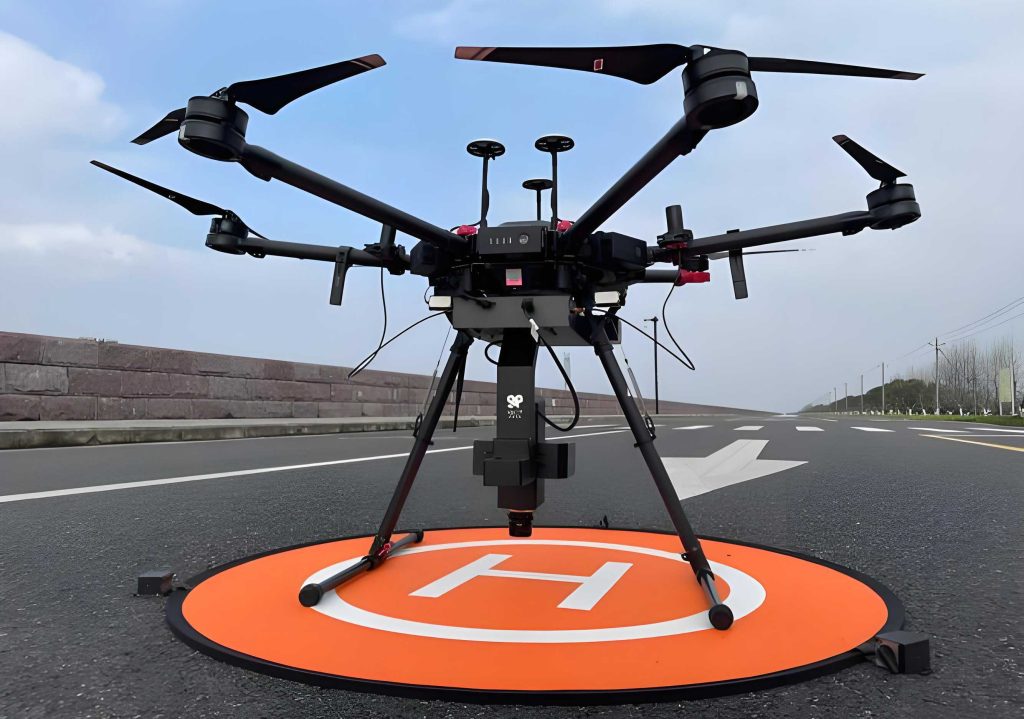
In contemporary operational and surveillance contexts, the role of Unmanned Aerial Vehicles (UAV drones) has become indispensable. These systems provide unparalleled advantages in terms of operational flexibility, endurance, and the ability to gather real-time intelligence from complex and often inaccessible areas. A core capability underpinning the effectiveness of a UAV drone is its onboard vision system, which must accurately and rapidly identify targets of interest within captured imagery. However, this task presents significant computational challenges. The platforms have stringent constraints on size, weight, and power (SWaP), limiting the available processing resources. Simultaneously, the imagery itself is challenging: targets can be small, obscured, or visually similar to the background, leading to frequent false positives and missed detections. This research addresses this critical gap by proposing an optimized object detection methodology based on a lightweight deep learning network, designed specifically to enhance the performance of UAV drone-based recognition systems.
The evolution of deep learning for object detection has yielded two primary families of algorithms. Two-stage detectors, such as the R-CNN series, prioritize accuracy by first generating region proposals and then classifying them. In contrast, single-stage detectors like YOLO (You Only Look Once) and SSD (Single Shot MultiBox Detector) frame detection as a regression problem, offering a superior balance between speed and accuracy, which is often more suitable for real-time applications on a UAV drone. Among these, the YOLO family has consistently pushed the boundaries of efficient detection. YOLOv5, in particular, stands out for its streamlined architecture and excellent performance. It comprises four main components: the Input module for data preprocessing, the Backbone for feature extraction, the Neck for feature aggregation, and the Prediction head for final detection. Despite its efficiency, the standard YOLOv5 model, especially its smaller variant YOLOv5s, can still struggle with the nuanced demands of UAV drone imagery, where computational efficiency and robustness to false alarms are paramount.
Our proposed methodology centers on a strategic enhancement of the YOLOv5s architecture. The core innovation lies in the systematic replacement and augmentation of its components to reduce computational overhead while improving feature discrimination. The overall framework of our improved algorithm is designed to maintain the structural elegance of YOLOv5 while injecting specialized modules for efficiency and attention.
The primary modification involves the backbone feature extraction network. We substitute the standard CSPNet-based modules in YOLOv5 with a more computationally efficient building block from the FasterNet architecture. The key to FasterNet’s efficiency is its use of Partial Convolution (PConv). Unlike standard convolution which operates on all input channels, PConv applies a regular convolution only to a subset of the input channels, leaving the remaining channels untouched. This dramatically reduces both computational cost and memory access. For a feature map of size $H \times W$, a convolutional kernel of size $K \times K$, and $C_p$ channels used for PConv, the floating-point operations (FLOPs) are given by:
$$ \text{FLOPs}_{\text{PConv}} = H \times W \times K^2 \times C_p^2 $$
If the total number of channels is $C = 4C_p$, the FLOPs of PConv become only $1/16$ of those of a standard convolution applied to all channels. The memory access is approximately:
$$ \text{Memory Access}_{\text{PConv}} \approx H \times W \times 2C_p $$
which is roughly a quarter of that required by standard convolution. This PConv layer is followed by pointwise (1×1) convolutions to facilitate communication across all channels. By integrating these FasterNet blocks, we construct a backbone that is significantly lighter than the original, making it highly suitable for deployment on a resource-constrained UAV drone platform.
| Model | Precision (P) | Recall (R) | mAP@0.50 | FPS | Params (Millions) | Model Size (MB) |
|---|---|---|---|---|---|---|
| YOLOv4 | 91.7% | 89.8% | 95.3% | 58 | 64.3 | 245.53 |
| GhostNet-YOLOv4 | 94.58% | 94.56% | 95.73% | 66 | 11.4 | 42.8 |
| YOLOv5s (Baseline) | 98.5% | 95.4% | 97.9% | 63 | 7.06 | 14.4 |
| YOLOv5s-Ghostv2 | 96.7% | 96.5% | 97.22% | 70 | 6.46 | 12.7 |
| F-YOLOv5s (Ours: FasterNet Backbone) | 97.0% | 97.7% | 99.0% | 61 | 5.81 | 11.3 |
As evidenced in the comparative table, our F-YOLOv5s model, which incorporates the FasterNet backbone, achieves a superior balance. It attains the highest mean Average Precision (mAP@0.50) of 99.0% and the highest Recall of 97.7%, indicating excellent detection completeness and accuracy. Crucially, it does this while having the smallest parameter count (5.81M) and model size (11.3MB) among the compared models, with a frame rate (61 FPS) suitable for real-time processing on a UAV drone.
To further refine the model’s ability to focus on semantically salient features and suppress irrelevant background noise—a common issue in cluttered UAV drone imagery—we incorporate an attention mechanism. We select the SimAM (Simple Attention Module) due to its parameter-free design, which aligns perfectly with our lightweight objective. Unlike channel or spatial attention that requires extra learnable parameters, SimAM infers 3D attention weights for each neuron by defining an energy function based on neuroscience theory. For a target neuron $t$ and other neurons $x_i$ in a single channel of a feature map $X \in \mathbb{R}^{C\times H\times W}$, the energy function is defined to measure linear separability:
$$ e_t(w_t, b_t, y, x_i) = (y_t – \hat{t})^2 + \frac{1}{M-1}\sum_{i=1}^{M-1} (y_0 – \hat{x}_i)^2 $$
where $\hat{t} = w_t t + b_t$ and $\hat{x}_i = w_t x_i + b_t$ are linear transformations, $M = H \times W$ is the number of neurons in that channel, and $y$ is a binary label. A simplified form with a regularization term $\lambda$ is:
$$ e_t(w_t, b_t, y, x_i) = \frac{1}{M-1}\sum_{i=1}^{M-1} (-1 – (w_t x_i + b_t))^2 + (1 – (w_t t + b_t))^2 + \lambda w_t^2 $$
The minimum energy and its corresponding weights are derived as:
$$ w_t = -\frac{2(t – \mu_t)}{(t – \mu_t)^2 + 2\sigma_t^2 + 2\lambda}, \quad b_t = -\frac{1}{2}(t + \mu_t)w_t $$
$$ e_t^* = \frac{4(\hat{\sigma}^2 + \lambda)}{(t – \hat{\mu})^2 + 2\hat{\sigma}^2 + 2\lambda} $$
Here, $\hat{\mu}$ and $\hat{\sigma}^2$ are the mean and variance of all neurons except $t$. The importance of a neuron is inversely proportional to $e_t^*$. A lower energy indicates the neuron is more distinctive and informative relative to its neighbors. The final feature refinement is performed as:
$$ \tilde{X} = \text{sigmoid}\left(\frac{1}{E}\right) \odot X $$
where $E$ is the energy map computed across all channels and spatial positions. Integrating SimAM into YOLOv5s enhances its feature representation without adding parameters, making the model more adept at identifying critical targets from a UAV drone’s perspective.
| Model | Precision (P) | Recall (R) | mAP@0.50 | mAP@0.50:0.95 | FPS | Model Size (MB) |
|---|---|---|---|---|---|---|
| YOLOv5s (Baseline) | 98.5% | 95.4% | 97.9% | 71.1% | 63 | 14.4 |
| S-YOLOv5s (Ours: + SimAM) | 96.7% | 98.1% | 98.8% | 71.8% | 62 | 13.7 |
The effectiveness of the SimAM module is clear. While precision sees a slight trade-off, recall increases significantly to 98.1%, meaning the model misses fewer targets—a critical improvement for surveillance tasks with a UAV drone. The mAP@0.50 also improves, demonstrating better overall detection quality.
We conducted comprehensive experiments to validate our complete model. The dataset consists of 3,884 carefully curated UAV drone images featuring three key military-related object categories: tanks, armored vehicles, and camouflaged defensive structures. The images encompass various challenging conditions such as lighting variations, weather effects, and complex backgrounds, accurately simulating real-world UAV drone reconnaissance scenarios. Our experimental environment was a Windows 10 system with an Intel Core i7-7700 CPU and an Nvidia GTX 1070 GPU. We used the PyTorch 1.9.1 framework. The model was trained for 200 epochs with an input resolution of $640 \times 640$, a batch size of 16, and the Adam optimizer.
To dissect the contribution of each proposed component, we performed an ablation study. The baseline model (A) is the standard YOLOv5s. Model (B) incorporates the SimAM attention mechanism (S-YOLOv5s). Model (C) uses the FasterNet backbone (F-YOLOv5s). Finally, our full proposed model (D) integrates both the FasterNet backbone and the SimAM attention mechanism (SF-YOLOv5s).
| Model | Precision (P) | Recall (R) | mAP@0.50 | mAP@0.50:0.95 | F1 Score | FPS | Model Size (MB) |
|---|---|---|---|---|---|---|---|
| (A) YOLOv5s | 98.5% | 95.4% | 97.9% | 71.1% | 96.9% | 63 | 14.4 |
| (B) S-YOLOv5s | 95.9% | 97.5% | 97.8% | 71.6% | 97.3% | 63 | 13.7 |
| (C) F-YOLOv5s | 96.7% | 98.1% | 98.8% | 70.8% | 97.3% | 61 | 11.3 |
| (D) SF-YOLOv5s (Proposed) | 97.5% | 97.5% | 99.3% | 70.3% | 97.5% | 64 | 11.3 |
The ablation study results are highly instructive. Comparing model (A) and (B) shows that adding SimAM primarily boosts recall (from 95.4% to 97.5%), confirming its role in reducing missed detections for the UAV drone. Comparing model (A) and (C) shows that the FasterNet backbone significantly improves mAP@0.50 (from 97.9% to 98.8%) while drastically reducing model size (from 14.4MB to 11.3MB), validating its effectiveness for lightweight feature extraction. Our final proposed model (D), SF-YOLOv5s, synthesizes the strengths of both components. It achieves the highest mAP@0.50 of 99.3% and a balanced, high precision and recall of 97.5%. Remarkably, it does this with a model size 21.5% smaller than the baseline and with an inference speed (64 FPS) comparable to, even slightly faster than, the original model. The F1 score, harmonizing precision and recall, also reaches its peak at 97.5%. This demonstrates that our lightweight network modifications do not compromise performance; instead, they create a more efficient and robust detector perfectly suited for a UAV drone platform.
The success of our SF-YOLOv5s model stems from a synergistic design. The FasterNet backbone provides a computationally efficient yet powerful foundation for feature extraction, directly addressing the SWaP constraints of a UAV drone. The parameter-free SimAM attention mechanism then acts as a fine-tuning filter, guiding the network to concentrate its representational capacity on the most informative regions of the UAV drone-captured image. This combination effectively mitigates the common issues of false alarms in cluttered environments and missed small targets. The significant reduction in model parameters and storage footprint means the system can be more readily deployed on embedded systems or integrated into the onboard processing pipeline of a UAV drone, enabling faster, more autonomous decision-making without relying heavily on bandwidth-limited data links to ground stations.
In conclusion, this research has successfully developed and validated an enhanced target recognition algorithm for UAV drone imagery based on a lightweight network architecture. By strategically integrating the FasterNet backbone for efficient feature extraction and the SimAM module for intelligent feature emphasis, we have created a model that surpasses the baseline YOLOv5s in critical metrics. Our SF-YOLOv5s model achieves superior accuracy (99.3% mAP), maintains a excellent balance between precision and recall (97.5% each), and does so with a significantly smaller and more efficient footprint. This represents a meaningful step forward in enabling more reliable, real-time, and autonomous target detection capabilities for UAV drone systems operating in complex and demanding environments. Future work may explore further optimization for specific drone-borne processors, integration with multi-modal data (e.g., thermal imagery), and adaptation to an even broader set of object categories relevant to UAV drone missions.